Recognition: unknown
Similar Users-Augmented Interest Network
Pith reviewed 2026-05-08 05:13 UTC · model grok-4.3
The pith
Augmenting a target user's behavior sequence with sequences from similar users improves click-through rate prediction despite data sparsity.
A machine-rendered reading of the paper's core claim, the machinery that carries it, and where it could break.
Core claim
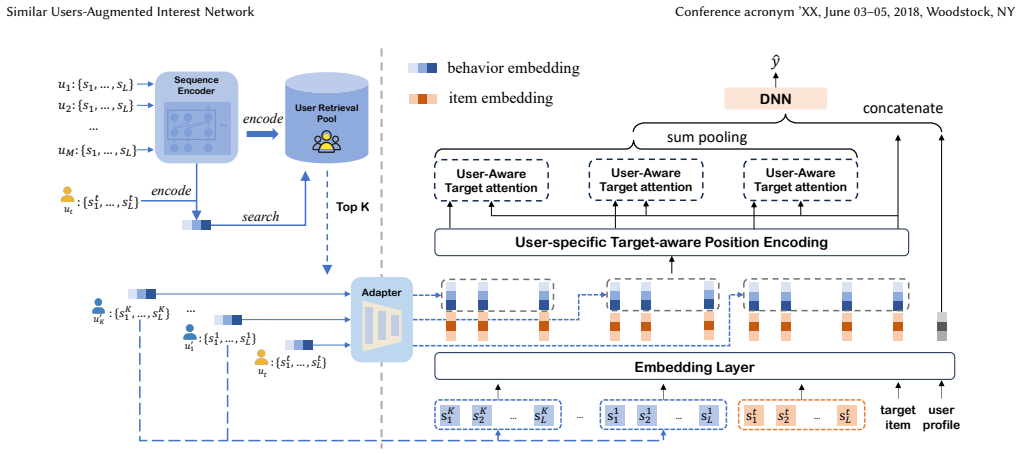
The SUIN method retrieves similar users from a pool using sequence-encoded behavior embeddings, concatenates their sequences to the target user's in descending similarity order to build an augmented sequence, applies user-specific target-aware position encoding to distinguish sources and relative positions, and uses user-aware target attention that models both item-item and user-user correlations to exploit the added behaviors while reducing noise, yielding higher CTR prediction accuracy than prior sequential models.
What carries the argument
User-aware target attention that jointly accounts for item-item and user-user correlations within the augmented multi-user sequence to leverage similar users' data while filtering noise.
If this is right
- The augmented sequence enables more comprehensive user profiling even when individual behavior histories are short or sparse.
- User-specific position encoding distinguishes the source of each behavior and its position relative to the target item in the combined sequence.
- User-aware attention reduces the effect of noisy behaviors contributed by similar users.
- The full method produces significantly higher CTR prediction accuracy than existing sequential models on both short-term and long-term benchmark datasets.
Where Pith is reading between the lines
- The retrieval-plus-augmentation pattern could be tested in other sequential recommendation settings such as session-based or next-item prediction where personal histories are also limited.
- If embedding-based similarity proves brittle on certain data, alternative similarity measures like explicit collaborative filtering scores might serve as drop-in replacements for the retrieval step.
- Distinguishing users inside the sequence via encoding and attention offers a general route for injecting collaborative signals into deep sequential models without full retraining.
Load-bearing premise
Behavior embeddings can reliably locate similar users whose added sequences supply useful preference signal rather than noise that the attention cannot sufficiently control.
What would settle it
An ablation experiment on the benchmark datasets where similar-user sequences are still retrieved and concatenated but the user-aware attention is replaced by standard target attention, and the resulting model performs no better than or worse than non-augmented baselines.
Figures




read the original abstract
Click-through rate (CTR) prediction is one of the core tasks in recommender systems. User behavior sequences, as one of the most effective features, can accurately reflect user preferences and significantly improve prediction accuracy. Richer behavior sequences often enable more comprehensive user profiling, and recent studies have shown that scaling the length of user behavior sequence can yield substantial gains in CTR. However, due to the widespread sparsity in recommender systems, incomplete behavior sequences are common in real-world scenarios. Existing sequential modeling methods often rely solely on the target user's own behavior, and therefore struggle in such scenarios. This paper proposes a novel method called SUIN (Similar Users-augmented Interest Network), which enhances the target user's behavior sequence with behaviors from similar users to enhance the user profile for CTR prediction. Specifically, we use behavior embeddings encoded by a sequence encoder to retrieve users with similar behaviors from a user retrieval pool. The behavior sequences of these similar users are then concatenated with that of the target user in descending order of similarity to construct an augmented sequence. Given that the augmented sequence contains behaviors from multiple users, we propose a user-specific target-aware position encoding, which identifies the source user of each behavior and captures its relative position to the target item. Furthermore, to mitigate the empirically observed noise in similar users' behaviors, we design a user-aware target attention that jointly considers item-item and user-user correlations, fully exploiting the potential of the augmented behavior sequence. Comprehensive experiments on widely-used short-term and long-term sequence benchmark datasets demonstrate that our method significantly outperforms state-of-the-art sequential CTR models.
Editorial analysis
A structured set of objections, weighed in public.
Referee Report
Summary. The paper proposes SUIN (Similar Users-augmented Interest Network) for CTR prediction in recommender systems. It retrieves similar users via sequence embeddings from a user retrieval pool, concatenates their behavior sequences with the target user's in descending similarity order to form an augmented sequence, introduces user-specific target-aware position encoding to identify user sources and relative positions to the target item, and designs user-aware target attention that jointly models item-item and user-user correlations to mitigate noise. Comprehensive experiments on short-term and long-term sequence benchmarks are claimed to show significant outperformance over state-of-the-art sequential CTR models.
Significance. If the results hold and the retrieval step adds net signal, the approach could meaningfully advance handling of sparse behavior sequences in CTR models by leveraging cross-user information, extending attention-based sequential models with multi-user augmentations and tailored encodings/attentions.
major comments (2)
- [§3] §3 (Method): The central claim depends on behavior embeddings retrieving users whose sequences contain CTR-aligned preference information rather than noise; however, no independent verification, correlation analysis, or ablation isolating the retrieval quality (e.g., comparing embedding similarity to held-out CTR overlap) is provided, leaving the downstream position encoding and attention to implicitly filter without explicit supervision or evidence.
- [Experiments] Experiments section (and abstract claim): While outperformance is asserted, the absence of specific quantitative metrics, baseline details, ablation studies on the number of similar users, or error analysis in the provided description makes it impossible to evaluate the magnitude, statistical reliability, or robustness of the reported gains.
minor comments (2)
- [§3] Notation for the augmented sequence construction and the joint attention mechanism could be clarified with explicit equations or pseudocode to improve reproducibility.
- [Abstract] The abstract would benefit from at least one quantitative result (e.g., relative improvement on a key metric) to substantiate the 'significantly outperforms' claim.
Simulated Author's Rebuttal
We appreciate the referee's thorough review and valuable suggestions for improving our manuscript on SUIN. We address the major comments point by point below, and indicate where revisions will be made to the paper.
read point-by-point responses
-
Referee: [§3] §3 (Method): The central claim depends on behavior embeddings retrieving users whose sequences contain CTR-aligned preference information rather than noise; however, no independent verification, correlation analysis, or ablation isolating the retrieval quality (e.g., comparing embedding similarity to held-out CTR overlap) is provided, leaving the downstream position encoding and attention to implicitly filter without explicit supervision or evidence.
Authors: We thank the referee for highlighting this important aspect. While the user-aware target attention mechanism is specifically designed to jointly model item-item and user-user correlations to mitigate noise from similar users' behaviors, we acknowledge that the manuscript lacks an explicit independent verification of the retrieval quality. In the revised version, we will add a new subsection or analysis in §3 or the experiments section that includes correlation analysis between embedding similarities and held-out CTR overlap, as well as an ablation study isolating the retrieval component. This will provide direct evidence supporting the central claim. revision: yes
-
Referee: [Experiments] Experiments section (and abstract claim): While outperformance is asserted, the absence of specific quantitative metrics, baseline details, ablation studies on the number of similar users, or error analysis in the provided description makes it impossible to evaluate the magnitude, statistical reliability, or robustness of the reported gains.
Authors: The full manuscript in Section 4 presents comprehensive experimental results, including specific quantitative metrics (e.g., AUC and LogLoss improvements), detailed baseline comparisons (such as against DIN, DIEN, BST, and other sequential models), and initial ablations on key components. However, we agree that additional studies on the number of similar users and error analysis would enhance the evaluation of robustness. We will revise the experiments section to include ablations varying the number of similar users (e.g., 1, 3, 5), statistical significance tests, and error analysis with case studies. These additions will allow for a clearer assessment of the gains' magnitude and reliability. revision: yes
Circularity Check
No circularity: architectural proposal validated on external benchmarks
full rationale
The paper presents SUIN as a new model architecture that retrieves similar users via behavior embeddings, augments the target sequence, applies user-specific position encoding, and uses joint item-user attention. All central claims are supported by empirical results on standard short-term and long-term CTR benchmark datasets rather than any internal derivation, fitted parameter renamed as prediction, or self-referential equation. No load-bearing step reduces the reported gains to quantities defined solely by the model's own inputs or prior self-citations; the retrieval and attention components are independently testable via the external evaluations.
Axiom & Free-Parameter Ledger
free parameters (1)
- number of similar users retrieved
axioms (1)
- domain assumption Behavior embeddings from a sequence encoder can be used to retrieve meaningfully similar users
invented entities (2)
-
user-specific target-aware position encoding
no independent evidence
-
user-aware target attention
no independent evidence
Reference graph
Works this paper leans on
-
[1]
Andreas Blattmann, Robin Rombach, Kaan Oktay, Jonas Müller, and Björn Ommer
-
[2]
Retrieval-augmented diffusion models.Advances in Neural Information Processing Systems35 (2022), 15309–15324
2022
-
[3]
Tesfaye Fenta Boka, Zhendong Niu, and Rama Bastola Neupane. 2024. A sur- vey of sequential recommendation systems: Techniques, evaluation, and future directions.Information Systems125 (2024), 102427
2024
-
[4]
Sebastian Borgeaud, Arthur Mensch, Jordan Hoffmann, Trevor Cai, Eliza Ruther- ford, Katie Millican, George Bm Van Den Driessche, Jean-Baptiste Lespiau, Bog- dan Damoc, Aidan Clark, et al. 2022. Improving language models by retrieving from trillions of tokens. InInternational conference on machine learning. PMLR, 2206–2240
2022
-
[5]
Yue Cao, Xiaojiang Zhou, Jiaqi Feng, Peihao Huang, Yao Xiao, Dayao Chen, and Sheng Chen. 2022. Sampling is all you need on modeling long-term user behaviors for CTR prediction. InProceedings of the 31st ACM International Conference on Information & Knowledge Management. 2974–2983
2022
-
[6]
Jianxin Chang, Chenbin Zhang, Zhiyi Fu, Xiaoxue Zang, Lin Guan, Jing Lu, Yiqun Hui, Dewei Leng, Yanan Niu, Yang Song, et al. 2023. TWIN: TWo-stage interest network for lifelong user behavior modeling in CTR prediction at kuaishou. In Proceedings of the 29th ACM SIGKDD Conference on Knowledge Discovery and Data Mining. 3785–3794
2023
-
[7]
Junxuan Chen, Baigui Sun, Hao Li, Hongtao Lu, and Xian-Sheng Hua. 2016. Deep CTR Prediction in Display Advertising. InProceedings of the 24th ACM International Conference on Multimedia (MM ’16). Association for Computing Machinery, 811–820
2016
-
[8]
Qiwei Chen, Changhua Pei, Shanshan Lv, Chao Li, Junfeng Ge, and Wenwu Ou
-
[9]
End-to-end user behavior retrieval in click-through rateprediction model. arXiv preprint arXiv:2108.04468(2021)
-
[10]
Qiwei Chen, Huan Zhao, Wei Li, Pipei Huang, and Wenwu Ou. 2019. Behavior sequence transformer for e-commerce recommendation in alibaba. InProceedings of the 1st international workshop on deep learning practice for high-dimensional sparse data. 1–4
2019
- [11]
-
[12]
Heng-Tze Cheng, Levent Koc, Jeremiah Harmsen, Tal Shaked, Tushar Chandra, Hrishi Aradhye, Glen Anderson, Greg Corrado, Wei Chai, Mustafa Ispir, Rohan Anil, Zakaria Haque, Lichan Hong, Vihan Jain, Xiaobing Liu, and Hemal Shah
-
[13]
InProceedings of the 1st Workshop on Deep Learning for Recommender Systems (DLRS 2016)
Wide & Deep Learning for Recommender Systems. InProceedings of the 1st Workshop on Deep Learning for Recommender Systems (DLRS 2016). Association for Computing Machinery, 7–10
2016
-
[14]
Kounianhua Du, Weinan Zhang, Ruiwen Zhou, Yangkun Wang, Xilong Zhao, Jiarui Jin, Quan Gan, Zheng Zhang, and David P Wipf. 2022. Learning enhanced representation for tabular data via neighborhood propagation.Advances in neural information processing systems35 (2022), 16373–16384
2022
-
[15]
Shereen Elsayed, Ahmed Rashed, and Lars Schmidt-Thieme. 2024. Multi- Behavioral Sequential Recommendation. InProceedings of the 18th ACM con- ference on recommender systems. 902–906
2024
-
[16]
Wenqi Fan, Yujuan Ding, Liangbo Ning, Shijie Wang, Hengyun Li, Dawei Yin, Tat-Seng Chua, and Qing Li. 2024. A survey on rag meeting llms: Towards retrieval-augmented large language models. InProceedings of the 30th ACM SIGKDD conference on knowledge discovery and data mining. 6491–6501
2024
-
[17]
Yufei Feng, Fuyu Lv, Weichen Shen, Menghan Wang, Fei Sun, Yu Zhu, and Keping Yang. 2019. Deep session interest network for click-through rate prediction. In Proceedings of the 28th International Joint Conference on Artificial Intelligence (Macao, China)(IJCAI’19). AAAI Press, 2301–2307
2019
-
[18]
Yunfan Gao, Yun Xiong, Xinyu Gao, Kangxiang Jia, Jinliu Pan, Yuxi Bi, Yixin Dai, Jiawei Sun, Haofen Wang, and Haofen Wang. 2023. Retrieval-augmented generation for large language models: A survey.arXiv preprint arXiv:2312.10997 2, 1 (2023)
work page internal anchor Pith review arXiv 2023
-
[19]
Xavier Glorot, Antoine Bordes, and Yoshua Bengio. 2011. Deep sparse rectifier neural networks. InProceedings of the fourteenth international conference on artificial intelligence and statistics. JMLR Workshop and Conference Proceedings, 315–323
2011
-
[20]
Lin Guan, Jia-Qi Yang, Zhishan Zhao, Beichuan Zhang, Bo Sun, Xuanyuan Luo, Jinan Ni, Xiaowen Li, Yuhang Qi, Zhifang Fan, et al. 2025. Make It Long, Keep It Fast: End-to-End 10k-Sequence Modeling at Billion Scale on Douyin.arXiv preprint arXiv:2511.06077(2025)
work page internal anchor Pith review arXiv 2025
-
[21]
Huifeng Guo, Ruiming Tang, Yunming Ye, Zhenguo Li, and Xiuqiang He. 2017. DeepFM: a factorization-machine based neural network for CTR prediction. In Proceedings of the 26th International Joint Conference on Artificial Intelligence (IJCAI’17). AAAI Press, 1725–1731
2017
- [22]
-
[23]
Wei Guo, Rong Su, Renhao Tan, Huifeng Guo, Yingxue Zhang, Zhirong Liu, Ruiming Tang, and Xiuqiang He. 2021. Dual graph enhanced embedding neural network for CTR prediction. InProceedings of the 27th ACM SIGKDD conference on knowledge discovery & data mining. 496–504
2021
-
[24]
Balázs Hidasi, Alexandros Karatzoglou, Linas Baltrunas, and Domonkos Tikk
-
[25]
Session-based recommendations with recurrent neural networks.arXiv preprint arXiv:1511.06939(2015)
work page internal anchor Pith review arXiv 2015
-
[26]
Guoqing Hu, An Zhang, Shuo Liu, Zhibo Cai, Xun Yang, and Xiang Wang. 2025. Alphafuse: Learn id embeddings for sequential recommendation in null space of language embeddings. InProceedings of the 48th International ACM SIGIR Conference on Research and Development in Information Retrieval. 1614–1623
2025
-
[27]
Junjie Huang, Guohao Cai, Jieming Zhu, Zhenhua Dong, Ruiming Tang, Weinan Zhang, and Yong Yu. 2024. Recall-Augmented Ranking: Enhancing Click-Through Rate Prediction Accuracy with Cross-Stage Data. InCompanion Proceedings of the ACM Web Conference 2024. 830–833
2024
-
[28]
Xu Huang, Defu Lian, Jin Chen, Liu Zheng, Xing Xie, and Enhong Chen. 2023. Cooperative retriever and ranker in deep recommenders. InProceedings of the ACM Web Conference 2023. 1150–1161
2023
-
[29]
Gautier Izacard, Patrick Lewis, Maria Lomeli, Lucas Hosseini, Fabio Petroni, Timo Schick, Jane Dwivedi-Yu, Armand Joulin, Sebastian Riedel, and Edouard Grave. 2023. Atlas: Few-shot learning with retrieval augmented language models. Journal of Machine Learning Research24, 251 (2023), 1–43
2023
-
[30]
Yuchin Juan, Yong Zhuang, Wei-Sheng Chin, and Chih-Jen Lin. 2016. Field- aware Factorization Machines for CTR Prediction. InProceedings of the 10th ACM Conference on Recommender Systems (RecSys ’16). Association for Computing Machinery, 43–50
2016
-
[31]
Wang-Cheng Kang and Julian McAuley. 2018. Self-attentive sequential recom- mendation. In2018 IEEE international conference on data mining (ICDM). IEEE, 197–206
2018
-
[32]
Yuxuan Lei, Xiaolong Chen, Defu Lian, Peiyan Zhang, Jianxun Lian, Chaozhuo Li, and Xing Xie. 2023. Practical Content-aware Session-based Recommendation: deep retrieve then shallow rank. InAmazon KDD Cup 2023 Workshop
2023
-
[33]
Patrick Lewis, Ethan Perez, Aleksandra Piktus, Fabio Petroni, Vladimir Karpukhin, Naman Goyal, Heinrich Küttler, Mike Lewis, Wen tau Yih, Tim Rocktäschel, Sebastian Riedel, and Douwe Kiela. 2020. Retrieval-Augmented Generation for Knowledge-Intensive NLP Tasks. arXiv:2005.11401 [cs.CL]
work page internal anchor Pith review arXiv 2020
-
[34]
Yushen Li, Jinpeng Wang, Tao Dai, Jieming Zhu, Jun Yuan, Rui Zhang, and Shu- Tao Xia. 2024. RAT: Retrieval-Augmented Transformer for Click-Through Rate Prediction. InCompanion Proceedings of the ACM Web Conference 2024 (WWW ’24). Association for Computing Machinery, 867–870
2024
-
[35]
Jianxun Lian, Xiaohuan Zhou, Fuzheng Zhang, Zhongxia Chen, Xing Xie, and Guangzhong Sun. 2018. xDeepFM: Combining Explicit and Implicit Feature Interactions for Recommender Systems. InProceedings of the 24th ACM SIGKDD International Conference on Knowledge Discovery & Data Mining (KDD ’18). Asso- ciation for Computing Machinery, 1754–1763
2018
- [36]
-
[37]
Xiao Ma, Liqin Zhao, Guan Huang, Zhi Wang, Zelin Hu, Xiaoqiang Zhu, and Kun Gai. 2018. Entire space multi-task model: An effective approach for estimating post-click conversion rate. InThe 41st International ACM SIGIR Conference on Research & Development in Information Retrieval. 1137–1140
2018
-
[38]
Erxue Min, Yu Rong, Tingyang Xu, Yatao Bian, Da Luo, Kangyi Lin, Junzhou Huang, Sophia Ananiadou, and Peilin Zhao. 2022. Neighbour interaction based click-through rate prediction via graph-masked transformer. InProceedings of the 45th international ACM SIGIR conference on research and development in information retrieval. 353–362
2022
-
[39]
Qi Pi, Weijie Bian, Guorui Zhou, Xiaoqiang Zhu, and Kun Gai. 2019. Practice on Long Sequential User Behavior Modeling for Click-Through Rate Prediction. InProceedings of the 25th ACM SIGKDD International Conference on Knowledge Discovery & Data Mining (KDD ’19). Association for Computing Machinery, 2671–2679
2019
-
[40]
Qi Pi, Guorui Zhou, Yujing Zhang, Zhe Wang, Lejian Ren, Ying Fan, Xiaoqiang Zhu, and Kun Gai. 2020. Search-based user interest modeling with lifelong sequential behavior data for click-through rate prediction. InProceedings of the 29th ACM International Conference on Information & Knowledge Management. 2685–2692
2020
-
[41]
Jiarui Qin, Weinan Zhang, Rong Su, Zhirong Liu, Weiwen Liu, Ruiming Tang, Xiuqiang He, and Yong Yu. 2021. Retrieval & Interaction Machine for Tabular Data Prediction.Proceedings of the 27th ACM SIGKDD Conference on Knowledge Discovery & Data Mining(2021)
2021
-
[42]
Jiarui Qin, Jiachen Zhu, Bo Chen, Zhirong Liu, Weiwen Liu, Ruiming Tang, Rui Zhang, Yong Yu, and Weinan Zhang. 2022. Rankflow: Joint optimization of multi- stage cascade ranking systems as flows. InProceedings of the 45th International ACM SIGIR Conference on Research and Development in Information Retrieval. 814–824
2022
-
[43]
Nils Reimers and Iryna Gurevych. 2019. Sentence-bert: Sentence embeddings using siamese bert-networks.arXiv preprint arXiv:1908.10084(2019)
work page internal anchor Pith review arXiv 2019
-
[44]
Steffen Rendle. 2010. Factorization Machines. In2010 IEEE International Confer- ence on Data Mining. 995–1000. Similar Users-Augmented Interest Network Conference acronym ’XX, June 03–05, 2018, Woodstock, NY
2010
-
[45]
Zihua Si, Lin Guan, Zhongxiang Sun, Xiaoxue Zang, Jing Lu, Yiqun Hui, Xingchao Cao, Zeyu Yang, Yichen Zheng, Dewei Leng, Kai Zheng, Chenbin Zhang, Yanan Niu, Yang Song, and Kun Gai. 2024. TWIN V2: Scaling Ultra-Long User Behav- ior Sequence Modeling for Enhanced CTR Prediction at Kuaishou(CIKM ’24). Association for Computing Machinery, 4890–4897
2024
-
[46]
Oumaima Stitini, Soulaimane Kaloun, and Omar Bencharef. 2022. Investigating different similarity metrics used in various recommender systems types: Scenario cases.The International Archives of the Photogrammetry, Remote Sensing and Spatial Information Sciences48 (2022), 187–193
2022
-
[47]
Fei Sun, Jun Liu, Jian Wu, Changhua Pei, Xiao Lin, Wenwu Ou, and Peng Jiang
-
[48]
InProceedings of the 28th ACM international conference on information and knowledge management
BERT4Rec: Sequential recommendation with bidirectional encoder rep- resentations from transformer. InProceedings of the 28th ACM international conference on information and knowledge management. 1441–1450
-
[49]
Ruoxi Wang, Bin Fu, Gang Fu, and Mingliang Wang. 2017. Deep & Cross Net- work for Ad Click Predictions. InProceedings of the ADKDD’17 (ADKDD’17). Association for Computing Machinery, Article 12
2017
- [50]
-
[51]
Wei Wei, Chao Huang, Lianghao Xia, Yong Xu, Jiashu Zhao, and Dawei Yin. 2022. Contrastive meta learning with behavior multiplicity for recommendation. In Proceedings of the fifteenth ACM international conference on web search and data mining. 1120–1128
2022
-
[52]
Jiancan Wu, Xiang Wang, Fuli Feng, Xiangnan He, Liang Chen, Jianxun Lian, and Xing Xie. 2021. Self-supervised graph learning for recommendation. InProceed- ings of the 44th international ACM SIGIR conference on research and development in information retrieval. 726–735
2021
-
[53]
Jun Xiao, Hao Ye, Xiangnan He, Hanwang Zhang, Fei Wu, and Tat-Seng Chua
-
[54]
AAAI Press, 3119–3125
Attentional factorization machines: learning the weight of feature interac- tions via attention networks(IJCAI’17). AAAI Press, 3119–3125
-
[55]
Zhibo Xiao, Luwei Yang, Wen Jiang, Yi Wei, Yi Hu, and Hao Wang. 2020. Deep multi-interest network for click-through rate prediction. InProceedings of the 29th ACM international conference on information & knowledge management. 2265–2268
2020
-
[56]
Xu Xie, Fei Sun, Zhaoyang Liu, Shiwen Wu, Jinyang Gao, Jiandong Zhang, Bolin Ding, and Bin Cui. 2022. Contrastive learning for sequential recommendation. In 2022 IEEE 38th international conference on data engineering (ICDE). IEEE, 1259– 1273
2022
-
[57]
Yueqi Xie, Peilin Zhou, and Sunghun Kim. 2022. Decoupled side information fusion for sequential recommendation. InProceedings of the 45th international ACM SIGIR conference on research and development in information retrieval. 1611– 1621
2022
- [58]
-
[59]
Jun Yuan, Guohao Cai, and Zhenhua Dong. 2025. A Contextual-Aware Position Encoding for Sequential Recommendation. InCompanion Proceedings of the ACM on Web Conference 2025. 577–585
2025
-
[60]
Yanzhao Zhang, Mingxin Li, Dingkun Long, Xin Zhang, Huan Lin, Baosong Yang, Pengjun Xie, An Yang, Dayiheng Liu, Junyang Lin, et al. 2025. Qwen3 Embedding: Advancing Text Embedding and Reranking Through Foundation Models.arXiv preprint arXiv:2506.05176(2025)
work page internal anchor Pith review arXiv 2025
-
[61]
Lei Zheng, Ning Li, Xianyu Chen, Quan Gan, and Weinan Zhang. 2023. Dense Representation Learning and Retrieval for Tabular Data Prediction(KDD ’23). Association for Computing Machinery, 3559–3569
2023
-
[62]
Guorui Zhou, Na Mou, Ying Fan, Qi Pi, Weijie Bian, Chang Zhou, Xiaoqiang Zhu, and Kun Gai. 2019. Deep interest evolution network for click-through rate prediction. InProceedings of the AAAI conference on artificial intelligence, Vol. 33. 5941–5948
2019
-
[63]
Guorui Zhou, Xiaoqiang Zhu, Chenru Song, Ying Fan, Han Zhu, Xiao Ma, Yanghui Yan, Junqi Jin, Han Li, and Kun Gai. 2018. Deep interest network for click-through rate prediction. InProceedings of the 24th ACM SIGKDD international conference on knowledge discovery & data mining. 1059–1068
2018
-
[64]
Haolin Zhou, Junwei Pan, Xinyi Zhou, Xihua Chen, Jie Jiang, Xiaofeng Gao, and Guihai Chen. 2024. Temporal Interest Network for User Response Prediction. In Companion Proceedings of the ACM Web Conference 2024. 413–422
2024
-
[65]
Kun Zhou, Hui Yu, Wayne Xin Zhao, and Ji-Rong Wen. 2022. Filter-enhanced MLP is all you need for sequential recommendation. InProceedings of the ACM web conference 2022. 2388–2399
2022
-
[66]
Jieming Zhu, Jinyang Liu, Shuai Yang, Qi Zhang, and Xiuqiang He. 2021. Open benchmarking for click-through rate prediction. InProceedings of the 30th ACM international conference on information & knowledge management. 2759–2769. Received 20 February 2007; revised 12 March 2009; accepted 5 June 2009
2021
discussion (0)
Sign in with ORCID, Apple, or X to comment. Anyone can read and Pith papers without signing in.