Recognition: unknown
Attention Is Not All You Need for Diffraction
Pith reviewed 2026-05-08 05:54 UTC · model grok-4.3
The pith
Reliable crystal symmetry extraction from powder diffraction requires crystallographic knowledge in both transformer architecture and training curriculum.
A machine-rendered reading of the paper's core claim, the machinery that carries it, and where it could break.
Core claim
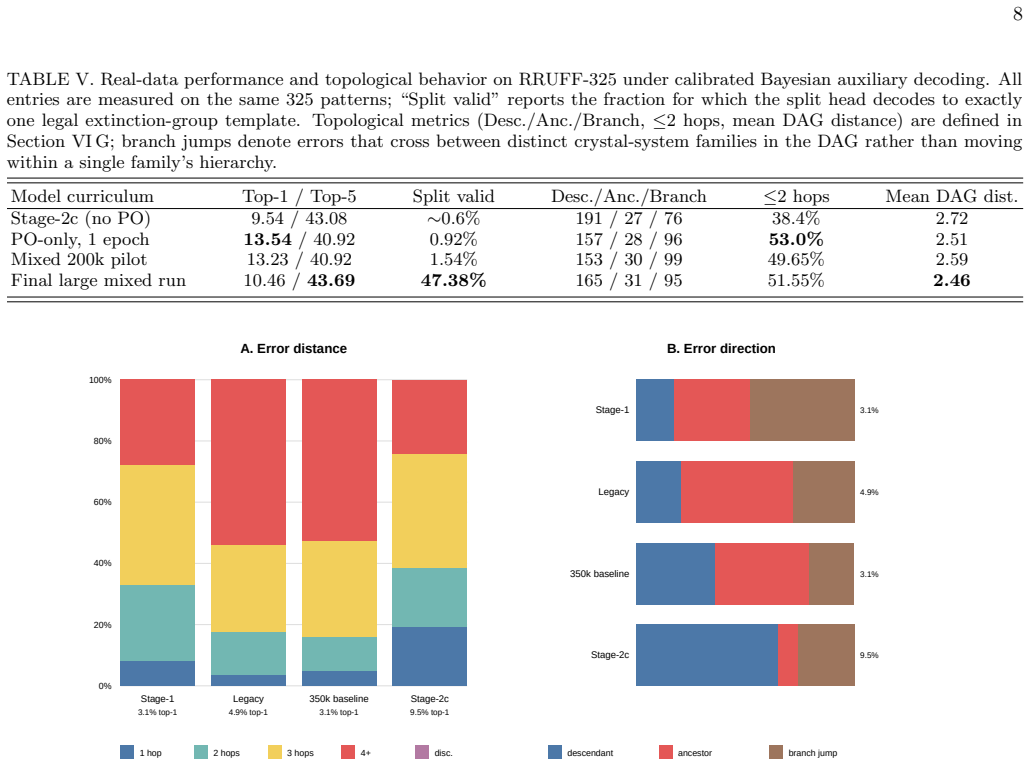
A physics-informed transformer classifies powder diffraction patterns into 99 extinction groups by combining an explicit sin^2(theta) coordinate channel, physics-aware positional encoding, and a structured multi-task decoder; trained with a three-stage curriculum of synthetic pretraining, realistic fine-tuning, and Bayesian prior injection plus post-hoc temperature scaling, its errors lie on the maximal translationengleiche subgroup hierarchy and predominantly flow to lower-symmetry descendants.
What carries the argument
Physics-informed transformer that uses an explicit sin^2(theta) coordinate channel, physics-aware positional encoding, and a structured multi-task decoder separating geometric rule learning from holistic pattern recognition, trained under a three-stage curriculum with post-hoc temperature scaling.
If this is right
- Prediction errors remain local on the directed acyclic graph of maximal translationengleiche subgroups rather than occurring at random.
- Misclassifications predominantly descend toward lower-symmetry descendants, matching the physical effect of noise erasing systematic-absence cues.
- Post-hoc temperature scaling alone calibrates the model for real-data use without requiring additional training.
- Physics-informed architectural choices and curriculum design are at least as important as raw model capacity for this scientific classification task.
Where Pith is reading between the lines
- The same principle of embedding domain-specific physical constraints into both architecture and training may generalize to other inverse problems where data are generated by selection rules or conservation laws.
- The observed locality of errors on the subgroup graph opens the possibility of hierarchical or graph-constrained post-processing to further reduce effective error rates.
- Future experiments could test whether the three-stage curriculum transfers to related tasks such as single-crystal diffraction indexing or neutron powder pattern analysis.
Load-bearing premise
The three-stage curriculum and post-hoc temperature scaling are sufficient to bridge the synthetic-to-real domain gap and produce robust performance on experimental powder patterns.
What would settle it
A controlled experiment showing that a plain attention transformer trained only on synthetic data achieves comparable accuracy on a large, diverse set of real experimental powder patterns, or that its misclassifications are randomly distributed across unrelated space groups rather than clustered within the translationengleiche subgroup hierarchy.
Figures
read the original abstract
Determining crystal symmetry from powder X-ray diffraction is a central problem in materials characterization, yet multiple space groups can produce indistinguishable patterns, making automated classification difficult. We show that attention-based architectures, while superior to convolutional networks for this task, are insufficient on their own: reliable symmetry extraction requires encoding crystallographic knowledge into both the network architecture and the training curriculum. We introduce a physics-informed transformer that classifies powder patterns into 99 extinction groups, the most specific symmetry classification accessible from diffraction data alone, using an explicit sin^2(theta) coordinate channel, physics-aware positional encoding, and a structured multi-task decoder that separates geometric rule learning from holistic pattern recognition. A three-stage curriculum of balanced synthetic pretraining, realistic fine-tuning with explicit preferred-orientation modeling, and Bayesian prior injection proves essential for bridging the synthetic-to-real domain gap, while post-hoc temperature scaling rather than additional training is the key remaining ingredient for robust real-data transfer. By mapping predictions onto the directed acyclic graph of maximal translationengleiche subgroups, we show that the calibrated model's errors are not random but physically structured: they remain local on the subgroup hierarchy and flow predominantly toward lower-symmetry descendants, consistent with the physical erasure of systematic-absence cues by real-world noise. These results establish that physics-informed target design, curriculum, and calibrated inference matter as much as model capacity for scientific machine learning on diffraction data.
Editorial analysis
A structured set of objections, weighed in public.
Referee Report
Summary. The manuscript claims that attention-based models alone are insufficient for classifying powder X-ray diffraction patterns into 99 extinction groups. It introduces a physics-informed transformer incorporating an explicit sin²(θ) coordinate channel, physics-aware positional encoding, and a structured multi-task decoder. A three-stage curriculum (balanced synthetic pretraining, realistic fine-tuning with preferred-orientation modeling, and Bayesian prior injection) plus post-hoc temperature scaling is presented as essential for synthetic-to-real transfer. Predictions are mapped onto the directed acyclic graph of maximal translationengleiche subgroups to show that errors are physically structured rather than random.
Significance. If the quantitative results and ablations hold, the work would demonstrate that domain-specific inductive biases and staged curricula can be as critical as model capacity for reliable scientific ML on diffraction data. It offers a concrete example of embedding crystallographic knowledge to improve robustness and interpretability in materials characterization, with potential to influence similar physics-informed approaches in other experimental domains.
major comments (2)
- [Abstract and §4] Abstract and §4 (real-data evaluation): The central claim that attention alone fails while the physics-informed architecture plus three-stage curriculum succeeds on real patterns requires ablation studies on real test sets. No quantitative comparison (accuracy, calibration, or error rates) is reported for variants lacking the sin²(θ) channel, physics-aware positional encoding, or individual curriculum stages, so the necessity of each element for bridging the domain gap is not demonstrated.
- [§5] §5 (error analysis on DAG): The assertion that calibrated-model errors 'remain local on the subgroup hierarchy and flow predominantly toward lower-symmetry descendants' is load-bearing for the physical-interpretability claim. Without reported metrics (e.g., mean DAG distance of errors versus random baseline, or fraction of errors to immediate descendants), it is unclear whether the structure exceeds what would be expected from class imbalance or noise alone.
minor comments (2)
- [Abstract] The abstract refers to '99 extinction groups' without a brief definition or reference to the standard crystallographic enumeration used.
- [Methods] Notation for the multi-task decoder and Bayesian prior injection should be introduced with explicit equations in the methods section to allow reproducibility.
Simulated Author's Rebuttal
We thank the referee for their careful reading and constructive comments, which help clarify the strength of our claims. We respond to each major point below and will incorporate the requested analyses in the revised manuscript.
read point-by-point responses
-
Referee: [Abstract and §4] Abstract and §4 (real-data evaluation): The central claim that attention alone fails while the physics-informed architecture plus three-stage curriculum succeeds on real patterns requires ablation studies on real test sets. No quantitative comparison (accuracy, calibration, or error rates) is reported for variants lacking the sin²(θ) channel, physics-aware positional encoding, or individual curriculum stages, so the necessity of each element for bridging the domain gap is not demonstrated.
Authors: We agree that the manuscript does not contain the requested ablations on the real test set, which weakens the support for the necessity of each inductive bias and curriculum stage in closing the domain gap. The original work reported overall real-data performance and synthetic ablations but omitted these direct comparisons. In the revision we will add a new subsection to §4 with quantitative results (accuracy, expected calibration error, and per-class error rates) for the full model versus variants lacking the sin²(θ) channel, lacking physics-aware positional encoding, and with each curriculum stage individually removed. These will be evaluated on the held-out real patterns. revision: yes
-
Referee: [§5] §5 (error analysis on DAG): The assertion that calibrated-model errors 'remain local on the subgroup hierarchy and flow predominantly toward lower-symmetry descendants' is load-bearing for the physical-interpretability claim. Without reported metrics (e.g., mean DAG distance of errors versus random baseline, or fraction of errors to immediate descendants), it is unclear whether the structure exceeds what would be expected from class imbalance or noise alone.
Authors: We acknowledge that the current §5 presents only qualitative DAG visualizations and does not supply the quantitative metrics needed to demonstrate that the observed error locality exceeds what class imbalance or random noise would produce. We will revise §5 to include (i) the mean DAG distance of misclassifications versus a random baseline that respects the empirical class distribution, (ii) the fraction of errors that land on immediate descendants, and (iii) a statistical comparison (e.g., permutation test) against the null model. These metrics will be reported for both the calibrated and uncalibrated models on the real test set. revision: yes
Circularity Check
No significant circularity; empirical claims rest on explicit comparisons rather than definitional reduction.
full rationale
The paper's central claims—that attention alone is insufficient and that physics-informed architecture plus three-stage curriculum plus temperature scaling are essential—are presented as outcomes of training and evaluation experiments on synthetic and real diffraction patterns. No equations or derivations are shown that reduce a 'prediction' to a fitted parameter by construction, nor is any uniqueness theorem or ansatz imported via self-citation in a load-bearing way. The abstract describes explicit design choices (sin^2(theta) channel, multi-task decoder, preferred-orientation modeling) whose necessity is asserted via performance differences, not by re-labeling inputs as outputs. This is a standard empirical ML study whose validity hinges on the quality of the held-out real-data tests and ablations, not on logical circularity.
Axiom & Free-Parameter Ledger
axioms (2)
- domain assumption The directed acyclic graph of maximal translationengleiche subgroups accurately represents physical relationships in symmetry.
- domain assumption Synthetic data with preferred-orientation modeling can approximate real diffraction patterns sufficiently for transfer learning.
Reference graph
Works this paper leans on
-
[1]
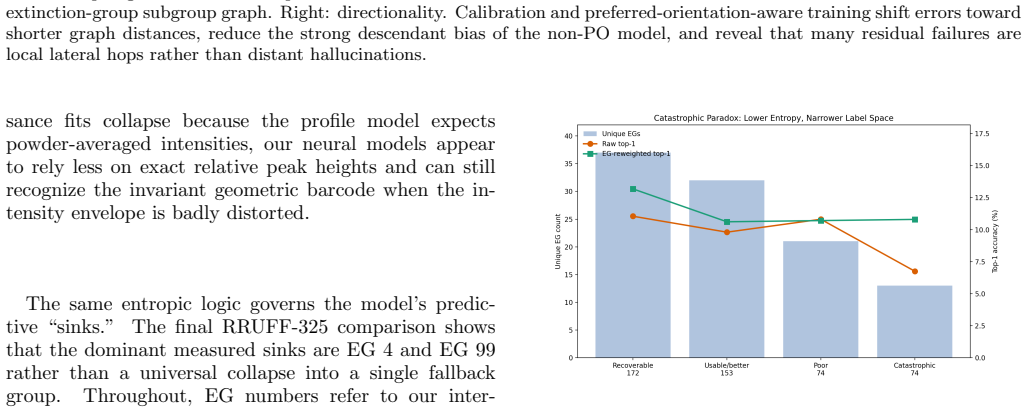
using algorith- mic family-consistency filters and nuisance-fit stratifica- tion (172 recoverable, 153 usable, 74 poor, 74 catas- trophic). This benchmark is algorithmically curated, not hand-cleaned, making the evaluation harder but more reproducible than sanitized sets used in prior work [4]. The second isRRUFF-325, a deterministic downstream subset fro...
-
[2]
Unsupported or pathological elements are removed from the chemistry support, including elements for which the PyXtal radius tables are incomplete
-
[3]
For the main phase, at least one general-position orbit is required when available, reducing accidental symmetry elevation into higher-symmetry supergroups
-
[4]
For the impurity phase, exact symmetry preservation is not required; the impurity only needs to yield a physi- cally plausible additional powder pattern
The generated main phase is accepted only if the realized extinction group detected byspglibmatches the intended label. For the impurity phase, exact symmetry preservation is not required; the impurity only needs to yield a physi- cally plausible additional powder pattern. The final stage-2 production recipe also used a tighterspglibtolerance (symprec= 10...
1981
- [5]
-
[6]
W. B. Park, J. Chung, J. Jung, K. Sohn, S. P. Singh, M. Pyo, N. Shin, and K.-S. Sohn, Classification of crystal structure using a convolutional neural network, IUCrJ4, 486 (2017)
2017
-
[7]
Lolla, H
S. Lolla, H. Liang, A. G. Kusne, I. Takeuchi, and W. Ratcliff, A Semi-Supervised Deep-Learning Approach for Automatic Crystal Structure Classification, Journal of Applied Crystallography55, 882 (2022)
2022
-
[8]
Schopmans, P
H. Schopmans, P. Reiser, and P. Friederich, Neural networks trained on synthetically generated crystals can extract structural information from ICSD powder X-ray diffractograms, Digital Discovery2, 1414 (2023)
2023
-
[9]
A. Vaswani, N. Shazeer, N. Parmar, J. Uszkoreit, L. Jones, A. N. Gomez, L. Kaiser, and I. Polosukhin, Attention is all you need (2023), arXiv:1706.03762 [cs.CL]
work page internal anchor Pith review arXiv 2023
-
[10]
Z. Chen, Y. Xie, Y. Wu, Y. Lin, S. Tomiya, and J. Lin, An interpretable and transferrable vision transformer model for rapid materials spectra classification, Digital Discovery3, 369 (2024)
2024
-
[11]
An Image is Worth 16x16 Words: Transformers for Image Recognition at Scale
A. Dosovitskiy, L. Beyer, A. Kolesnikov, D. Weissenborn, X. Zhai, T. Unterthiner, M. Dehghani, M. Minderer, G. Heigold, S. Gelly, J. Uszkoreit, and N. Houlsby, An image is worth 16x16 words: Transformers for image recognition at scale (2021), arXiv:2010.11929 [cs.CV]
work page internal anchor Pith review arXiv 2021
-
[12]
Simonnet, M
T. Simonnet, M. D. Fall, S. Grangeon, and B. Galerne, Vision transformers for x-ray diffraction patterns analysis, in ICASSP 2025 - 2025 IEEE International Conference on Acoustics, Speech and Signal Processing (ICASSP)(2025) pp. 1–5. 29
2025
-
[13]
R. W. Grosse-Kunstleve, N. K. Sauter, N. W. Moriarty, and P. D. Adams, TheComputational Crystallography Toolbox: crystallographic algorithms in a reusable software framework, Journal of Applied Crystallography35, 126 (2002)
2002
-
[14]
Fredericks, K
S. Fredericks, K. Parrish, D. Sayre, and Q. Zhu, Pyxtal: A python library for crystal structure generation and symmetry analysis, Computer Physics Communications261, 107810 (2021)
2021
-
[15]
A. H. Larsen, J. J. Mortensen, J. Blomqvist, I. E. Castelli, R. Christensen, M. Du lak, J. Friis, M. N. Groves, B. Hammer, C. Hargus, E. D. Hermes, P. C. Jennings, P. B. Jensen, J. Kermode, J. R. Kitchin, E. L. Kolsbjerg, J. Kubal, K. Kaasbjerg, S. Lysgaard, J. B. Maronsson, T. Maxson, T. Olsen, L. Pastewka, A. Peterson, C. Rostgaard, J. Schiøtz, O. Sch¨ ...
2017
-
[16]
Institut Laue–Langevin, PyCrysFML: Python bindings for the Crystallographic Fortran Modules Library (2023), available athttps://code.ill.fr/scientific-software/pycrysfml
2023
-
[17]
J. Su, Y. Lu, S. Pan, A. Murtadha, B. Wen, and Y. Liu, Roformer: Enhanced transformer with rotary position embedding (2023), arXiv:2104.09864 [cs.CL]
work page internal anchor Pith review arXiv 2023
-
[18]
Decoupled Weight Decay Regularization
I. Loshchilov and F. Hutter, Decoupled weight decay regularization (2019), arXiv:1711.05101 [cs.LG]
work page internal anchor Pith review arXiv 2019
-
[19]
D. P. Kingma and J. Ba, Adam: A method for stochastic optimization (2017), arXiv:1412.6980 [cs.LG]
work page internal anchor Pith review arXiv 2017
-
[20]
C. Guo, G. Pleiss, Y. Sun, and K. Q. Weinberger, On calibration of modern neural networks, inProceedings of the 34th International Conference on Machine Learning(PMLR, 2017) pp. 1321–1330
2017
-
[21]
Lafuente, R
B. Lafuente, R. T. Downs, H. Yang, and N. Stone, The power of databases: The RRUFF project, inHighlights in Mineralogical Crystallography, edited by T. Armbruster and R. M. Danisi (Walter de Gruyter GmbH, Berlin, Germany,
-
[22]
1–30, database available athttps://rruff.info
pp. 1–30, database available athttps://rruff.info
-
[23]
G. W. Brier, Verification of forecasts expressed in terms of probability, Monthly Weather Review78, 1 (1950)
1950
-
[24]
B. Cao, Y. Liu, Z. Zheng, R. Tan, J. Li, and T.-y. Zhang, Simxrd-4m: Big simulated x-ray diffraction data and crystal symmetry classification benchmark, inInternational Conference on Learning Representations(2025)
2025
-
[25]
Wortsman, G
M. Wortsman, G. Ilharco, S. Y. Gadre, R. Roelofs, R. Gontijo-Lopes, A. Morcos, H. Namkoong, A. Farhadi, Y. Carmon, S. Kornblith, and L. Schmidt, Model soups: Averaging weights of multiple fine-tuned models improves accuracy without increasing inference time, Proceedings of the 39th International Conference on Machine Learning162, 23965 (2022), we use the ...
2022
-
[26]
S. Wiegreffe and Y. Pinter, Attention is not not explanation (2019), arXiv:1908.04626 [cs.CL]
discussion (0)
Sign in with ORCID, Apple, or X to comment. Anyone can read and Pith papers without signing in.