Recognition: unknown
With arms wide open: a VLT/MUSE view of the mechanisms driving unwinding spiral arms in cluster galaxies
Pith reviewed 2026-05-08 05:35 UTC · model grok-4.3
The pith
Tidal interactions drive spiral-arm unwinding in one cluster galaxy while ram pressure stripping drives it in another.
A machine-rendered reading of the paper's core claim, the machinery that carries it, and where it could break.
Core claim
Unwinding in UG101 is primarily driven by tidal interactions, while unwinding in UG103 is primarily driven by ram pressure stripping, although a combined effect cannot be excluded for UG101. This follows from UG101 having irregular stellar and gas kinematics plus unwound features beyond R_tid approximately 1.5 times the effective radius, and from UG103 having regular stellar but disturbed gas kinematics with truncation facing the ICM, plus stellar population ages consistent with an infall time of about 1.6 Gyr.
What carries the argument
The differential kinematic response of gas versus stars to gravitational versus hydrodynamical perturbations, combined with the calculated tidal radius R_tid and age-binned stellar population maps from SINOPSIS.
If this is right
- The same combination of kinematic comparison and stellar age mapping can classify the driver of unwinding in larger samples of cluster galaxies.
- Unwinding can be used as a clock for the time since a galaxy experienced strong environmental influence.
- Stellar population ages provide an independent check on whether the inferred mechanism matches the galaxy's orbital history in the cluster.
- Cases with mixed signatures remain possible and require multi-tracer data to separate contributions.
Where Pith is reading between the lines
- Similar unwound morphologies can arise from physically distinct processes, so morphology alone is insufficient to diagnose the environment a galaxy has passed through.
- The method could be extended to IFU surveys to measure the relative frequency of tidal versus ram-pressure-driven unwinding as a function of cluster-centric distance.
- If the two mechanisms produce distinguishable kinematic fingerprints, they may also leave different imprints on the star-formation history and quenching timeline.
Load-bearing premise
The assumption that proximity of close neighbors reliably selects the dominant mechanism and that the estimated tidal radius accurately marks where tidal forces dominate without major contributions from other processes.
What would settle it
High-resolution hydrodynamic simulations of UG103 that include only ram pressure and show whether they reproduce the observed one-sided gas truncation, extended gas on the opposite side, and unwound arm morphology without requiring tidal forces.
Figures





read the original abstract
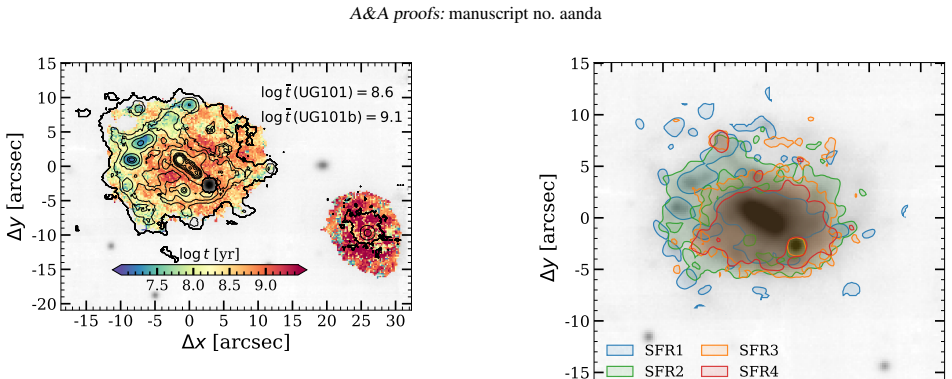
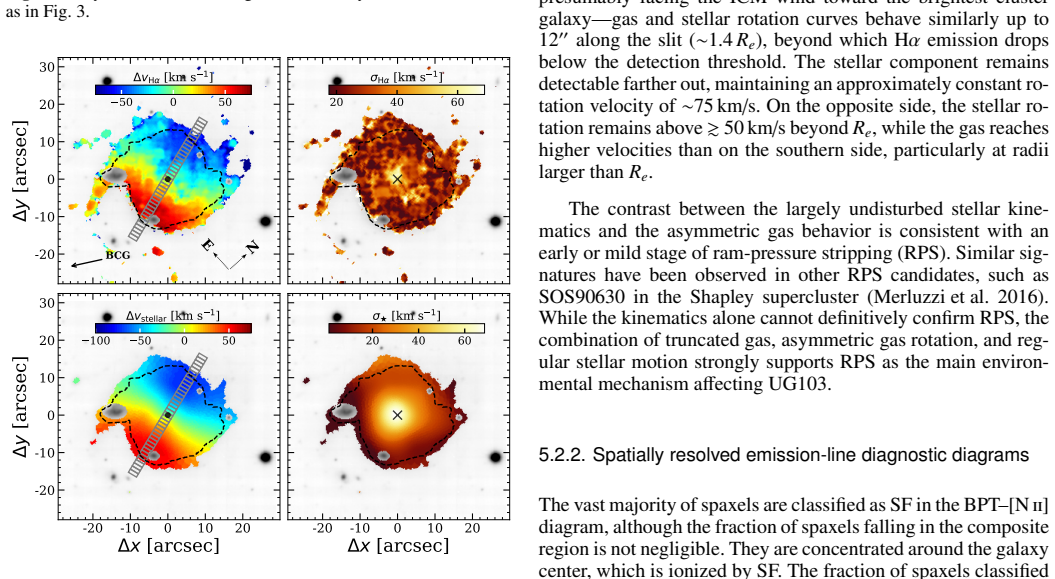
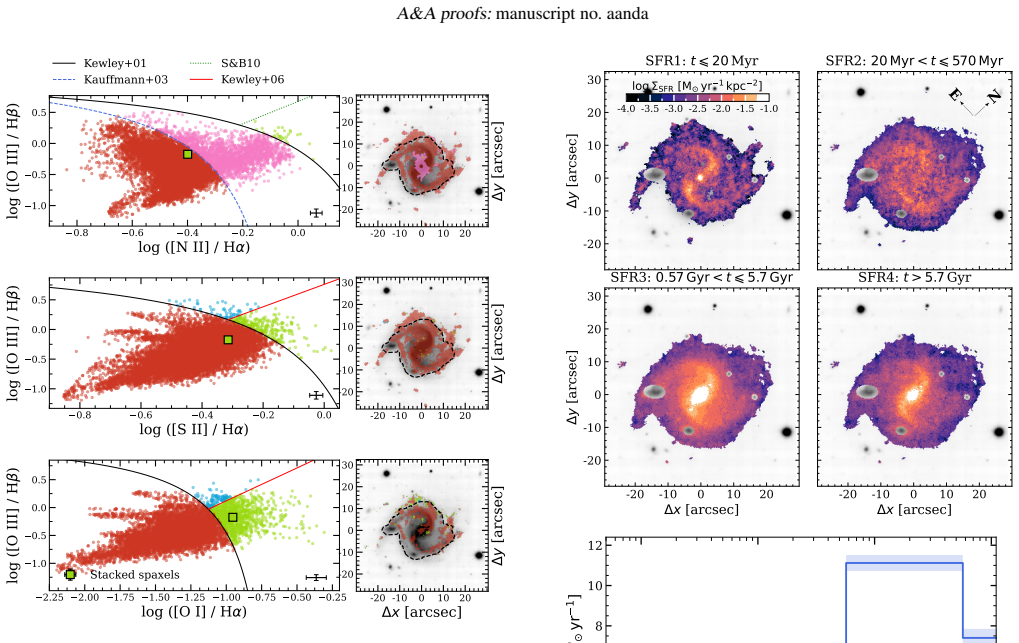
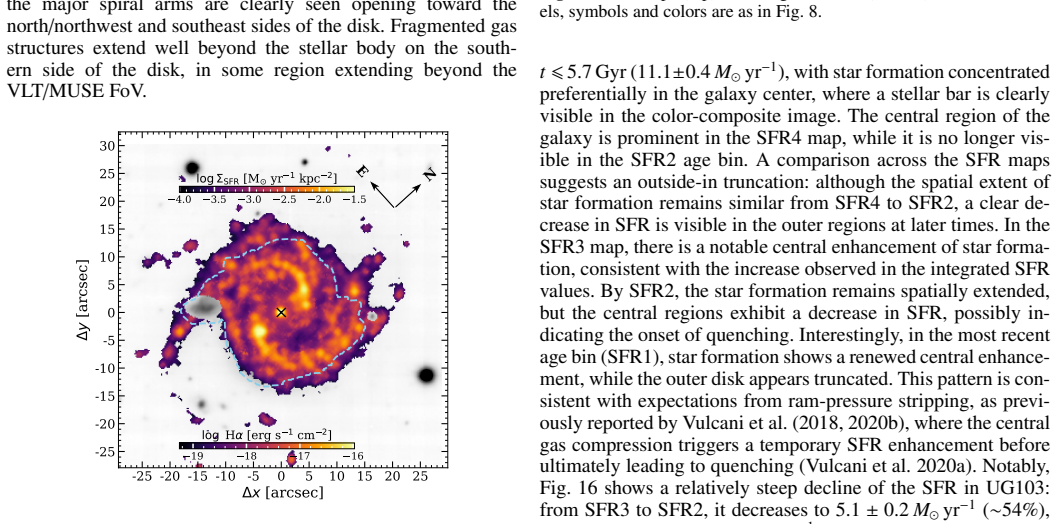
The environmental mechanisms driving unwinding spiral arms in cluster galaxies remain debated. While earlier studies attributed it mainly to gravitational interactions, recent works suggest that RPS alone can induce unwinding. We present a VLT/MUSE spatially resolved analysis to investigate the mechanisms responsible for spiral-arm unwinding in two galaxies, UG101 and UG103, drawn from a larger sample. They are selected as tidal and RPS-driven candidates, respectively, based on the proximity of close neighbors. We estimate the galactocentric radius at which tidal forces, from a companion or the cluster potential, become relevant ($R_{\mathrm{tid}}$). We examine gas and stellar kinematics, exploiting their different responses to gravitational and hydrodynamical perturbations. SINOPSIS is used to map stellar populations in age bins and constrain unwinding timescales. For UG101, we find $R_{\mathrm{tid}} \sim 1.5 R_e$, while the unwound features extend beyond this radius. UG101 shows irregular stellar and gas kinematics; its rotation curve indicates similar motions, although the gas is truncated on one side and extended on the other. For UG103, neither the closest companion nor the cluster appear capable of triggering unwinding. UG103 displays regular stellar but disturbed gas kinematics, with truncation on the disk side likely facing the ICM wind and gas extended in the opposite direction. Stellar population maps show the emergence and unwinding of the spiral arms in UG103 on timescales consistent with its cluster infall time ($\sim 1.6$ Gyr). We conclude that unwinding in UG101 and UG103 is primarily driven by tidal interactions and RPS, respectively, although a combined effect cannot be excluded for UG101. Our methodology provides a framework to identify the mechanisms driving unwinding in cluster galaxies from spatially resolved properties.
Editorial analysis
A structured set of objections, weighed in public.
Referee Report
Summary. The manuscript uses VLT/MUSE integral-field spectroscopy to study spiral-arm unwinding in two cluster galaxies, UG101 (selected as tidal candidate due to close neighbor) and UG103 (selected as RPS candidate). It computes the tidal radius R_tid where companion or cluster tides become relevant, contrasts gas versus stellar kinematics (exploiting their differing responses to gravitational and hydrodynamical effects), and applies SINOPSIS to derive stellar-age maps for timescale constraints. The central conclusion is that tidal interactions primarily drive unwinding in UG101 (possible combined effects not excluded) while RPS drives it in UG103, offering a spatially resolved framework for mechanism identification.
Significance. If the kinematic distinctions and age-timing results hold under quantitative scrutiny, the work provides a useful observational template for separating tidal and ram-pressure effects on spiral structure using MUSE data. The differential gas-star response and use of stellar populations to match infall timescales (~1.6 Gyr for UG103) are concrete strengths that address an ongoing debate in cluster galaxy evolution.
major comments (2)
- [R_tid estimation] R_tid calculation (methods/results sections describing the estimate): For UG101, R_tid ~1.5 R_e is used to argue that unwinding extends beyond tidal influence, and for UG103 it is stated that neither companion nor cluster tides suffice. No uncertainties are propagated from mass ratios, orbital parameters, or cluster mass profile assumptions, yet this quantity is load-bearing for assigning RPS as the dominant mechanism in UG103.
- [Kinematic and population analysis] Mechanism attribution (results and discussion sections): The assignment of tidal driving to UG101 (irregular stellar/gas kinematics, one-sided truncation) versus RPS to UG103 (regular stellar kinematics, one-sided gas truncation facing ICM) rests on qualitative map interpretation without reported quantitative asymmetry metrics or direct comparison to tidal/RPS hydrodynamic simulations. This link is central to the strongest claim and requires strengthening to confirm mechanism specificity.
minor comments (2)
- [Abstract and stellar population maps] Abstract and § on stellar populations: Specify the exact radial extent of unwound features beyond R_tid in UG101 and the precise age bins or fitting assumptions in SINOPSIS that yield the ~1.6 Gyr timescale for UG103.
- [Notation and methods] Notation: Ensure consistent use of R_e (effective radius) and R_tid throughout, and clarify whether R_tid is computed separately for companion and cluster potentials with explicit formulas.
Simulated Author's Rebuttal
We thank the referee for their constructive and positive review, which highlights the potential of our spatially resolved MUSE analysis. We address each major comment below and have revised the manuscript to incorporate improvements where feasible.
read point-by-point responses
-
Referee: [R_tid estimation] R_tid calculation (methods/results sections describing the estimate): For UG101, R_tid ~1.5 R_e is used to argue that unwinding extends beyond tidal influence, and for UG103 it is stated that neither companion nor cluster tides suffice. No uncertainties are propagated from mass ratios, orbital parameters, or cluster mass profile assumptions, yet this quantity is load-bearing for assigning RPS as the dominant mechanism in UG103.
Authors: We agree that the original presentation lacked propagated uncertainties, which is a valid point for strengthening the analysis. In the revised manuscript we have added a new subsection in the methods that propagates uncertainties by varying the companion mass ratio over a plausible range (1:1 to 1:10), orbital parameters consistent with cluster dynamics, and two different cluster mass profiles drawn from the literature. For UG103 the upper envelope of these uncertainties still places R_tid well beyond the observed unwound features, preserving the conclusion that neither companion nor cluster tides dominate. We have also updated the relevant results and discussion paragraphs to reference these error estimates explicitly. revision: yes
-
Referee: [Kinematic and population analysis] Mechanism attribution (results and discussion sections): The assignment of tidal driving to UG101 (irregular stellar/gas kinematics, one-sided truncation) versus RPS to UG103 (regular stellar kinematics, one-sided gas truncation facing ICM) rests on qualitative map interpretation without reported quantitative asymmetry metrics or direct comparison to tidal/RPS hydrodynamic simulations. This link is central to the strongest claim and requires strengthening to confirm mechanism specificity.
Authors: The kinematic and morphological distinctions are indeed presented through direct inspection of the MUSE maps, which show clear differences (irregular stellar velocity field and asymmetric gas truncation in UG101 versus regular stellar rotation with one-sided gas truncation in UG103). To address the request for quantification we have added asymmetry indices (CAS parameters and m=1 Fourier amplitudes) for both the stellar and ionized-gas components in the revised results section; these metrics confirm the visual impressions and are now reported with uncertainties. Direct side-by-side comparison with new hydrodynamic simulations is beyond the scope of this observational paper; we have instead expanded the discussion to cite existing simulation suites whose predicted signatures match the observed gas-star differential response and truncation directions in each galaxy. revision: partial
Circularity Check
No significant circularity: mechanism attribution relies on independent observational diagnostics
full rationale
The paper selects UG101 and UG103 as candidates based on neighbor proximity, computes R_tid from separate mass and orbital estimates, and then attributes mechanisms using direct MUSE-derived observables: stellar/gas kinematics (irregular vs. regular), one-sided truncation and extension patterns, and SINOPSIS age maps showing emergence timescales matching cluster infall. These quantities are not defined from the final conclusion, no parameters are fitted to the target result and then relabeled as predictions, and no load-bearing self-citations or ansatzes reduce the chain to its inputs by construction. The derivation is therefore self-contained against external benchmarks.
Axiom & Free-Parameter Ledger
axioms (2)
- domain assumption Neighbor proximity selects the dominant mechanism (tidal or RPS)
- standard math Standard tidal radius formula applies inside the cluster potential
Reference graph
Works this paper leans on
-
[1]
Abadi, M. G., Moore, B., & Bower, R. G. 1999, MNRAS, 308, 947 Abbott, T. M. C., Adamów, M., Aguena, M., et al. 2021, ApJS, 255, 20 Adams, S. M., Zaritsky, D., Sand, D. J., et al. 2012, AJ, 144, 128 Akhlaghi, M. & Ichikawa, T. 2015, ApJS, 220, 1 Bacon, R., Accardo, M., Adjali, L., et al. 2010, in Society of Photo-Optical In- strumentation Engineers (SPIE) ...
work page internal anchor Pith review arXiv 1999
-
[2]
The bottom panel shows the spectrum from the brightest spaxel of a clump located far from the stellar disk, exhibiting S /N = 1.5, therefore not included in the binning process. The first spectrum illustrates a case where the stellar continuum and ionized gas are well de- tected at the spaxel resolution, whereas the second case demon- strates the result o...
2021
discussion (0)
Sign in with ORCID, Apple, or X to comment. Anyone can read and Pith papers without signing in.