Recognition: unknown
#MakeBeefGreatAgain: A Cross-Platform Analysis of Early #MAHA Discourse
Pith reviewed 2026-05-08 04:47 UTC · model grok-4.3
The pith
Most early #MAHA posts ignored the campaign's five official health priorities.
A machine-rendered reading of the paper's core claim, the machinery that carries it, and where it could break.
Core claim
The analysis shows a substantial disconnect between #MAHA public discourse and the stated MAHA agenda, with 81.3 percent of posts not engaging any of the five campaign priorities. Platforms clustered into three broad environments: grassroots partisan-support spaces, informational sources, and health-focused spaces. As a result, #MAHA functioned less as a unified campaign agenda than as a symbolic frame interpreted differently across platforms.
What carries the argument
Agenda-Melding Theory, which tracks how public and media agendas interact and diverge in digital settings, applied via structural topic modeling and AI-assisted annotation to classify whether posts addressed the campaign priorities.
If this is right
- Campaign slogans often circulate in public discourse without direct ties to their original policy priorities.
- The same hashtag produces distinct thematic clusters depending on the platform and user community.
- Public agendas around political slogans form through reinterpretation rather than direct transmission of campaign messaging.
- Fragmented digital spaces transform how campaign language is amplified and repurposed over time.
Where Pith is reading between the lines
- Campaign teams may need platform-tailored messaging to reduce divergence between slogan use and intended priorities.
- Similar patterns of slogan reinterpretation could appear in other political hashtags and reduce message coherence.
- Over longer periods the hashtag might stabilize around meanings unrelated to the original five priorities.
Load-bearing premise
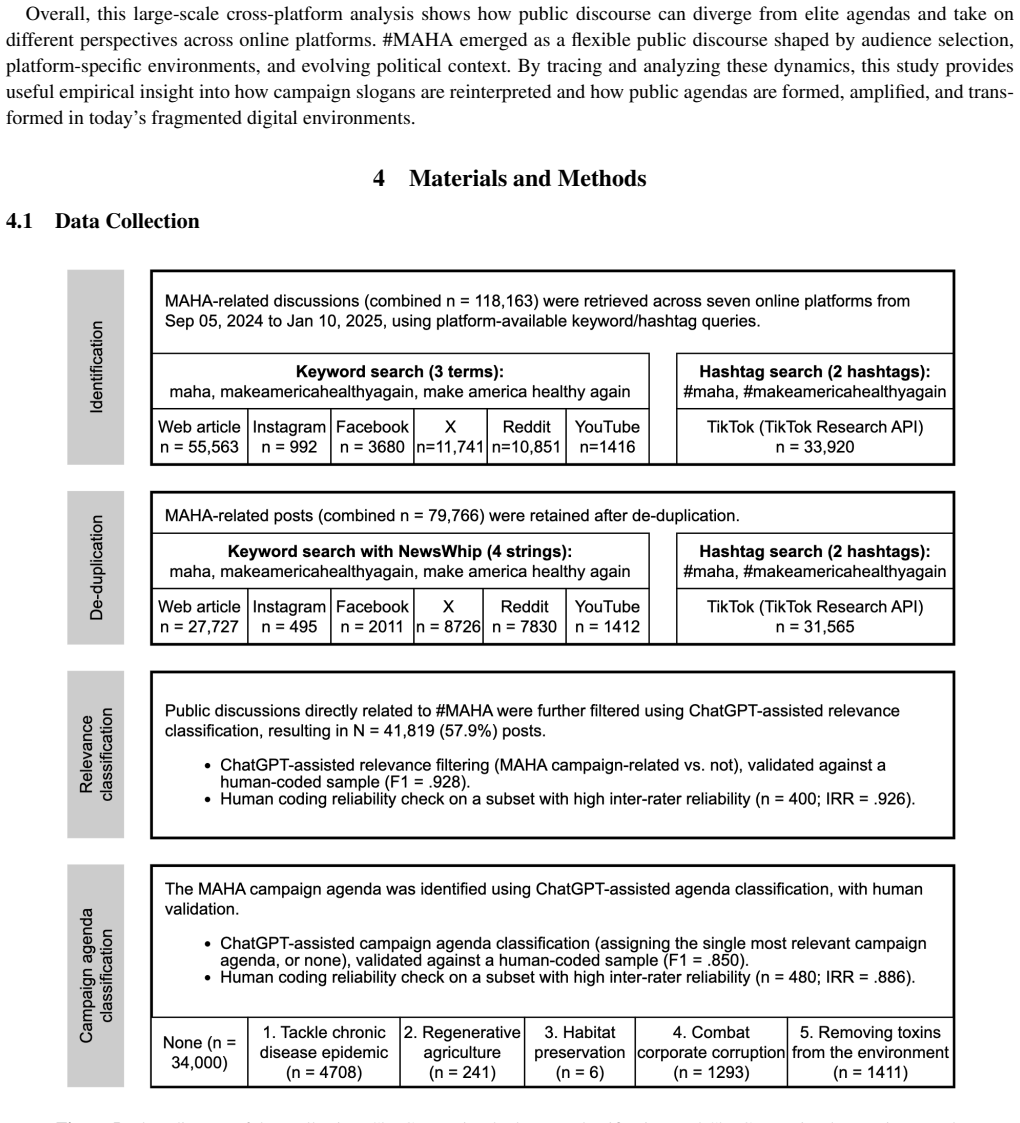
The five official MAHA campaign priorities were correctly identified from official sources and the AI-assisted annotation plus topic modeling accurately distinguished posts that engaged those priorities from those that did not.
What would settle it
An independent manual coding of a random sample of the 41,819 posts that finds substantially more than 18.7 percent of posts addressing at least one of the five priorities would undermine the central claim of widespread disconnect.
Figures


read the original abstract
Make America Healthy Again (MAHA) is a health-related campaign slogan proposed by Robert F. Kennedy Jr. and later incorporated into the political coalition of President Trump. While #MAHA quickly circulated beyond the campaign itself and became a prominent hashtag for public discussion, it remains unclear whether this public discourse reflected, reshaped, or diverged from the stated agenda of the MAHA campaign. This study presents a large-scale, cross-platform analysis of early #MAHA public discourse between September 2024 and January 2025, using the framework of Agenda-Melding Theory. Drawing on 41,819 #MAHA-related posts, this study combines structural topic modeling, interrupted time-series analysis, and AI-assisted data annotation to examine the thematic structure and temporal dynamics. The most prominent finding is the substantial disconnect between #MAHA public discourse and the stated MAHA agenda: 81.3% of posts did not engage any of the five campaign priorities of the MAHA campaign. There were also pronounced cross-platform differences, with online platforms clustering into three broad discourse environments: (a) grassroots partisan-support spaces, (b) informational sources, and (c) health-focused spaces. #MAHA functioned less as a unified campaign agenda than as a symbolic frame interpreted differently across platforms. More broadly, this study provides useful empirical insight into how campaign slogans are reinterpreted and how public agendas are formed, amplified, and transformed in the fragmented digital environments.
Editorial analysis
A structured set of objections, weighed in public.
Referee Report
Summary. The paper analyzes 41,819 #MAHA-related social media posts collected between September 2024 and January 2025. It applies structural topic modeling, interrupted time-series analysis, and AI-assisted annotation to map thematic structure, temporal dynamics, and cross-platform variation. The central empirical claim is that public #MAHA discourse diverges sharply from the official MAHA campaign agenda, with 81.3% of posts engaging none of the five stated campaign priorities; platforms cluster into three discourse environments (grassroots partisan-support, informational, and health-focused), and #MAHA functions primarily as a symbolic frame rather than a unified agenda.
Significance. If the priority classification proves reliable, the study supplies concrete, large-scale evidence that campaign slogans are rapidly reinterpreted in fragmented digital environments, consistent with Agenda-Melding Theory. The combination of topic modeling, time-series methods, and cross-platform comparison on a sizable corpus is a methodological strength that could inform future work on agenda formation online.
major comments (2)
- [Abstract and Methods] Abstract and Methods section on AI-assisted annotation: The 81.3% figure (and all downstream claims about thematic disconnect and platform clustering) rests on the binary classification of posts as engaging or not engaging the five MAHA priorities. No definition of 'engagement,' no enumeration of the five priorities, and no validation statistics (accuracy, precision/recall, human-AI agreement rate, or size of the validation sample) are supplied. Without these, it is impossible to assess whether the reported disconnect is a measurement artifact.
- [Results] Results section reporting the 81.3% statistic: The claim that 81.3% of the 41,819 posts engage none of the five priorities is presented as a direct count from the annotated data. If the AI classifier was not validated against a human-coded gold standard, systematic mislabeling (e.g., over- or under-detection of priority-related language) would propagate into the structural topic model outputs and the interrupted time-series analysis, undermining the cross-platform clustering interpretation.
minor comments (2)
- [Abstract] Abstract: The five campaign priorities are referenced but never listed; including a brief enumeration would allow readers to evaluate the scope of the 'disconnect' claim without consulting external sources.
- [Introduction] The title references '#MakeBeefGreatAgain' while the body concerns #MAHA; a short clarifying sentence in the introduction would prevent reader confusion about the relationship between the two hashtags.
Simulated Author's Rebuttal
We thank the referee for their careful and constructive review. We agree that the AI-assisted annotation requires substantially more methodological detail to support the central claims. We will revise the manuscript accordingly and address each comment below.
read point-by-point responses
-
Referee: [Abstract and Methods] Abstract and Methods section on AI-assisted annotation: The 81.3% figure (and all downstream claims about thematic disconnect and platform clustering) rests on the binary classification of posts as engaging or not engaging the five MAHA priorities. No definition of 'engagement,' no enumeration of the five priorities, and no validation statistics (accuracy, precision/recall, human-AI agreement rate, or size of the validation sample) are supplied. Without these, it is impossible to assess whether the reported disconnect is a measurement artifact.
Authors: We concur that these details are essential for evaluating the classification. In the revised manuscript we will expand the Methods section to enumerate the five MAHA campaign priorities, supply an explicit operational definition of 'engagement,' and report full validation statistics (accuracy, precision, recall, human-AI agreement rate, and validation-sample size) from a human-coded gold standard. These additions will allow readers to judge whether the 81.3% figure reflects a genuine thematic disconnect. revision: yes
-
Referee: [Results] Results section reporting the 81.3% statistic: The claim that 81.3% of the 41,819 posts engage none of the five priorities is presented as a direct count from the annotated data. If the AI classifier was not validated against a human-coded gold standard, systematic mislabeling (e.g., over- or under-detection of priority-related language) would propagate into the structural topic model outputs and the interrupted time-series analysis, undermining the cross-platform clustering interpretation.
Authors: We acknowledge the risk of error propagation. The revised manuscript will include a dedicated validation subsection demonstrating the AI classifier's performance against human annotations. Reporting these metrics will substantiate the 81.3% statistic and support the reliability of the subsequent topic-model and time-series results. revision: yes
Circularity Check
No circularity: primary result is direct empirical count from annotated posts
full rationale
The paper's central claim (81.3% of 41,819 posts did not engage the five MAHA priorities) is produced by collecting #MAHA posts and applying AI-assisted annotation plus structural topic modeling to label engagement. This is an observational measurement on external data rather than any derivation that reduces by construction to fitted parameters, self-definitions, or self-citations. No equations, ansatzes, or uniqueness theorems are invoked that would make the percentage tautological; the result stands or falls on the validity of the annotation process and data collection, which are independent inputs.
Axiom & Free-Parameter Ledger
axioms (1)
- domain assumption Agenda-Melding Theory supplies a valid framework for interpreting slogan reinterpretation across platforms
Reference graph
Works this paper leans on
-
[1]
Make America Healthy Again (MAHA) PAC: Official Site, March 2025
MAHA. Make America Healthy Again (MAHA) PAC: Official Site, March 2025. URL https://web.archive.org/web/ 20250308194651/https://www.maha.vote/
2025
-
[2]
Establishing the President’s Make America Healthy Again Commission, February 2025
The White House. Establishing the President’s Make America Healthy Again Commission, February 2025. URL https://www.whitehouse.gov/presidential-actions/2025/02/establishing-the-presidents-make-america-healthy-again- commission/
2025
-
[3]
State Food Additive Legislation Surged Across 38 States in 2025 (Plus Other Food Policy Trends We Saw Last Year)
Katherine Tschopp. State Food Additive Legislation Surged Across 38 States in 2025 (Plus Other Food Policy Trends We Saw Last Year). URL https://www.multistate.us/insider/2026/1/14/state-food-additive-legislation-surged-across-38- states-in-2025-plus-other-food-policy-trends-we-saw-last-year
2025
-
[4]
#maha, 2026
TikTok. #maha, 2026. URL https://www.tiktok.com/tag/maha
2026
-
[5]
#maha • Instagram, 2026
Instagram. #maha • Instagram, 2026. URL https://www.instagram.com/explore/search/keyword/?q=%23maha
2026
-
[6]
The MAHA sphere of influence.POLITICO, March 2026
Kelly Hooper and Chelsea Cirruzzo. The MAHA sphere of influence.POLITICO, March 2026. URL https://www. politico.com/newsletters/politico-pulse/2025/05/23/the-maha-sphere-of-influence-00366757
2026
-
[7]
Whole Foods, MAHA and the Battle Over Healthy Eating in America.The New York Times, October
Ben Ryder Howe. Whole Foods, MAHA and the Battle Over Healthy Eating in America.The New York Times, October
-
[8]
URL https://www.nytimes.com/2025/10/29/dining/whole-foods.html
ISSN 0362-4331. URL https://www.nytimes.com/2025/10/29/dining/whole-foods.html
2025
-
[9]
Watch: Is MAHA the New MAGA?, February 2026
Hannah Norman Sable-Smith, Bram. Watch: Is MAHA the New MAGA?, February 2026. URL https://kffhealthnews. org/news/article/watch-video-make-america-healthy-again-maha-maga-rfk-explainer/
2026
-
[10]
Tina Reed. RFK Jr. and MAHA’s not-so-secret weapon – moms, August 2025. URL https://www.axios.com/2025/08/31/ rfk-jr-vaccine-fluoride-moms-influencers
2025
-
[11]
Shaw, Maxwell McCombs, David H
Donald L. Shaw, Maxwell McCombs, David H. Weaver, and Bradley J. Hamm. INDIVIDUALS, GROUPS, AND AGENDA MELDING: A THEORY OF SOCIAL DISSONANCE.International Journal of Public Opinion Research, 11(1):2–24, March 1999. ISSN 0954-2892. doi: 10.1093/ijpor/11.1.2. URL https://doi.org/10.1093/ijpor/11.1.2
-
[12]
Shayan Alipour, Alessandro Galeazzi, Emanuele Sangiorgio, Michele Avalle, Ljubisa Bojic, Matteo Cinelli, and Walter Quattrociocchi. Cross-platform social dynamics: an analysis of ChatGPT and COVID-19 vaccine conversations.Scientific Reports, 14(1):2789, February 2024. ISSN 2045-2322. doi: 10.1038/s41598-024-53124-x. URL https://doi.org/10.1038/ s41598-024-53124-x
-
[13]
Pevehouse, Yibing Sun, Hyerin Kwon, Ruixue Lian, Rui Wang, Xinxia Dong, and Dhavan V
Mengyu Li, Jiyoun Suk, Yini Zhang, Jon C. Pevehouse, Yibing Sun, Hyerin Kwon, Ruixue Lian, Rui Wang, Xinxia Dong, and Dhavan V . Shah. Platform affordances, discursive opportunities, and social media activism: A cross-platform analysis of #MeToo on Twitter, Facebook, and Reddit, 2017–2020.New Media & Society, 28(1):119–147, January 2026. ISSN 1461-4448. d...
-
[14]
Daniel J Sude and Shira Dvir-Gvirsman. Different platforms, different uses: testing the effect of platforms and individual differences on perception of incivility and self-reported uncivil behavior.Journal of Computer-Mediated Communication, 28(2):zmac035, March 2023. ISSN 1083-6101. doi: 10.1093/jcmc/zmac035. URL https://doi.org/10.1093/jcmc/zmac035
-
[15]
Ideological frag- mentation of the social media ecosystem: From echo chambers to echo platforms.PNAS Nexus, 4(9):pgaf262, September
Edoardo Di Martino, Alessandro Galeazzi, Michele Starnini, Walter Quattrociocchi, and Matteo Cinelli. Ideological frag- mentation of the social media ecosystem: From echo chambers to echo platforms.PNAS Nexus, 4(9):pgaf262, September
-
[16]
doi: 10.1093/pnasnexus/pgaf262
ISSN 2752-6542. doi: 10.1093/pnasnexus/pgaf262. URL https://doi.org/10.1093/pnasnexus/pgaf262
-
[17]
Pelletier, Alexandra Krallman, Frank G
Mark J. Pelletier, Alexandra Krallman, Frank G. Adams, and Tyler Hancock. One size doesn’t fit all: a uses and gratifica- tions analysis of social media platforms.Journal of Research in Interactive Marketing, 14(2):269–284, June 2020. ISSN 2040-7122. doi: 10.1108/JRIM-10-2019-0159. URL https://doi.org/10.1108/JRIM-10-2019-0159
-
[18]
Michael D. Slater. Reinforcing Spirals: The Mutual Influence of Media Selectivity and Media Effects and Their Impact on Individual Behavior and Social Identity.Communication Theory, 17(3):281–303, August 2007. ISSN 1050-3293. doi: 10.1111/j.1468-2885.2007.00296.x. URL https://doi.org/10.1111/j.1468-2885.2007.00296.x
-
[19]
Chris J. Vargo. Public “agendamelding” in the United States: assessing the relative influence of different types of online news on partisan agendas from 2015 to 2020.Journal of Information Technology & Politics, 19(3):284–301, July 2022. ISSN 1933-1681. doi: 10.1080/19331681.2021.1972893. URL https://doi.org/10.1080/19331681.2021.1972893. eprint: https://...
-
[20]
Yumeng Luo and Teresa M. Harrison. How citizen journalists impact the agendas of traditional media and the government policymaking process in China.Global Media and China, 4(1):72–93, March 2019. ISSN 2059-4364. doi: 10.1177/ 2059436419835771. URL https://doi.org/10.1177/2059436419835771
-
[21]
Social Media and Political Agenda Setting.Political Communication, 39(1):39–60, January 2022
Fabrizio Gilardi, Theresa Gessler, Ma ¨el Kubli, and Stefan M ¨uller. Social Media and Political Agenda Setting.Political Communication, 39(1):39–60, January 2022. ISSN 1058-4609. doi: 10.1080/10584609.2021.1910390. URL https: //doi.org/10.1080/10584609.2021.1910390. eprint: https://doi.org/10.1080/10584609.2021.1910390
-
[22]
Desiree Steppat, Laia Castro Herrero, and Frank Esser. Selective exposure in different political information environ- ments – How media fragmentation and polarization shape congruent news use.European Journal of Communication, 37(1):82–102, February 2022. ISSN 0267-3231. doi: 10.1177/02673231211012141. URL https://doi.org/10.1177/ 02673231211012141
-
[23]
Pablo Porten-Che ´e and Christiane Eilders. Fragmentation in high-choice media environments from a micro-perspective: Effects of selective exposure on issue diversity in individual repertoires.Communications, 44(2):139–161, June 2019. ISSN 1613-4087. doi: 10.1515/commun-2018-2013. URL https://www.degruyterbrill.com/document/doi/10.1515/ commun-2018-2013/html
-
[24]
Active audience and uses and gratifications
Helen Wood. Active audience and uses and gratifications. InThe SAGE Handbook of Television Studies. SAGE Publica- tions, Limited, London, UNITED KINGDOM, 2014. ISBN 978-1-4739-1108-6. URL http://ebookcentral.proquest.com/ lib/utah/detail.action?docID=4013166
2014
-
[25]
Uses and Gratifications as Media Choice
Marina Krcmar and Yuliya Strizhakova. Uses and Gratifications as Media Choice. InMedia Choice : A Theoretical and Empirical Overview. Taylor & Francis Group, Oxford, UNITED KINGDOM, 2009. ISBN 978-0-203-93865-2. URL http://ebookcentral.proquest.com/lib/utah/detail.action?docID=425515
2009
-
[26]
Research API|TikTok for Developers, 2024
TikTok. Research API|TikTok for Developers, 2024. URL https://developers.tiktok.com/products/research-api/
2024
-
[27]
API Reference|YouTube Data API, 2025
YouTube Data API. API Reference|YouTube Data API, 2025. URL https://developers.google.com/youtube/v3/docs
2025
-
[28]
Newswhip Spike, 2026
Newswhip. Newswhip Spike, 2026. URL https://www.newswhip.com/spike-real-time-media-monitoring/
2026
-
[29]
Real-time web articles monitoring, 2026
Newswhip. Real-time web articles monitoring, 2026. URL https://www.newswhip.com/real-time-web-article- monitoring/
2026
-
[30]
Margaret E. Roberts, Brandon M. Stewart, and Dustin Tingley. stm: An R Package for Structural Topic Models.Journal of Statistical Software, 91(2):1 – 40, October 2019. doi: 10.18637/jss.v091.i02. URL https://www.jstatsoft.org/index.php/ jss/article/view/v091i02
-
[31]
clean food
Jos ´e Pinheiro, Douglas Bates, and R Core Team. nlme: Linear and Nonlinear Mixed Effects Models, 2026. URL https: //CRAN.R-project.org/package=nlme. Supplementary Information for #MakeBeefGreatAgain: A Cross-Platform Analysis of Early #MAHA Discourse Post count Agenda-aligned post % b (SE) p b (SE) p Intercept 47.96 (129.64) .712 0.131 (0.03) .000 Time 5...
2026
discussion (0)
Sign in with ORCID, Apple, or X to comment. Anyone can read and Pith papers without signing in.