Recognition: unknown
GRRMHD Simulations of State Transitions in Non-Jetted Tidal Disruption Events
Pith reviewed 2026-05-08 02:19 UTC · model grok-4.3
The pith
GRRMHD simulations show TDE disks become thermally unstable in 17-46 days, causing X-ray luminosity to drop by nearly 100 times.
A machine-rendered reading of the paper's core claim, the machinery that carries it, and where it could break.
Core claim
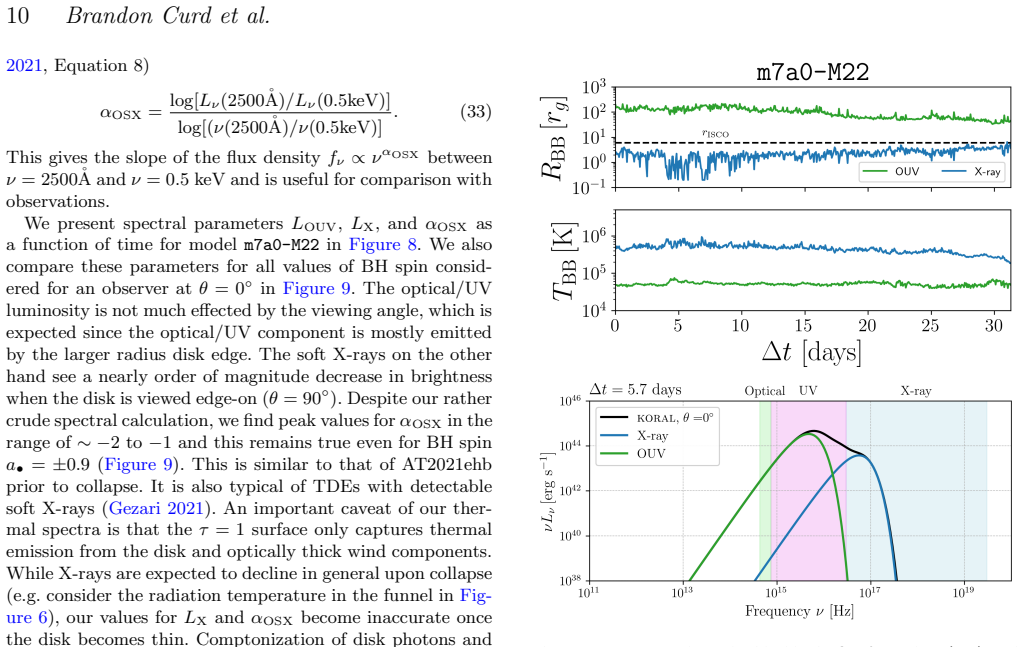
In the cooling envelope model the circularized debris reaches a shallow density profile and near-Eddington accretion only after several months. The GRRMHD runs of the corresponding magnetized tori show that the disk becomes thermally unstable within 17.1-46.5 days. Collapse is preceded by a soft X-ray excess in the thermal spectrum and is followed by a nearly two-order-of-magnitude decline in X-ray luminosity. Blackbody radius and temperature evolve in a spin-dependent manner, and the simulated spectra and soft X-ray luminosities reproduce those of AT2021ehb.
What carries the argument
General relativistic radiation magnetohydrodynamics simulations of magnetized tori taken from the near-Eddington stage of the cooling envelope model, used to evolve the thermal stability and radiative spectra of the accretion flow.
If this is right
- X-ray luminosity falls by nearly two orders of magnitude once the disk collapses.
- A soft X-ray excess appears in the spectrum immediately before the instability develops.
- Blackbody radius and temperature change in a manner that depends on black hole spin.
- The resulting spectra and luminosities are similar to those measured for AT2021ehb.
Where Pith is reading between the lines
- Thermal instability in the disk itself may be the dominant cause of state transitions in non-jetted TDEs.
- Multi-epoch observations of many TDEs could test whether measured transition times scale with black hole spin as the models predict.
- The same instability may appear in other accretion flows that develop shallow density profiles and strong radiative cooling.
Load-bearing premise
The chosen initial magnetized torus faithfully represents the late-stage debris structure from the cooling envelope model without a full self-consistent calculation from the original stellar disruption.
What would settle it
An observed non-jetted TDE that maintains steady high X-ray luminosity without a soft excess or sharp drop for more than 50 days after reaching near-Eddington accretion rates.
Figures




read the original abstract
Circularization of the stream material into a debris cloud during tidal disruption events (TDEs) was recently demonstrated in one of the most accurate long duration TDE simulations to-date. The cooling envelope model (CEM) provides a description of the circularized debris cloud and its emission over time well beyond circularization across different disruption parameters. In the CEM, sub-Eddington accretion rates occur early in TDEs and the debris has a shallow density profile of roughly $\rho \propto r^{-1}$, with Eddington accretion only being achieved after several months. To explore the late stages of the CEM, we perform general relativistic radiation magnetohydrodynamics (GRRMHD) simulations of magnetized tori adapted from the near Eddington phase of the CEM for a $1M_\odot$ star disrupted around a $10^7 M_\odot$ black hole (BH). We find that the disk becomes thermally unstable within 17.1-46.5 days depending on the spin of the BH. Thermal spectra show a soft X-ray excess prior to collapse, with a nearly two order of magnitude decline in X-ray luminosity upon disk collapse. Furthermore, the evolution of the blackbody radius and temperature of our models are correlated with the spin of the black hole. The spectral properties and soft X-ray luminosity in our models are similar to the TDE AT2021ehb, which is a non-jetted TDE with late X-rays and a state transition after $\approx 271$ days.
Editorial analysis
A structured set of objections, weighed in public.
Referee Report
Summary. The paper performs GRRMHD simulations of magnetized tori adapted from the near-Eddington phase of the cooling envelope model (CEM) for a 1 M⊙ star disrupted by a 10^7 M⊙ black hole. It reports that the disk undergoes thermal instability and collapse within 17.1–46.5 days (depending on BH spin), producing a soft X-ray excess prior to collapse followed by a nearly two-order-of-magnitude drop in X-ray luminosity. The blackbody radius and temperature evolution correlate with spin, and the spectral properties plus soft X-ray luminosities are stated to be similar to the observed non-jetted TDE AT2021ehb (which shows a state transition at ~271 days).
Significance. If the reported instability is robust, the work supplies a concrete numerical pathway from the CEM's late-stage debris to observed TDE state transitions, including spin-dependent timing and the characteristic soft X-ray excess plus luminosity drop. This strengthens the physical interpretation of events like AT2021ehb and supplies falsifiable predictions for blackbody evolution versus spin.
major comments (3)
- [Numerical Setup] Numerical Setup section: No grid resolution, convergence tests, or quantitative error estimates are reported for the GRRMHD runs. Because the central result is the spin-dependent thermal instability onset time (17.1–46.5 days) and subsequent collapse, the absence of these diagnostics leaves open the possibility that the instability is sensitive to numerical dissipation or resolution choices rather than being a physical outcome of the ideal MHD + radiative cooling setup.
- [Initial Conditions] Initial Conditions / §3: The tori are described as 'adapted from' the CEM near-Eddington phase with the ρ ∝ r^{-1} profile. The manuscript must detail the precise mapping procedure for density, angular momentum, entropy, and embedded magnetic field, and demonstrate that this adaptation preserves the thermal instability threshold; otherwise the reported spin dependence and collapse times cannot be confidently attributed to the CEM debris rather than to the adaptation choices.
- [Results] Results / Comparison to AT2021ehb: The simulated collapse occurs 17.1–46.5 days after the start of the near-Eddington phase, while the observed transition in AT2021ehb is at ~271 days. The paper should explicitly map the simulation start time onto the observational timeline (accounting for the months of sub-Eddington evolution in the CEM) and quantify whether the soft X-ray luminosity and spectral shape match at corresponding epochs; without this, the claimed similarity remains qualitative and the timescale discrepancy is unaddressed.
minor comments (2)
- [Abstract] Abstract: 'nearly two order of magnitude decline' should read 'nearly two orders of magnitude decline'.
- [Figures] Figure captions and axis labels should explicitly state the time origin (days after simulation start or after disruption) and the spin values used for each curve to improve readability.
Simulated Author's Rebuttal
We thank the referee for their thorough and constructive comments on our manuscript. We have carefully considered each point and provide detailed responses below. We believe these revisions will strengthen the paper and address the concerns raised.
read point-by-point responses
-
Referee: [Numerical Setup] Numerical Setup section: No grid resolution, convergence tests, or quantitative error estimates are reported for the GRRMHD runs. Because the central result is the spin-dependent thermal instability onset time (17.1–46.5 days) and subsequent collapse, the absence of these diagnostics leaves open the possibility that the instability is sensitive to numerical dissipation or resolution choices rather than being a physical outcome of the ideal MHD + radiative cooling setup.
Authors: We acknowledge the importance of demonstrating numerical robustness for our key results on the thermal instability. In the revised manuscript, we will add details on the grid resolution employed in the GRRMHD simulations, including the number of zones in each dimension. Additionally, we will include convergence tests by running lower-resolution simulations and comparing the onset times of the instability and collapse. Quantitative error estimates on the collapse times will be provided based on these tests. This will confirm that the reported spin-dependent times (17.1–46.5 days) are physical and not artifacts of numerical choices. revision: yes
-
Referee: [Initial Conditions] Initial Conditions / §3: The tori are described as 'adapted from' the CEM near-Eddington phase with the ρ ∝ r^{-1} profile. The manuscript must detail the precise mapping procedure for density, angular momentum, entropy, and embedded magnetic field, and demonstrate that this adaptation preserves the thermal instability threshold; otherwise the reported spin dependence and collapse times cannot be confidently attributed to the CEM debris rather than to the adaptation choices.
Authors: We agree that a more precise description of the initial condition adaptation is necessary. In the revised version, we will expand §3 to detail the exact mapping procedure, specifying how the density profile (ρ ∝ r^{-1}), specific angular momentum distribution, entropy, and the initial magnetic field configuration (including the plasma beta) are extracted and interpolated from the CEM model. We will also include a comparison of key quantities such as the thermal instability criterion (e.g., the cooling function and heating balance) between the original CEM and our adapted tori to show that the threshold is preserved. This will strengthen the attribution of the results to the physical CEM debris evolution. revision: yes
-
Referee: [Results] Results / Comparison to AT2021ehb: The simulated collapse occurs 17.1–46.5 days after the start of the near-Eddington phase, while the observed transition in AT2021ehb is at ~271 days. The paper should explicitly map the simulation start time onto the observational timeline (accounting for the months of sub-Eddington evolution in the CEM) and quantify whether the soft X-ray luminosity and spectral shape match at corresponding epochs; without this, the claimed similarity remains qualitative and the timescale discrepancy is unaddressed.
Authors: We appreciate this point on connecting the simulation timeline to observations. In the revised manuscript, we will add an explicit mapping of the simulation start time to the observational timeline for AT2021ehb. This will account for the several months of sub-Eddington evolution in the CEM prior to reaching the near-Eddington phase where our simulations begin. We will include a discussion and possibly a schematic figure illustrating the total time from disruption to the state transition, showing how the 17.1–46.5 days in simulation correspond to the observed ~271 days. Furthermore, we will quantify the soft X-ray luminosities and spectral shapes at corresponding epochs, providing a more detailed comparison beyond the qualitative similarity stated in the abstract. This will address the timescale discrepancy by clarifying the phase alignment. revision: yes
Circularity Check
Simulation dynamics generate instability times and spectral evolution; CEM adaptation is cited prior work but does not reduce claims to self-definition or fitted inputs.
full rationale
The paper's derivation consists of running GRRMHD simulations on initial tori adapted from the CEM, then extracting instability onset (17.1-46.5 days), soft X-ray excess, and luminosity drop as direct outputs of the evolved MHD + cooling equations. These quantities are not predefined by the initial conditions or by any fit to the target observables; the spin dependence and AT2021ehb comparison function as post-simulation diagnostics against external data. The CEM citation supplies the starting density profile but is not invoked as a uniqueness theorem or ansatz that forces the reported collapse behavior. No equation in the provided text equates a 'prediction' to a fitted parameter or renames an input as an output. This yields only minor self-citation load (score 2) without load-bearing circularity in the central claims.
Axiom & Free-Parameter Ledger
free parameters (1)
- Black hole spin parameter
axioms (1)
- domain assumption The cooling envelope model accurately describes the circularized debris at the near-Eddington phase used for initial conditions.
Reference graph
Works this paper leans on
-
[1]
1995, ApJL, 438, L37, doi: 10.1086/187709
Abramowicz M. A., Chen X., Kato S., Lasota J.-P., Regev O., 1995, @doi [ ] 10.1086/187709 , https://ui.adsabs.harvard.edu/abs/1995ApJ...438L..37A 438, L37
-
[2]
Alush Y., Stone N. C., 2025, @doi [ ] 10.3847/1538-4357/adf217 , https://ui.adsabs.harvard.edu/abs/2025ApJ...993...14A 993, 14
-
[3]
Chael A. A., Narayan R., S a dowski A., 2017, @doi [ ] 10.1093/mnras/stx1345 , https://ui.adsabs.harvard.edu/abs/2017MNRAS.470.2367C 470, 2367
-
[4]
Curd B., 2021, @doi [ ] 10.1093/mnras/stab2172 , https://ui.adsabs.harvard.edu/abs/2021MNRAS.507.3207C 507, 3207
-
[5]
Curd B., Narayan R., 2019, @doi [ ] 10.1093/mnras/sty3134 , https://ui.adsabs.harvard.edu/abs/2019MNRAS.483..565C 483, 565
-
[6]
Curd B., Narayan R., 2023, @doi [ ] 10.1093/mnras/stac3330 , https://ui.adsabs.harvard.edu/abs/2023MNRAS.518.3441C 518, 3441
-
[7]
C., Roth N., Ramirez-Ruiz E., Miller M
Dai L., McKinney J. C., Roth N., Ramirez-Ruiz E., Miller M. C., 2018, @doi [ ] 10.3847/2041-8213/aab429 , https://ui.adsabs.harvard.edu/abs/2018ApJ...859L..20D 859, L20
-
[8]
Dexter J., Scepi N., Begelman M. C., 2021, @doi [ ] 10.3847/2041-8213/ac2608 , https://ui.adsabs.harvard.edu/abs/2021ApJ...919L..20D 919, L20
-
[9]
Eftekhari T., et al., 2024, @doi [arXiv e-prints] 10.48550/arXiv.2404.10036 , https://ui.adsabs.harvard.edu/abs/2024arXiv240410036E p. arXiv:2404.10036
-
[10]
Evans C. R., Kochanek C. S., 1989, @doi [ ] 10.1086/185567 , https://ui.adsabs.harvard.edu/abs/1989ApJ...346L..13E 346, L13
-
[11]
Gammie C. F., McKinney J. C., T \'o th G., 2003, @doi [ ] 10.1086/374594 , https://ui.adsabs.harvard.edu/abs/2003ApJ...589..444G 589, 444
-
[12]
Gezari S., 2021, @doi [ ] 10.1146/annurev-astro-111720-030029 , https://ui.adsabs.harvard.edu/abs/2021ARA&A..59...21G 59, 21
-
[13]
Golightly E. C. A., Nixon C. J., Coughlin E. R., 2019, @doi [ ] 10.3847/2041-8213/ab380d , https://ui.adsabs.harvard.edu/abs/2019ApJ...882L..26G 882, L26
-
[14]
Guillochon J., Ramirez-Ruiz E., 2013, @doi [ ] 10.1088/0004-637X/767/1/25 , https://ui.adsabs.harvard.edu/abs/2013ApJ...767...25G 767, 25
-
[15]
Guolo M., Gezari S., Yao Y., van Velzen S., Hammerstein E., Cenko S. B., Tokayer Y. M., 2024, @doi [ ] 10.3847/1538-4357/ad2f9f , https://ui.adsabs.harvard.edu/abs/2024ApJ...966..160G 966, 160
-
[16]
Habibi A., Abbassi S., 2019, @doi [ ] 10.3847/1538-4357/ab5793 , https://ui.adsabs.harvard.edu/abs/2019ApJ...887..256H 887, 256
-
[17]
Possible power source of Seyfert galaxies and QSOs
Hills J. G., 1975, @doi [ ] 10.1038/254295a0 , https://ui.adsabs.harvard.edu/abs/1975Natur.254..295H 254, 295
-
[18]
Huang J., Feng H., Gu W.-M., Wu W.-B., 2023, @doi [ ] 10.3847/1538-4357/ace71e , https://ui.adsabs.harvard.edu/abs/2023ApJ...954..150H 954, 150
-
[19]
Kato Y., Mineshige S., Shibata K., 2004, @doi [ ] 10.1086/381234 , https://ui.adsabs.harvard.edu/abs/2004ApJ...605..307K 605, 307
-
[20]
Lan c ov \'a D., et al., 2019, @doi [ ] 10.3847/2041-8213/ab48f5 , https://ui.adsabs.harvard.edu/abs/2019ApJ...884L..37L 884, L37
-
[21]
Li S.-L., Begelman M. C., 2014, @doi [ ] 10.1088/0004-637X/786/1/6 , https://ui.adsabs.harvard.edu/abs/2014ApJ...786....6L 786, 6
-
[23]
Liska M. T. P., Musoke G., Tchekhovskoy A., Porth O., Beloborodov A. M., 2022b, @doi [ ] 10.3847/2041-8213/ac84db , https://ui.adsabs.harvard.edu/abs/2022ApJ...935L...1L 935, L1
-
[24]
Liska M. T. P., Kaaz N., Chatterjee K., Emami R., Musoke G., 2024, @doi [ ] 10.3847/1538-4357/ad344a , https://ui.adsabs.harvard.edu/abs/2024ApJ...966...47L 966, 47
-
[25]
Mainetti D., Lupi A., Campana S., Colpi M., Coughlin E. R., Guillochon J., Ramirez-Ruiz E., 2017, @doi [ ] 10.1051/0004-6361/201630092 , https://ui.adsabs.harvard.edu/abs/2017A&A...600A.124M 600, A124
-
[26]
2014, Monthly Notices of the Royal Astronomical Society, 441, 3177, doi: 10.1093/mnras/stu762
McKinney J. C., Tchekhovskoy A., Sadowski A., Narayan R., 2014, @doi [ ] 10.1093/mnras/stu762 , https://ui.adsabs.harvard.edu/abs/2014MNRAS.441.3177M 441, 3177
-
[27]
Metzger B. D., 2022, @doi [ ] 10.3847/2041-8213/ac90ba , https://ui.adsabs.harvard.edu/abs/2022ApJ...937L..12M 937, L12
-
[28]
Meza M. R., Huang X., Davis S. W., Jiang Y.-F., 2025, @doi [arXiv e-prints] 10.48550/arXiv.2506.00109 , https://ui.adsabs.harvard.edu/abs/2025arXiv250600109M p. arXiv:2506.00109
-
[29]
Narayan R., Igumenshchev I. V., Abramowicz M. A., 2003, @doi [ ] 10.1093/pasj/55.6.L69 , https://ui.adsabs.harvard.edu/abs/2003PASJ...55L..69N 55, L69
-
[30]
Navarro Navarro N., Piran T., 2025, @doi [ ] 10.3847/1538-4357/ad96b7 , https://ui.adsabs.harvard.edu/abs/2025ApJ...983..177N 983, 177
-
[31]
D., Thorne K
Novikov I. D., Thorne K. S., 1973, in Black Holes (Les Astres Occlus). pp 343--450
1973
-
[32]
Pasham D. R., et al., 2015, @doi [ ] 10.1088/0004-637X/805/1/68 , https://ui.adsabs.harvard.edu/abs/2015ApJ...805...68P 805, 68
-
[33]
S., 1989, in Morris M., ed., Vol
Phinney E. S., 1989, in Morris M., ed., Vol. 136, The Center of the Galaxy. p. 543
1989
-
[34]
Piro A. L., Mockler B., 2025, @doi [ ] 10.3847/1538-4357/adc729 , https://ui.adsabs.harvard.edu/abs/2025ApJ...985...77P 985, 77
-
[35]
Qiao E., Wu Y., Lin Y., Guo M., Liu J., Guo C., Jin C., Jiang N., 2025, @doi [ ] 10.1093/mnras/staf719 , https://ui.adsabs.harvard.edu/abs/2025MNRAS.539.3473Q 539, 3473
-
[36]
Rees M. J., 1988, @doi [ ] 10.1038/333523a0 , https://ui.adsabs.harvard.edu/abs/1988Natur.333..523R 333, 523
-
[37]
, archivePrefix = "arXiv", eprint =
Ressler S. M., Tchekhovskoy A., Quataert E., Gammie C. F., 2017, @doi [ ] 10.1093/mnras/stx364 , https://ui.adsabs.harvard.edu/abs/2017MNRAS.467.3604R 467, 3604
-
[38]
Roth N., Anninos P., Fragile P. C., Pickrel D., 2025, @doi [ ] 10.3847/1538-4357/adb1c1 , https://ui.adsabs.harvard.edu/abs/2025ApJ...981..144R 981, 144
-
[39]
Ryu T., Krolik J., Piran T., Noble S. C., Avara M., 2023, @doi [ ] 10.3847/1538-4357/acf5de , https://ui.adsabs.harvard.edu/abs/2023ApJ...957...12R 957, 12
-
[40]
S a dowski A., Narayan R., 2015, @doi [ ] 10.1093/mnras/stv2022 , https://ui.adsabs.harvard.edu/abs/2015MNRAS.454.2372S 454, 2372
-
[41]
S a dowski A., Narayan R., 2016, @doi [ ] 10.1093/mnras/stv2941 , https://ui.adsabs.harvard.edu/abs/2016MNRAS.456.3929S 456, 3929
-
[42]
S a dowski A., Narayan R., Tchekhovskoy A., Zhu Y., 2013, @doi [ ] 10.1093/mnras/sts632 , https://ui.adsabs.harvard.edu/abs/2013MNRAS.429.3533S 429, 3533
-
[43]
, archivePrefix = "arXiv", eprint =
S a dowski A., Narayan R., McKinney J. C., Tchekhovskoy A., 2014, @doi [ ] 10.1093/mnras/stt2479 , https://ui.adsabs.harvard.edu/abs/2014MNRAS.439..503S 439, 503
-
[44]
2015, MNRAS, 447, 49, doi: 10.1093/mnras/stu2387
S a dowski A., Narayan R., Tchekhovskoy A., Abarca D., Zhu Y., McKinney J. C., 2015, @doi [ ] 10.1093/mnras/stu2387 , https://ui.adsabs.harvard.edu/abs/2015MNRAS.447...49S 447, 49
-
[45]
S a dowski A., Tejeda E., Gafton E., Rosswog S., Abarca D., 2016, @doi [ ] 10.1093/mnras/stw589 , https://ui.adsabs.harvard.edu/abs/2016MNRAS.458.4250S 458, 4250
-
[46]
, archivePrefix = "arXiv", eprint =
S a dowski A., Wielgus M., Narayan R., Abarca D., McKinney J. C., Chael A., 2017, @doi [ ] 10.1093/mnras/stw3116 , https://ui.adsabs.harvard.edu/abs/2017MNRAS.466..705S 466, 705
-
[47]
Steinberg E., Stone N. C., 2024, @doi [ ] 10.1038/s41586-023-06875-y , https://ui.adsabs.harvard.edu/abs/2024Natur.625..463S 625, 463
-
[48]
Sutherland R. S., Dopita M. A., 1993, @doi [ ] 10.1086/191823 , https://ui.adsabs.harvard.edu/abs/1993ApJS...88..253S 88, 253
-
[49]
R., Zubovas, K., & Power, C.\ 2011, , 415, 1, L6
Tchekhovskoy A., Narayan R., McKinney J. C., 2011, @doi [ ] 10.1111/j.1745-3933.2011.01147.x , https://ui.adsabs.harvard.edu/abs/2011MNRAS.418L..79T 418, L79
-
[50]
C., Narayan R., 2012, in Journal of Physics Conference Series
Tchekhovskoy A., McKinney J. C., Narayan R., 2012, in Journal of Physics Conference Series. p. 012040 ( @eprint arXiv 1202.2864 ), @doi 10.1088/1742-6596/372/1/012040
-
[51]
Thomsen L. L., Kwan T. M., Dai L., Wu S. C., Roth N., Ramirez-Ruiz E., 2022, @doi [ ] 10.3847/2041-8213/ac911f , https://ui.adsabs.harvard.edu/abs/2022ApJ...937L..28T 937, L28
-
[52]
Tuna S., Metzger B. D., Jiang Y.-F., Antoni A., 2025, @doi [arXiv e-prints] 10.48550/arXiv.2512.14810 , https://ui.adsabs.harvard.edu/abs/2025arXiv251214810T p. arXiv:2512.14810
-
[53]
Utsumi A., Ohsuga K., Takahashi H. R., Asahina Y., 2022, @doi [ ] 10.3847/1538-4357/ac7eb8 , https://ui.adsabs.harvard.edu/abs/2022ApJ...935...26U 935, 26
-
[54]
Wang J.-M., Szuszkiewicz E., Lu F.-J., Zhou Y.-Y., 1999, @doi [ ] 10.1086/307686 , https://ui.adsabs.harvard.edu/abs/1999ApJ...522..839W 522, 839
-
[55]
Wu W.-B., Gu W.-M., Sun M., 2022, @doi [ ] 10.3847/1538-4357/ac6588 , https://ui.adsabs.harvard.edu/abs/2022ApJ...930..108W 930, 108
-
[56]
Yao Y., et al., 2022, @doi [ ] 10.3847/1538-4357/ac898a , https://ui.adsabs.harvard.edu/abs/2022ApJ...937....8Y 937, 8
-
[57]
A., Berger E., Margutti R., Pooley G
Zauderer B. A., Berger E., Margutti R., Pooley G. G., Sari R., Soderberg A. M., Brunthaler A., Bietenholz M. F., 2013, @doi [ ] 10.1088/0004-637X/767/2/152 , https://ui.adsabs.harvard.edu/abs/2013ApJ...767..152Z 767, 152
-
[58]
Zheng S.-M., Yuan F., Gu W.-M., Lu J.-F., 2011, @doi [ ] 10.1088/0004-637X/732/1/52 , https://ui.adsabs.harvard.edu/abs/2011ApJ...732...52Z 732, 52
discussion (0)
Sign in with ORCID, Apple, or X to comment. Anyone can read and Pith papers without signing in.