Recognition: unknown
High Harmonic Radiation from a Low-K Biharmonic Planar Undulator
Pith reviewed 2026-05-07 17:32 UTC · model grok-4.3
The pith
Superimposing a subharmonic field on a low-K undulator boosts the fifth and seventh harmonics to enable strong short-wavelength output.
A machine-rendered reading of the paper's core claim, the machinery that carries it, and where it could break.
Core claim
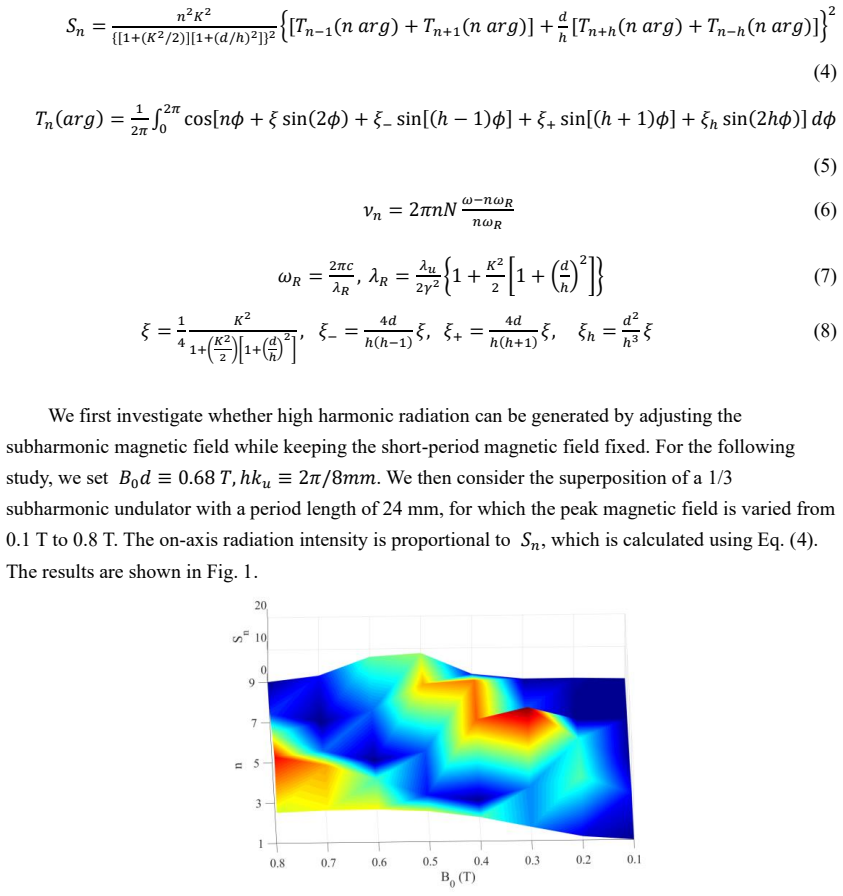
By superimposing a 1/3 subharmonic undulator field onto a short-period superconducting undulator, the on-axis intensities of the 5th and 7th harmonics are significantly enhanced, corresponding to radiation near the 2nd harmonic of the short-period superconducting undulator. The results are confirmed by both theoretical analysis and numerical simulations. The biharmonic configuration effectively overcomes the limitations of low-K undulators for high harmonic generation, with reasonable parameters selected considering technical challenges, enabling an unprecedented photon flux in the 16-22 keV energy range with a 3.5 GeV beam.
What carries the argument
The biharmonic undulator, formed by adding a 1/3 subharmonic magnetic field to a short-period main field, which modifies the electron trajectory to increase the amplitude of selected higher harmonics.
Load-bearing premise
The theoretical analysis and numerical simulations accurately capture real-world performance without unmodeled effects from field errors or beam dynamics.
What would settle it
A prototype measurement on a biharmonic undulator that shows the fifth and seventh harmonic fluxes remain at the same low level as a standard low-K undulator, or that the 16-22 keV output falls well below the simulated values.
Figures

read the original abstract
High harmonic generation by an undulator is a key issue for extending the photon energy range of synchrotron light sources. In this work, we propose a biharmonic planar undulator operating in the low-K regime (K<1) to enhance high-harmonic radiation. By superimposing a 1/3 subharmonic undulator field onto a short-period superconducting undulator, a biharmonic undulator is formed. The on-axis intensities of the 5th and 7th harmonics are significantly enhanced, corresponding to radiation near the 2nd harmonic of the short-period superconducting undulator. The results are confirmed by both theoretical analysis and numerical simulations using SPECTRA. It shows that the biharmonic configuration effectively overcomes the limitations of low-K undulators for high harmonic generation. In this study, reasonable undulator parameters are selected with full consideration of technical challenges. The simulation indicates that an unprecedented photon flux in the 16-22 keV energy range can be achieved with a 3.5 GeV beam, offering a promising approach for high brightness, short-wavelength synchrotron radiation.
Editorial analysis
A structured set of objections, weighed in public.
Referee Report
Summary. The manuscript proposes a biharmonic planar undulator formed by superimposing a 1/3-subharmonic field component onto a short-period low-K (K<1) superconducting undulator. Theoretical analysis and SPECTRA simulations are used to demonstrate significant on-axis intensity enhancement of the 5th and 7th harmonics (corresponding to radiation near the 2nd harmonic of the short-period device), enabling high photon flux in the 16-22 keV range with a 3.5 GeV electron beam while addressing limitations of conventional low-K undulators for high-harmonic generation. Parameters are stated to have been chosen with technical challenges in mind.
Significance. If the reported intensity gains hold under realistic conditions, the approach could provide a practical route to higher-brightness short-wavelength radiation from existing or moderate-energy rings without requiring higher beam energy or undulator K values. The use of standard undulator theory plus SPECTRA code for confirmation is a positive element, though the absence of error-propagation results limits immediate applicability claims.
major comments (2)
- [Parameter selection and simulation results (near end of abstract and corresponding results section)] The central claim that the biharmonic configuration overcomes low-K limitations for high-harmonic generation rests on ideal-field SPECTRA simulations and theoretical analysis. No quantitative tolerance study or error-propagation analysis is provided for amplitude/phase mismatches or higher multipoles in the superimposed field, which the skeptic note correctly identifies as load-bearing for translating simulated flux to achievable performance in a real superconducting planar undulator.
- [Discussion of undulator parameters] The statement that 'reasonable undulator parameters are selected with full consideration of technical challenges' is not supported by explicit tolerance budgets or sensitivity curves showing how small deviations from perfect sinusoidal superposition affect the reported 5th/7th harmonic gains. This omission weakens the bridge from ideal calculation to device feasibility.
minor comments (2)
- [Abstract and results] The abstract and main text would benefit from a concise table listing the specific undulator period, K values for both components, gap, and beam energy used in the SPECTRA runs, together with the exact on-axis intensity enhancement factors obtained.
- [Theoretical analysis] Notation for the biharmonic field (e.g., definition of the 1/3-subharmonic amplitude relative to the fundamental) should be introduced explicitly with an equation in the theoretical analysis section to allow readers to reproduce the analytic intensity expressions.
Simulated Author's Rebuttal
We thank the referee for the careful and constructive review. The comments correctly identify that the bridge from ideal simulations to practical device performance requires additional quantitative support. We respond to each major comment below and will revise the manuscript to incorporate sensitivity analysis.
read point-by-point responses
-
Referee: [Parameter selection and simulation results (near end of abstract and corresponding results section)] The central claim that the biharmonic configuration overcomes low-K limitations for high-harmonic generation rests on ideal-field SPECTRA simulations and theoretical analysis. No quantitative tolerance study or error-propagation analysis is provided for amplitude/phase mismatches or higher multipoles in the superimposed field, which the skeptic note correctly identifies as load-bearing for translating simulated flux to achievable performance in a real superconducting planar undulator.
Authors: We agree that the presented results rely on ideal-field assumptions in both the analytic treatment and SPECTRA simulations. This is a genuine limitation when claiming applicability to a physical superconducting undulator. In the revised manuscript we will add a dedicated subsection containing SPECTRA runs with controlled perturbations: amplitude mismatches of ±1 % and ±2 %, phase errors of ±3° and ±5°, and a representative higher-multipole component. The resulting degradation in 5th- and 7th-harmonic on-axis intensity will be quantified and compared with the ideal gains, thereby providing the requested error-propagation information. revision: yes
-
Referee: [Discussion of undulator parameters] The statement that 'reasonable undulator parameters are selected with full consideration of technical challenges' is not supported by explicit tolerance budgets or sensitivity curves showing how small deviations from perfect sinusoidal superposition affect the reported 5th/7th harmonic gains. This omission weakens the bridge from ideal calculation to device feasibility.
Authors: The chosen parameters (20 mm period, K ≈ 0.8 for the fundamental, 1/3-subharmonic amplitude ratio ≈ 0.3) were guided by existing superconducting undulator technology, but we did not supply explicit tolerance budgets or sensitivity curves. We will insert new figures and text that display the 5th- and 7th-harmonic intensity as functions of amplitude and phase deviation. These curves will directly support the claim that the selected parameters remain practical within realistic fabrication tolerances. revision: yes
Circularity Check
No significant circularity; derivation relies on standard theory and external simulation
full rationale
The paper derives the high-harmonic enhancement from the standard undulator radiation formulas applied to a superimposed biharmonic magnetic field (short-period fundamental plus 1/3 subharmonic). This is then verified by direct numerical integration in the external SPECTRA code. No parameter is fitted to the target harmonic intensities and then re-used as a 'prediction'; the biharmonic profile is an explicit input ansatz whose radiation output is computed independently. No self-citation chain is load-bearing for the central result, and the chosen parameters are stated to be selected with technical constraints in mind rather than tuned to force the reported flux. The derivation chain is therefore self-contained against external benchmarks and does not reduce to its own inputs by construction.
Axiom & Free-Parameter Ledger
free parameters (1)
- 1/3 subharmonic field amplitude
axioms (1)
- domain assumption Standard undulator radiation formulas remain valid under linear superposition of two periodic fields
Reference graph
Works this paper leans on
-
[1]
The radiation wavelength is inversely proportional to 𝛾2 (where γ is the relativistic energy factor of the beam), Increasing the beam energy is a direct approach, but it is costly
Introduction Producing high flux short-wavelength radiation in synchrotron light sources represents one of the most important directions in the development of accelerator technology. The radiation wavelength is inversely proportional to 𝛾2 (where γ is the relativistic energy factor of the beam), Increasing the beam energy is a direct approach, but it is c...
-
[2]
[ 11,12]
Biharmonic planar undulator theory In this section, we briefly review the theoretical framework presented in Ref. [ 11,12]. A biharmonic planar undulator with the on-axis magnetic field given by Eq. (2). 𝐵𝑦 = 𝐵0[sin(𝑘𝑢𝑧) + 𝑑𝑠𝑖𝑛(ℎ𝑘𝑢𝑧)], ℎ ≡ 𝑖𝑛𝑡𝑒𝑔𝑒𝑟 (2) Where h is harmonic number of the undulator periods, d is the magnetic field coefficient. The on- axis br...
-
[3]
Here SSRF storage ring is taken for calculating [14], the parameters are listed in Table 1
Numerical results In this section, we use SPECTRA [13] to calculate the on-axis flux and compare different cases with the biharmonic planar undulator to illustrate its properties as well as to verify whether the theoretical results presented in Section 1 are consistent with the numerical results. Here SSRF storage ring is taken for calculating [14], the p...
-
[4]
Resonance occurs when the radiation from one period adds constructively in phase with that from other periods
Physical picture It is well known that undulator radiation is enhanced by the resonance effect between different periods [15]. Resonance occurs when the radiation from one period adds constructively in phase with that from other periods. The resonance wavelength is determined by the undulator period length and the beam energy as shown in Eq. (9). 𝜆𝑛 = 𝜆𝑢 ...
-
[5]
The engineering feasibility is taken into account in selecting the undulator parameters in this study
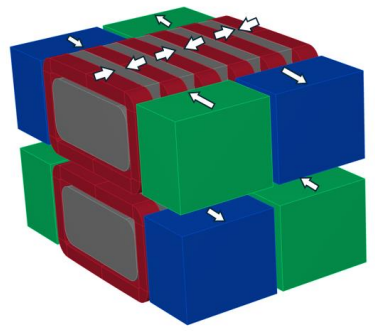
Summary This paper has demonstrated that a biharmonic planar undulator with a low-K parameter can effectively enhance high harmonic radiation. The engineering feasibility is taken into account in selecting the undulator parameters in this study. A preliminary consideration of the undulator design is as shown in Fig.8. Following the concept of the APPLE-Kn...
-
[6]
S.H. Kim, A scaling law for the magnetic fields of superconducting undulators, Nuclear Instruments and Methods in Physics Research A 546 (2005) 604-619. https:/doi.org/10.1016/j.nima.2005.03.150
-
[7]
K. Zhang and Marco Calvi, Review and prospects of world-wide superconducting undulator development for synchrotrons and FELs, Supercond. Sci. Technol. 35 (2022) 093001. https:/doi.org/10.1088/1361-6668/ac782a
-
[8]
Benabderrahmane, et al., Development of PR2FE14B Cryogenic Undulator at Soleil, Proceedings of IPAC2011, San Sebastián, Spain, 3233-3235
C. Benabderrahmane, et al., Development of PR2FE14B Cryogenic Undulator at Soleil, Proceedings of IPAC2011, San Sebastián, Spain, 3233-3235
-
[9]
M. Calvi, et al., GdBCO bulk superconducting helical undulator for x-ray free-electron lasers, Physical Review Research, 5 (2023) L032020. https:/doi.org/10.1103/PhysRevResearch.5.L032020
-
[10]
S. Tantawi, et al., Experimental Demonstration of a Tunable Microwave Undulator, Physical Review Letters, 112 (2014) 164802. https:/doi.org/10.1103/PhysRevLett.112.164802
-
[11]
J. E. Lawler, et al., Nearly copropagating sheared laser pulse FEL undulator for soft x-rays, Journal of Physics D: Applied Physics, 46 (2013) 325501 (11pp). https:/doi.org/10.1088/0022-3727/46/32/325501
-
[12]
B. C. Jiang, et al., Using a Bessel light beam as an ultrashort period helical undulator, Physical Review Accelerators and Beams, 20 (2017) 070701. https:/doi.org/10.1103/PhysRevAccelBeams.20.070701
-
[13]
K. Zhang et al., Record field in a 10 mm-period bulk high-temperature superconducting undulator, Supercond. Sci. Technol., vol. 36, no.5, Mar.2023, Art. no. 05LT01. https:/doi.org/10.1088/1361-6668/acc1a8
-
[14]
Dattoli, V
G. Dattoli, V . V . Mikhailin, P. L. Ottaviani, K. V . Zhukovsky, Two-frequency Undulator and Harmonic Generation by an Ultra relativistic Electron, J. Appl. Phys. 100, 084507 (2006)
2006
-
[15]
K. V . Zhukovsky, Undulator and free-electron laser radiation with field harmonics and off-axis effects taken into account analytically, Physics-Uspekhi 64 (3) 304-316 (2021). https:/doi.org/10.3367/UFNe.2020.06.038803
-
[16]
Dattolia, A
G. Dattolia, A. Doriaa, L. Giannessia, P.L. Ottaviani, Bunching and exotic undulator configurations in SASE FELs, Nuclear Instruments and Methods in Physics Research A 507 (2003) 388-391
2003
-
[17]
A.M. Kalitenko, K.V . Zhukovskii, Radiation from Elliptical Undulators with Magnetic Field Harmonics, J. Exp. Theor. Phys. 130, 327–337 (2020). https:/doi.org/10.1134/S106377612001015X
-
[18]
Tanaka, Major upgrade of the synchrotron radiation calculation code SPECTRA, J
T. Tanaka, Major upgrade of the synchrotron radiation calculation code SPECTRA, J. Synchrotron Radiation 28, 1267 (2021). https:/doi.org/10.1107/S1600577521004100
-
[19]
Liu Gui-Min, et al., Lattice Design for SSRF Storage Ring, Chinese Physics C, 2006, 30(S1): 144-146
2006
-
[20]
Alexander Wu Chao, (2020), Lectures on Accelerator Physics, World Scientific
2020
-
[21]
Synchrotron Radiation 22, 901–907 (2015)
Fuhao Ji, et al., Design and performance of the APPLE-Knot undulator, J. Synchrotron Radiation 22, 901–907 (2015). http://dx.doi.org/10.1107/S1600577515006062
discussion (0)
Sign in with ORCID, Apple, or X to comment. Anyone can read and Pith papers without signing in.