Recognition: unknown
Wasserstein convergence rates for empirical measures of point processes
Pith reviewed 2026-05-07 17:57 UTC · model grok-4.3
The pith
Sharp convergence rates and concentration bounds are established for empirical measures of point processes under a newly introduced Wasserstein distance on counting measures.
A machine-rendered reading of the paper's core claim, the machinery that carries it, and where it could break.
Core claim
we establish sharp upper and lower bounds on the convergence rate of the empirical measures of point processes under the Wasserstein distance
Load-bearing premise
The new metric on the space of counting measures is well-defined and induces a Wasserstein distance that makes the convergence statements hold for the point processes under study (details of the metric construction and any regularity conditions on the processes are not visible in the abstract).
Figures
read the original abstract
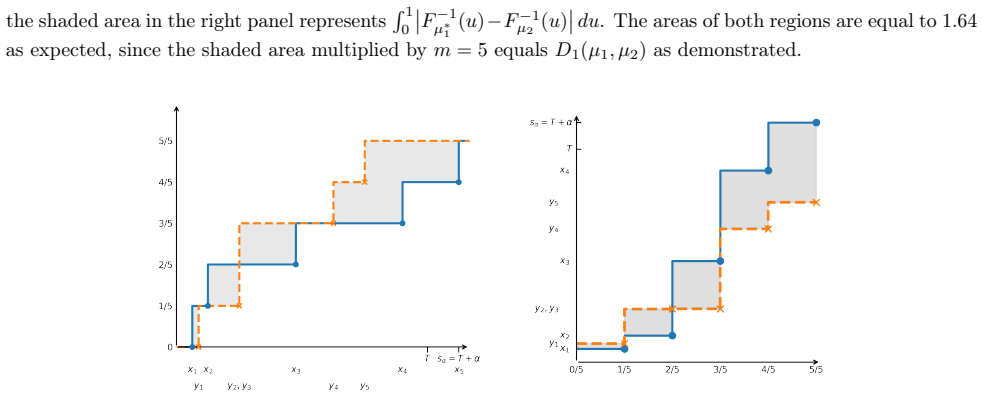
In this paper, we establish sharp upper and lower bounds on the convergence rate of the empirical measures of point processes under the Wasserstein distance. To this end, we first introduce a new metric on the space of counting measures and, based on this metric, define a Wasserstein distance between point processes. We then employ it to study the convergence rate of the empirical measures of point processes, which serves as a natural tool for identifying the distribution of the underlying point process. Furthermore, we derive concentration results. These theoretical results provide constructive tools for hypothesis testing and statistical inference for point processes. The applicability of our results is demonstrated through several practical examples.
Editorial analysis
A structured set of objections, weighed in public.
Axiom & Free-Parameter Ledger
Reference graph
Works this paper leans on
-
[1]
Ambrosio, N
L. Ambrosio, N. Gigli, G. Savaré, Gradient Flows in Metric Spaces and in the Space of Probability Measures. Lectures in Mathematics ETH Zürich, second edition, Birkhäuser, 2008. OCLC: 254181287
2008
-
[2]
K. B. Athreya, P. E. Ney, Branching Processes. Dover Books on Mathematics, Dover Publications, 2004
2004
-
[3]
Baccelli, B
F. Baccelli, B. Błaszczyszyn, M. K. Karray, Random measures, point processes, and stochastic geometry (2024)
2024
-
[4]
A. D. Barbour, Stein’s method and Poisson process convergence. J. Appl. Probab. (1988) 175–184, https://doi.org/10.1017/s0021900200040341. A celebration of applied probability. 35
-
[5]
A. D. Barbour, L. Holst, S. Janson, Poisson approximation,Oxford Studies in Probability, volume 2. The Clarendon Press, Oxford University Press, New York, 1992. Oxford Science Publications
1992
-
[6]
E.Boissard, T.LeGouic, OnthemeanspeedofconvergenceofempiricalandoccupationmeasuresinWasser- stein distance. Ann. Inst. Henri Poincaré Probab. Stat. 50 (2014) 539–563, https://doi.org/10.1214/12- AIHP517
work page doi:10.1214/12- 2014
-
[7]
T. C. Brown, A. Xia, On metrics in point process approximation. Stochastics Stochastics Rep. 52 (1995) 247–263, https://doi.org/10.1080/17442509508833974
-
[8]
L. H. Y. Chen, A. Xia, Stein’s method, palm theory and poisson process approximation. Ann. Probab. 32 (2004), http://dx.doi.org/10.1214/009117904000000027
-
[9]
O. Cronie, M. N. M. Van Lieshout, A non-model-based approach to bandwidth selection for kernel estimators of spatial intensity functions. Biometrika 105 (2018) 455–462, https://doi.org/10.1093/biomet/asy001
-
[10]
D. J. Daley, D. Vere-Jones, Introduction to the Theory of Point Processes, Volume I: Elementary Theory and Methods. Probability and Its Applications, second edition, Springer, New York, 2003
2003
-
[11]
V. H. De La Peña, A general class of exponential inequalities for martingales and ratios. Ann. Probab. 27 (1999) 537 – 564, https://doi.org/10.1214/aop/1022677271
-
[12]
L. Decreusefond, M. Schulte, C. Thäle, Functional Poisson approximation in Kantorovich–Rubinstein dis- tance with applications to U-statistics and stochastic geometry. The Annals of Probability 44 (2016) 2147 – 2197, https://doi.org/10.1214/15-AOP1020
-
[13]
Constructive quan- tization: approximation by empirical measures
S. Dereich, M. Scheutzow, R. Schottstedt, Constructive quantization: approximation by empirical measures. Ann. Inst. Henri Poincaré Probab. Stat. 49 (2013) 1183–1203, https://doi.org/10.1214/12-AIHP489
-
[14]
Diggle, A kernel method for smoothing point process data
P. Diggle, A kernel method for smoothing point process data. J. R. Stat. Soc. Ser. C. Appl. Stat. 34 (1985) 138–147, https://doi.org/10.2307/2347366
-
[15]
R. M. Dudley, The speed of mean Glivenko-Cantelli convergence. Ann. Math. Stat. 40 (1969) 40–50, https://doi.org/10.1214/aoms/1177697802
-
[16]
R. M. Dudley, Real Analysis and Probability. Cambridge Studies in Advanced Mathematics, second edition, Cambridge University Press, 2002
2002
-
[17]
N. Fournier, A. Guillin, On the rate of convergence in Wasserstein distance of the empirical measure. Probab. Theory Relat. Fields 162 (2015) 707–738, https://doi.org/10.1007/s00440-014-0583-7
-
[18]
F. Gao, L. Zhu, Precise deviations for Hawkes processes. Bernoulli 27 (2021) 221 – 248, https://doi.org/10.3150/20-BEJ1235
-
[19]
Y. Guan, A. Jalilian, R. Waagepetersen, Quasi-likelihood for spatial point processes. J. R. Stat. Soc. Ser. B. Stat. Methodol. 77 (2015) 677–697, https://doi.org/10.1111/rssb.12083
-
[20]
Y. Guan, Y. Shen, A weighted estimating equation approach for inhomogeneous spatial point processes. Biometrika 97 (2010) 867–880, https://doi.org/10.1093/biomet/asq043
-
[21]
A. G. Hawkes, D. Oakes, A cluster process representation of a self-exciting process. J. Appl. Probab. 11 (1974) 493–503, https://doi.org/10.1017/s0021900200096273. 36
-
[22]
J. Heikkinen, E. Arjas, Non-parametric bayesian estimation of a spatial Poisson intensity. Scand. J. Stat. 25 (1998) 435–450, https://doi.org/10.1111/1467-9469.00114
-
[23]
Jagers, Branching Processes with Biological Applications
P. Jagers, Branching Processes with Biological Applications. A Wiley-Interscience publication, Wiley, 1975
1975
-
[24]
Kallenberg, Random Measures
O. Kallenberg, Random Measures. fourth edition, Akademie-Verlag, Berlin, 1986
1986
-
[25]
G. Last, M. Penrose, Lectures on the Poisson Process. Institute of Mathematical Statistics Textbooks, Cambridge University Press, 2017
2017
-
[26]
P. J. Laub, Y. Lee, P. K. Pollett, T. Taimre, Hawkes models and their applications. Annu. Rev. Stat. Appl. 12 (2025) 233–258, https://doi.org/10.1146/annurev-statistics-112723-034304
-
[27]
J. Lei, Convergence and concentration of empirical measures under Wasserstein distance in unbounded functional spaces. Bernoulli 26 (2020) 767–798, https://doi.org/10.3150/19-BEJ1151
-
[28]
C. McDiarmid, On the method of bounded differences. In: Surveys in combinatorics, 1989 (Norwich, 1989), London Math. Soc. Lecture Note Ser., volume 141, 148–188, Cambridge Univ. Press, Cambridge (1989) https://doi.org/10.1017/cbo9781107359949.008
-
[29]
V. M. Panaretos, Y. Zemel, Statistical aspects of Wasserstein distances. Annu. Rev. Stat. Appl. 6 (2019) 405–431, https://doi.org/10.1146/annurev-statistics-030718-104938
-
[30]
Schuhmacher, Estimation of distances between point process distributions
D. Schuhmacher, Estimation of distances between point process distributions. Ph.D. thesis, University of Zurich (2005)
2005
-
[31]
Schuhmacher, Upper bounds for spatial point process approximations
D. Schuhmacher, Upper bounds for spatial point process approximations. Ann. Appl. Probab. 15 (2005) 615–651, https://doi.org/10.1214/105051604000000684
-
[32]
Schuhmacher, Stein’s method and Poisson process approximation for a class of Wasserstein metrics
D. Schuhmacher, Stein’s method and Poisson process approximation for a class of Wasserstein metrics. Bernoulli 15 (2009) 550–568, https://doi.org/10.3150/08-BEJ161
-
[33]
D. Schuhmacher, A. Xia, A new metric between distributions of point processes. Adv. Appl. Probab. 40 (2008) 651–672, https://doi.org/10.1239/aap/1222868180
- [34]
-
[35]
K. R. Stromberg, An introduction to classical real analysis. AMS Chelsea Publishing, Providence, RI, 1981
1981
-
[36]
corrected reprint of the 1981 original [MR0604364]
1981
-
[37]
S. van de Geer, Exponential inequalities for martingales, with application to maximum likelihood estimation for counting processes. Ann. Stat. 23 (1995) 1779–1801, https://doi.org/10.1214/aos/1176324323
-
[38]
M. N. M. van Lieshout, On estimation of the intensity function of a point process. Methodol. Comput. Appl. Probab. 14 (2012) 567–578, https://doi.org/10.1007/s11009-011-9244-9
-
[39]
M. N. M. van Lieshout, Non-parametric adaptive bandwidth selection for kernel estimators of spatial inten- sity functions. Ann. Inst. Stat. Math. 76 (2024) 313–331, https://doi.org/10.1007/s10463-023-00890-6
-
[40]
V. S. Varadarajan, On the convergence of sample probability distributions. Sankhy¯ a 19 (1958) 23–26
1958
-
[41]
Villani, Topics in optimal transportation, volume 58
C. Villani, Topics in optimal transportation, volume 58. American Mathematical Soc., 2021. 37
2021
-
[42]
J. Weed, F. Bach, Sharp asymptotic and finite-sample rates of convergence of empirical measures in Wasser- stein distance. Bernoulli 25 (2019) 2620–2648, https://doi.org/10.3150/18-bej1065
-
[43]
Xia, Stein’s method and Poisson process approximation
A. Xia, Stein’s method and Poisson process approximation. In: An Introduction to Stein’s Method,Lecture Notes Series, Institute for Mathematical Sciences, National University of Singapore, volume 4, 115–181, Singapore University Press, Singapore (2005)
2005
-
[44]
S. Xiao, M. Farajtabar, X. Ye, J. Yan, L. Song, H. Zha, Wasserstein learning of deep generative point process models. In: Adv. Neural Inf. Process. Syst., volume 30, 2017
2017
-
[45]
Zhu, Moderate deviations for Hawkes processes
L. Zhu, Moderate deviations for Hawkes processes. Stat. Probab. Lett. 83 (2013) 885–890, https://doi.org/10.1016/j.spl.2012.12.011. 38
discussion (0)
Sign in with ORCID, Apple, or X to comment. Anyone can read and Pith papers without signing in.