Recognition: unknown
Ground state of the Hubbard model with spin-dependent linear potential
Pith reviewed 2026-05-07 17:30 UTC · model grok-4.3
The pith
A spin-dependent linear potential breaks fermion pairs sequentially in the one-dimensional Hubbard model.
A machine-rendered reading of the paper's core claim, the machinery that carries it, and where it could break.
Core claim
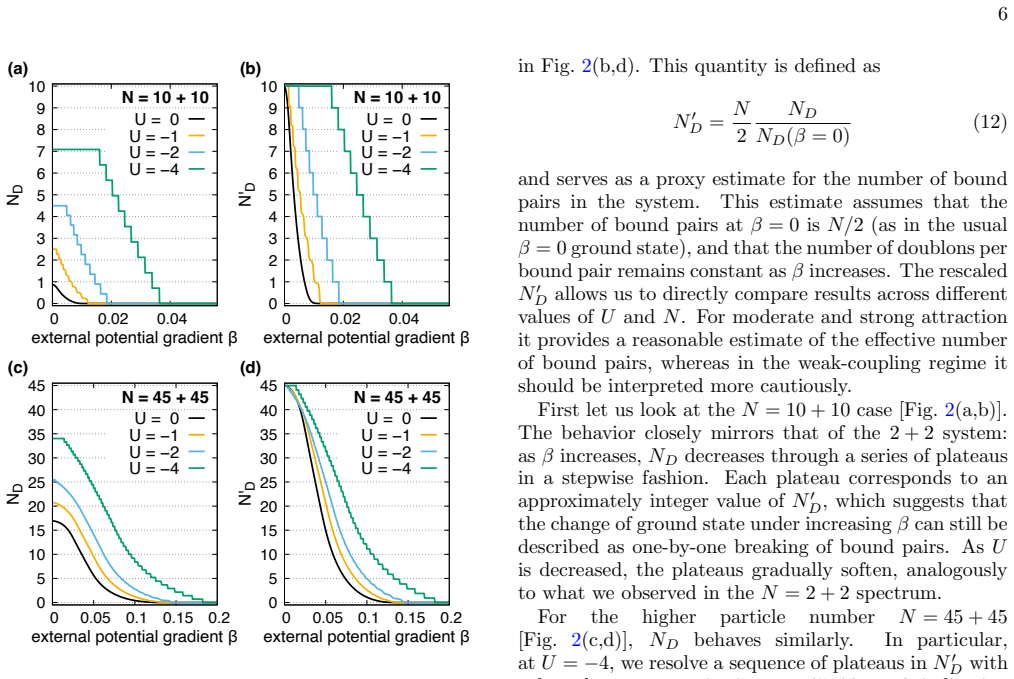
In the ground state of the one-dimensional Fermi-Hubbard model with open boundary conditions and a spin-dependent linear potential of gradient β opposite for the two spins, three regimes are identified: for small β, fermion pairing remains robust; for intermediate β, the doublon number decreases in a staircase manner as pairs break successively one by one; for large β, the spin components are completely spatially separated. Closed-form analytical estimates for the critical threshold gradients are derived using a phenomenological model and local-density approximation.
What carries the argument
The spin-dependent linear potential with opposite gradients β for the two spin species, which competes with attractive interactions to control the spatial distribution and pairing of fermions.
If this is right
- The number of doubly occupied sites decreases in discrete steps with increasing β, enabling integer-level control of bound pairs.
- Critical threshold values for the transitions can be predicted by simple analytical models.
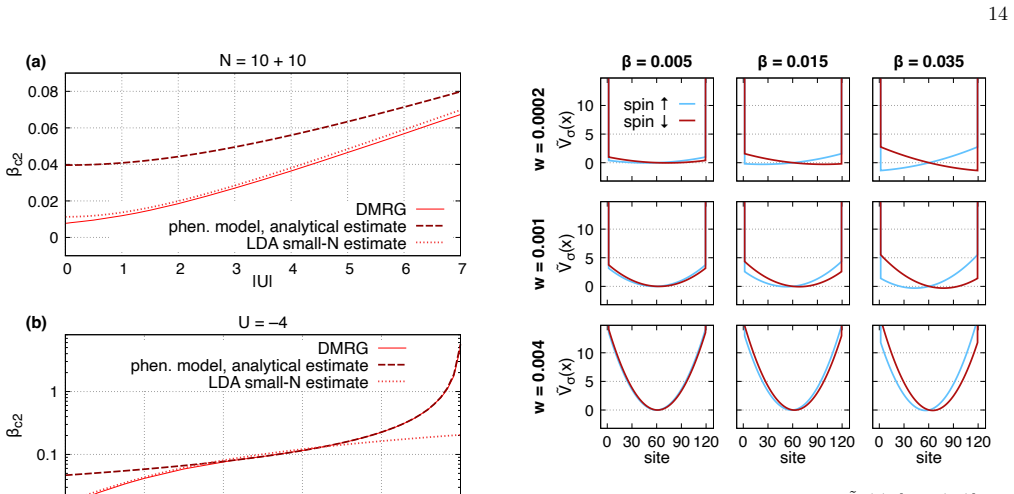
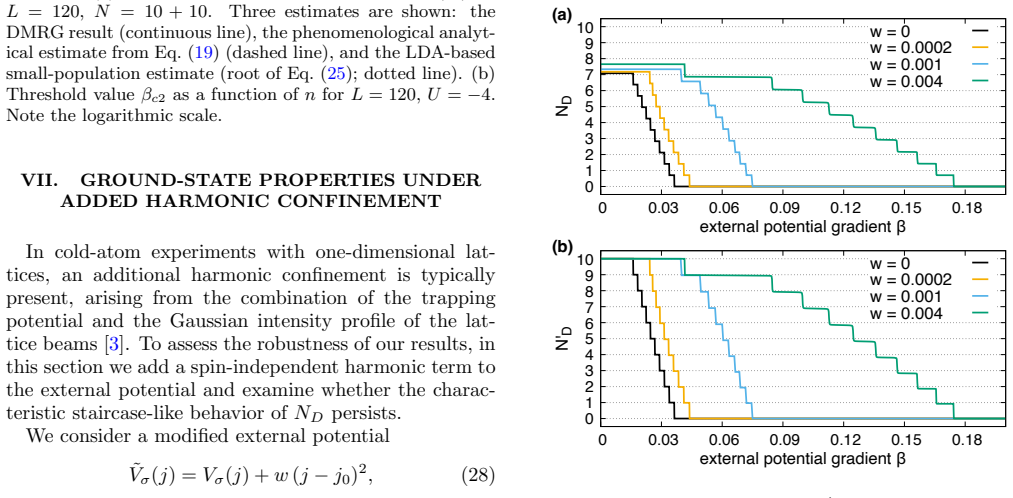
- The staircase structure in doublon number persists when additional harmonic confinement is applied.
- These ground-state properties are directly observable in cold-atom experiments using optical lattices.
Where Pith is reading between the lines
- This approach could allow preparation of quantum states with a precisely chosen number of fermion pairs for further manipulation.
- Similar spin-dependent forces might enable controlled pair breaking in other interacting systems or dimensions.
- Engineering external potentials this way offers a route to study the transition from paired to separated states without thermal effects.
Load-bearing premise
The phenomenological model and local-density approximation predict the critical gradients accurately without large corrections from quantum fluctuations, boundary effects, or higher-order terms.
What would settle it
An experimental or numerical observation that the doublon number changes continuously with β instead of in steps, or that the measured critical gradients differ markedly from the derived analytical expressions.
Figures




read the original abstract
We investigate the competition between attractive spin-spin interactions and spin-separating external forces in the ground state of a one-dimensional Fermi-Hubbard model. We consider a lattice with open boundary conditions, subject to a linear external potential whose gradient is opposite for the two spin components, so that each spin species sees a potential minimum at a different end of the lattice. Using density-matrix renormalization group (DMRG) simulations, we map the ground-state density distributions and the number of doubly occupied sites as a function of the potential gradient $\beta$ and interaction strength. We identify three distinct regimes separated by critical threshold gradients: (i) a small-$\beta$ regime where fermion pairing remains robust against the external potential; (ii) an intermediate-$\beta$ phase-separated regime characterized by a staircase-like decrease in the doublon number, corresponding to the successive, one-by-one breaking of bound pairs; and (iii) a large-$\beta$ regime where the two spin components are completely spatially separated. We complement the numerical results with a phenomenological model and a local-density approximation analysis, from which we derive closed-form analytical estimates for these critical threshold values. We also verify that the staircase structure persists under additional harmonic confinement. Our results are directly testable in cold-atom experiments, and demonstrate that a spin-dependent linear potential enables precise, integer-level control of the number of bound fermion pairs.
Editorial analysis
A structured set of objections, weighed in public.
Referee Report
Summary. The manuscript investigates the ground state of the one-dimensional attractive Fermi-Hubbard model on an open chain subject to a spin-dependent linear potential (opposite gradients for each spin). Using DMRG, it maps density profiles and doublon number versus gradient β and interaction strength, identifying three regimes: (i) small-β robust pairing, (ii) intermediate-β phase separation with staircase-like doublon reduction from successive pair breaking, and (iii) large-β complete spin separation. Closed-form critical β thresholds are derived via a phenomenological model and local-density approximation (LDA); the staircase persists under added harmonic confinement. Results are positioned as experimentally testable for integer-level pair control.
Significance. If the claims hold, the work provides a concrete route to precise, tunable control of bound pairs in 1D quantum gases, with direct relevance to cold-atom experiments. The combination of standard DMRG numerics with analytical estimates is a methodological strength, and the persistence under harmonic confinement broadens applicability. However, the significance depends on demonstrating that the LDA/phenomenological thresholds accurately predict the numerical onsets without large corrections.
major comments (3)
- [DMRG simulations] DMRG results section: No convergence parameters (bond dimension, truncation error, or finite-size scaling) or error bars are reported for the doublon number versus β or the density distributions. This is load-bearing for confirming the sharpness of the three regimes and the staircase structure.
- [Phenomenological model and LDA] Phenomenological model and LDA analysis: The closed-form critical gradients are stated to predict the DMRG-observed thresholds, but the manuscript provides no quantitative comparison (e.g., table of predicted vs. observed β values) or estimate of corrections from 1D quantum fluctuations, Friedel oscillations, or open-boundary effects. These can produce O(1) shifts to the local chemical-potential balance that LDA neglects, directly affecting the claimed integer-level control.
- [Results] Results on regimes: The intermediate-β staircase is central to the pair-breaking interpretation, yet no direct overlay or tabulated comparison is given between the analytical critical points and the numerical onsets of each step in the doublon number.
minor comments (2)
- Figure captions and labels should explicitly mark the three regimes and the critical β values on all plots of doublon number and densities for clarity.
- [Abstract] The abstract states that the staircase persists under harmonic confinement but does not specify the confinement strength or show corresponding data; this detail belongs in the main text or supplementary material.
Simulated Author's Rebuttal
We thank the referee for the careful reading of our manuscript and the constructive comments, which help improve the clarity and rigor of our presentation. We address each major comment point by point below, indicating planned revisions where appropriate.
read point-by-point responses
-
Referee: [DMRG simulations] DMRG results section: No convergence parameters (bond dimension, truncation error, or finite-size scaling) or error bars are reported for the doublon number versus β or the density distributions. This is load-bearing for confirming the sharpness of the three regimes and the staircase structure.
Authors: We agree that explicit documentation of DMRG convergence parameters is necessary to substantiate the sharpness of the regimes and the staircase structure. In the revised manuscript we will add a dedicated paragraph (and, if space permits, an appendix) specifying the bond dimensions used (up to 400), the truncation-error threshold (typically < 10^{-8}), the system sizes employed for finite-size checks (L = 40 to 100), and the procedure used to estimate error bars on the doublon number from the discarded weight. These additions will allow readers to assess the numerical reliability directly. revision: yes
-
Referee: [Phenomenological model and LDA] Phenomenological model and LDA analysis: The closed-form critical gradients are stated to predict the DMRG-observed thresholds, but the manuscript provides no quantitative comparison (e.g., table of predicted vs. observed β values) or estimate of corrections from 1D quantum fluctuations, Friedel oscillations, or open-boundary effects. These can produce O(1) shifts to the local chemical-potential balance that LDA neglects, directly affecting the claimed integer-level control.
Authors: We acknowledge that the original text lacks a side-by-side quantitative comparison. We will insert a table that lists, for several representative values of the interaction strength, the analytically predicted critical β values together with the β values at which the DMRG doublon number exhibits each step. In the same section we will add a brief discussion of possible corrections arising from quantum fluctuations and open boundaries. While a complete, non-perturbative quantification of all O(1) shifts would require additional extensive calculations, we can show that the leading finite-size and Friedel corrections remain smaller than the spacing between consecutive staircase steps for the system sizes considered, thereby preserving the integer-level control at the level of resolution reported. revision: partial
-
Referee: [Results] Results on regimes: The intermediate-β staircase is central to the pair-breaking interpretation, yet no direct overlay or tabulated comparison is given between the analytical critical points and the numerical onsets of each step in the doublon number.
Authors: We will modify the relevant figure (and its caption) to overlay the analytically derived critical gradients as vertical lines on the plot of doublon number versus β. In addition, we will include a short table that explicitly lists the predicted and numerically observed positions of each step for the parameter sets shown. These changes will make the correspondence between the phenomenological model and the DMRG data transparent and will strengthen the pair-breaking interpretation. revision: yes
Circularity Check
No significant circularity; DMRG numerics independent of analytical estimates
full rationale
The paper's core evidence consists of DMRG simulations that directly map density distributions and doublon numbers versus β and interaction strength, revealing the three regimes and staircase structure. The phenomenological model and LDA analysis are introduced afterward as complementary tools to obtain closed-form estimates for the critical thresholds. No equations or descriptions indicate that model parameters are fitted to DMRG outputs, that thresholds are adjusted post hoc, or that any prediction reduces to a self-definition or renaming of the numerical input. The derivation chain remains non-circular because the numerical results stand on their own as an external benchmark while the analytics provide an independent explanatory layer.
Axiom & Free-Parameter Ledger
free parameters (2)
- potential gradient β
- interaction strength
axioms (2)
- domain assumption Standard 1D Fermi-Hubbard Hamiltonian with on-site attraction and nearest-neighbor hopping under open boundary conditions
- ad hoc to paper Local-density approximation sufficient to derive closed-form critical gradients
Reference graph
Works this paper leans on
-
[1]
(15) gives 2βc2 N 2 − L+ 1 2 ≈ − p U 2 + 16,(18) which yields βc2L≈ √ U 2 + 16 1−n+ 1 L .(19) 11 0 0.01 0.02 0.03 0.04 0 1 2 3 4 5 6 7 (a) N = 45 + 45 DMRG model, an
Substituting into Eq. (15) gives 2βc2 N 2 − L+ 1 2 ≈ − p U 2 + 16,(18) which yields βc2L≈ √ U 2 + 16 1−n+ 1 L .(19) 11 0 0.01 0.02 0.03 0.04 0 1 2 3 4 5 6 7 (a) N = 45 + 45 DMRG model, an. model, num. βc1 |U| 0.1 0.15 0.2 0.25 0 1 2 3 4 5 6 7 (b) DMRG model, an. model, num. βc2 |U| 0 0.01 0.02 0.03 0 1 2 3 4 5 6 7 (c) N = 10 + 10 DMRG model, an. model, nu...
-
[2]
Hubbard, Electron correlations in narrow energy bands, Proc
J. Hubbard, Electron correlations in narrow energy bands, Proc. R. Soc. A276, 238 (1963)
1963
-
[3]
Lewenstein, A
M. Lewenstein, A. Sanpera, V. Ahufinger, B. Damski, A. Sen(De), and U. Sen, Ultracold atomic gases in op- tical lattices: mimicking condensed matter physics and beyond, Adv. Phys.56, 243 (2007)
2007
-
[4]
Bloch, Ultracold quantum gases in optical lattices, Nat
I. Bloch, Ultracold quantum gases in optical lattices, Nat. Phys.1, 23 (2005)
2005
-
[5]
F. H. Essler, H. Frahm, F. G¨ ohmann, A. Kl¨ umper, and V. E. Korepin,The one-dimensional Hubbard model (Cambridge University Press, 2005)
2005
-
[6]
X.-W. Guan, M. T. Batchelor, and C. Lee, Fermi gases in one dimension: From Bethe ansatz to experiments, Rev. Mod. Phys.85, 1633 (2013)
2013
-
[7]
Bergkvist, P
S. Bergkvist, P. Henelius, and A. Rosengren, Local- density approximation for confined bosons in an optical lattice, Phys. Rev. A70, 053601 (2004)
2004
-
[8]
F¨ olling, A
S. F¨ olling, A. Widera, T. M¨ uller, F. Gerbier, and I. Bloch, Formation of Spatial Shell Structure in the Superfluid to Mott Insulator Transition, Phys. Rev. Lett.97, 060403 (2006)
2006
-
[9]
Schneider, L
U. Schneider, L. Hackerm¨ uller, S. Will, T. Best, I. Bloch, T. A. Costi, R. W. Helmes, D. Rasch, and A. Rosch, Metallic and insulating phases of repulsively interacting fermions in a 3D optical lattice, Science322, 1520 (2008)
2008
-
[10]
N. A. Boidi, K. Hallberg, A. Aharony, and O. Entin- Wohlman, Coexistence of insulating phases in confined fermionic chains with a Wannier-Stark potential, Phys. Rev. B109, L041404 (2024)
2024
-
[11]
Greiner, O
M. Greiner, O. Mandel, T. Esslinger, T. W. H¨ ansch, and I. Bloch, Quantum phase transition from a superfluid to a Mott insulator in a gas of ultracold atoms, Nature415, 39 (2002)
2002
-
[12]
Simon, W
J. Simon, W. S. Bakr, R. Ma, M. E. Tai, P. M. Preiss, and M. Greiner, Quantum simulation of antiferromag- netic spin chains in an optical lattice, Nature472, 307 (2011)
2011
-
[13]
Meinert, M
F. Meinert, M. J. Mark, E. Kirilov, K. Lauber, P. Wein- 19 mann, A. J. Daley, and H.-C. N¨ agerl, Quantum Quench in an Atomic One-Dimensional Ising Chain, Phys. Rev. Lett.111, 053003 (2013)
2013
-
[14]
Aidelsburger, M
M. Aidelsburger, M. Atala, M. Lohse, J. T. Barreiro, B. Paredes, and I. Bloch, Realization of the Hofstadter Hamiltonian with Ultracold Atoms in Optical Lattices, Phys. Rev. Lett.111, 185301 (2013)
2013
-
[15]
Miyake, G
H. Miyake, G. A. Siviloglou, C. J. Kennedy, W. C. Bur- ton, and W. Ketterle, Realizing the Harper Hamiltonian with Laser-Assisted Tunneling in Optical Lattices, Phys. Rev. Lett.111, 185302 (2013)
2013
-
[16]
Meinert, M
F. Meinert, M. J. Mark, E. Kirilov, K. Lauber, P. Wein- mann, M. Gr¨ obner, A. J. Daley, and H.-C. N¨ agerl, Ob- servation of many-body dynamics in long-range tunneling after a quantum quench, Science344, 1259 (2014)
2014
-
[17]
Dimitrova, N
I. Dimitrova, N. Jepsen, A. Buyskikh, A. Venegas- Gomez, J. Amato-Grill, A. Daley, and W. Ketterle, En- hanced Superexchange in a Tilted Mott Insulator, Phys. Rev. Lett.124, 043204 (2020)
2020
-
[18]
C. J. Kennedy, W. C. Burton, W. C. Chung, and W. Ketterle, Observation of Bose–Einstein condensation in a strong synthetic magnetic field, Nat. Phys.11, 859 (2015)
2015
-
[19]
Heidrich-Meisner, A
F. Heidrich-Meisner, A. E. Feiguin, U. Schollw¨ ock, and W. Zwerger, BCS-BEC crossover and the disappear- ance of Fulde-Ferrell-Larkin-Ovchinnikov correlations in a spin-imbalanced one-dimensional Fermi gas, Phys. Rev. A81, 023629 (2010)
2010
-
[20]
S. A. S¨ offing, M. Bortz, and S. Eggert, Density profile of interacting fermions in a one-dimensional optical trap, Phys. Rev. A84, 021602 (2011)
2011
-
[21]
V. L. Campo, K. Capelle, J. Quintanilla, and C. Hoo- ley, Quantitative Determination of the Hubbard Model Phase Diagram from Optical Lattice Experiments by Two-Parameter Scaling, Phys. Rev. Lett.99, 240403 (2007)
2007
-
[22]
Snyder, I
A. Snyder, I. Tanabe, and T. De Silva, Compressibility and entropy of cold fermions in one-dimensional optical lattices, Phys. Rev. A83, 063632 (2011)
2011
-
[23]
Tezuka and M
M. Tezuka and M. Ueda, Ground states and dynamics of population-imbalanced Fermi condensates in one dimen- sion, New J. Phys.12, 055029 (2010)
2010
-
[24]
Sch¨ onhammer, O
K. Sch¨ onhammer, O. Gunnarsson, and R. M. Noack, Density-functional theory on a lattice: Comparison with exact numerical results for a model with strongly corre- lated electrons, Phys. Rev. B52, 2504 (1995)
1995
-
[25]
Xianlong, M
G. Xianlong, M. Polini, M. P. Tosi, V. L. Campo, K. Capelle, and M. Rigol, Bethe ansatz density- functional theory of ultracold repulsive fermions in one- dimensional optical lattices, Phys. Rev. B73, 165120 (2006)
2006
-
[26]
Angelone, M
A. Angelone, M. Campostrini, and E. Vicari, Univer- sal quantum behavior of interacting fermions in one- dimensional traps: From few particles to the trap ther- modynamic limit, Phys. Rev. A89, 023635 (2014)
2014
-
[27]
Schollw¨ ock, The density-matrix renormalization group, Rev
U. Schollw¨ ock, The density-matrix renormalization group, Rev. Mod. Phys.77, 259 (2005)
2005
-
[28]
Chen and G
A.-H. Chen and G. Xianlong, Phase separation in opti- cal lattices in a spin-dependent external potential, Phys. Rev. A81, 013628 (2010)
2010
-
[29]
Dalmonte, K
M. Dalmonte, K. Dieckmann, T. Roscilde, C. Hartl, A. E. Feiguin, U. Schollw¨ ock, and F. Heidrich-Meisner, Dimer, trimer, and Fulde-Ferrell-Larkin-Ovchinnikov liquids in mass- and spin-imbalanced trapped binary mixtures in one dimension, Phys. Rev. A85, 063608 (2012)
2012
-
[30]
Wei, Y.-M
X.-B. Wei, Y.-M. Meng, Z.-M. Wu, and X.-L. Gao, Phase diagram of the Fermi–Hubbard model with spin- dependent external potentials: A DMRG study, Chinese Phys. B24, 117101 (2015)
2015
-
[31]
Recati, I
A. Recati, I. Carusotto, C. Lobo, and S. Stringari, Dipole Polarizability of a Trapped Superfluid Fermi Gas, Phys. Rev. Lett.97, 190403 (2006)
2006
-
[32]
A. P. Koller, M. L. Wall, J. Mundinger, and A. M. Rey, Dynamics of Interacting Fermions in Spin-Dependent Po- tentials, Phys. Rev. Lett.117, 195302 (2016)
2016
-
[33]
G. G. Batrouni and R. T. Scalettar, Interaction-induced gradients across a confined fermion lattice, Phys. Rev. A 96, 033632 (2017)
2017
-
[34]
Hauschild and F
J. Hauschild and F. Pollmann, Efficient numerical sim- ulations with Tensor Networks: Tensor Network Python (TeNPy), SciPost Phys. Lect. Notes , 5 (2018)
2018
-
[35]
I. V. Lukin, Y. V. Slyusarenko, and A. G. Sotnikov, Many-body localization in a quantum gas with long- range interactions and linear external potential, Phys. Rev. B105, 184307 (2022)
2022
-
[36]
Stey and G
G. Stey and G. Gusman, Wannier-Stark ladders and the energy spectrum of an electron in a finite one dimensional crystal, J. Phys. C: Solid State Phys.6, 650 (1973)
1973
-
[37]
S. N. Khonina, S. G. Volotovsky, S. I. Kharitonov, and N. L. Kazanskiy, Calculating the Energy Spectrum of Complex Low-Dimensional Heterostructures in the Elec- tric Field, Sci. World J.2013, 807462 (2013)
2013
-
[38]
P. E. Kornilovitch, Two-particle bound states on a lat- tice, Ann. Phys. (N. Y.)460, 169574 (2024)
2024
-
[39]
Heidrich-Meisner, G
F. Heidrich-Meisner, G. Orso, and A. E. Feiguin, Phase separation of trapped spin-imbalanced Fermi gases in one-dimensional optical lattices, Phys. Rev. A81, 053602 (2010)
2010
discussion (0)
Sign in with ORCID, Apple, or X to comment. Anyone can read and Pith papers without signing in.