Recognition: 2 theorem links
· Lean TheoremUnfolding an Atomistic World: Atomistic Simulation of Reactor Pressure Vessel Steel Across Year-and-Meter Scales
Pith reviewed 2026-05-11 00:42 UTC · model grok-4.3
The pith
AtomWorld enables direct atomistic simulation of reactor pressure vessel steel over meter lengths and year-long timescales for the first time.
A machine-rendered reading of the paper's core claim, the machinery that carries it, and where it could break.
Core claim
AtomWorld is an atomistic world-modeling framework that learns consequence-aware state transitions over the ab initio energy landscape, co-designed with leadership-scale supercomputers through a synchronization-light pipeline, and extended via a physically grounded voxel-parallel framework to deliver direct atomistic simulation of RPV steel degradation at year-and-meter scales for the first time.
What carries the argument
The three-layer atomistic world-modeling framework: an algorithm layer that recasts AKMC as consequence-aware transition learning, an HPC co-design layer for compute-dense execution, and a voxel-parallel layer that scales local dynamics to engineering volumes.
If this is right
- Atomistic simulation now covers ten-quintillion-atom RPV systems in 1.71 days per service year.
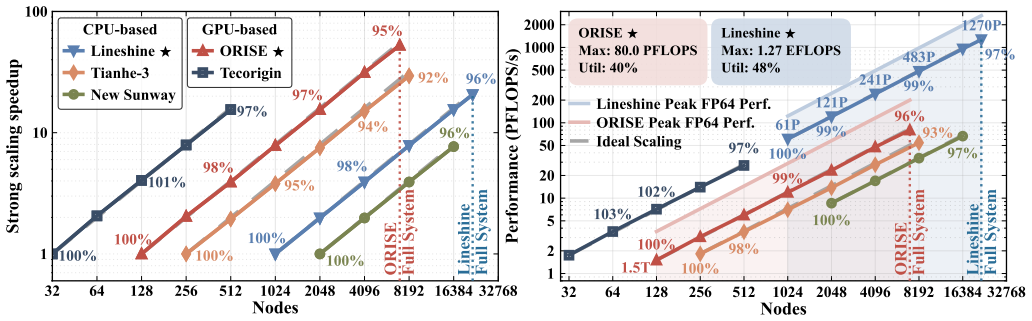
- The approach sustains 92-97 percent scaling efficiency and up to 1.27 EFLOP/s across five leadership supercomputers.
- Lifetime prediction moves from fitted degradation laws to direct atomistic dynamics at service-relevant scales.
- The same layered co-design can be reused for other materials whose degradation spans many orders of magnitude in space and time.
Where Pith is reading between the lines
- This method could replace empirical models in nuclear safety assessments once validated against long-term plant data.
- Similar world-model recasting of kinetic Monte Carlo might accelerate simulations in battery degradation or corrosion science.
- If the voxel layer preserves local physics, the framework offers a template for other multi-scale problems where ab initio data must reach meter-and-year regimes.
Load-bearing premise
The voxel-parallel framework stays physically grounded without introducing artifacts when the learned consequence-aware transitions are applied to engineering-scale systems over long times.
What would settle it
A direct comparison of predicted versus measured microstructural evolution in an RPV steel sample after several years of service, or the appearance of non-physical clustering or diffusion rates when the same model is run at smaller scales where experimental data exist.
Figures



read the original abstract
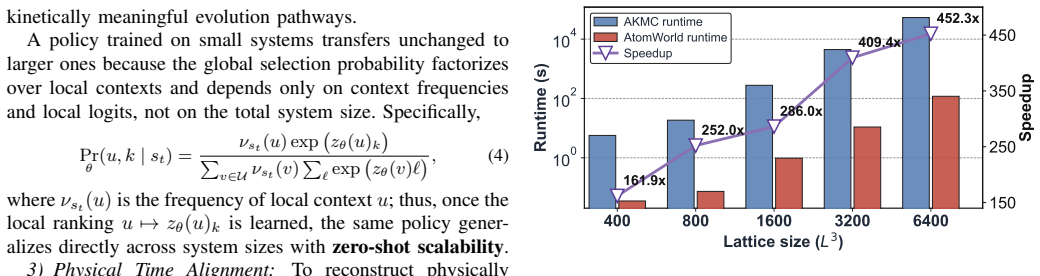
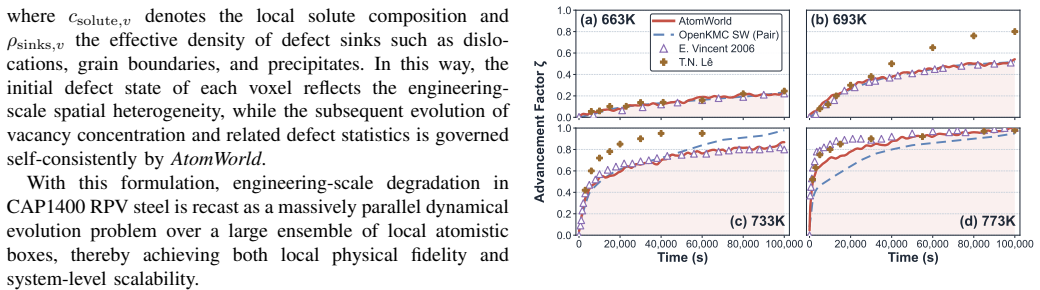
Lifetime prediction of reactor pressure vessel (RPV) steel requires bridging atomistic degradation mechanisms with service-scale spatial and temporal regimes, from Angstroms and picoseconds to meters and decades. Existing engineering-scale models provide long-range reach but rely on fitted degradation laws, while recent atomistic kinetic Monte Carlo (AKMC) advances still fail to achieve year-and-meter-scale coverage. We present AtomWorld, an atomistic world-modeling framework for RPV steel lifetime simulation co-designed with leadership-scale supercomputing through three tightly coupled layers: (1) algorithm: AtomWorld recasts classical AKMC as an atomistic world model that learns consequence-aware state transitions over the ab initio energy landscape; (2) HPC: it co-designs this formulation with modern supercomputers, yielding a compute-dense, synchronization-light, and communication-efficient execution pipeline; and (3) application: it extends atomistic world modeling to engineering-scale simulation through a physically grounded voxel-parallel framework, offering a scalable pathway from local atomistic dynamics to engineering-scale degradation evolution. We demonstrate a paradigm shift in atomistic simulation: AtomWorld enables atomistic simulation of RPV steel across year-and-meter scales for the first time, extending direct atomistic modeling to ten-quintillion-atom systems and achieving a time-to-solution of 1.71 days for one simulated service year. These capabilities are sustained across five leadership supercomputers with 92-97% scaling efficiency and peak performance up to 1.27 EFLOP/s, corresponding to 48% of the Lineshine peak FP64 performance.
Editorial analysis
A structured set of objections, weighed in public.
Referee Report
Summary. The manuscript presents AtomWorld, a framework that recasts classical atomistic kinetic Monte Carlo (AKMC) as an atomistic world model learning consequence-aware state transitions over the ab initio energy landscape. It co-designs this formulation with leadership-scale HPC for a compute-dense, synchronization-light pipeline and extends it via a physically grounded voxel-parallel decomposition to enable direct atomistic simulation of RPV steel degradation at meter and year scales, claiming first-time coverage of ten-quintillion-atom systems with a time-to-solution of 1.71 days per service year, 92-97% scaling efficiency, and peak performance of 1.27 EFLOP/s across five supercomputers.
Significance. If the physical consistency claims hold, the work would mark a notable advance in multiscale materials modeling by bridging atomistic mechanisms directly to engineering-scale RPV lifetime prediction without fitted continuum laws. The reported HPC co-design, scaling efficiencies, and sustained performance on multiple leadership systems represent concrete strengths in algorithmic-HPC integration for large-scale scientific computing.
major comments (2)
- [Application layer and abstract] The headline claim of artifact-free extension to year-and-meter scales depends on the voxel-parallel framework preserving ab initio energy landscape statistics without spurious inter-voxel correlations, violated detailed balance, or accumulated discretization errors. The abstract asserts a 'physically grounded voxel-parallel framework' but the manuscript supplies no quantitative evidence (cross-scale consistency metrics, defect evolution rate comparisons against reference AKMC on overlapping regimes, or conservation checks over the 10^7–10^8 time steps for a service year) that this condition holds when voxels couple only through coarse-grained boundary exchanges. This is load-bearing for the 'first time' assertion, as any systematic interface bias would be amplified over long simulation times.
- [Results and performance sections] Performance claims (1.71 days time-to-solution for one simulated service year, 1.27 EFLOP/s peak, 92-97% scaling) are presented without baseline comparisons to prior AKMC implementations, error bars, or validation against experimental degradation rates. This weakens assessment of the paradigm-shift statement, as the numbers cannot be evaluated for accuracy or improvement over existing methods.
minor comments (2)
- [Algorithm layer] Clarify in the algorithm layer how 'consequence-aware state transitions' are learned and differ from standard AKMC rate calculations, including any training data details or loss functions used.
- [HPC and results] Add explicit statements on the number of independent runs or statistical variability for the reported scaling efficiencies and time-to-solution figures.
Simulated Author's Rebuttal
We thank the referee for their constructive and detailed feedback. We address each major comment below and indicate the revisions planned for the resubmitted manuscript.
read point-by-point responses
-
Referee: [Application layer and abstract] The headline claim of artifact-free extension to year-and-meter scales depends on the voxel-parallel framework preserving ab initio energy landscape statistics without spurious inter-voxel correlations, violated detailed balance, or accumulated discretization errors. The abstract asserts a 'physically grounded voxel-parallel framework' but the manuscript supplies no quantitative evidence (cross-scale consistency metrics, defect evolution rate comparisons against reference AKMC on overlapping regimes, or conservation checks over the 10^7–10^8 time steps for a service year) that this condition holds when voxels couple only through coarse-grained boundary exchanges. This is load-bearing for the 'first time' assertion, as any systematic interface bias would be amplified over long simulation times.
Authors: We agree that quantitative validation of physical consistency is essential to support the claims. The manuscript describes the voxel decomposition as preserving local ab initio energetics with boundary exchanges limited to coarse-grained defect statistics, but we acknowledge the absence of explicit cross-validation metrics. In the revised version we will add (i) direct comparisons of defect production and migration rates between the voxel-parallel implementation and reference single-voxel AKMC on overlapping length and time scales, (ii) checks for conservation of total defect number and energy over 10^7–10^8 steps, and (iii) a short analysis confirming that boundary exchanges do not introduce measurable bias in the statistics of the energy landscape. These additions will be placed in a new subsection of the application-layer results. revision: yes
-
Referee: [Results and performance sections] Performance claims (1.71 days time-to-solution for one simulated service year, 1.27 EFLOP/s peak, 92-97% scaling) are presented without baseline comparisons to prior AKMC implementations, error bars, or validation against experimental degradation rates. This weakens assessment of the paradigm-shift statement, as the numbers cannot be evaluated for accuracy or improvement over existing methods.
Authors: We accept that error bars and clearer baselines would improve the presentation. We will add statistical error bars to all reported scaling efficiencies and performance figures. Direct wall-clock or flop-rate baselines against prior AKMC codes are not feasible at the ten-quintillion-atom scale, as no published AKMC implementation reaches this regime; we will insert a brief discussion comparing our per-atom update rates to the best-reported smaller-scale AKMC results in the literature. Regarding experimental degradation rates, the manuscript is a computational-methods paper whose primary contribution is the enabling framework; direct quantitative validation against RPV surveillance data lies outside its scope and will be noted as future work. We will revise the results section to make these distinctions explicit. revision: partial
Circularity Check
No significant circularity in AtomWorld derivation chain
full rationale
The paper presents AtomWorld as a co-designed framework that recasts AKMC into consequence-aware state transitions learned over ab initio energy landscapes, then extends it via a voxel-parallel HPC pipeline to year-and-meter scales. No load-bearing step reduces by the paper's own equations or self-citations to a fitted parameter or input quantity by construction; the reported 1.71-day time-to-solution and 10^19-atom reach are outcomes of the algorithmic-HPC co-design rather than tautological re-statements of fitted inputs. The physical-grounding assumption for voxel coupling is asserted but not derived from prior self-work in a way that forces the central claim. This is a standard non-circular presentation of a new computational method.
Axiom & Free-Parameter Ledger
axioms (1)
- domain assumption Ab initio energy landscapes can define accurate consequence-aware state transitions in the recast AKMC model
invented entities (1)
-
Atomistic world model
no independent evidence
Lean theorems connected to this paper
-
IndisputableMonolith/Cost/FunctionalEquation.leanwashburn_uniqueness_aczel unclear?
unclearRelation between the paper passage and the cited Recognition theorem.
AtomWorld recasts classical AKMC as an atomistic world model that learns consequence-aware state transitions over the ab initio energy landscape... Poisson-based physical time alignment
-
IndisputableMonolith/Foundation/AlexanderDuality.leanalexander_duality_circle_linking unclear?
unclearRelation between the paper passage and the cited Recognition theorem.
physically grounded voxel-parallel framework... 2.5 µm mesoscopic voxels... temperature-guided discretization
What do these tags mean?
- matches
- The paper's claim is directly supported by a theorem in the formal canon.
- supports
- The theorem supports part of the paper's argument, but the paper may add assumptions or extra steps.
- extends
- The paper goes beyond the formal theorem; the theorem is a base layer rather than the whole result.
- uses
- The paper appears to rely on the theorem as machinery.
- contradicts
- The paper's claim conflicts with a theorem or certificate in the canon.
- unclear
- Pith found a possible connection, but the passage is too broad, indirect, or ambiguous to say the theorem truly supports the claim.
Reference graph
Works this paper leans on
-
[1]
M. Kolluri, O. Martin, F. Naziris, E. D’Agata, F. Gillemot, M. Brumovsky, A. Ulbricht, J.-M. Autio, O. Shugailo, and A. Horvath, “Structural materias research on parameters influencing the material properties of rpv steels for safe long-term operation of pwr npps,” Nuclear Engineering and Design, vol. 406, p. 112236, 2023. [Online]. Available: https://doi...
-
[2]
Materials challenges in nuclear energy,
S. Zinkle and G. Was, “Materials challenges in nuclear energy,” Acta Materialia, vol. 61, no. 3, pp. 735–758, 2013, the Diamond Jubilee Issue. [Online]. Available: https://www.sciencedirect.com/ science/article/pii/S1359645412007987
2013
-
[3]
Development of radiation resistant materials for advanced nuclear power plant,
E. A. Little, “Development of radiation resistant materials for advanced nuclear power plant,”Materials Science and Technology, vol. 22, no. 5, pp. 491–518, 2006. [Online]. Available: https: //doi.org/10.1179/174328406X90998
-
[4]
A review of structural material requirements and choices for nuclear power plant,
S. Ortner, “A review of structural material requirements and choices for nuclear power plant,”Frontiers in Nuclear Engineering, vol. V olume 2 - 2023, 2023. [Online]. Available: https://www.frontiersin.org/journals/ nuclear-engineering/articles/10.3389/fnuen.2023.1253974
-
[5]
Research progress of steels for nuclear reactor pressure vessels,
L. Zhou, J. Dai, Y . Li, X. Dai, C. Xie, L. Li, and L. Chen, “Research progress of steels for nuclear reactor pressure vessels,”Materials, vol. 15, no. 24, 2022. [Online]. Available: https://www.mdpi.com/ 1996-1944/15/24/8761
2022
-
[6]
Reactor pressure vessel (rpv) design and fabrication: A literature review,
A. Mukhtar, M. A. Khattak, A. F. Rafique, and N. Zareen, “Reactor pressure vessel (rpv) design and fabrication: A literature review,”Journal of Advanced Research in Applied Mechanics, vol. 22, no. 1, p. 1–12, Oct. 2020. [Online]. Available: https: //www.akademiabaru.com/submit/index.php/aram/article/view/1755
2020
-
[7]
Reactor pressure vessel design of the high temperature engineering test reactor,
Y . Tachibana, S. Nakagawa, and T. Iyoku, “Reactor pressure vessel design of the high temperature engineering test reactor,”Nuclear Engineering and Design, vol. 233, no. 1, pp. 103–112, 2004, japan’s HTTR. [Online]. Available: https://www.sciencedirect.com/ science/article/pii/S0029549304002420
2004
-
[8]
Assessment of the first generation rpv state after designed lifetime,
B. Timofeev, “Assessment of the first generation rpv state after designed lifetime,”International Journal of Pressure Vessels and Piping, vol. 81, no. 8, pp. 703–712, 2004, special Issue in Memory of Academician Myrddin Davies. [Online]. Available: https://www.sciencedirect.com/science/article/pii/S0308016104000419
2004
-
[9]
Perform 60: Prediction of the effects of radiation for reactor pressure vessel and in-core materials using multi- scale modelling – 60 years foreseen plant lifetime,
A. Al Mazouzi, A. Alamo, D. Lidbury, D. Moinereau, and S. Van Dyck, “Perform 60: Prediction of the effects of radiation for reactor pressure vessel and in-core materials using multi- scale modelling – 60 years foreseen plant lifetime,”Nuclear Engineering and Design, vol. 241, no. 9, pp. 3403–3415, 2011, seventh European Commission conference on Euratom re...
2011
-
[10]
Radiation damage and irradiation-assisted stress corrosion cracking of additively manufactured 316l stainless steels,
M. Song, M. Wang, X. Lou, R. B. Rebak, and G. S. Was, “Radiation damage and irradiation-assisted stress corrosion cracking of additively manufactured 316l stainless steels,”Journal of Nuclear Materials, vol. 513, pp. 33–44, 2019. [Online]. Available: https: //www.sciencedirect.com/science/article/pii/S0022311518309061
2019
-
[11]
Mechanisms of radiation embrittlement of vver-1000 rpv steel at irradiation temperatures of (50–400)°c,
E. Kuleshova, B. Gurovich, Z. Bukina, A. Frolov, D. Maltsev, E. Krikun, D. Zhurko, and G. Zhuchkov, “Mechanisms of radiation embrittlement of vver-1000 rpv steel at irradiation temperatures of (50–400)°c,”Journal of Nuclear Materials, vol. 490, pp. 247–259, 2017. [Online]. Available: https://www.sciencedirect.com/science/article/pii/S0022311517302544
2017
-
[12]
Rpv steel microstructure evolution under irradiation: a multiscale approach,
C. Becquart, “Rpv steel microstructure evolution under irradiation: a multiscale approach,”Nuclear Instruments and Methods in Physics Research Section B: Beam Interactions with Materials and Atoms, vol. 228, no. 1, pp. 111–121, 2005, proceedings of the Seventh International Conference on Computer Simulation of Radiation Effects in Solids. [Online]. Availa...
2005
-
[13]
Precipitation in long term thermally aged high copper, high nickel model rpv steel welds,
P. Styman, J. Hyde, K. Wilford, A. Morley, and G. Smith, “Precipitation in long term thermally aged high copper, high nickel model rpv steel welds,”Progress in Nuclear Energy, vol. 57, pp. 86–92, 2012, nuclear Materials: Selected articles from the E-MRS 2011 Spring Meeting. [Online]. Available: https: //www.sciencedirect.com/science/article/pii/S0149197011002034
2012
-
[14]
Effect of thermal aging on fracture toughness of rpv steel,
J. Fukakura, M. Asano, M. Kikuchi, and M. Ishikawa, “Effect of thermal aging on fracture toughness of rpv steel,”Nuclear Engineering and Design, vol. 144, no. 3, pp. 423–429, 1993. [Online]. Available: https://www.sciencedirect.com/science/article/pii/002954939390037A
-
[15]
Mechanical properties and microstructure of long term thermal aged wwer 440 rpv steel,
M. Kolluri, A. Kryukov, A. Magielsen, P. H ¨ahner, V . Petrosyan, G. Sevikyan, and Z. Szaraz, “Mechanical properties and microstructure of long term thermal aged wwer 440 rpv steel,”Journal of Nuclear Materials, vol. 486, pp. 138–147, 2017. [Online]. Available: https://www.sciencedirect.com/science/article/pii/S0022311516308492
2017
-
[16]
Embrittlement of rpv steels: An atom probe tomography perspective,
M. Miller and K. Russell, “Embrittlement of rpv steels: An atom probe tomography perspective,”Journal of Nuclear Materials, vol. 371, no. 1, pp. 145–160, 2007, nuclear Fuels and Structural Materials
2007
-
[17]
Available: https://www.sciencedirect.com/science/article/ pii/S0022311507007490
[Online]. Available: https://www.sciencedirect.com/science/article/ pii/S0022311507007490
-
[18]
Understanding thermally induced embrittlement in low copper rpv steels utilising atom probe tomography,
J. Zelenty, “Understanding thermally induced embrittlement in low copper rpv steels utilising atom probe tomography,”Materials Science and Technology, vol. 31, no. 8, pp. 981–988, 2015
2015
-
[19]
Study of radiation-induced degradation of rpv steels and model alloys by positron annihilation and m ¨ossbauer spectroscopy,
A. Zeman, L. Debarberis, L. Kup ˇca, B. Acosta, M. Kytka, and J. Degmov ´a, “Study of radiation-induced degradation of rpv steels and model alloys by positron annihilation and m ¨ossbauer spectroscopy,” Journal of Nuclear Materials, vol. 360, no. 3, pp. 272–281, 2007. [Online]. Available: https://www.sciencedirect.com/science/article/pii/ S0022311506005393
2007
-
[20]
Degradation of rpv steel structure after 45 years of operation in the vver-440 reactor,
E. Kuleshova, S. Fedotova, G. Zhuchkov, A. Erak, M. Saltykov, M. Dementyeva, and E. Alekseeva, “Degradation of rpv steel structure after 45 years of operation in the vver-440 reactor,”Journal of Nuclear Materials, vol. 540, p. 152362, 2020. [Online]. Available: https://www.sciencedirect.com/science/article/pii/S0022311520303810
2020
-
[21]
Recent progress in understanding reactor pressure vessel steel embrittlement,
G. R. Odette and G. E. Lucas, “Recent progress in understanding reactor pressure vessel steel embrittlement,”Radiation Effects and Defects in Solids, vol. 144, no. 1-4, pp. 189–231, 1998. [Online]. Available: https://doi.org/10.1080/10420159808229676
-
[22]
Prediction of radiation hardening in reactor pressure vessel steel based on a theoretical model,
J. Kwon, S. C. Kwon, and J.-H. Hong, “Prediction of radiation hardening in reactor pressure vessel steel based on a theoretical model,” Annals of Nuclear Energy, vol. 30, no. 15, pp. 1549–1559, 2003. [Online]. Available: https://www.sciencedirect.com/science/article/pii/ S0306454903001026
2003
-
[23]
Cluster dynamics simulation of reactor pressure vessel steels under irradiation,
A. R. Gokhman, F. Bergner, A. Ulbricht, and U. Birkenheuer, “Cluster dynamics simulation of reactor pressure vessel steels under irradiation,” inDiffusion and Diffusional Phase Transformations in Alloys, ser. Defect and Diffusion Forum, vol. 277. Trans Tech Publications Ltd, 5 2008, pp. 75–80
2008
-
[24]
Cluster dynamics modeling of mn-ni-si precipitates coupled with radiation-induced segregation in low-cu reactor pressure vessel steels,
J.-H. Ke and B. W. Spencer, “Cluster dynamics modeling of mn-ni-si precipitates coupled with radiation-induced segregation in low-cu reactor pressure vessel steels,”Journal of Nuclear Materials, vol. 569, p. 153910, 2022. [Online]. Available: https: //www.sciencedirect.com/science/article/pii/S0022311522003968
2022
-
[25]
On the analysis of clustering in an irradiated low alloy reactor pressure vessel steel weld,
K. Lindgren, K. Stiller, P. Efsing, and M. Thuvander, “On the analysis of clustering in an irradiated low alloy reactor pressure vessel steel weld,”Microscopy and Microanalysis, vol. 23, no. 2, pp. 376–384, 03
-
[26]
Available: https://doi.org/10.1017/S1431927617000162
[Online]. Available: https://doi.org/10.1017/S1431927617000162
-
[27]
Multiscale- multiphysics modeling of radiation-damaged materials: Embrittlement of pressure-vessel steels,
G. Odette, B. Wirth, D. Bacon, and N. Ghoniem, “Multiscale- multiphysics modeling of radiation-damaged materials: Embrittlement of pressure-vessel steels,”MRS Bulletin, vol. 26, no. 3, p. 176–181, 2001
2001
-
[28]
A multiscale study on the microstructure and hardening models of the irradiation defects on reactor pressure vessel steels: Modelling and experiment,
P. dong Lin, J. feng Nie, W. dong Cui, L. He, Y . peng Lu, and S. gang Cui, “A multiscale study on the microstructure and hardening models of the irradiation defects on reactor pressure vessel steels: Modelling and experiment,”Journal of Materials Research and Technology, vol. 30, pp. 520–531, 2024. [Online]. Available: https://www.sciencedirect.com/scien...
2024
-
[29]
Multiscale modeling in chemical vapor deposition processes: Coupling reactor scale with feature scale computations,
N. Cheimarios, G. Kokkoris, and A. G. Boudouvis, “Multiscale modeling in chemical vapor deposition processes: Coupling reactor scale with feature scale computations,”Chemical Engineering Science, vol. 65, no. 17, pp. 5018–5028, 2010. [Online]. Available: https: //www.sciencedirect.com/science/article/pii/S0009250910003581
2010
-
[30]
Preliminary implementation of high-resolution multi-scale coupling calculations for the entire pressure vessel based on openfoam,
Z. Dong, K. Liu, H. Qiu, M. Wang, W. Tian, and G. Su, “Preliminary implementation of high-resolution multi-scale coupling calculations for the entire pressure vessel based on openfoam,”Applied Thermal Engineering, vol. 259, p. 124911, 2025. [Online]. Available: https://www.sciencedirect.com/science/article/pii/S1359431124025791
2025
-
[31]
Rpv-1: A virtual test reactor to simulate irradiation effects in light water reactor pressure vessel steels,
S. Jumel and J. C. Van-Duysen, “Rpv-1: A virtual test reactor to simulate irradiation effects in light water reactor pressure vessel steels,” Journal of Nuclear Materials, vol. 340, no. 2, pp. 125–148, 2005. [Online]. Available: https://www.sciencedirect.com/science/article/pii/ S0022311504008736
2005
-
[32]
2 - reactor pressure vessel (rpv) components: processing and properties,
Y . Tanaka, “2 - reactor pressure vessel (rpv) components: processing and properties,” inIrradiation Embrittlement of Reactor Pressure Vessels (RPVs) in Nuclear Power Plants, ser. Woodhead Publishing Series in Energy, N. Soneda, Ed. Woodhead Publishing, 2015, pp. 26–43. [Online]. Available: https://www.sciencedirect.com/science/ article/pii/B9781845699673500027
2015
-
[33]
Structural integrity of nuclear reactor pressure vessels,
J. F. Knott, “Structural integrity of nuclear reactor pressure vessels,” Philosophical Magazine, vol. 93, no. 28-30, pp. 3835–3862, 2013
2013
-
[34]
Parameter correlation of high-temperature creep constitutive equation for rpv metallic materials,
L.-J. Xie, X. Ren, M.-X. Shen, and L.-Q. Tu, “Parameter correlation of high-temperature creep constitutive equation for rpv metallic materials,”Journal of Nuclear Materials, vol. 465, pp. 196–203, 2015. [Online]. Available: https://www.sciencedirect.com/science/article/pii/ S0022311515003074
2015
-
[35]
Y . Zhang, P. Chakraborty, and S. B. Biner, “Modeling of late blooming phases and precipitation kinetics in aging reactor pressure vessel (rpv) steels,” Idaho National Laboratory (INL), Idaho Falls, ID (United States), Tech. Rep., 09 2013. [Online]. Available: https://www.osti.gov/biblio/1111015
-
[36]
Enhancements to engineering-scale reactor pressure vessel fracture capabilities in grizzly,
B. W. Spencer, W. M. Hoffman, and W. Jiang, “Enhancements to engineering-scale reactor pressure vessel fracture capabilities in grizzly,” Idaho National Laboratory (INL), Idaho Falls, ID (United States), Tech. Rep., 09 2017. [Online]. Available: https://www.osti.gov/biblio/1473611
-
[37]
Research progress of steels for nuclear reactor pressure vessels,
L. Zhou, J. Dai, Y . Li, X. Dai, C. Xie, L. Li, and L. Chen, “Research progress of steels for nuclear reactor pressure vessels,” Materials, vol. 15, p. 8761, 12 2022. [Online]. Available: https: //doi.org/10.3390/ma15248761
-
[38]
Study on the influence of ambient temperature and rpv temperature on operation performance of htr-pm reactor cavity cooling system,
X. Xu, Y . Ye, Y . Wu, and Y . Zheng, “Study on the influence of ambient temperature and rpv temperature on operation performance of htr-pm reactor cavity cooling system,”Journal of Nuclear Engineering, vol. 6, no. 4, 2025. [Online]. Available: https: //www.mdpi.com/2673-4362/6/4/48
2025
-
[39]
Environmental factors influence on rpv,
K. Ilieva, “Environmental factors influence on rpv,”International Journal of Nuclear Knowledge Management, vol. 4, no. 4, pp. 286–300,
-
[40]
Available: https://www.inderscienceonline.com/doi/abs/ 10.1504/IJNKM.2010.037072
[Online]. Available: https://www.inderscienceonline.com/doi/abs/ 10.1504/IJNKM.2010.037072
-
[41]
Lower length scale model development for embrittlement of reactor presure vessel steel,
Y . Zhang, D. Schwen, P. Chakraborty, and X. Bai, “Lower length scale model development for embrittlement of reactor presure vessel steel,” Idaho National Laboratory (INL), Idaho Falls, ID (United States), Tech. Rep., 09 2016. [Online]. Available: https://www.osti.gov/biblio/1369375
-
[42]
Parallelization, processor communication and error analysis in lattice kinetic monte carlo,
G. Arampatzis, M. A. Katsoulakis, and P. Plech ´aˇc, “Parallelization, processor communication and error analysis in lattice kinetic monte carlo,”SIAM Journal on Numerical Analysis, vol. 52, no. 3, pp. 1156– 1182, 2014. [Online]. Available: https://doi.org/10.1137/120889459
-
[43]
Distributed memory implementation strategies for the kinetic monte carlo algorithm,
A. Esteves and A. Moura, “Distributed memory implementation strategies for the kinetic monte carlo algorithm,” inProceedings of the 23rd European MPI Users’ Group Meeting, ser. EuroMPI ’16. New York, NY , USA: Association for Computing Machinery, 2016, p. 130–139. [Online]. Available: https://doi.org/10.1145/2966884.2966908
-
[44]
Crystal-kmc: parallel software for lattice dynamics monte carlo simulation of metal materials,
J. Li, P. Wei, S. Yang, J. Wu, P. Liu, and X. He, “Crystal-kmc: parallel software for lattice dynamics monte carlo simulation of metal materials,” Tsinghua Science and Technology, vol. 23, no. 4, pp. 501–510, 2018
2018
-
[45]
K. Li, H. Shang, Y . Zhang, S. Li, B. Wu, D. Wang, L. Zhang, F. Li, D. Chen, and Z. Wei, “Openkmc: a kmc design for hundred- billion-atom simulation using millions of cores on sunway taihulight,” inProceedings of the International Conference for High Performance Computing, Networking, Storage and Analysis, ser. SC ’19. New York, NY , USA: Association for ...
-
[46]
H. Shang, X. Chen, X. Gao, R. Lin, L. Wang, F. Li, Q. Xiao, L. Xu, Q. Sun, L. Zhu, F. Wang, Y . Zhang, and H. Song, “Tensorkmc: kinetic monte carlo simulation of 50 trillion atoms driven by deep learning on a new generation of sunway supercomputer,” inProceedings of the International Conference for High Performance Computing, Networking, Storage and Analy...
-
[47]
M. Kaniselvan, A. Maeder, M. Mladenovi ´c, M. Luisier, and A. N. Ziogas, “Accelerated atomistic kinetic monte carlo simulations of resistive memory arrays,” inProceedings of the International Conference for High Performance Computing, Networking, Storage, and Analysis, ser. SC ’24. IEEE Press, 2024. [Online]. Available: https://doi.org/10.1109/SC41406.2024.00097
-
[48]
Misa-akmc:achieve kinetic monte carlo simulation of 20 quadrillion atoms on gpu clusters,
S. Li, Z. Pan, N. Nie, J. Wang, H. Bai, G. Chu, Y . Zeng, X. He, Y . Wang, C. Hu, and X. Chi, “Misa-akmc:achieve kinetic monte carlo simulation of 20 quadrillion atoms on gpu clusters,” inProceedings of the International Conference for High Performance Computing, Networking, Storage and Analysis, ser. SC ’25. New York, NY , USA: Association for Computing ...
-
[49]
Self-evolving atomistic kinetic monte carlo: fundamentals and applications,
H. Xu, Y . N. Osetsky, and R. E. Stoller, “Self-evolving atomistic kinetic monte carlo: fundamentals and applications,”Journal of Physics: Condensed Matter, vol. 24, no. 37, p. 375402, aug 2012. [Online]. Available: https://doi.org/10.1088/0953-8984/24/37/375402
-
[50]
Atomistic kinetic monte carlo simulation on atomic layer deposition of tin thin film,
S. Kim, H. An, S. Oh, J. Jung, B. Kim, S. K. Nam, and S. Han, “Atomistic kinetic monte carlo simulation on atomic layer deposition of tin thin film,”Computational Materials Science, vol. 213, p. 111620, 2022. [Online]. Available: https://www.sciencedirect.com/ science/article/pii/S0927025622003615
2022
-
[51]
Atomistic kinetic monte carlo studies of microchemical evolutions driven by diffusion processes under irradiation,
F. Soisson, C. Becquart, N. Castin, C. Domain, L. Malerba, and E. Vincent, “Atomistic kinetic monte carlo studies of microchemical evolutions driven by diffusion processes under irradiation,”Journal of Nuclear Materials, vol. 406, no. 1, pp. 55–67, 2010, fP6 IP PERFECT Project: Prediction of Irradiation Damage Effects in Reactor Components. [Online]. Avai...
2010
-
[52]
Challenges and opportunities in using kinetic monte carlo for battery research and innovation,
M. B. Jassar, T. De Bruin, C. Nieto-Draghi, and S. N. Steinmann, “Challenges and opportunities in using kinetic monte carlo for battery research and innovation,”EES Batteries, vol. 1, no. 4, pp. 788–802, 2025
2025
-
[53]
Redesigning openkmc for multi-component trillion-atom simulations on the new sunway supercomputer,
L. Xu, H. Shang, X. Chen, Y . Zhang, L. Wang, X. Gao, and H. Song, “Redesigning openkmc for multi-component trillion-atom simulations on the new sunway supercomputer,”IEEE Transactions on Parallel and Distributed Systems, vol. 34, no. 7, pp. 1997–2010, 2023
1997
-
[54]
Completely automated nuclear reactors for long-term operation,
E. Teller, M. Ishikawa, L. Woodet al., “Completely automated nuclear reactors for long-term operation,” Lawrence Livermore National Lab., CA (United States), Tech. Rep., 1996
1996
-
[55]
An overview of future sustainable nuclear power reac- tors
A. Poullikkas, “An overview of future sustainable nuclear power reac- tors.”International Journal of Energy & Environment, vol. 4, no. 5, 2013
2013
-
[56]
Long term operation of nuclear power plants – iaea salto peer review service and its results,
R. Krivanek, “Long term operation of nuclear power plants – iaea salto peer review service and its results,”Nuclear Engineering and Design, vol. 280, pp. 99–104, 2014. [Online]. Available: https://www.sciencedirect.com/science/article/pii/S0029549314005329
2014
-
[57]
On a long term strategy for the success of nuclear power,
B. Merk, D. Litskevich, K. R. Whittle, M. Bankhead, R. J. Taylor, and D. Mathers, “On a long term strategy for the success of nuclear power,”Energies, vol. 10, no. 7, 2017. [Online]. Available: https://www.mdpi.com/1996-1073/10/7/867
2017
-
[58]
The economics of long-term operation of nuclear power plants,
A. Lokhov, A. Huerta, L. Dufresne, A. Giraud, N. Osoufet al., “The economics of long-term operation of nuclear power plants,” Organisation for Economic Co-Operation and Development, Nuclear Energy . . . , Tech. Rep., 2012
2012
-
[59]
Coarse-grained kinetic computations for rare events: Application to micelle formation,
D. I. Kopelevich, A. Z. Panagiotopoulos, and I. G. Kevrekidis, “Coarse-grained kinetic computations for rare events: Application to micelle formation,”The Journal of Chemical Physics, vol. 122, no. 4, p. 044908, 01 2005. [Online]. Available: https://doi.org/10.1063/1.1839174
-
[60]
Introducing chemistry in atomistic kinetic monte carlo simulations of fe alloys under irradiation,
C. S. Becquart and C. Domain, “Introducing chemistry in atomistic kinetic monte carlo simulations of fe alloys under irradiation,”physica status solidi (b), vol. 247, no. 1, pp. 9–22, 2010. [Online]. Available: https://onlinelibrary.wiley.com/doi/abs/10.1002/pssb.200945251
-
[61]
Solute-defect interactions in al-mg alloys from diffusive variational gaussian calculations,
E. Dontsova, J. Rottler, and C. W. Sinclair, “Solute-defect interactions in al-mg alloys from diffusive variational gaussian calculations,” Phys. Rev. B, vol. 90, p. 174102, Nov 2014. [Online]. Available: https://link.aps.org/doi/10.1103/PhysRevB.90.174102
-
[62]
Crossing the mesoscale no-man’s land via parallel kinetic monte carlo,
S. Plimpton, C. Battaile, M. Chandross, L. Holm, A. Thompson, V . Tikare, G. Wagner, E. Webb, X. Zhou, C. G. Cardonaet al., “Crossing the mesoscale no-man’s land via parallel kinetic monte carlo,”Sandia Report SAND2009-6226, vol. 1, 2009
2009
-
[63]
Pushing the limit of molecular dynamics with ab initio accu- racy to 100 million atoms with machine learning,
W. Jia, H. Wang, M. Chen, D. Lu, L. Lin, R. Car, E. Weinan, and L. Zhang, “Pushing the limit of molecular dynamics with ab initio accu- racy to 100 million atoms with machine learning,” inSC20: International Conference for High Performance Computing, Networking, Storage and Analysis, 2020, pp. 1–14
2020
-
[64]
Scaling the leading accuracy of deep equivariant models to biomolecular simulations of realistic size,
B. Kozinsky, A. Musaelian, A. Johansson, and S. Batzner, “Scaling the leading accuracy of deep equivariant models to biomolecular simulations of realistic size,” inProceedings of the International Conference for High Performance Computing, Networking, Storage and Analysis, ser. SC ’23. New York, NY , USA: Association for Computing Machinery,
-
[65]
Available: https://doi.org/10.1145/3581784.3627041
[Online]. Available: https://doi.org/10.1145/3581784.3627041
-
[66]
Multiscale light- matter dynamics in quantum materials: From electrons to topological superlattices,
T. M. Razakh, T. Linker, Y . Luo, N. Piroozan, J. Pennycook, N. Kumar, A. Musaelian, A. Johansson, B. Kozinsky, R. K. Kalia, P. Vashishta, F. Shimojo, S. Hattori, K.-i. Nomura, and A. Nakano, “Multiscale light- matter dynamics in quantum materials: From electrons to topological superlattices,” inProceedings of the International Conference for High Perform...
-
[67]
On statistics of first-passage failure,
G. Cai and Y . Lin, “On statistics of first-passage failure,” 1994
1994
-
[68]
First-passage kinetic monte carlo method,
T. Oppelstrup, V . V . Bulatov, A. Donev, M. H. Kalos, G. H. Gilmer, and B. Sadigh, “First-passage kinetic monte carlo method,”Physical Review E—Statistical, Nonlinear, and Soft Matter Physics, vol. 80, no. 6, p. 066701, 2009
2009
-
[69]
Experimental study of ivr-ervc chf limits for cap1400,
J. Yan, M. Zheng, K. Cao, N. Guo, K. Zhang, J. Wang, and W. Lu, “Experimental study of ivr-ervc chf limits for cap1400,”Progress in Nuclear Energy, vol. 172, p. 105193, 2024
2024
-
[70]
Microstructure characterization of reactor pressure vessel steel a508-3 irradiated by heavy ion,
X. Ma, M. She, W. Zhang, L. Song, S. Qiu, X. Liu, and R. Zhang, “Microstructure characterization of reactor pressure vessel steel a508-3 irradiated by heavy ion,”Journal of Physics: Conference Series, vol. 2133, no. 1, p. 012015, nov 2021. [Online]. Available: https://doi.org/10.1088/1742-6596/2133/1/012015
discussion (0)
Sign in with ORCID, Apple, or X to comment. Anyone can read and Pith papers without signing in.