Recognition: unknown
A Morphological Identification and Study of Radio Galaxies from LoTSS DR2. III. The Multiwavelength Analysis of Winged Radio Galaxies
Pith reviewed 2026-05-08 02:27 UTC · model grok-4.3
The pith
Winged radio galaxies form through the interplay of jet power, stability, and host environment rather than isolated mechanisms.
A machine-rendered reading of the paper's core claim, the machinery that carries it, and where it could break.
Core claim
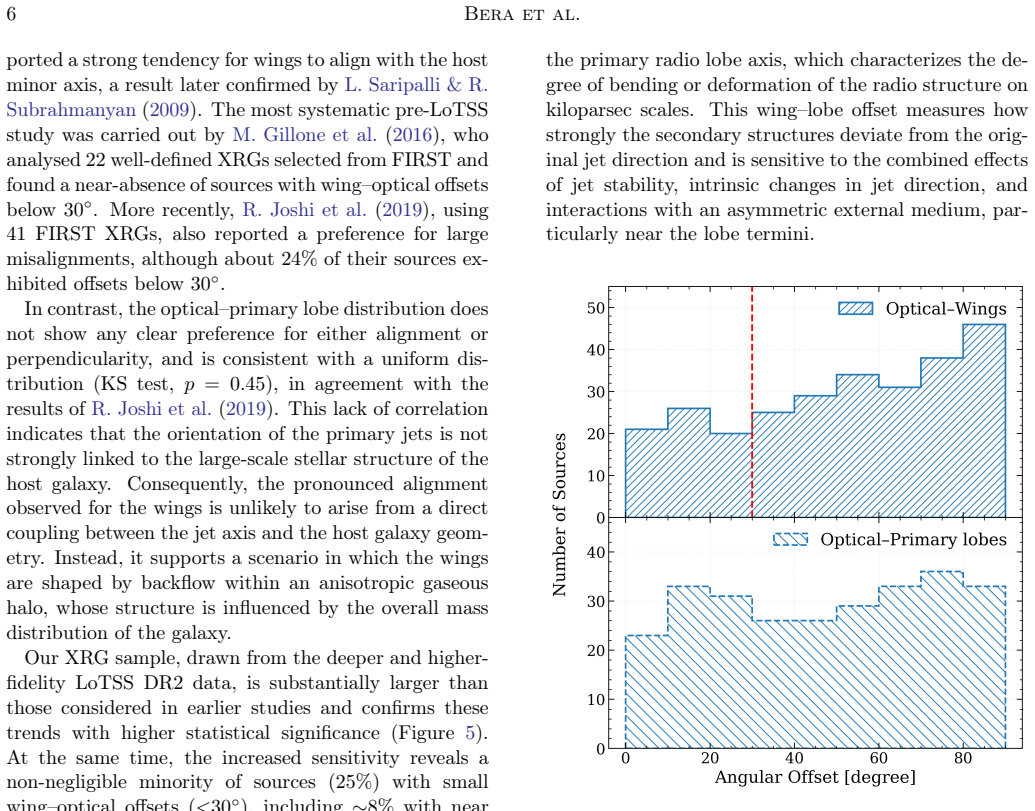
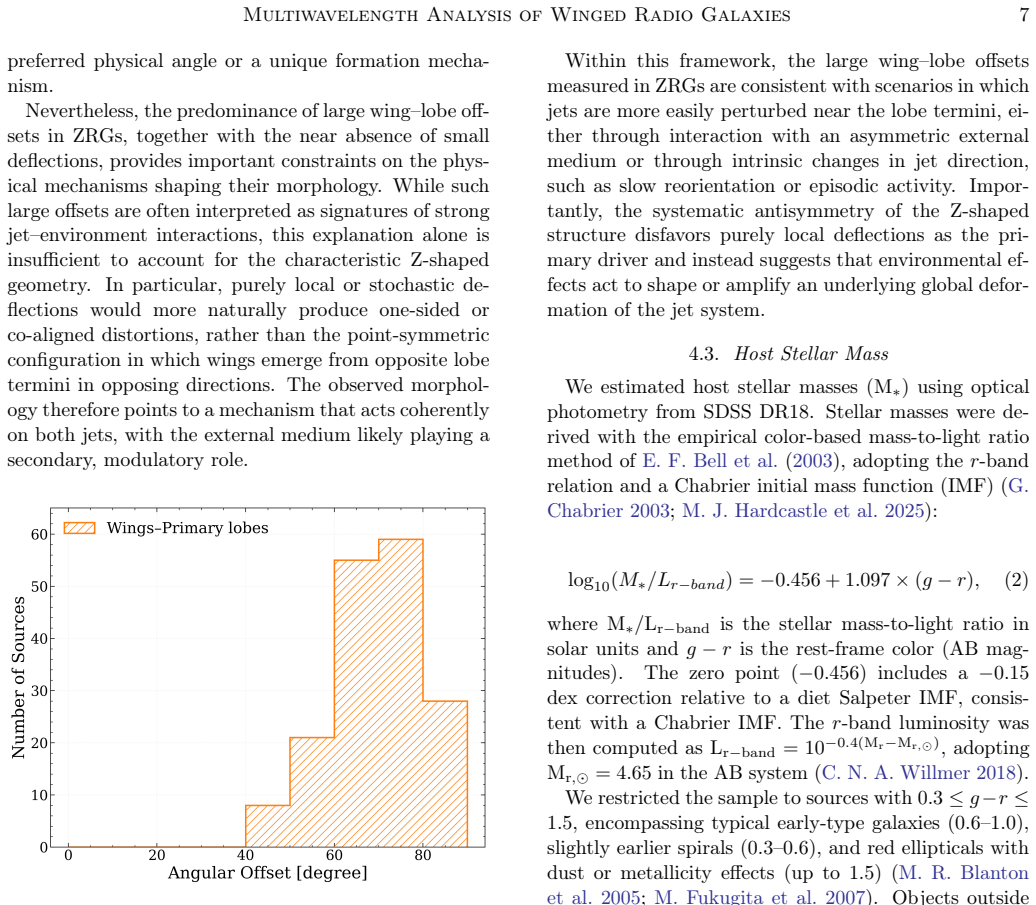
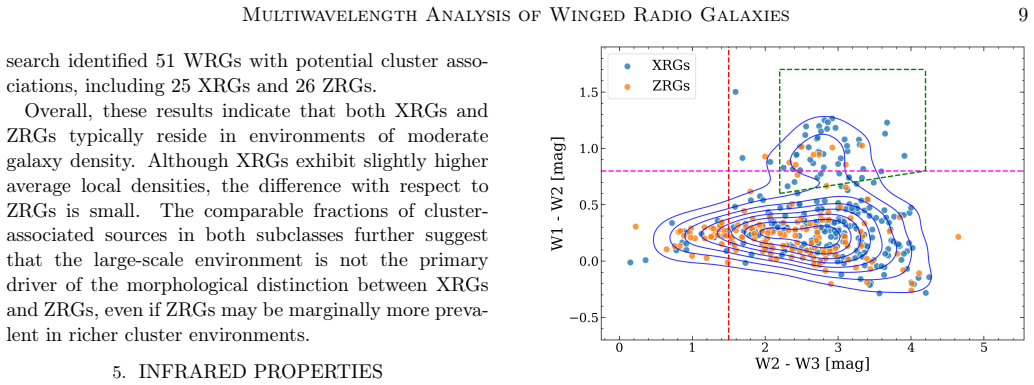
The central claim is that X-shaped radio galaxies mostly display large misalignments between wings and the optical major axis, consistent with backflow, while about 25 percent show small offsets suggesting jet reorientation, and Z-shaped sources exhibit antisymmetric lobe deformations pointing to a single coherent mechanism modulated by local interactions. These differences align with X-shaped objects hosting more powerful AGN and merger-related gas, whereas Z-shaped objects are predominantly lower-excitation radio galaxies associated with FR I morphologies. The authors therefore state that the physical processes shaping both types need not differ fundamentally, and that the final morphology
What carries the argument
Measurements of angular offsets between radio wings and the optical major axis of host galaxies, combined with mid-infrared diagnostics of gas and AGN excitation levels.
If this is right
- X-shaped sources are on average more radio-luminous and more frequently host powerful AGN with merger-related cold gas.
- Z-shaped sources are statistically linked to lower jet power and FR I morphologies, making them more susceptible to environmental perturbations.
- A substantial fraction of X-shaped galaxies exhibit small wing offsets consistent with jet reorientation in addition to backflow.
- Z-shaped deformations arise from a coherent process affecting both jets, with lobe termini shaped by local environmental interactions.
Where Pith is reading between the lines
- The shared underlying physics implies that models developed for one morphological type can inform the other without separate formation channels.
- The association with merger gas suggests winged morphologies may trace recent galaxy interactions that fuel the central engine.
- Future radio surveys could test whether the observed offset distribution holds in different density environments.
Load-bearing premise
The observed angular offsets and lobe shapes can be read directly as evidence for specific mechanisms such as backflow or reorientation without hydrodynamic simulations to test the interpretations.
What would settle it
Hydrodynamic simulations of jets with varying powers propagating through elliptical galaxy atmospheres that fail to reproduce the measured distribution of wing offsets or the fraction of antisymmetric Z-shaped lobes would challenge the claimed mechanisms.
Figures






read the original abstract
We present a multiwavelength follow-up study of 621 winged radio galaxies (WRGs) recently identified from LoTSS DR2, constituting the largest statistically significant samples of X-shaped (XRGs) and Z-shaped (ZRGs) radio galaxies to date. Our results show that WRGs are predominantly strongly radio-dominated, with XRGs on average more radio-luminous than ZRGs. Their optical hosts are massive elliptical galaxies residing in moderate-density environments. For 270 of XRGs, we measure angular offsets between the radio wings and the optical major axis. While most XRGs show large misalignments consistent with hydrodynamic backflow along the host minor axis, a substantial fraction ($\sim$25\%) exhibits small offsets (<30{\deg}), indicating that additional processes, such as jet reorientation, may also play a role. ZRGs, in contrast, are characterized by strongly antisymmetric deformations of their radio lobes pointing toward a coherent mechanism affecting both jets, modulated by local environmental interactions at the lobe termini. Mid-infrared diagnostics indicate merger-related cold gas in many WRGs, particularly XRGs, which also more frequently host powerful AGN, while ZRGs are more often classified as low-excitation radio galaxies (LERGs). This is consistent with our previous results showing that, although most WRGs exhibit FR II morphologies, FR I sources are almost exclusively ZRGs, suggesting that Z-shaped structures are statistically associated with lower jet power and are therefore more susceptible to perturbations. Nevertheless, the physical processes responsible for shaping XRGs and ZRGs need not be fundamentally different. Instead, the final morphology likely reflects the interplay between jet power, jet stability, and the surrounding environment.
Editorial analysis
A structured set of objections, weighed in public.
Referee Report
Summary. The paper presents a multiwavelength analysis of 621 winged radio galaxies (WRGs) identified in LoTSS DR2, the largest such sample to date, split into X-shaped (XRGs) and Z-shaped (ZRGs) subsets. It reports that XRGs are on average more radio-luminous than ZRGs, with optical hosts that are massive ellipticals in moderate-density environments; angular offsets between radio wings and the optical major axis are measured for 270 XRGs, with most showing large misalignments (>30°) interpreted as consistent with hydrodynamic backflow along the minor axis while ~25% show small offsets suggesting possible jet reorientation. ZRGs exhibit strongly antisymmetric lobe deformations. Mid-IR diagnostics indicate merger-related cold gas, with XRGs more often hosting powerful AGN and ZRGs more frequently classified as LERGs and FR I sources. The central conclusion is that the final WRG morphology reflects the interplay between jet power, jet stability, and the surrounding environment rather than fundamentally different processes for XRGs and ZRGs.
Significance. If the statistical associations hold, this work substantially enlarges the known population of WRGs and provides new empirical constraints on how jet power and environment shape radio morphologies, building directly on the authors' prior papers in the series. The use of uniform public survey data (LoTSS DR2 plus multiwavelength cross-matches) and the focus on observable diagnostics (offsets, mid-IR colors, FR classification) are clear strengths that allow reproducible follow-up. The qualified language ('likely reflects', 'consistent with') avoids overclaiming causality.
major comments (2)
- [Results section on angular offsets] The offset analysis for the 270 XRGs (large vs. small misalignments and the ~25% small-offset fraction) is load-bearing for the claim that both backflow and reorientation operate. The manuscript does not report the measurement method, position-angle uncertainties, or robustness tests against host ellipticity errors; without these, it is unclear whether the small-offset population is statistically distinct from measurement scatter or selection effects.
- [Discussion] The interpretation that ZRGs arise from lower jet power and greater susceptibility to coherent environmental perturbations rests on the near-exclusive association with FR I sources and antisymmetric deformations. No quantitative comparison (analytic or simulated) is provided to show that the observed deformation amplitudes and antisymmetry are predicted by the reported jet powers and host environments; the correlations remain consistent with the claim but do not discriminate against alternatives such as projection or episodic activity.
minor comments (2)
- [Abstract] The abstract refers to 'our previous results' on FR I/II associations without a citation to Papers I or II; adding the reference would improve standalone readability.
- [Figures] Figure captions for the offset histograms and lobe-deformation examples should explicitly state the sample size, selection cuts, and any error bars or binning choices.
Simulated Author's Rebuttal
We thank the referee for their constructive and positive review. We address each major comment below and have revised the manuscript accordingly to improve methodological transparency and interpretive balance.
read point-by-point responses
-
Referee: [Results section on angular offsets] The offset analysis for the 270 XRGs (large vs. small misalignments and the ~25% small-offset fraction) is load-bearing for the claim that both backflow and reorientation operate. The manuscript does not report the measurement method, position-angle uncertainties, or robustness tests against host ellipticity errors; without these, it is unclear whether the small-offset population is statistically distinct from measurement scatter or selection effects.
Authors: We agree that the measurement details require explicit documentation. In the revised manuscript we have added a new paragraph in Section 3.2 that describes the position-angle measurement procedure: radio wing axes are determined by fitting the outer lobe edges in the LoTSS DR2 images, while the optical major axis is taken from the SDSS r-band isophotal fit. Position-angle uncertainties are quantified via Monte Carlo resampling of the image noise and host ellipticity (typical 1σ uncertainty 8–12°). Robustness tests, now reported in the same section, show that the ~25 % small-offset (<30°) fraction remains statistically significant (>3σ above zero) even when host ellipticity is varied by ±0.1 or when sources near the resolution limit are excluded. These additions confirm that the small-offset population is not an artifact of measurement scatter. revision: yes
-
Referee: [Discussion] The interpretation that ZRGs arise from lower jet power and greater susceptibility to coherent environmental perturbations rests on the near-exclusive association with FR I sources and antisymmetric deformations. No quantitative comparison (analytic or simulated) is provided to show that the observed deformation amplitudes and antisymmetry are predicted by the reported jet powers and host environments; the correlations remain consistent with the claim but do not discriminate against alternatives such as projection or episodic activity.
Authors: We acknowledge that the discussion is primarily empirical. The revised text now explicitly states that the observed antisymmetric deformations and FR I association are consistent with lower-power jets being more easily perturbed, but that projection effects and episodic activity remain viable alternatives that cannot be ruled out with the present data alone. We have added citations to existing hydrodynamic simulations (e.g., those demonstrating enhanced lobe deformation for FR I-like jets in mildly perturbed media) and clarified that a dedicated quantitative comparison tailored to our sample parameters lies beyond the scope of this observational study. We identify such modeling as a natural direction for follow-up work. revision: partial
Circularity Check
No significant circularity: purely observational study with independent statistical findings.
full rationale
The paper reports morphological classifications, angular offset measurements, luminosity comparisons, and mid-IR diagnostics from the LoTSS DR2 sample of 621 WRGs. All conclusions follow directly from these new data and external model comparisons; no equations, fitted parameters, or predictions are defined in terms of the target results. The single reference to 'our previous results' on FR I/II associations is corroborative rather than load-bearing for the central interpretive claim, which rests on the current sample's statistics. No self-definitional loops, fitted-input predictions, or ansatz smuggling occur.
Axiom & Free-Parameter Ledger
Reference graph
Works this paper leans on
-
[1]
2020, ApJS, 249, 3, doi: 10.3847/1538-4365/ab929e
Ahumada, R., Allende Prieto, C., Almeida, A., et al. 2020, ApJS, 249, 3, doi: 10.3847/1538-4365/ab929e
-
[2]
F., Argudo-Fern´ andez, M., et al
Almeida, A., Anderson, S. F., Argudo-Fernández, M., et al. 2023, ApJS, 267, 44, doi: 10.3847/1538-4365/acda98
-
[3]
Bell, E. F., McIntosh, D. H., Katz, N., & Weinberg, M. D. 2003, ApJS, 149, 289, doi: 10.1086/378847
-
[4]
Bera, S., Pal, S., Sasmal, T. K., & Mondal, S. 2020, ApJS, 251, 9, doi: 10.3847/1538-4365/abb367
-
[5]
Bera, S., Sasmal, T. K., Patra, D., & Mondal, S. 2022, ApJS, 260, 7, doi: 10.3847/1538-4365/ac5cc4
-
[6]
Bera, S. K., Fang, T., Sasmal, T. K., et al. 2025, ApJS, 278, 34, doi: 10.3847/1538-4365/adc67f
-
[7]
Blanton, M. R., Eisenstein, D., Hogg, D. W., Schlegel, D. J., & Brinkmann, J. 2005, ApJ, 629, 143, doi: 10.1086/422897 Bogdán, Á., van Weeren, R. J., Kraft, R. P., et al. 2014, ApJL, 782, L19, doi: 10.1088/2041-8205/782/2/L19
-
[8]
Boller, T., Freyberg, M. J., Trümper, J., et al. 2016, A&A, 588, A103, doi: 10.1051/0004-6361/201525648
-
[9]
2002, A&A, 394, 39, doi: 10.1051/0004-6361:20021070
Capetti, A., Zamfir, S., Rossi, P., et al. 2002, A&A, 394, 39, doi: 10.1051/0004-6361:20021070
-
[10]
Chabrier, G. 2003, PASP, 115, 763, doi: 10.1086/376392
-
[11]
Cheung, C. C. 2007, AJ, 133, 2097, doi: 10.1086/513095
-
[12]
2018, arXiv e-prints, arXiv:1801.04276, doi: 10.48550/arXiv.1801.04276
Volonteri, M. 2018, arXiv e-prints, arXiv:1801.04276, doi: 10.48550/arXiv.1801.04276
-
[13]
M., Wright, E
Cutri, R. M., Wright, E. L., Conrow, T., et al. 2021,, VizieR On-line Data Catalog: II/328. Originally published in: IPAC/Caltech (2013)
2021
-
[14]
Dennett-Thorpe, J., Scheuer, P. A. G., Laing, R. A., et al. 2002, MNRAS, 330, 609, doi: 10.1046/j.1365-8711.2002.05106.x
-
[15]
Evans, I. N., Evans, J. D., Martínez-Galarza, J. R., et al. 2024, ApJS, 274, 22, doi: 10.3847/1538-4365/ad6319
-
[16]
Fanaroff, B. L., & Riley, J. M. 1974, MNRAS, 167, 31P, doi: 10.1093/mnras/167.1.31P
-
[17]
2007, AJ, 134, 579, doi: 10.1086/518962
Fukugita, M., Nakamura, O., Okamura, S., et al. 2007, AJ, 134, 579, doi: 10.1086/518962
-
[18]
2016, A&A, 587, A25, doi: 10.1051/0004-6361/201527244
Gillone, M., Capetti, A., & Rossi, P. 2016, A&A, 587, A25, doi: 10.1051/0004-6361/201527244
-
[19]
2024, Frontiers in Astronomy and Space Sciences, 11, 1371101, doi: 10.3389/fspas.2024.1371101
Giri, G., Fendt, C., Thorat, K., Bodo, G., & Rossi, P. 2024, Frontiers in Astronomy and Space Sciences, 11, 1371101, doi: 10.3389/fspas.2024.1371101
-
[20]
2023, ApJS, 268, 49, doi: 10.3847/1538-4365/acebca
Giri, G., Vaidya, B., & Fendt, C. 2023, ApJS, 268, 49, doi: 10.3847/1538-4365/acebca
-
[21]
2022, A&A, 662, A5, doi: 10.1051/0004-6361/202142546
Giri, G., Vaidya, B., Rossi, P., et al. 2022, A&A, 662, A5, doi: 10.1051/0004-6361/202142546
-
[22]
ULTRA-HIGH-ENERGY COSMIC RAYS FROM CENTAURUS A: JET INTERACTION WITH GASEOUS SHELLS
Gopal-Krishna, Biermann, P. L., de Souza, V., & Wiita, P. J. 2010, ApJL, 720, L155, doi: 10.1088/2041-8205/720/2/L155
-
[23]
Gopal-Krishna, Biermann, P. L., & Wiita, P. J. 2003, ApJL, 594, L103, doi: 10.1086/378766 Gürkan, G., Hardcastle, M. J., & Jarvis, M. J. 2014, MNRAS, 438, 1149, doi: 10.1093/mnras/stt2264 Gürkan, G., Hardcastle, M. J., Best, P. N., et al. 2019, A&A, 622, A11, doi: 10.1051/0004-6361/201833892
-
[24]
Astronomy & Astrophysics , author =
Hardcastle, M. J., Horton, M. A., Williams, W. L., et al. 2023, A&A, 678, A151, doi: 10.1051/0004-6361/202347333
-
[25]
Hardcastle, M. J., Pierce, J. C. S., Duncan, K. J., et al. 2025, Monthly Notices of the Royal Astronomical Society, 539, 1856, doi: 10.1093/mnras/staf622
-
[26]
Hodges-Kluck, E. J., & Reynolds, C. S. 2011, ApJ, 733, 58, doi: 10.1088/0004-637X/733/1/58
-
[27]
Hodges-Kluck, E. J., & Reynolds, C. S. 2012, ApJ, 746, 167, doi: 10.1088/0004-637X/746/2/167
-
[28]
Cheung, C. C. 2010, ApJL, 717, L37, doi: 10.1088/2041-8205/717/1/L37
-
[29]
H., Cohen, M., Masci, F., et al
Jarrett, T. H., Cohen, M., Masci, F., et al. 2011, ApJ, 735, 112, doi: 10.1088/0004-637X/735/2/112
-
[30]
2019, ApJ, 887, 266, doi: 10.3847/1538-4357/ab536f
Joshi, R., Krishna, G., Yang, X., et al. 2019, ApJ, 887, 266, doi: 10.3847/1538-4357/ab536f
-
[31]
Lal, D. V., & Rao, A. P. 2005, MNRAS, 356, 232, doi: 10.1111/j.1365-2966.2004.08442.x Multiw a velength Analysis of Winged Radio Galaxies13
-
[32]
Lal, D. V., & Rao, A. P. 2007, MNRAS, 374, 1085, doi: 10.1111/j.1365-2966.2006.11225.x
-
[33]
Lalakos, A., Gottlieb, O., Kaaz, N., et al. 2022, ApJL, 936, L5, doi: 10.3847/2041-8213/ac7bed
-
[34]
V., Melchior, A.-L., & Zolotukhin, I
Landt, H., Cheung, C. C., & Healey, S. E. 2010, MNRAS, 408, 1103, doi: 10.1111/j.1365-2966.2010.17183.x
-
[35]
P., & Parma, P
Leahy, J. P., & Parma, P. 1992, in Extragalactic Radio Sources. From Beams to Jets, ed. J. Roland, H. Sol, & G. Pelletier, 307–308
1992
-
[36]
Leahy, J. P., & Williams, A. G. 1984, MNRAS, 210, 929, doi: 10.1093/mnras/210.4.929
-
[37]
Merloni, A., Lamer, G., Liu, T., et al. 2024, A&A, 682, A34, doi: 10.1051/0004-6361/202347165
work page internal anchor Pith review doi:10.1051/0004-6361/202347165 2024
-
[38]
Merritt, D., & Ekers, R. D. 2002, Science, 297, 1310, doi: 10.1126/science.1074688
-
[39]
2023, MNRAS, 523, 1648, doi: 10.1093/mnras/stad1533
Misra, A., Jamrozy, M., & Weżgowiec, M. 2023, MNRAS, 523, 1648, doi: 10.1093/mnras/stad1533
-
[40]
2025, MNRAS, 536, 2025, doi: 10.1093/mnras/stae2639
Misra, A., Jamrozy, M., Weżgowiec, M., & Kozieł-Wierzbowska, D. 2025, MNRAS, 536, 2025, doi: 10.1093/mnras/stae2639
-
[41]
Peng, C. Y., Ho, L. C., Impey, C. D., & Rix, H.-W. 2010, AJ, 139, 2097, doi: 10.1088/0004-6256/139/6/2097 Planck Collaboration, Aghanim, N., Akrami, Y., et al. 2020, A&A, 641, A6, doi: 10.1051/0004-6361/201833910
-
[42]
2015, ApJS, 220, 7, doi: 10.1088/0067-0049/220/1/7
Subrahmanyan, R. 2015, ApJS, 220, 7, doi: 10.1088/0067-0049/220/1/7
-
[43]
Roberts, D. H., Saripalli, L., Wang, K. X., et al. 2018, ApJ, 852, 47, doi: 10.3847/1538-4357/aa9c49
-
[44]
2017, A&A, 606, A57, doi: 10.1051/0004-6361/201730594
Rossi, P., Bodo, G., Capetti, A., & Massaglia, S. 2017, A&A, 606, A57, doi: 10.1051/0004-6361/201730594
-
[45]
2014, MNRAS, 438, 796, doi: 10.1093/mnras/stt2239
Murphy, T. 2014, MNRAS, 438, 796, doi: 10.1093/mnras/stt2239
-
[46]
2009, ApJ, 695, 156, doi: 10.1088/0004-637X/695/1/156
Saripalli, L., & Subrahmanyan, R. 2009, ApJ, 695, 156, doi: 10.1088/0004-637X/695/1/156
-
[47]
2024, ApJ, 969, 156, doi: 10.3847/1538-4357/ad500e
Sethi, S., Kuźmicz, A., Jamrozy, M., & Slavcheva-Mihova, L. 2024, ApJ, 969, 156, doi: 10.3847/1538-4357/ad500e
-
[48]
Shimwell, T. W., Hardcastle, M. J., Tasse, C., et al. 2022, A&A, 659, A1, doi: 10.1051/0004-6361/202142484
-
[49]
Stern, D., Assef, R. J., Benford, D. J., et al. 2012, ApJ, 753, 30, doi: 10.1088/0004-637X/753/1/30
-
[50]
2021, ApJL, 923, L25, doi: 10.3847/2041-8213/ac374c
Ubertosi, F., Gitti, M., Brighenti, F., et al. 2021, ApJL, 923, L25, doi: 10.3847/2041-8213/ac374c
-
[51]
A., Coriat, M., Traulsen, I., et al
Webb, N. A., Coriat, M., Traulsen, I., et al. 2020, A&A, 641, A136, doi: 10.1051/0004-6361/201937353
-
[52]
Wen, Z. L., Han, J. L., & Liu, F. S. 2012, ApJS, 199, 34, doi: 10.1088/0067-0049/199/2/34
-
[53]
Willmer, C. N. A. 2018, ApJS, 236, 47, doi: 10.3847/1538-4365/aabfdf
-
[54]
Wright, E. L., Eisenhardt, P. R. M., Mainzer, A. K., et al. 2010, AJ, 140, 1868, doi: 10.1088/0004-6256/140/6/1868
-
[55]
2019, ApJS, 245, 17, doi: 10.3847/1538-4365/ab4811
Yang, X., Joshi, R., Gopal-Krishna, et al. 2019, ApJS, 245, 17, doi: 10.3847/1538-4365/ab4811
-
[56]
2015, MNRAS, 449, 3191, doi: 10.1093/mnras/stv460
Yang, X.-h., Chen, P.-s., & Huang, Y. 2015, MNRAS, 449, 3191, doi: 10.1093/mnras/stv460
-
[57]
Miller, B. P. 2019, MNRAS, 482, 2016, doi: 10.1093/mnras/sty2832
-
[58]
Zier, C. 2005, MNRAS, 364, 583, doi: 10.1111/j.1365-2966.2005.09586.x
-
[59]
Zier, C., & Biermann, P. L. 2001, A&A, 377, 23, doi: 10.1051/0004-6361:20010862 14Bera et al. APPENDIX A.SAMPLE POLAR MAPS AND PA MEASUREMENTS Here we present a set of representative WRGs whose wing structures are less well defined and whose lobes and wings exhibit noticeable asymmetries. These examples illustrate cases where PA measurements carry higher ...
discussion (0)
Sign in with ORCID, Apple, or X to comment. Anyone can read and Pith papers without signing in.