Recognition: unknown
Pressure sensing by electro-mechanical coupling in compliant dielectric membranes polarized by a bias voltage
Pith reviewed 2026-05-07 17:45 UTC · model grok-4.3
The pith
A bias voltage polarizes soft dielectric membranes to generate measurable voltage signals from pressure-induced capacitance changes.
A machine-rendered reading of the paper's core claim, the machinery that carries it, and where it could break.
Core claim
The authors show that a bias voltage can polarize dielectric materials to enable electro-mechanical coupling, thereby compensating for the absence of spontaneous polarization observed in piezoelectrics. This grants access to soft elastomers with a wider range of elastic properties. For nearly incompressible materials such as poly(dimethylsiloxane), the capacitance change during dynamic membrane deformation is large enough to yield a measurable dynamic voltage change over the membrane, providing a working example of a highly compliant pressure sensor.
What carries the argument
Bias-voltage polarization of dielectric membranes, which creates electro-mechanical coupling by linking mechanical deformation to capacitance variations that produce a voltage signal.
If this is right
- Soft elastomer membranes can serve as dynamic pressure sensors where stiff piezoelectric materials would add excessive mechanical impedance.
- Capacitance changes in nearly incompressible dielectrics translate directly into usable voltage signals for sensing applications.
- Materials with elastic moduli far below those of ceramics or PVDF become viable for vibration and pressure sensing.
- The method provides an alternative polarization route that does not require inherent piezoelectric properties in the base material.
Where Pith is reading between the lines
- These compliant sensors could be attached to flexible or biological surfaces without altering their natural motion.
- The same bias-voltage approach might be tested for strain or force sensing in other soft structures beyond pressure.
- Long-term performance under sustained bias and repeated cycling would determine practical durability beyond the initial demonstration.
Load-bearing premise
A bias voltage can reliably compensate for the lack of spontaneous polarization in dielectric elastomers to create stable electro-mechanical coupling sufficient for sensing without instabilities or extra material modifications.
What would settle it
If a biased silicone rubber membrane under known cyclic pressure loading produces no measurable dynamic voltage signal despite clear deformation and capacitance variation, the central claim would be falsified.
Figures




read the original abstract
Among smart materials, piezoelectric materials occupy a very prominent position for sensing and actuation functions. Combined with simple or more advanced shunts, they are also proposed in various vibration mitigation schemes. However, the selection of available piezoelectric materials is mainly limited to ceramics (with an elastic modulus in the order of 10 Gpa (e.g. PZT ceramics) and a few polymer materials, with elastic modulus in the range of 1 Gpa (e.g. PVDF). In both cases, the high mechanical impedance and, consequently, the small dynamic strains limit the application of these materials to stiff structures. In this contribution, we discuss using a bias voltage to polarize dielectric materials and thereby compensate for the lack of spontaneous polarization observed in piezoelectrics. This enables access to materials with a wider range of elastic properties, such as soft elastomers, e.g. poly(dimethylsiloxane). As an example, we present a practical implementation of a silicone rubber membrane used as a highly compliant dynamic pressure sensor. For such nearly-incompressible materials, the capacitance change during dynamic deformation of the membranes is sufficiently large to generate a measurable dynamic voltage change over the membrane.
Editorial analysis
A structured set of objections, weighed in public.
Referee Report
Summary. The manuscript proposes using a DC bias voltage to polarize soft, nearly-incompressible dielectric elastomers such as PDMS, thereby inducing electro-mechanical coupling that compensates for the absence of spontaneous polarization in these materials. It claims that pressure-induced deformation produces a sufficiently large capacitance change to generate a measurable dynamic voltage signal (via the constant-charge relation) suitable for dynamic pressure sensing in compliant membranes.
Significance. If the stability window and signal strength can be demonstrated, the approach would enable sensing and actuation with low-modulus, high-strain materials that are inaccessible to conventional piezoelectrics, potentially benefiting soft robotics, wearable devices, and vibration control in compliant structures.
major comments (2)
- [Abstract] Abstract: the assertion that 'the capacitance change during dynamic deformation of the membranes is sufficiently large to generate a measurable dynamic voltage change' is load-bearing for the central claim yet is stated without any derivation of expected ΔC/C under volume-conserving area expansion, without comparison to typical noise floors, and without bounds on the bias voltage V that keep the device below the pull-in or wrinkling threshold (both signal and Maxwell stress scale as V²).
- [Abstract] The manuscript supplies no analysis or experimental verification of the operating window in which |ΔV| exceeds noise while V remains below the electromechanical instability limit set by pre-stretch, thickness, and modulus; this omission leaves the 'measurable' and 'stable' assertions unverified.
Simulated Author's Rebuttal
We thank the referee for the constructive comments on our manuscript. The points raised regarding the abstract are well taken and highlight the need for additional supporting analysis to substantiate the central claims about signal measurability and device stability. We address each comment below and will incorporate the necessary revisions.
read point-by-point responses
-
Referee: [Abstract] Abstract: the assertion that 'the capacitance change during dynamic deformation of the membranes is sufficiently large to generate a measurable dynamic voltage change' is load-bearing for the central claim yet is stated without any derivation of expected ΔC/C under volume-conserving area expansion, without comparison to typical noise floors, and without bounds on the bias voltage V that keep the device below the pull-in or wrinkling threshold (both signal and Maxwell stress scale as V²).
Authors: We agree that the abstract would benefit from a concise supporting derivation and estimates. For nearly incompressible elastomers under volume conservation (A·h = constant), capacitance scales as C ∝ A², yielding ΔC/C ≈ 2(ΔA/A) for small area changes induced by pressure. Under constant charge, the resulting voltage signal is ΔV = −V(ΔC/C). In the revised manuscript we will add a brief derivation of this relation together with order-of-magnitude estimates (e.g., for 1 % strain and kV-scale bias, ΔV lies in the volt range, well above typical μV–mV noise floors of voltage amplifiers). We will also state the upper limit on V set by the pull-in instability, obtained from equating elastic restoring stress to Maxwell stress and adjusted for pre-stretch. These additions will be placed in the abstract or as a short footnote. revision: yes
-
Referee: [Abstract] The manuscript supplies no analysis or experimental verification of the operating window in which |ΔV| exceeds noise while V remains below the electromechanical instability limit set by pre-stretch, thickness, and modulus; this omission leaves the 'measurable' and 'stable' assertions unverified.
Authors: We concur that an explicit operating window must be delineated. The full text describes the bias-voltage approach and presents a practical membrane implementation, yet the abstract lacks the requested bounds. In revision we will add an analytical expression for the maximum stable bias voltage, V_max ≈ sqrt[(2/3)·Y·h³/(ε·A)] scaled by a pre-stretch factor, together with the corresponding minimum pressure that produces |ΔV| above noise. This will be cross-referenced to the experimental results already shown in the manuscript. The revision will therefore supply the missing analytical framework; any additional experimental mapping of the full window will be noted as future work if not already contained in the data. revision: yes
Circularity Check
No derivation chain present; claims remain descriptive without equations or self-referential reductions
full rationale
The provided abstract and context contain no equations, derivations, or load-bearing mathematical steps. The central claim—that a bias voltage polarizes soft elastomers sufficiently for measurable dynamic voltage from capacitance changes under pressure—is stated qualitatively without any formal chain that could reduce to inputs by construction, fitted parameters, or self-citation. No self-definitional loops, uniqueness theorems, or ansatzes are invoked. This is the expected honest non-finding when a paper offers a conceptual implementation rather than a derived result.
Axiom & Free-Parameter Ledger
axioms (1)
- domain assumption Bias voltage can polarize dielectric elastomers to produce electro-mechanical coupling comparable to piezoelectrics for sensing purposes.
Reference graph
Works this paper leans on
-
[1]
Piezoelectric materials hold a prominent position in this field, due to their excellent coupling coefficients (e.g
Introduction Energy coupling between the mechanical and electrical domain using smart materials offers a host of possible applications, ranging from strain and vibration sensing to shape morphing and energy harvesting [1, 2, 3]. Piezoelectric materials hold a prominent position in this field, due to their excellent coupling coefficients (e.g. lea d zirconat...
-
[2]
5 GPa [11]). Everyday engineering systems such as engine suspensions or shock dampers undergo much larger strains, and the growing field of soft robotics has a high demand for compliant materials. While recent efforts [12] have led to the development of piezoelectric elastomers, in this paper we present an alternative to such highly specialized materials. ...
-
[3]
3) on thin, compliant dielectric membranes, subject to a static bias voltage, and their coupling with an acoustic pressure field
of and experiments (Sec. 3) on thin, compliant dielectric membranes, subject to a static bias voltage, and their coupling with an acoustic pressure field. The system discussed here shows that strong electromechanical coupling can be achieved using standard silicone rubber with moderate relative permittivity. Such a membrane is the most basic component of p...
-
[4]
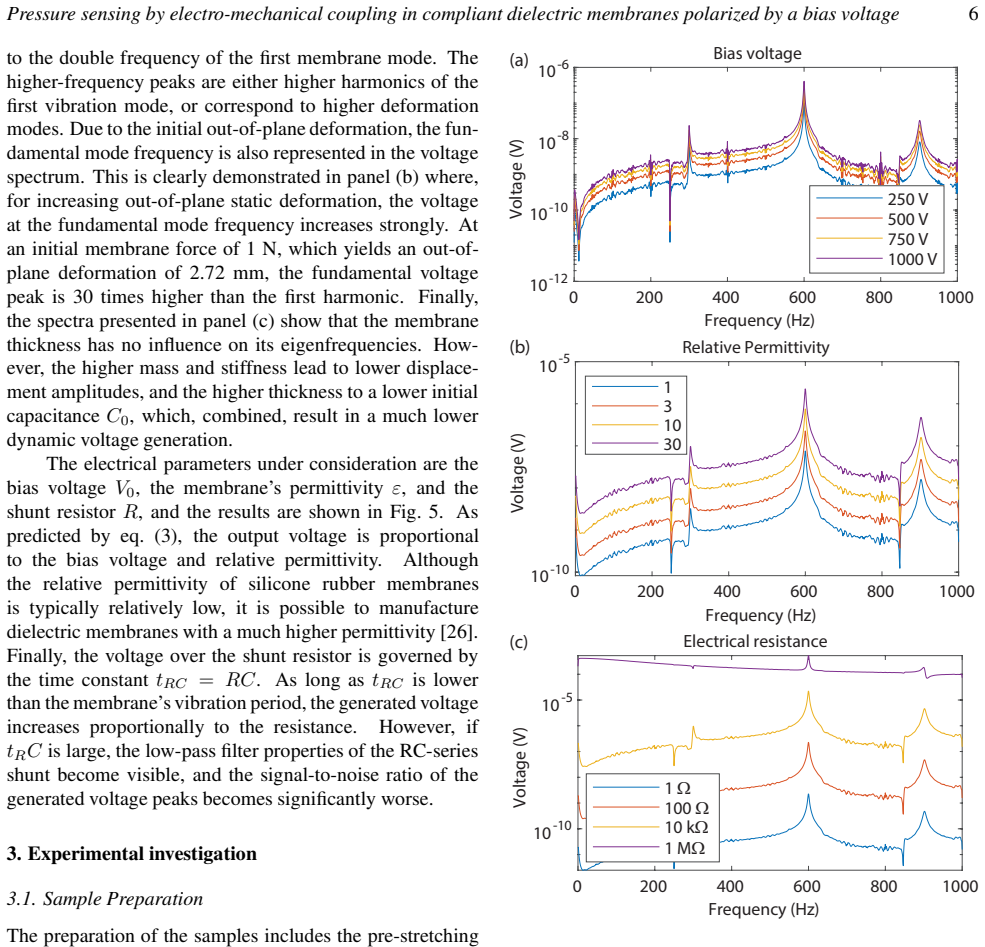
Modelling electro-mechanical coupling in dielectric membranes 2.1. Analytical approximation of dynamic voltage generation In this work, a nearly incompressible membrane is first stretched to a desired mechanical prestrain, and then polarized by a DC bias voltage charging the electrodes on both sides of the membrane. The electrostatic force acts on the elec...
2023
-
[5]
Experimental investigation 3.1. Sample Preparation The preparation of the samples includes the pre-stretching of the membrane, its fixation on an external frame, the application of thin electrodes, and the preparation of connections to the voltage source. The workflow for the preparation is well established and is carried out with tool s and materials devel...
-
[6]
2 and thickness 100 µ m and 200 µ m. In all cases, the bias 0 1 2 3 4 5 time [s] -0.5 0 0.5velocity (m/s) 0 1 2 3 4 5 time [s] -0.04 -0.02 0 0.02 0.04Voltage (V) 200 400 600 800 1000 1200 Frequency [Hz] 10 -10 10 -5 Voltage (V) Velocity (m/s) Figure 9. Measured time signals (membrane velocity and generated voltage) for a 100 µ m membrane with a 20% static...
-
[7]
However, the mechanism at the base of the observed flow of current is different than in piezoelectric crystals with spontaneous electric dipoles
Conclusions The simulations and experiments described in this work show that the combination of thin dielectrics with an externally applied bias voltage show coupling between the mechanical and electrical domain, similar to a piezoelectric material. However, the mechanism at the base of the observed flow of current is different than in piezoelectric crysta...
-
[8]
Smart materials types, properties and application s: A review
Shashi Bahl, Himanshu Nagar, Inderpreet Singh, and Shan kar Sehgal. Smart materials types, properties and application s: A review. Materials Today: Proceedings, 28:1302–1306, 2020
2020
-
[9]
3d printing of smart materials: A review on recent progresses i n 4d printing
Zhong Xun Khoo, Joanne Ee Mei Teoh, Y ong Liu, Chee Kai Chua , Shoufeng Y ang, Jia An, Kah Fai Leong, and Wai Y ee Y eong. 3d printing of smart materials: A review on recent progresses i n 4d printing. Virtual and Physical Prototyping, 10(3):103–122, 2015
2015
-
[10]
A revie w of energy harvesting using piezoelectric materials: state -of-the- art a decade later (2008–2018)
Mohsen Safaei, Henry A Sodano, and Steven R Anton. A revie w of energy harvesting using piezoelectric materials: state -of-the- art a decade later (2008–2018). Smart materials and structures , 28(11):113001, 2019
2008
-
[11]
A review on piezo- electric materials and their applications
Madunuri Chandra Sekhar, Eshwarappa V eena, Nagasamu- dram Suresh Kumar, Kadiyala Chandra Babu Naidu, Allam Mallikarjuna, and Dudekula Baba Basha. A review on piezo- electric materials and their applications. Crystal Research and Technology, 58(2):2200130, 2023
2023
-
[12]
A review of ceramic, polymer and composite piezoelectric materials
Mahpara Habib, Iza Lantgios, and Katherine Hornbostel. A review of ceramic, polymer and composite piezoelectric materials . Journal of Physics D: Applied Physics , 55(42):423002, 2022
2022
-
[13]
Recent advances of capaci- tive sensors: Materials, microstructure designs, applica tions, and opportunities
Allen J Cheng, Liao Wu, Zhao Sha, Wenkai Chang, Dewei Chu, Chun Hui Wang, and Shuhua Peng. Recent advances of capaci- tive sensors: Materials, microstructure designs, applica tions, and opportunities. Advanced Materials Technologies, 8(11):2201959, 2023
2023
-
[14]
Flexible and stretchable capacitive sensors with dif ferent microstructures
Jing Qin, Li-Juan Yin, Y a-Nan Hao, Shao-Long Zhong, Dong - Li Zhang, Ke Bi, Y ong-Xin Zhang, Y u Zhao, and Zhi-Min Dang. Flexible and stretchable capacitive sensors with dif ferent microstructures. Advanced Materials, 33(34):2008267, 2021
2021
-
[15]
Deformation and strength behavior of a soft pzt ceramic
Dietrich Munz, Theo Fett, Stefan Mueller, and Gerhard Th un. Deformation and strength behavior of a soft pzt ceramic. In Smart Structures and Materials 1998: Mathematics and Contr ol in Smart Structures, volume 3323, pages 84–95. SPIE, 1998
1998
-
[16]
Implementation of tunable frequency-dependent stiffness elements via integ rated shunted piezoelectric stacks
Bart V an Damme, Rico Weber, Jascha U Schmied, Adri- aan Spierings, and Andrea Bergamini. Implementation of tunable frequency-dependent stiffness elements via integ rated shunted piezoelectric stacks. Smart Materials and Structures , 33(7):075037, 2024
2024
-
[17]
Pzt phase diagram determination by measurement of elastic moduli
Abderrazak Bouzid, EM Bourim, Maurice Gabbay, and Gilb ert Fantozzi. Pzt phase diagram determination by measurement of elastic moduli. Journal of the European Ceramic Society , 25(13):3213–3221, 2005
2005
-
[18]
Dependence of the dielectric constant on th e structure of extruded polyvinylidene fluoride films
I Y u Dmitriev, SV Gladchenko, VK Lavrent’ev, OE Praslov a, and GK Elyashevich. Dependence of the dielectric constant on th e structure of extruded polyvinylidene fluoride films. Russian journal of applied chemistry , 79:642–646, 2006
2006
-
[19]
How to make elastomers piezoelectric? Advanced Materials Technologies , 8(15):2300099, 2023
Francis Owusu, Thulasinath Raman V enkatesan, Frank A N ¨ uesch, Ricardo Martin Negri, and Dorina M Opris. How to make elastomers piezoelectric? Advanced Materials Technologies , 8(15):2300099, 2023
2023
-
[20]
So ft capacitive pressure sensors: Trends, challenges, and pers pectives, 3 2022
Kyoung Ho Ha, Heeyong Huh, Zhengjie Li, and Nanshu Lu. So ft capacitive pressure sensors: Trends, challenges, and pers pectives, 3 2022
2022
-
[21]
Soft wearable pressure sensors for beat -to- beat blood pressure monitoring
Joshua Kim, En Fan Chou, Jamie Le, Sabrina Wong, Michael Chu, and Michelle Khine. Soft wearable pressure sensors for beat -to- beat blood pressure monitoring. Advanced Healthcare Materials, 8, 7 2019
2019
-
[22]
IEEE, 2020
IEEE FLEPS2020 : IEEE International Conference on Flexible and Printable Sensors and Systems : virtual conference, August 16- 19, 2020 : 2020 conference proceedings . IEEE, 2020
2020
-
[23]
Progress in achieving high-perf ormance piezoresistive and capacitive flexible pressure sensors: A review, 4 2020
Wufan Chen and Xin Y an. Progress in achieving high-perf ormance piezoresistive and capacitive flexible pressure sensors: A review, 4 2020
2020
-
[24]
Damadoran, Jing Xia, Lane W
Canan Dagdeviren, Y ewang Su, Pauline Joe, Raissa Y ona, Y uhao Liu, Y un Soung Kim, Y ongan Huang, Anoop R. Damadoran, Jing Xia, Lane W. Martin, Y onggang Huang, and John A. Rogers. Conformable amplified lead zirconate titanate sens ors with enhanced piezoelectric response for cutaneous pressu re monitoring. Nature Communications, 5, 8 2014. Pressure sens...
2014
-
[25]
A flexible, trans parent, ultralow detection limit capacitive pressure sensor
Marouen Zammali, Sijun Liu, and Wei Y u. A flexible, trans parent, ultralow detection limit capacitive pressure sensor. Advanced Materials Interfaces, 9, 6 2022
2022
-
[26]
Carbon nanotube network topology-enhanced iontronic capacitive pressure sensor with high linearity and ultrahigh sensitivity
Jiawei Zhao, Haoyu Guo, Haiyang Liu, Tongqiang Fu, Wenz he Zhou, Zicai Zhu, and Qiao Hu. Carbon nanotube network topology-enhanced iontronic capacitive pressure sensor with high linearity and ultrahigh sensitivity. ACS Applied Materials and Interfaces, 15:47327–47337, 10 2023
2023
-
[27]
N¨ uesch, and Dorina M
Francis Owusu, Frank A. N¨ uesch, and Dorina M. Opris. St retchable high response piezoelectric elastomers based on polable po ly- norbornene fillers in a polydimethylsiloxane matrix. Advanced Functional Materials, 32, 10 2022
2022
-
[28]
Skin-like elastomer embedde d zinc oxide nanoarrays for biomechanical energy harvesting
Congran Jin, Lin Dong, Zhe Xu, Andrew Closson, Andrew Ca be, Aleksandra Gruslova, Scott Jenney, Danny Escobedo, James Elliott, Michael Zhang, et al. Skin-like elastomer embedde d zinc oxide nanoarrays for biomechanical energy harvesting. Advanced Materials Interfaces, 8(10):2100094, 2021
2021
-
[29]
Ashish Kumar, Arathy V arghese, Dheeraj Kalra, Anshuma n Raunak, Jaiverdhan, Mahanth Prasad, Vijay Janyani, and R. P . Y adav. Mems-based piezoresistive and capacitive microphones: A review on materials and methods, 1 2024
2024
-
[30]
Integrated arrays of air-dielectric grap hene transistors as transparent active-matrix pressure sensor s for wide pressure ranges
Sung Ho Shin, Sangyoon Ji, Seiho Choi, Kyoung Hee Pyo, Byeong Wan An, Jihun Park, Joohee Kim, Ju Y oung Kim, Ki Suk Lee, Soon Y ong Kwon, Jaeyeong Heo, Byong Guk Park, and Jang Ung Park. Integrated arrays of air-dielectric grap hene transistors as transparent active-matrix pressure sensor s for wide pressure ranges. Nature Communications, 8, 3 2017
2017
-
[31]
Soft capacitive pressure sensor with enhanced sens itivity assisted by zno nw interlayers and airgap
Y ogeenth Kumaresan, Sihang Ma, Oliver Ozioko, and Ravi nder Dahiya. Soft capacitive pressure sensor with enhanced sens itivity assisted by zno nw interlayers and airgap. IEEE Sensors Journal, 22:3974–3982, 3 2022
2022
-
[32]
Stacked dielectric elastomer actuator for tensile force transmission
Gabor Kovacs, L D¨ uring, S Michel, and G Terrasi. Stacked dielectric elastomer actuator for tensile force transmission. Sensors and actuators A: Physical, 155(2):299–307, 2009
2009
-
[33]
High-perm ittivity polysiloxanes for solvent-free fabrication of dielectric elastomer actuators
Johannes von Szczepanski and Dorina M Opris. High-perm ittivity polysiloxanes for solvent-free fabrication of dielectric elastomer actuators. Advanced Materials Technologies , 8(2):2201372, 2023
2023
-
[34]
Applicat ion of bias voltage to tune the resonant frequency of membrane-bas ed electroactive polymer energy harvesters
Lin Dong, Michael Grissom, and Frank T Fisher. Applicat ion of bias voltage to tune the resonant frequency of membrane-bas ed electroactive polymer energy harvesters. In Energy Harvesting and Storage: Materials, Devices, and Applications VII , volume 9865, pages 96–110. SPIE, 2016
2016
discussion (0)
Sign in with ORCID, Apple, or X to comment. Anyone can read and Pith papers without signing in.