Recognition: unknown
OxyPOM: a biogeochemical model for Oxygen and Particulate Organic Matter dynamics with detailed temperature sensitivity
Pith reviewed 2026-05-07 17:09 UTC · model grok-4.3
The pith
Nuanced temperature sensitivities for key processes in the OxyPOM model produce seasonal oxygen patterns and carbon production estimates that differ sharply from uniform-sensitivity versions.
A machine-rendered reading of the paper's core claim, the machinery that carries it, and where it could break.
Core claim
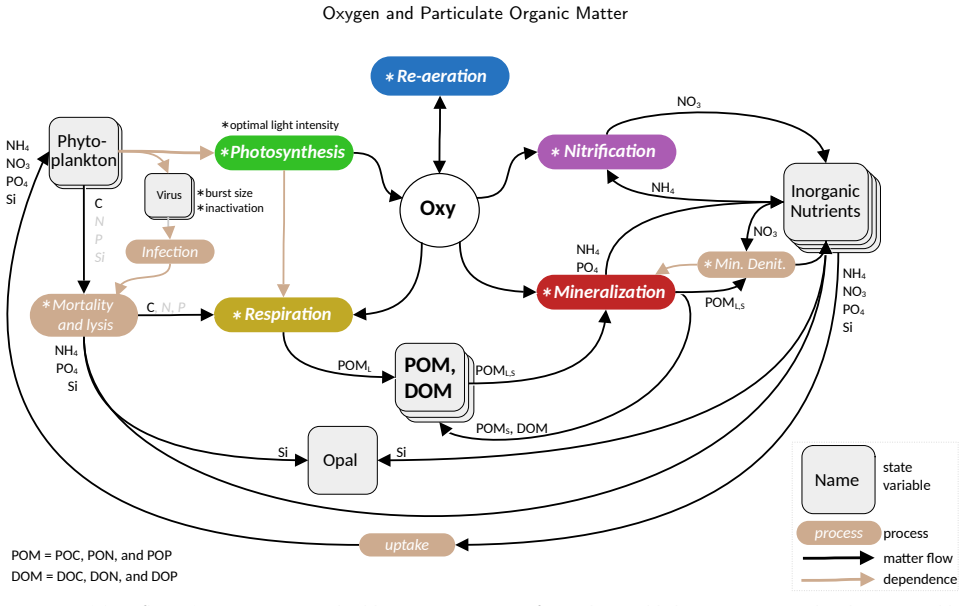
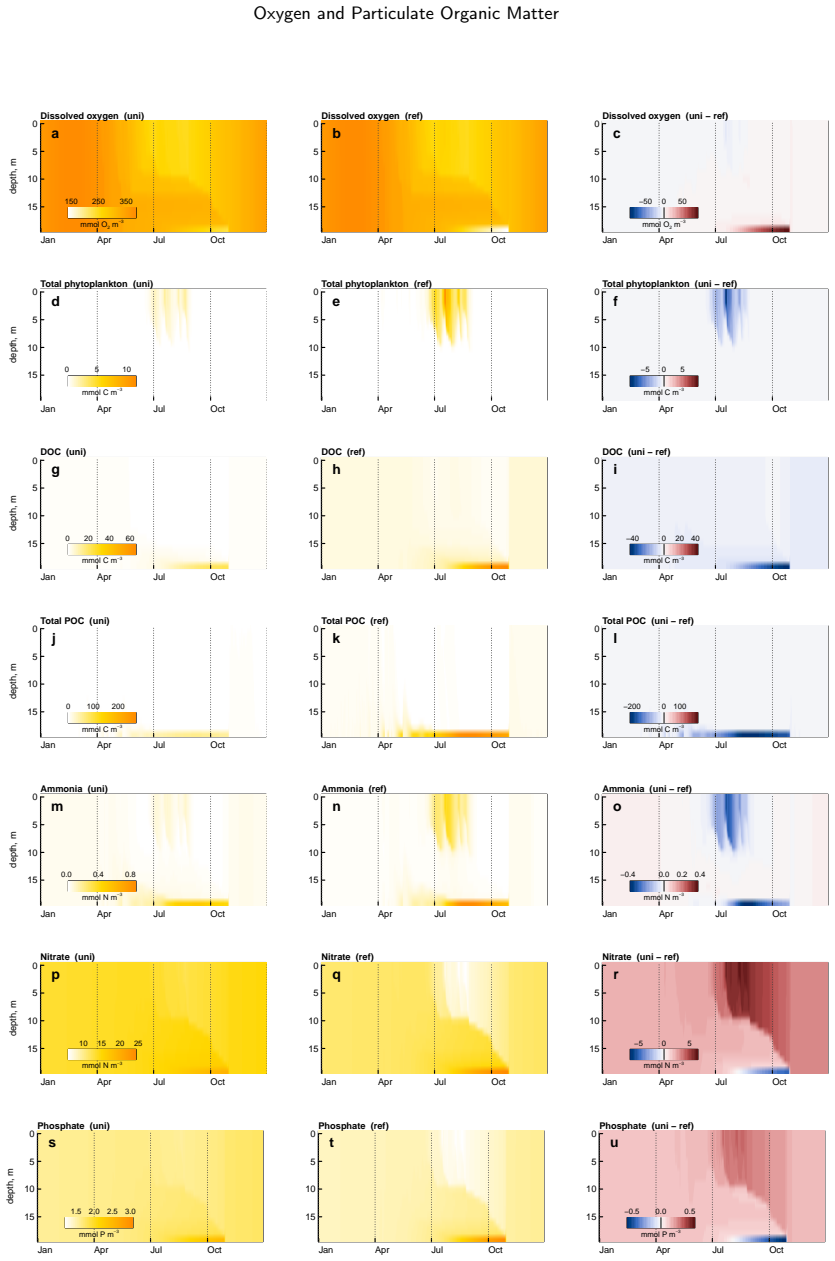
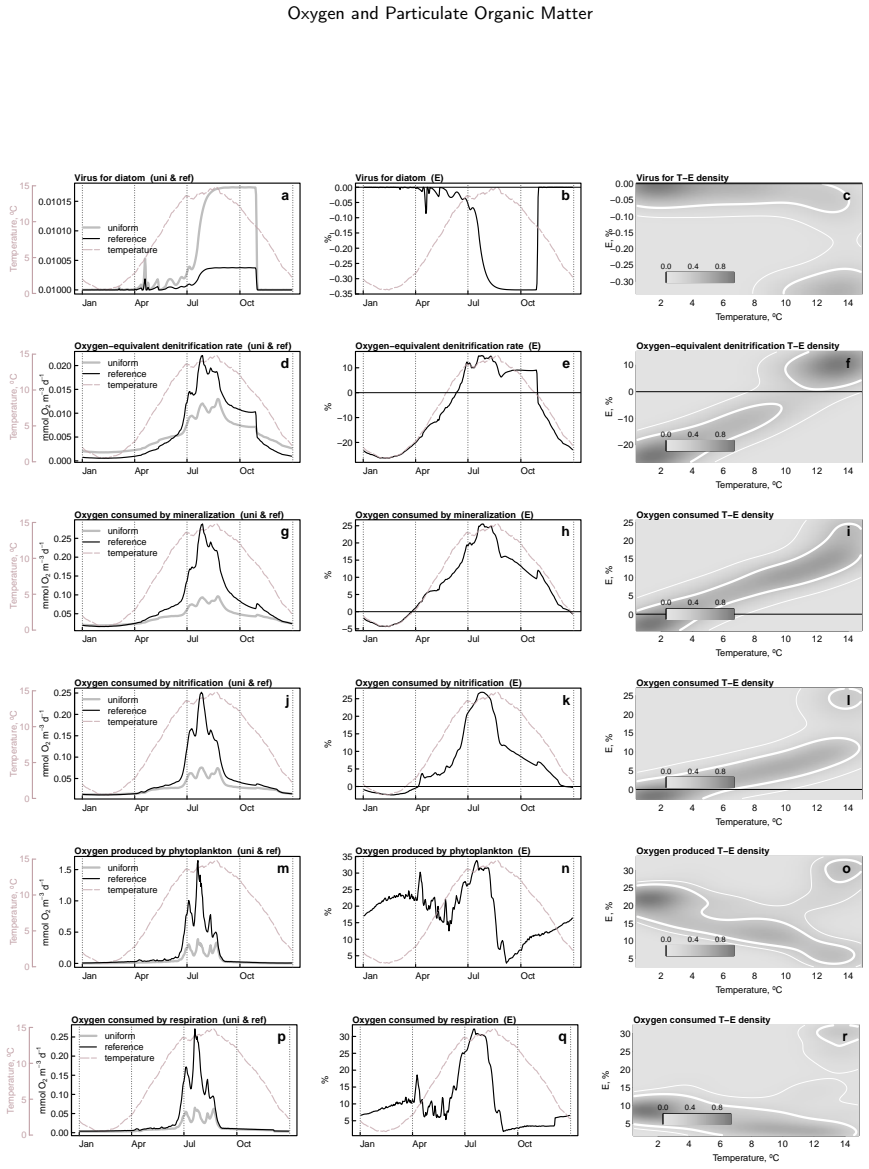
OxyPOM incorporates nuanced temperature sensitivities for photosynthesis, re-aeration, respiration, mineralization, and nitrification together with optimal light intensity, winter grazing inhibition, and pathogenesis; in idealized water-column tests representing seasonal low-oxygen estuarine conditions, uniform sensitivities alter seasonal oxygen-process patterns and underestimate particulate organic carbon production by up to a factor of four while overestimating nutrient concentrations.
What carries the argument
Process-specific temperature response functions applied inside the OxyPOM biogeochemical model to the oxygen production and consumption pathways.
If this is right
- Seasonal timing of oxygen production, consumption, and re-aeration shifts when process-specific temperature functions replace uniform ones, with the largest differences appearing in summer.
- Annual oxygen budgets can remain similar, yet annual particulate organic carbon production and nutrient standing stocks change substantially.
- The model structure supports direct testing of hypotheses about heatwaves and progressive warming on hypoxia development.
Where Pith is reading between the lines
- Similar process-specific temperature functions could be added to other biogeochemical models to reduce bias in carbon-cycle projections under climate scenarios.
- The idealized setup implies that field validation in multiple estuaries would be required before widespread adoption for management applications.
- Heatwave events may widen the gap between nuanced and uniform predictions, potentially improving early-warning capability for low-oxygen episodes.
Load-bearing premise
The idealized water column experiment accurately represents a typical estuarine seasonal low-oxygen environment and the chosen process-specific temperature response functions are biologically realistic.
What would settle it
Direct comparison of OxyPOM output for particulate organic carbon production and nutrient concentrations against time-series observations from a real estuary across seasons with varying temperatures would show whether the nuanced functions improve accuracy over uniform sensitivities.
Figures

read the original abstract
Periods of low dissolved oxygen concentration -- hypoxia and anoxia -- threaten the health of aquatic ecosystems and the services they provide.Hypoxia is strongly influenced by temperature, but the different sensitivities and response functions of oxygen removal and production processes to temperature are not regarded in most models. Here we present OxyPOM -- Oxygen and Particulate Organic Matter, a nuanced temperature-aware process-based biogeochemical model. OxyPOM incorporates nuanced temperature sensitivities for the key oxygen-related processes photosynthesis, re-aeration, respiration, mineralization, and nitrification. Further sensitive variables like optimal light intensity, winter grazing inhibition, and pathogenesis are also represented. Our model was tested in an idealized water column experiment, representing a typical estuarine seasonal low-oxygen environment. Differences between nuanced and uniform temperature sensitivities affect seasonal patterns of oxygen-related processes, resulting in under- or overestimation during different times of the year, particularly with higher differences in summer. While these changes may balance in the overall annual oxygen budget, uniform sensitivities underestimate particulate organic carbon production by up to a factor of four along the year and overestimate nutrient concentrations. This nuanced approach to temperature sensitivity allows us to explore and test new hypotheses related to climate warming and heatwaves, addressing the ecosystem changes demanded by climate change models.
Editorial analysis
A structured set of objections, weighed in public.
Referee Report
Summary. The paper introduces OxyPOM, a process-based biogeochemical model for oxygen and particulate organic matter dynamics that incorporates nuanced, process-specific temperature response functions for photosynthesis, re-aeration, respiration, mineralization, and nitrification, plus additional factors such as optimal light intensity, winter grazing inhibition, and pathogenesis. The model is tested via an idealized 1-D water column experiment representing a typical estuarine seasonal low-oxygen environment. The central result is that switching from nuanced to uniform temperature sensitivities alters seasonal patterns of oxygen-related processes (with larger differences in summer) and, while annual oxygen budgets may balance, produces up to a factor-of-four underestimation of particulate organic carbon production and overestimation of nutrient concentrations.
Significance. If the idealized differences hold under more realistic conditions and the chosen temperature functions prove biologically accurate, the work would strengthen the case for process-specific temperature dependencies in hypoxia and carbon-cycle modeling, particularly for climate-warming and heatwave scenarios. The modular construction with independent process functions is a clear strength, as it permits direct attribution of output differences to temperature sensitivity choices rather than confounding parameter adjustments.
major comments (2)
- [Idealized water column experiment] Idealized water column experiment (abstract): the quantitative claim that uniform sensitivities underestimate particulate organic carbon production by up to a factor of four rests on a single 1-D setup with prescribed seasonal forcing that omits lateral advection, variable sediment-water exchange, and site-specific light or grazing data. Any of these omitted processes could alter the relative weighting of photosynthesis, respiration, and mineralization sufficiently to shrink or remove the reported gap.
- [Abstract] Abstract: no quantitative time series, error bars, validation metrics, or direct comparison to estuarine observations are supplied to support the idealized-experiment results, including the factor-of-four POC claim and the seasonal under-/over-estimation patterns. Without such grounding, the broader assertion that nuanced sensitivities are required to avoid real-world seasonal mis-estimation remains an in-model artifact.
minor comments (1)
- The abstract would be strengthened by briefly stating the specific functional forms (e.g., Q10 coefficients or Arrhenius parameters) adopted for each process, which would aid immediate reproducibility and allow readers to judge biological realism.
Simulated Author's Rebuttal
We thank the referee for the constructive comments on the idealized nature of the experiments and the presentation of results. We address each major comment below and have made revisions to strengthen the manuscript.
read point-by-point responses
-
Referee: [Idealized water column experiment] Idealized water column experiment (abstract): the quantitative claim that uniform sensitivities underestimate particulate organic carbon production by up to a factor of four rests on a single 1-D setup with prescribed seasonal forcing that omits lateral advection, variable sediment-water exchange, and site-specific light or grazing data. Any of these omitted processes could alter the relative weighting of photosynthesis, respiration, and mineralization sufficiently to shrink or remove the reported gap.
Authors: We agree that the 1-D water column experiment is idealized and omits processes such as lateral advection, variable sediment-water exchange, and site-specific light or grazing data. The reported factor-of-four difference in POC production is therefore specific to this controlled setup with prescribed forcing. The experiment was designed to isolate the effects of process-specific temperature sensitivities without confounding adjustments to other parameters. We have added an explicit limitations paragraph in the Discussion section stating these omissions and noting that the quantitative magnitude could differ in more complex models. The core qualitative result—that uniform sensitivities produce different seasonal patterns—still serves as a valid proof-of-concept for the importance of nuanced temperature functions. revision: partial
-
Referee: [Abstract] Abstract: no quantitative time series, error bars, validation metrics, or direct comparison to estuarine observations are supplied to support the idealized-experiment results, including the factor-of-four POC claim and the seasonal under-/over-estimation patterns. Without such grounding, the broader assertion that nuanced sensitivities are required to avoid real-world seasonal mis-estimation remains an in-model artifact.
Authors: The abstract summarizes results from the idealized experiment. We have revised the abstract to clarify that the factor-of-four POC underestimation and seasonal patterns are findings from the controlled 1-D model rather than observational data. The manuscript contains figures showing seasonal time series of oxygen, process rates, and POC, but we acknowledge the lack of error bars, validation metrics, and direct estuarine comparisons in this study, which focuses on sensitivity analysis. We have adjusted the language in the abstract and conclusions to avoid implying direct real-world applicability and to frame the work as demonstrating potential effects that warrant further validation. revision: yes
Circularity Check
No circularity: model and comparison are self-contained forward simulations
full rationale
The paper constructs OxyPOM as a new process-based model incorporating independent, literature-derived temperature response functions for photosynthesis, re-aeration, respiration, mineralization, and nitrification, plus additional variables like optimal light and grazing inhibition. It then executes two forward simulations (nuanced vs. uniform sensitivities) in a single idealized 1-D water column with prescribed seasonal forcing and reports emergent differences, including the factor-of-four POC production gap. No step reduces by construction to its own inputs: the uniform case is an explicit contrast rather than a fitted parameter renamed as prediction, no self-citations bear load for uniqueness or ansatzes, and no derivation chain equates outputs to presupposed definitions. The quantitative results are simulation artifacts of the chosen functions and setup, not self-referential loops.
Axiom & Free-Parameter Ledger
free parameters (1)
- process-specific temperature sensitivity parameters
axioms (1)
- domain assumption Standard process-based rate equations for oxygen and organic matter cycling hold in estuarine environments
Reference graph
Works this paper leans on
-
[1]
Marine phytoplankton functional types exhibit diverse responses to thermal change. Nat. Commun. 12, 1–9. doi:10.1038/s41467-021-266 51-8. Baer, S.E., Connelly, T.L., Sipler, R.E., Yager, P.L., Bronk, D.A., 2014. Effect of temperature on rates of ammonium uptake and nitrification in the western coastal Arctic during winter, spring, and summer. Global Bioge...
-
[2]
Freshwater methane emissions offset the continental carbon sink. Science 331, 50. doi:10.1126/science.1196808. Behrenfeld, M.J., Doney, S.C., Lima, I., Boss, E.S., Siegel, D.A., 2013. Annual cycles of ecological disturbance and recovery underlying the subarctic Atlantic spring plankton bloom. Global Biogeochem. Cycles 27, 526–540. doi:10.1002/gbc.20050. B...
-
[3]
Extent,patterns,anddriversofhypoxiaintheworld’sstreamsand rivers. Limnol. Oceanogr. Lett. 8, 453–463. doi:10.1002/lol2.10297. Bruggeman, J., Bolding, K., 2014. A general framework for aquatic biogeochemical models. Environ. Model. Softw. 61, 249–265. doi:10 .1016/j.envsoft.2014.04.002. Burchard, H., Hetland, R.D., 2010. Quantifying the contributions of ti...
-
[4]
doi:10.1016/j.ecss.2018.01.020. Hu,F.,Bolding,K.,Bruggeman,J.,Jeppesen,E.,Flindt,M.R.,VanGerven, L.,Janse,J.H.,Janssen,A.B.,Kuiper,J.J.,Mooij,W.M.,Trolle,D.,2016. FABM-PCLake-Linkingaquaticecologywithhydrodynamics. Geosci. Model Dev. 9, 2271–2278. doi:10.5194/gmd-9-2271-2016. Johannsson, O.E., Ferreira, M.S., Crémazy, A., De Boeck, G., Val, A.L., Wood,C.M...
-
[5]
Neumann, T., Radtke, H., Cahill, B., Schmidt, M., Rehder, G., 2022
doi:10.1128/AEM.69.5.2580-2586.2003. Neumann, T., Radtke, H., Cahill, B., Schmidt, M., Rehder, G., 2022. Non- Redfieldian carbon model for the Baltic Sea (ERGOM version 1.2) – implementation and budget estimates. Geosci. Model Dev. 15, 8473–
-
[6]
Olonscheck, D., Hofmann, M., Worm, B., Schellnhuber, H.J., 2013
doi:10.5194/gmd-15-8473-2022. Olonscheck, D., Hofmann, M., Worm, B., Schellnhuber, H.J., 2013. De- composingtheeffectsofoceanwarmingonchlorophyllaconcentrations intophysicallyandbiologicallydrivencontributions. Environ.Res.Lett
-
[7]
Padhy, R.N., Singh, P.K., 1977
doi:10.1088/1748-9326/8/1/014043. Padhy, R.N., Singh, P.K., 1977. Effect of temperature on the adsorption and one-step growth of the Nostoc virus N-1. Arch. Microbiol. 115, 163–167. doi:10.1007/BF00406370. Parada, V., Herndl, G.J., Weinbauer, M.G., 2006. Viral burst size of heterotrophicprokaryotesinaquaticsystems.J.Mar.Biol.Assoc.United Kingdom 86, 613–6...
-
[8]
Sherman,E.,Moore,J.K.,Primeau,F.,Tanouye,D.,2016
doi:10.1016/j.jmarsys.2006.01.005. Sherman,E.,Moore,J.K.,Primeau,F.,Tanouye,D.,2016. Temperaturein- fluenceonphytoplanktoncommunitygrowthrates. GlobalBiogeochem. Cycles 30, 550–559. doi:10.1002/2015GB005272. Soetaert, K., Herman, P.M., Middelburg, J.J., Heip, C., Smith, C.L., Tett, P., Wild-Allen, K., 2001. Numerical modelling of the shelf break ecosystem...
-
[9]
Woody, M.A., Cliver, D.O., 1995
doi:10.1016/0304-3800(95)00196-4. Woody, M.A., Cliver, D.O., 1995. Effects of temperature and host cell growth phase on replication of F- specific RNA coliphage Q𝛽. Appl. Environ. Microbiol. 61, 1520–1526. doi:10.1128/aem.61.4.1520-1526. 1995. Yakushev, E.V., Debolskaya, E.I., Kuznetsov, I.S., Staalstrøm, A., 2013. Modelling of the meromictic fjord hunnbu...
discussion (0)
Sign in with ORCID, Apple, or X to comment. Anyone can read and Pith papers without signing in.