Recognition: unknown
Electrical conductivity of crack-template-based transparent conducting films: mean-field approximation, effective medium theory, and simulation
Pith reviewed 2026-05-07 17:20 UTC · model grok-4.3
The pith
Numerical simulations show that mean-field approximations overestimate the electrical conductivity of crack-template films by 13 to 79 percent.
A machine-rendered reading of the paper's core claim, the machinery that carries it, and where it could break.
Core claim
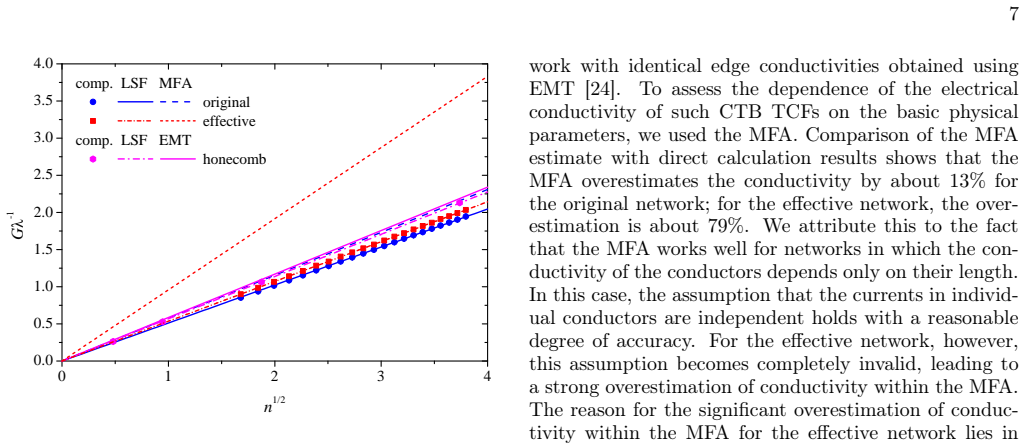
Direct numerical calculations for the Poisson-Voronoi diagram showed that the mean field approximation overestimated the conductivity of the original network by approximately 13%, and of the effective network by 79%. In addition, a hexagonal network with an edge conductivity distribution corresponding to the Poisson-Voronoi diagram was studied: for it, the predictions of the effective medium theory turned out to be more accurate than for the Poisson-Voronoi diagram, which was explained by the greater structural homogeneity of the periodic hexagonal lattice. Our results showed that when modeling crack-template-based transparent conducting films, especially in the case of hierarchical cracks 3
What carries the argument
The edge network of a two-dimensional Poisson-Voronoi diagram with conductivity assigned either inversely to edge length or uniformly according to effective medium theory.
If this is right
- Mean-field approximation overestimates conductivity by approximately 13% in the original length-dependent network.
- Mean-field approximation overestimates conductivity by approximately 79% in the effective uniform network.
- Effective medium theory predictions are more accurate for a regular hexagonal network than for the irregular Poisson-Voronoi diagram.
- Mean-field approximation can lead to significant errors for hierarchical cracks with variable width where resistance is not proportional to length.
Where Pith is reading between the lines
- Accurate modeling of crack films may require incorporating more realistic crack width variations beyond simple length proportionality.
- Errors from mean-field methods could mislead the design of transparent conductors by overpredicting performance.
- Similar overestimation issues might occur in other disordered network models used in materials physics.
- Further simulations using different random tessellations could test the robustness of the 13% and 79% error figures.
Load-bearing premise
Crack-template-based films can be represented accurately as the edges of a two-dimensional Poisson-Voronoi diagram with conductivities either inversely proportional to length or uniform via effective medium theory.
What would settle it
Experimental measurement of conductivity in fabricated crack-template films that matches the mean-field approximation values rather than the numerical simulation results on the Poisson-Voronoi network would falsify the overestimation finding.
Figures
read the original abstract
In our work, crack-template-based transparent conducting films were modeled as networks corresponding to the edges of a two-dimensional Poisson--Voronoi diagram. Two types of networks were considered: the original one, in which the conductivity of each edge was inversely proportional to its length, and the effective one, where all edges had the same conductivity obtained from the effective medium theory. The mean field approximation was used for analytical evaluation of the electrical conductivity. Direct numerical calculations for the Poisson--Voronoi diagram showed that the mean field approximation overestimated the conductivity of the original network by approximately 13\%, and of the effective network by 79\%. In addition, a hexagonal network with an edge conductivity distribution corresponding to the Poisson--Voronoi diagram was studied: for it, the predictions of the effective medium theory turned out to be more accurate than for the Poisson--Voronoi diagram, which was explained by the greater structural homogeneity of the periodic hexagonal lattice. Our results showed that when modeling crack-template-based transparent conducting films, especially in the case of hierarchical cracks with variable width (where the resistance was not simply proportional to the length), the application of the mean field approximation could potentially lead to significant errors.
Editorial analysis
A structured set of objections, weighed in public.
Referee Report
Summary. The paper models crack-template-based transparent conducting films as edge networks of 2D Poisson-Voronoi diagrams. It applies the mean-field approximation to compute electrical conductivity for an 'original' network (edge conductivity inversely proportional to length) and an 'effective' network (uniform conductivity from effective medium theory). Direct numerical simulations are used to benchmark the approximation, yielding overestimations of ~13% and ~79%, respectively. A periodic hexagonal network with matching edge-conductivity statistics is also examined, and the work concludes that mean-field methods can produce significant errors for such films, particularly when real hierarchical cracks have variable widths that violate the length-proportional resistance assumption.
Significance. If the central numerical comparisons hold, the manuscript supplies a concrete benchmark for the accuracy of mean-field and effective-medium approximations in disordered resistor networks, with the 79% discrepancy in the effective case being especially noteworthy. The hexagonal-lattice comparison usefully isolates the role of structural homogeneity. These findings could inform modeling choices for transparent conducting films. The significance is reduced, however, by the absence of any statistical validation of the Poisson-Voronoi topology against experimental crack images and by the lack of methodological details needed to reproduce the quoted percentages.
major comments (2)
- [Direct numerical calculations for the Poisson-Voronoi diagram] The central claims rest on the reported 13% and 79% overestimations obtained from direct numerical calculations on the Poisson-Voronoi diagram. The manuscript provides no information on the number of Voronoi cells or seeds used to generate the networks, the boundary conditions employed when solving for conductivity, the number of independent realizations averaged, or any statistical uncertainties. This absence renders the quantitative discrepancies unverifiable and prevents assessment of their robustness.
- [Model definition and discussion of hierarchical cracks] The abstract and conclusion correctly caution that real hierarchical cracks have variable width, so resistance is not simply proportional to length. Nevertheless, all quantitative results (including the 13% and 79% figures) are derived under the 1/length assumption. A brief sensitivity test varying the conductivity-length relation would make the warning that mean-field approximations 'could potentially lead to significant errors' more concrete and directly tied to the central claim.
minor comments (2)
- [Abstract] The abstract states the overestimations as 'approximately 13%' and '79%' without indicating whether these are means over multiple samples or single-run values; adding this clarification would improve precision.
- [Hexagonal network analysis] The statement that effective-medium theory is more accurate for the hexagonal network 'due to the greater structural homogeneity' remains qualitative. A simple quantitative metric (e.g., variance of node coordination numbers or edge-length distribution) would strengthen the comparison.
Simulated Author's Rebuttal
We thank the referee for the careful reading and constructive comments, which have helped us identify areas where the manuscript can be strengthened for clarity and reproducibility. We address each major comment below and will incorporate the suggested revisions.
read point-by-point responses
-
Referee: [Direct numerical calculations for the Poisson-Voronoi diagram] The central claims rest on the reported 13% and 79% overestimations obtained from direct numerical calculations on the Poisson-Voronoi diagram. The manuscript provides no information on the number of Voronoi cells or seeds used to generate the networks, the boundary conditions employed when solving for conductivity, the number of independent realizations averaged, or any statistical uncertainties. This absence renders the quantitative discrepancies unverifiable and prevents assessment of their robustness.
Authors: We agree that these details are required for full reproducibility and verification of the quoted percentages. In the revised manuscript we will add a Methods subsection specifying that the networks were generated from 2000 Poisson seeds in a unit square, solved under periodic boundary conditions via a sparse-matrix formulation of Kirchhoff's laws, and averaged over 100 independent realizations. The standard error of the mean for the conductivity is below 2% in both the original and effective networks; these numbers will be stated explicitly so that the 13% and 79% overestimations can be reproduced. revision: yes
-
Referee: [Model definition and discussion of hierarchical cracks] The abstract and conclusion correctly caution that real hierarchical cracks have variable width, so resistance is not simply proportional to length. Nevertheless, all quantitative results (including the 13% and 79% figures) are derived under the 1/length assumption. A brief sensitivity test varying the conductivity-length relation would make the warning that mean-field approximations 'could potentially lead to significant errors' more concrete and directly tied to the central claim.
Authors: We accept the suggestion. Although the present study employs the conventional length-proportional resistance model, a short sensitivity analysis will be added in the revision. We will recompute the mean-field overestimation for conductivity-length relations of the form sigma ~ l^(-beta) with beta = 1 and beta = 1.5 (the latter approximating a modest width variation) and report the resulting changes in the discrepancy. This will directly illustrate how the error grows when the simple 1/l assumption is relaxed, reinforcing the caution about hierarchical cracks. revision: yes
Circularity Check
No significant circularity; analytical approximations tested against independent numerical benchmarks
full rationale
The paper constructs Poisson-Voronoi edge networks, assigns conductivities either as inversely proportional to edge length or as a single uniform value from effective medium theory, then applies mean-field approximation to obtain analytical conductivity estimates. Direct numerical calculations performed on the same generated diagrams serve as an external benchmark, yielding the reported 13% and 79% overestimations. No parameters are fitted to a data subset and then re-predicted, no self-citations form load-bearing steps in the derivation, and the hexagonal-lattice comparison is likewise evaluated numerically rather than by construction. The chain therefore remains self-contained against external computational validation.
Axiom & Free-Parameter Ledger
axioms (2)
- domain assumption Crack-template films correspond to the edges of a two-dimensional Poisson-Voronoi diagram.
- domain assumption Edge conductivity is inversely proportional to length in the original network.
Reference graph
Works this paper leans on
-
[1]
We will call such a network theoriginal network
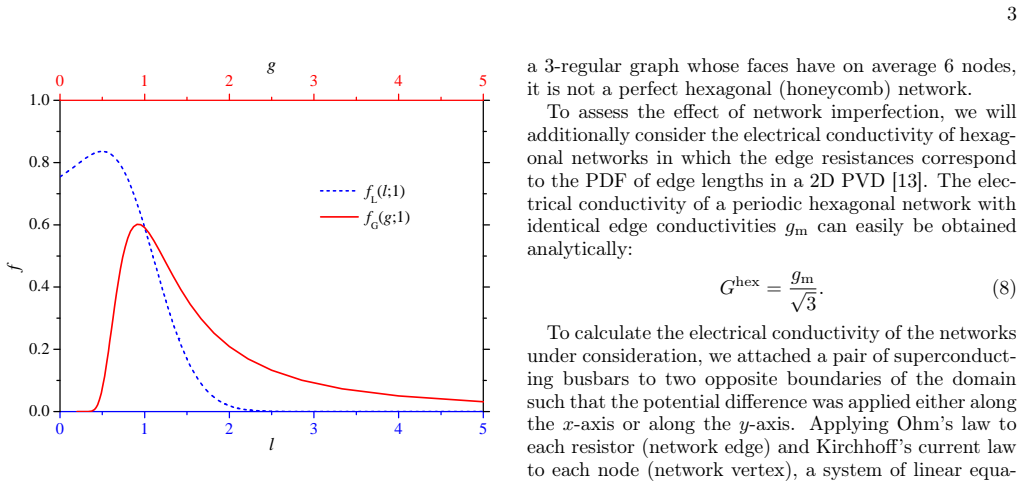
Assume that the edges of the graph under consid- eration are conductors with constant and identical cross-section𝐴, and the electrical conductivity of the conductor material is𝜎 0. We will call such a network theoriginal network. 3 0 1 2 3 4 5 0.00 .20 .40 .60 .81 .0 f l fL ( l ;1) fG ( g ; 1)0 1 2 3 4 5 g Figure 1. PDF of the length𝑙and electrical conduc...
-
[2]
We will call such a network theeffective network
Assume that the edges of the graph under consider- ation are conductors, and all edges have the same electrical conductivity equal to𝑔 m. We will call such a network theeffective network. Remarks concerning the effective network: (i) at this stage we deliberately do not specify the value of𝑔m or the method for finding it, since for the main part of the th...
-
[3]
If the network is macroscopically homogeneous, one can expectthattheelectricpotentialvariesalongthenetwork almost linearly
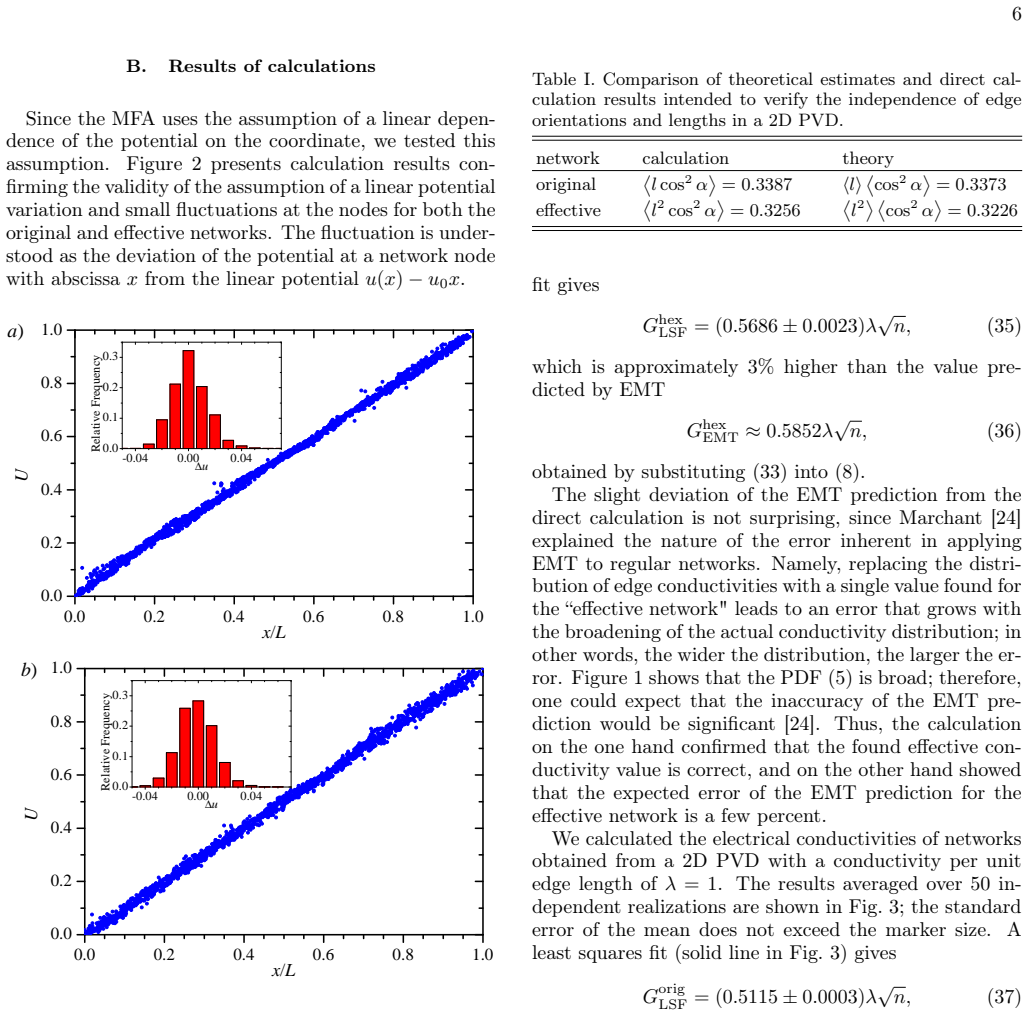
Mean field approximation Suppose a uniform electrostatic field with strength𝐸 is applied, and the field vector is parallel to the plane in which the conducting network under consideration lies. If the network is macroscopically homogeneous, one can expectthattheelectricpotentialvariesalongthenetwork almost linearly. The mean field approximation (MFA) is b...
-
[4]
straightforward
Thermal power of the original network The current along the𝑘-th edge, whose endpoints are vertices𝑉and𝑊, is 𝑖𝑘 = 𝜆 𝑙𝑘 ((El𝑘) +𝛿𝑢 𝑘) =𝜆𝐸cos𝛼 𝑘 + 𝜆 𝑙𝑘 𝛿𝑢𝑘.(12) Here𝛿𝑢 𝑘 = ∆𝑢 𝑉 −∆𝑢 𝑊 is the difference of potential fluctuations at the ends of the𝑘-th edge. By Kirchhoff’s current law, ∑︁ 𝑘 𝑖𝑘 =𝜆𝐸 ∑︁ 𝑘 cos𝛼 𝑘 +𝜆 ∑︁ 𝑘 𝛿𝑢𝑘 𝑙𝑘 = 0,(13) where the summation is over ...
-
[5]
straightforward
Thermal power of the effective network Similarly, we find the thermal power dissipated in the effectivenetwork. Thecurrentalongthe𝑘-thedge, whose endpoints are vertices𝑉and𝑊, is 𝑖𝑘 =𝑔 m(𝑢𝑉 −𝑢 𝑊 ) =𝑔 m ((El𝑘) +𝛿𝑢 𝑘).(19) Kirchhoff’s current law gives ∑︁ 𝑘 (𝐸𝑙𝑘 cos𝛼 𝑘 +𝛿𝑢 𝑘) = 0.(20) The power dissipated in this edge is 𝑞𝑘 =𝑔 m(𝐸𝑙𝑘 cos𝛼 𝑘 +𝛿𝑢 𝑘)2 =𝑔 m (︀ 𝐸2...
-
[6]
In this case, the graph is 3-regular
Relations for a network corresponding to a 2D Poisson–Voronoi diagram on a plane Consider an important special case where the graph corresponds to the edges of a 2D PVD. In this case, the graph is 3-regular. The orientations of its edges are equiprobable, so⟨cos 2 𝛼⟩= 1/2. Taking into account the information presented in Sec- tion IIB, and since𝑛= 3𝑛 s, ⟨...
-
[7]
effective network
Estimation of electrical conductivity within the effective medium theory Since the electrical conductivity of a linear conductor of constant cross-section is related to its length as𝑔= 𝜆/𝑙, the PDF of conductivity can be expressed in terms of the PDF of lengths. Switching to the edge length distribution𝑓 𝐿(𝑙, 𝑛s)and introducing the dimensionless variable𝜉...
2023
-
[8]
E. S. Cama, M. Pasini, U. Giovanella, and F. Galeotti, Coatings15, 189 (2025)
2025
-
[9]
E. S. Cama, M. Pasini, F. Galeotti, and U. Giovanella, Materials18, 3091 (2025)
2025
-
[10]
Z.Zeng, C.Wang,andJ.Gao,J.Appl.Phys.127,065104 (2020)
2020
-
[11]
Kim and T
J. Kim and T. M. Truskett, Appl. Phys. Lett.120, 211108 (2022)
2022
-
[12]
Y. Y. Tarasevich, I. V. Vodolazskaya, and A. V. Eserke- pov, Appl. Phys. Lett.123, 263501 (2023)
2023
-
[13]
Esteki, D
K. Esteki, D. Curic, H. G. Manning, E. Sheerin, M. S. Ferreira, J. J. Boland, and C. G. Rocha, Nanoscale15, 10394 (2023)
2023
-
[14]
Qiang, D
D. Qiang, D. Charaklias, R. Dorey, and I. Mohagheghian, Adv. Theory Simul.7, 2301221 (2024)
2024
-
[15]
Y. Y. Tarasevich, A. V. Eserkepov, I. V. Vodolazskaya, and A. P. Chatterjee, Phys. Rev. E111, 045404 (2025)
2025
-
[16]
Y. Y. Tarasevich, A. V. Eserkepov, and I. V. Vodolazskaya, Phys. Rev. E108, 044143 (2023)
2023
-
[17]
Okabe, B
A. Okabe, B. Boots, K. Sugihara, and S. N. Chiu,Spa- tial tessellations, 2nd ed., Wiley series in probability and statistics (John Wiley & Sons, Inc., Chichester, 2000)
2000
-
[18]
J. L. Meijering, Philips Res. Rep.8, 270 (1953)
1953
-
[19]
Muche, Math
L. Muche, Math. Nachr.178, 271 (1996)
1996
-
[20]
K. A. Brakke, Statistics of random plane Voronoi tessel- lations, Personal page of Ken Brakke, Professor Emeri- tus Department of Mathematics and Computer Science Susquehanna University (2005)
2005
-
[21]
D. A. G. Bruggeman, Ann. Phys.416, 636 (1935)
1935
-
[22]
Kirkpatrick, Rev
S. Kirkpatrick, Rev. Mod. Phys.45, 574 (1973)
1973
-
[23]
J. P. Clerc, G. Giraud, J. M. Laugier, and J. M. Luck, Adv. Phys.39, 191 (1990)
1990
-
[24]
J. M. Luck, Phys. Rev. B43, 3933 (1991)
1991
-
[25]
Sahimi and T
M. Sahimi and T. T. Tsotsis, Ind. Eng. Chem. Res.36, 3043 (1997)
1997
-
[26]
O’Callaghan, C
C. O’Callaghan, C. Gomes da Rocha, H. G. Manning, J. J. Boland, and M. S. Ferreira, Phys. Chem. Chem. Phys.18, 27564 (2016)
2016
-
[27]
Kirkpatrick, Phys
S. Kirkpatrick, Phys. Rev. Lett.27, 1722 (1971)
1971
-
[28]
Joy and W
T. Joy and W. Strieder, J. Phys. C: Solid State Phys.11, L867 (1978)
1978
-
[29]
Joy and W
T. Joy and W. Strieder, J. Phys. C: Solid State Phys.12, L279 (1979)
1979
-
[30]
R. M. Foster, IRE Trans. Circuit Theory8, 75 (1961)
1961
-
[31]
Marchant, J
J. Marchant, J. Phys. C: Solid State Phys.12, L517 (1979)
1979
-
[32]
J. C. Maxwell,A treatise on electricity and magnetism (Hansebooks, 2016)
2016
discussion (0)
Sign in with ORCID, Apple, or X to comment. Anyone can read and Pith papers without signing in.