Recognition: unknown
SVOM Real-time Response and Collaboration System
Pith reviewed 2026-05-07 17:52 UTC · model grok-4.3
The pith
SVOM's BeiDou-3 real-time system enabled 172 gamma-ray burst detections and 1040 observations in its first year
A machine-rendered reading of the paper's core claim, the machinery that carries it, and where it could break.
Core claim
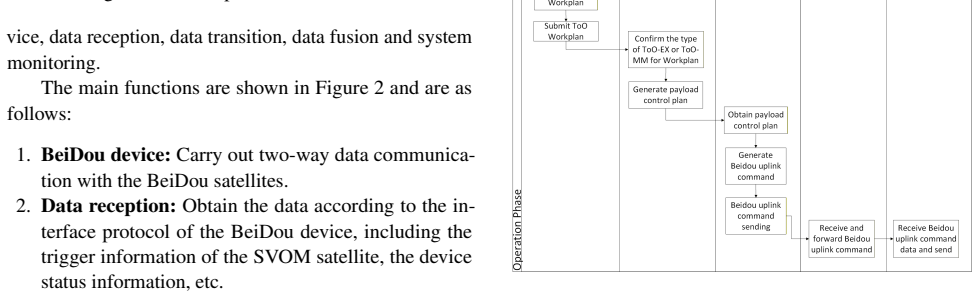
SVOM has implemented on-board and on-ground designs that use the BeiDou-3 short message communication service to enable real-time data flow and collaboration. This allows immediate response to gamma-ray burst triggers. In the first year of in-flight operation, SVOM detected 172 gamma-ray bursts, including 147 by the GRM instrument and 62 by the ECLAIRs instrument, while performing 1040 observations consisting of 122 ToO-EX, 48 ToO-MM, and 870 ToO-NOM observations, all of which increased the mission's scientific output.
What carries the argument
The BeiDou-3 short message communication service, which transmits alerts and data in real time between the satellite and ground segment to trigger rapid follow-up and collaboration.
Load-bearing premise
The reported detection and observation counts result directly from the new BeiDou-3 real-time response system rather than from instrument performance or other mission factors.
What would settle it
A side-by-side comparison of detection and observation rates for SVOM or a similar mission during periods before versus after BeiDou-3 integration, or with another transient monitor lacking equivalent real-time short-message capability.
Figures



read the original abstract
The SVOM mission (Space-based multi-band astronomical Variable Objects Monitor) is a Franco-Chinese mission dedicated to the study of the most distant explosions of stars, the gamma-ray bursts. Here, we introduce the real-time response and collaboration system of SVOM, with the adoption of the BeiDou-3 short message communication service. We present the SVOM on-board and on-ground system designs and data flow, together with the collaboration mechanism with other missions. In the first year of the in-flight operation, SVOM has detected 172 gamma-ray bursts, including 147 by the GRM instrument and 62 by the ECLAIRs instrument. At the same time, SVOM has performed 1040 observations, including 122 ToO-EX(Target of Opportunity-Exceptional) observations, 48 ToO-MM(Target of Opportunity-Multi-messenger) observations and 870 ToO-NOM(Target of Opportunity-Nominal) observations. All these have increased the scientific output of the mission.
Editorial analysis
A structured set of objections, weighed in public.
Referee Report
Summary. The paper describes the SVOM mission's real-time response and collaboration system, which integrates the BeiDou-3 short-message service for low-latency alerts and follow-up coordination. It outlines the on-board and on-ground architectures, data flows, and inter-mission collaboration protocols, then presents first-year in-flight statistics: 172 GRB detections (147 by GRM, 62 by ECLAIRs) and 1040 ToO observations (122 ToO-EX, 48 ToO-MM, 870 ToO-NOM), asserting that these results have increased the mission's scientific output.
Significance. A clear technical description of the BeiDou-3 integration provides a useful operational template for other high-energy missions requiring rapid multi-messenger coordination. If the reported counts can be shown to depend on the real-time channel, the work would offer concrete evidence of improved follow-up efficiency in GRB astronomy; the current presentation leaves that causal link unverified.
major comments (2)
- [Abstract] Abstract: the statement that the 172 GRB detections and 1040 observations 'have increased the scientific output of the mission' is presented immediately after the BeiDou-3 system description but without any baseline comparison, latency distribution, or fraction of triggers routed through the short-message service versus other channels.
- [Results / Operations section] The manuscript provides no disaggregation of the 1040 ToO observations (or the 172 GRBs) by response pathway, preventing assessment of whether the reported numbers are attributable to the new real-time system rather than instrument sensitivity, orbit, or conventional scheduling.
minor comments (1)
- [Abstract] The expansions of ToO-EX, ToO-MM and ToO-NOM are given in parentheses but would be clearer if collected in a short table or glossary for readers outside the SVOM collaboration.
Simulated Author's Rebuttal
We thank the referee for the careful reading and for highlighting the need to strengthen the connection between the described BeiDou-3 real-time system and the reported operational statistics. We agree that the current manuscript does not demonstrate a causal link and will revise the text to avoid overclaiming while preserving the technical description of the system.
read point-by-point responses
-
Referee: [Abstract] Abstract: the statement that the 172 GRB detections and 1040 observations 'have increased the scientific output of the mission' is presented immediately after the BeiDou-3 system description but without any baseline comparison, latency distribution, or fraction of triggers routed through the short-message service versus other channels.
Authors: We agree that the phrasing implies a direct benefit from the real-time system without supporting evidence. The manuscript is a technical description of the on-board, on-ground, and collaboration architecture together with first-year aggregate results. We will revise the abstract to remove the assertion that the detections and observations 'have increased the scientific output' and instead state only the achieved numbers during the period the system was in operation. This change will be incorporated in the revised manuscript. revision: yes
-
Referee: [Results / Operations section] The manuscript provides no disaggregation of the 1040 ToO observations (or the 172 GRBs) by response pathway, preventing assessment of whether the reported numbers are attributable to the new real-time system rather than instrument sensitivity, orbit, or conventional scheduling.
Authors: The manuscript reports only aggregate counts from the first year of flight operations conducted with the integrated real-time response system. No pathway-specific breakdown (BeiDou-3 short-message service versus other channels) is available in the data sources used for this paper, nor is a comparison to a hypothetical baseline without the real-time channel possible from the existing mission logs. We will add a clarifying sentence in the results section stating that all listed ToO observations and GRB detections occurred while the BeiDou-3-based system was active, without claiming exclusive attribution. A full disaggregation would require additional analysis outside the scope of the current work. revision: partial
- Disaggregation of the 1040 ToO observations and 172 GRBs by response pathway is not available from the mission data used in the manuscript.
Circularity Check
No circularity: purely descriptive operations report with no derivations or self-referential predictions
full rationale
The paper is a system-description and operations summary. It introduces the BeiDou-3 real-time response architecture, describes on-board/ground data flows and collaboration mechanisms, then states first-year mission statistics (172 GRBs, 1040 ToO observations) as factual outcomes. No equations, fitted parameters, predictions, or uniqueness theorems appear; the statistics are not derived from the system description by construction, nor is any result renamed or smuggled via self-citation. Attribution to the new system versus other factors is an evidentiary question outside the scope of circularity analysis. The derivation chain is empty, so the paper is self-contained against external benchmarks.
Axiom & Free-Parameter Ledger
Reference graph
Works this paper leans on
-
[1]
2004, ApJ, 611, 1005
Gehrels, N., Chincarini, G., Giommi, P., et al. 2004, ApJ, 611, 1005
2004
-
[2]
L., Schanne, S., Lachaud, C., & others
Godet, O., Atteia, J. L., Schanne, S., Lachaud, C., & others. 2026, RAA (Research in Astronomy and Astrophysics), this issue, 1 G¨otz, D., Crepaldi, S., Doumayrou, E., et al. 2026, RAA (Research in Astronomy and Astrophysics), this issue, 1
2026
-
[3]
J., & others
Huang, M., Zheng, S. J., & others. 2026, RAA (Research in Astronomy and Astrophysics), this issue, 1
2026
-
[4]
2026, RAA (Research in Astronomy and Astrophysics), this issue, 1
Liu, Y ., Bai, M., Wei, M., & Li, B. 2026, RAA (Research in Astronomy and Astrophysics), this issue, 1
2026
-
[5]
2026, RAA (Research in Astronomy and Astrophysics), this issue, 1
Louvin, H., Corre, D., Formica, A., & others. 2026, RAA (Research in Astronomy and Astrophysics), this issue, 1
2026
-
[6]
L., Wang, J
Qiu, Y . L., Wang, J. M., Ho, L. C., et al. 2026, RAA (Research in Astronomy and Astrophysics), this issue, 1
2026
-
[7]
C., Dong, Y
Sun, J. C., Dong, Y . W., He, J., Liu, J. T., & others. 2026, RAA (Research in Astronomy and Astrophysics), this issue, 1
2026
-
[8]
2020, Satellite Navigation, 1, 8
Yang, Y ., Gao, W., Guo, S., Mao, Y ., & Yang, Y . 2020, Satellite Navigation, 1, 8
2020
-
[9]
2025, Science China
Yuan, W., Dai, L., Feng, H., et al. 2025, Science China
2025
-
[10]
Physics, Mechanics, and Astronomy, 68, 239501 5 Table 2: Joint SVOM/Swift observations in 2025 . No Name Uncatalogued sources(Total sources) Trigger Time(UTC) 1 GRB 251103A 1 (2) 2025-11-03 04:46:26 2 GRB 251027A 3 (0) 2025-10-27 09:37:56 3 GRB 251026A 2 (0) 2025-10-26 08:26:46 4 GRB 251025B 1 (0) 2025-10-25 14:24:00 5 sb25102501 0 (1) 2025-10-25 09:32:38...
2025
discussion (0)
Sign in with ORCID, Apple, or X to comment. Anyone can read and Pith papers without signing in.