Recognition: unknown
GRM Scientific Pipeline
Pith reviewed 2026-05-07 17:46 UTC · model grok-4.3
The pith
The GRM data processing system converts gamma-ray burst detections into L1B/C scientific products through modular event-driven design.
A machine-rendered reading of the paper's core claim, the machinery that carries it, and where it could break.
Core claim
Through modular architecture design and automated processing workflow, the GRM data processing system realizes precise conversion and scientific analysis of GRB detection data, providing robust technical support for future system upgrades and cross-platform collaboration.
What carries the argument
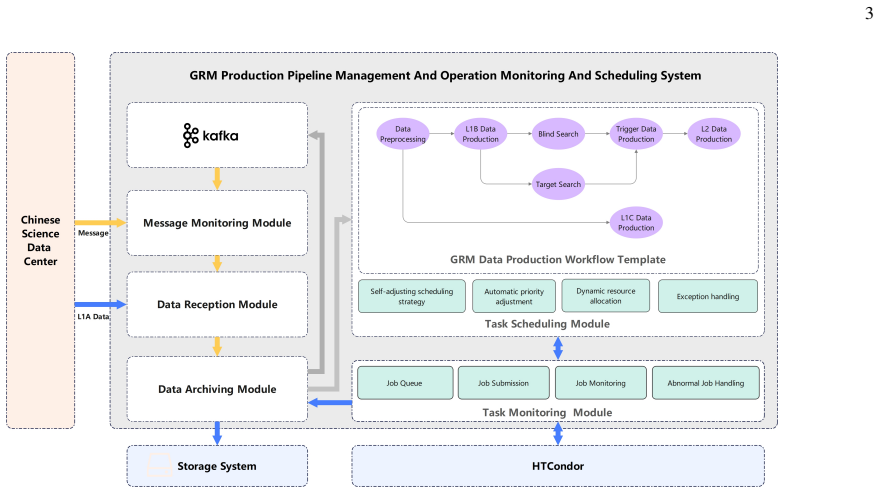
Event-driven architecture combined with distributed design that routes data through real-time X-band links and a task scheduling system to generate L1B/C scientific products.
If this is right
- Enables efficient production of L1B and L1C level scientific data products from GRB detections.
- Supports real-time monitoring of large volumes of observational data from the GRM payload.
- Facilitates rapid response to high-energy transient events captured by the instrument.
- Provides a foundation for future upgrades and collaboration across different computing platforms.
Where Pith is reading between the lines
- The same modular workflow could be reused for data streams from other gamma-ray instruments on similar missions.
- Linking the pipeline outputs directly to multi-messenger alert systems would shorten the time to joint observations.
- Running the described scheduler on simulated high-rate data bursts would test whether the real-time claim holds under peak load.
Load-bearing premise
The described event-driven architecture and distributed design will achieve real-time processing and precise conversion of massive observational data.
What would settle it
Actual on-orbit processing of a detected GRB event with measured latency under one minute and output products that match independent manual reduction of the same raw counts.
Figures


read the original abstract
The Gamma-Ray Monitor (GRM) is a key payload of the Space-based multiband astronomical Variable Objects Monitor (SVOM) mission, which is designed to detect gamma ray bursts (GRBs) within the energy range of 15 keV to 5 MeV. The GRM Instrument Center (GRM\_IC) features real-time data processing through the X-band, enabling rapid response of high-energy GRB events. The system employs an event-driven architecture and distributed design, achieving efficient processing and real-time monitoring of massive observational data. Through comprehensive data production processes and scientific data product management, the system achieves efficient production of scientific data products of the L1B / C level through the submission of jobs to the task scheduling system. Through modular architecture design and automated processing workflow, the GRM data processing system realizes precise conversion and scientific analysis of GRB detection data, providing robust technical support for future system upgrades and cross-platform collaboration.
Editorial analysis
A structured set of objections, weighed in public.
Referee Report
Summary. The manuscript describes the GRM Scientific Pipeline for the SVOM mission's Gamma-Ray Monitor instrument, which detects GRBs in the 15 keV–5 MeV range. It outlines an event-driven, distributed architecture for real-time data processing via X-band, job submission to a task scheduler for L1B/C product generation, modular design, and automated workflows intended to enable precise conversion and scientific analysis of GRB data while supporting future upgrades and cross-platform use.
Significance. A well-documented pipeline architecture for space-based GRB data handling could provide useful reference material for instrument teams on SVOM or similar missions. However, the manuscript supplies only high-level design descriptions with no performance metrics, validation results, or empirical demonstrations, so its significance remains that of an unverified system overview rather than a demonstrated technical advance.
major comments (1)
- [Abstract] Abstract: the central claims that the system 'achieves efficient processing and real-time monitoring of massive observational data' and 'realizes precise conversion and scientific analysis' rest entirely on assertions about the event-driven and distributed design. No latency, throughput, error-rate, or scaling measurements are reported, nor is any validation against known GRB events or ground-truth data provided. This directly undermines the functional-correctness and performance assertions that constitute the paper's main contribution.
Simulated Author's Rebuttal
We thank the referee for their review and constructive feedback on the manuscript describing the GRM Scientific Pipeline. We address the major comment below and have revised the manuscript to ensure claims are appropriately supported by the presented content.
read point-by-point responses
-
Referee: [Abstract] Abstract: the central claims that the system 'achieves efficient processing and real-time monitoring of massive observational data' and 'realizes precise conversion and scientific analysis' rest entirely on assertions about the event-driven and distributed design. No latency, throughput, error-rate, or scaling measurements are reported, nor is any validation against known GRB events or ground-truth data provided. This directly undermines the functional-correctness and performance assertions that constitute the paper's main contribution.
Authors: We agree that the abstract's phrasing implies achieved performance outcomes that are not quantitatively demonstrated in the manuscript. The paper's focus is the description of the event-driven distributed architecture, modular workflows, and data product generation processes for the SVOM GRM instrument. In the revised version, we will update the abstract to describe the design features and their intended benefits for efficient processing without asserting specific performance results. We will also add a short section outlining the architectural rationale for real-time capabilities and note that detailed latency, throughput, and validation metrics against flight data will be presented in subsequent operational papers once the mission is active. This revision ensures the claims align with the manuscript's scope as a system architecture reference. revision: yes
Circularity Check
No circularity; purely descriptive system architecture report with no derivations or fitted claims.
full rationale
The paper is a technical description of the GRM data processing pipeline's modular architecture, event-driven design, job submission workflow, and L1B/C product generation. No equations, parameter fittings, predictions, or first-principles derivations appear anywhere in the provided text or abstract. Claims of 'precise conversion' and 'real-time processing' are presented as outcomes of the described design choices rather than results derived from prior data or self-referential inputs. No self-citations, uniqueness theorems, or ansatzes are invoked as load-bearing steps. The manuscript contains no derivation chain that could reduce to its own inputs by construction.
Axiom & Free-Parameter Ledger
Reference graph
Works this paper leans on
-
[1]
1993, ApJ, 413, 281 4
Band, D., Matteson, J., Ford, L., et al. 1993, ApJ, 413, 281 4
1993
-
[2]
S., Camp, J., et al
Blackburn, L., Briggs, M. S., Camp, J., et al. 2015, The Astrophysical Journal Supplement Series, 217, 8 4, 5
2015
-
[3]
L., Li, C
Cai, C., Xiong, S. L., Li, C. K., et al. 2021, Monthly Notices of the Royal Astronomical Society, 508, 3910–3920 4, 5
2021
-
[4]
2024, Science China Physics, Mechanics, and Astronomy, 68 4
Cai, C., Zhang, Y .-Q., Xiong, S.-L., et al. 2024, Science China Physics, Mechanics, and Astronomy, 68 4
2024
-
[5]
2025, ApJS, 277, 9 5
Cai, C., Zhang, Y .-Q., Xiong, S.-L., et al. 2025, ApJS, 277, 9 5
2025
-
[6]
2010, Science China Physics, Mechanics, and Astronomy, 53, 40 4
Dong, Y ., Wu, B., Li, Y ., Zhang, Y ., & Zhang, S. 2010, Science China Physics, Mechanics, and Astronomy, 53, 40 4
2010
-
[7]
Eichler, D., Livio, M., Piran, T., & Schramm, D. N. 1989, Nature, 340, 126 1
1989
-
[8]
2018, in Space Telescopes and Instrumentation 2018: Ultraviolet to Gamma Ray, ed
Gonzalez, F., & Yu, S. 2018, in Space Telescopes and Instrumentation 2018: Ultraviolet to Gamma Ray, ed. J.-W. A. den Herder, S. Nikzad, & K. Nakazawa, V ol. 10699, International Society for Optics and Photonics (SPIE), 1069920 1
2018
-
[9]
2020, Scientia Sinica
Guo, D., Peng, W., Zhu, Y ., et al. 2020, Scientia Sinica
2020
-
[10]
W., Strong, I
Klebesadel, R. W., Strong, I. B., & Olson, R. A. 1973, The Astrophysical Journal, 182, L85 1
1973
-
[11]
Wei, J., Cordier, B., Antier, S., et al. 2016, arXiv e-prints, arXiv:1610.06892 1
work page internal anchor Pith review arXiv 2016
-
[12]
Woosley, S. E. 1993, The Astrophysical Journal, 405, 273 1
1993
-
[13]
2022, in 44th COSPAR Scientific Assembly
Xiong, S., & Zhang, S.-N. 2022, in 44th COSPAR Scientific Assembly. Held 16-24 July, V ol. 44, 1927 5
2022
-
[14]
2020, Chinese Astronomy and Astrophysics, 44, 269 1
Yu, S.-j., Gonzalez, F., Wei, J.-y., Zhang, S.-n., & Cordier, B. 2020, Chinese Astronomy and Astrophysics, 44, 269 1
2020
-
[15]
2013, Research in Astronomy and Astrophysics, 13, 1381 4
Zhao, D.-H., Wu, B.-B., Song, L.-M., et al. 2013, Research in Astronomy and Astrophysics, 13, 1381 4
2013
-
[16]
2018, Research in Astronomy and Astrophysics, 18, 057 5
Zhao, Y ., Zhang, B.-B., Xiong, S.-L., et al. 2018, Research in Astronomy and Astrophysics, 18, 057 5
2018
-
[17]
2024, Research in Astronomy and Astrophysics, 24, 104003 6
Zhao, Y ., Xue, W., Xiong, S., et al. 2024, Research in Astronomy and Astrophysics, 24, 104003 6
2024
discussion (0)
Sign in with ORCID, Apple, or X to comment. Anyone can read and Pith papers without signing in.