Recognition: unknown
SVOM/VT: Real-Time Onboard Data Processing
Pith reviewed 2026-05-07 17:55 UTC · model grok-4.3
The pith
SVOM/VT onboard pipeline processes images in real time to deliver VHF data for 78% of slewed GRBs and identify optical counterparts in 56% of cases within 18 minutes.
A machine-rendered reading of the paper's core claim, the machinery that carries it, and where it could break.
Core claim
In-flight performance analysis confirms the pipeline's robustness, demonstrating the availability of VT VHF data for 78 percent of promptly slewed SVOM GRBs, with 56 percent leading to the identification of optical counterparts, typically within 18 minutes post-trigger.
Load-bearing premise
The image quality assessment, correction, and stacking algorithms perform correctly and without significant information loss or false detections when operating on actual space data under variable background and cosmic-ray conditions.
Figures

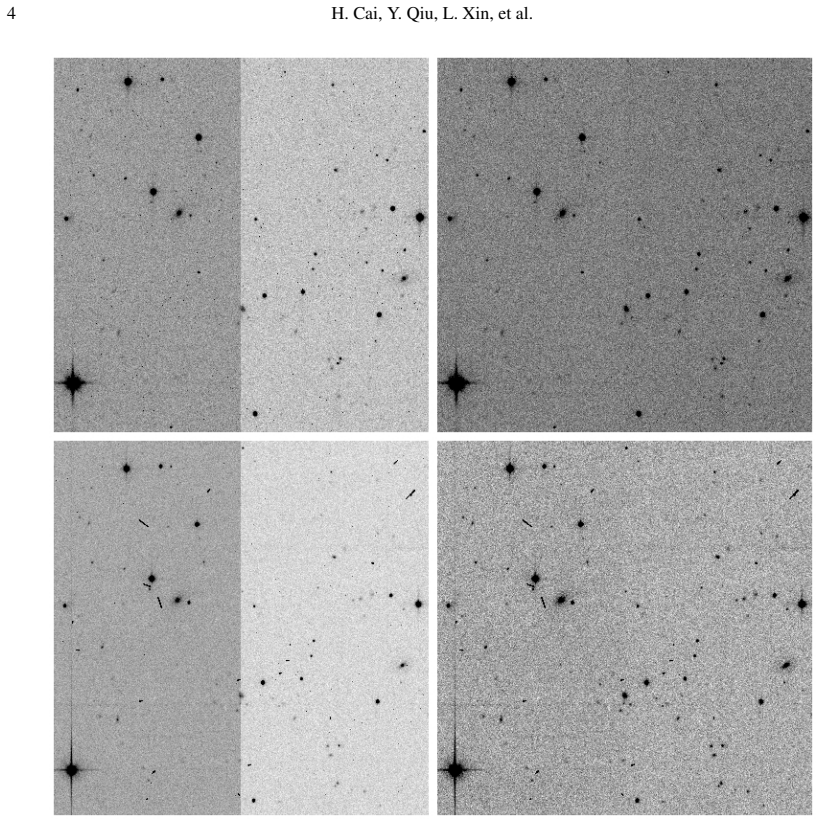


read the original abstract
The SVOM Visible Telescope (VT) is critical for the rapid identification of gamma-ray burst (GRB) optical counterparts, particularly for high-redshift candidates that require immediate infrared spectroscopic follow-up. To address the stringent bandwidth constraints of the VHF downlink while ensuring real-time data availability, we developed the VT Onboard Data Processing Pipeline (VOPP).This paper details the software architecture, algorithms, and hardware implementation of VOPP using an FPGA and a CPU. The pipeline performs essential real-time tasks, including image quality assessment, dark and flat-field correction, and optimized image stacking to mitigate cosmic ray contamination and variable background noise. Furthermore, it generates compact source catalogs and highly compressed 1-bit images to facilitate rapid downlink.In-flight performance analysis confirms the pipeline's robustness, demonstrating the availability of VT VHF data for 78 percent of promptly slewed SVOM GRBs, with 56 percent leading to the identification of optical counterparts, typically within 18 minutes post-trigger.
Editorial analysis
A structured set of objections, weighed in public.
Referee Report
Summary. The paper describes the SVOM Visible Telescope (VT) Onboard Data Processing Pipeline (VOPP), including its FPGA/CPU architecture and algorithms for real-time image quality assessment, dark/flat-field correction, cosmic-ray mitigation via stacking, compact source catalog generation, and 1-bit image compression to meet VHF downlink constraints. It reports in-flight performance metrics of VT VHF data availability for 78% of promptly slewed SVOM GRBs, with 56% leading to optical counterpart identification typically within 18 minutes post-trigger.
Significance. If the reported performance holds under rigorous validation, the pipeline provides a concrete demonstration of onboard real-time data reduction for space-based GRB follow-up, addressing bandwidth limits and enabling timely high-redshift counterpart identification. The detailed hardware/software implementation offers a practical reference for future transient astronomy missions.
major comments (1)
- [In-flight performance analysis] In-flight performance analysis section: the reported 78% VHF data availability and 56% optical counterpart identification rates are given as aggregate percentages without supporting quantitative validation such as completeness/purity metrics, false-positive rates from cosmic-ray residuals, error analysis, or direct comparisons against ground-processed full-frame images. This is load-bearing for the robustness claim, since the central result depends on the image quality assessment, correction, and stacking algorithms introducing no significant information loss or spurious detections on actual orbital data with variable backgrounds.
minor comments (1)
- [Abstract] The abstract asserts that in-flight analysis 'confirms the pipeline's robustness' without specifying the validation methods or metrics employed.
Axiom & Free-Parameter Ledger
Reference graph
Works this paper leans on
-
[1]
P., Abbott, R., Abbott, T
Abbott, B. P., Abbott, R., Abbott, T. D., et al. 2017, Phys. Rev. Lett., 119, 161101 2
2017
-
[2]
1996, A&AS, 117, 393 10
Bertin, E., & Arnouts, S. 1996, A&AS, 117, 393 10
1996
- [3]
-
[4]
Cordier, B., Wei, J. Y ., Tanvir, N. R., et al. 2025, arXiv e-prints, arXiv:2507.18783 2, 14
-
[5]
A., Beardmore, A
Evans, P. A., Beardmore, A. P., Goad, M. R., et al. 2008, in American Institute of Physics Conference Series, V ol. 1000, Gamma-ray Bursts 2007, ed. M. Galassi, D. Palmer, & E. Fenimore (AIP), 539 8
2008
-
[6]
2004, ApJ, 611, 1005 2
Gehrels, N., Chincarini, G., Giommi, P., et al. 2004, ApJ, 611, 1005 2
2004
-
[7]
2015, Phys
Kumar, P., & Zhang, B. 2015, Phys. Rep., 561, 1 2
2015
-
[8]
Q., & Reichart, D
Lamb, D. Q., & Reichart, D. E. 2000, ApJ, 536, 1 2
2000
-
[9]
L., Qiu, Y ., Xin, L
Li, H. L., Qiu, Y ., Xin, L. P., et al. 2026b, Research in Astron. Astrophys. (RAA), 1, this issue 14 M´esz´aros, P. 2006, Reports on Progress in Physics, 69, 2259 2
2006
-
[10]
2026, Research in Astron
Qiu, Y .-L., Xin, L.-P., Deng, J.-S., et al. 2026, Research in Astron. Astrophys. (RAA), 1, this issue 2, 9, 13, 14
2026
-
[11]
Roming, P. W. A., Kennedy, T. E., Mason, K. O., et al. 2005, Space Sci. Rev., 120, 95 2
2005
-
[12]
2010, Science China Physics, Mechanics, and Astronomy, 53, 51 8
Wang, T., Qiu, Y ., Cai, H., & Deng, J. 2010, Science China Physics, Mechanics, and Astronomy, 53, 51 8
2010
-
[13]
Wei, J., Cordier, B., Antier, S., et al. 2016, arXiv e-prints, arXiv:1610.06892 2
work page internal anchor Pith review arXiv 2016
-
[14]
E., & Bloom, J
Woosley, S. E., & Bloom, J. S. 2006, ARA&A, 44, 507 2
2006
-
[15]
Palmerio, J
Wu, C., Jesse T. Palmerio, J. T., Sadibekova, T., Canton, Y ., & Tazhenova, K. 2026, Research in Astron. Astrophys. (RAA), 1, this issue 8, 9, 11, 13, 14
2026
-
[16]
H., Qiu, Y
Yao, Z. H., Qiu, Y . L., Xin, L. P., et al. 2026, Research in Astron. Astrophys. (RAA), 1, this issue 11
2026
-
[17]
2025, Science China Physics, Mechanics, and Astronomy, 68, 239501 2
Yuan, W., Dai, L., Feng, H., et al. 2025, Science China Physics, Mechanics, and Astronomy, 68, 239501 2
2025
discussion (0)
Sign in with ORCID, Apple, or X to comment. Anyone can read and Pith papers without signing in.