Recognition: unknown
SVOM/C-GFT: Instrumentation and Performances on the SVOM Alerts
Pith reviewed 2026-05-07 17:42 UTC · model grok-4.3
The pith
The C-GFT 1.2-meter telescope meets its design specifications for rapid follow-up of SVOM gamma-ray burst alerts after more than a year of operation.
A machine-rendered reading of the paper's core claim, the machinery that carries it, and where it could break.
Core claim
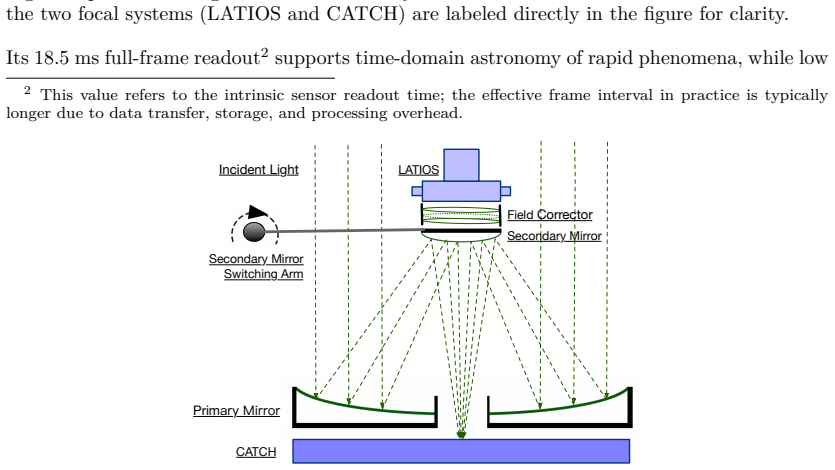
The C-GFT observatory, featuring a 1.2-m telescope with the prime-focus LATIOS wide-field camera and the Cassegrain-focus three-channel CATCH camera, operates under an automated framework that processes SVOM alerts, acquires images, and runs data pipelines; results from more than one year of post-launch service confirm that the entire system meets its design specifications for rapid identification and monitoring of optical counterparts.
What carries the argument
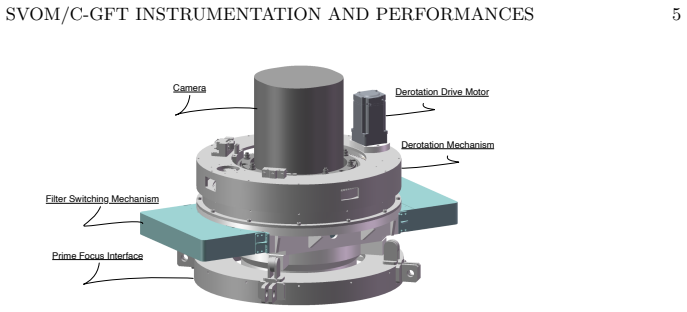
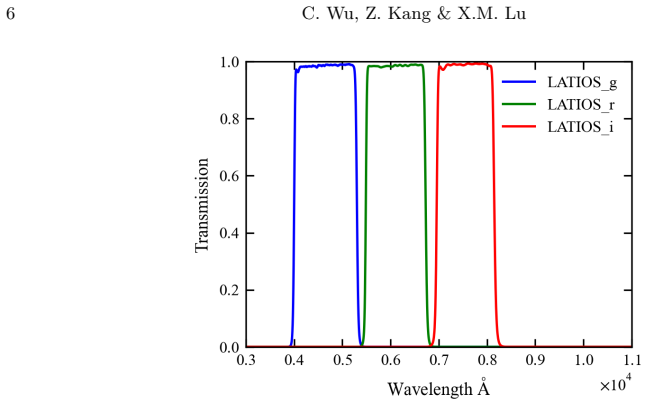
The switchable focal-plane instruments (LATIOS wide-field camera and CATCH three-channel camera) combined with the automated operational framework that handles alert reception, telescope pointing, and data processing.
If this is right
- The automated system enables reliable rapid-response observations whenever SVOM issues a gamma-ray burst alert.
- Dual-camera capability supports both wide-field searches and detailed multi-band follow-up in a single facility.
- Data pipelines deliver processed images and measurements that meet the precision needed for scientific analysis of transients.
- Operational performance remains consistent enough to support continuous participation in the SVOM alert network.
Where Pith is reading between the lines
- The same automated alert-handling approach could be applied to other satellite missions that issue transient alerts.
- Extended multi-year monitoring would help identify any seasonal or instrumental trends that the first-year sample might miss.
- Coordination with additional ground telescopes could reduce overall response gaps in the SVOM follow-up network.
Load-bearing premise
The one-year dataset is assumed to represent the telescope's ongoing performance without undetected systematic biases, calibration drifts, or selection effects in the reported metrics.
What would settle it
A later dataset covering a second full year that shows the system falling short on response time, image quality, or counterpart detection rate would indicate the performance claim does not hold for sustained operation.
Figures



read the original abstract
The Chinese Ground Follow-up Telescope (C-GFT) is an optical facility upgraded to support the Space Variable Objects Monitor mission (\textit{SVOM}). Located at the Jilin Observation Station, it is capable of rapidly identifying and monitoring the optical counterparts of Gamma-Ray Bursts (GRBs). The 1.2-m telescope is equipped with two switchable focal-plane instruments: the prime-focus wide-field LATIOS camera and the Cassegrain-focus three-channel CATCH camera. In this paper, we present a system overview, including the observatory, the telescope, the instrumentation, the automated operational framework managed by the Operations Center, and the data processing pipelines. We also report the performance results obtained during over one year of \textit{SVOM}'s post-launch operations. The results demonstrate that the system meets its design specifications and delivers robust observational and operational performance.
Editorial analysis
A structured set of objections, weighed in public.
Referee Report
Summary. The manuscript describes the Chinese Ground Follow-up Telescope (C-GFT) for the SVOM mission, covering its location at Jilin, the 1.2-m telescope, switchable instruments (prime-focus LATIOS wide-field camera and Cassegrain CATCH three-channel camera), the Operations Center-managed automated framework, data processing pipelines, and performance results from over one year of post-launch SVOM operations. The central claim is that the system meets its design specifications and delivers robust observational and operational performance for rapid GRB counterpart identification.
Significance. If substantiated with quantitative metrics, this instrumentation paper would be useful for documenting SVOM ground-follow-up capabilities and could serve as a reference for similar automated GRB follow-up facilities. The detailed system overview and pipeline descriptions add practical value for the community. However, the significance is tempered by the absence of explicit quantitative performance data, error bars, or validation against design goals in the provided text, limiting the ability to assess long-term robustness.
major comments (2)
- [Performance results (as referenced in abstract)] The performance results section asserts that the system meets design specifications after one year of operations, but provides no quantitative metrics (e.g., measured response times, sensitivity limits, uptime fractions, or alert completeness rates) with uncertainties, comparisons to pre-launch goals, or statistical details. This leaves the central claim unassessable from the manuscript text.
- [Performance results and system overview] The one-year operational dataset is presented as representative of robust performance without explicit checks for selection effects (e.g., whether followed-up alerts are unbiased relative to the full SVOM alert stream), calibration stability of the LATIOS or CATCH cameras, or seasonal/operational biases in the automated pipeline. These omissions directly affect the reliability of the robustness claim.
minor comments (1)
- [Abstract] The abstract would benefit from including at least one or two key quantitative performance numbers to summarize the results section.
Simulated Author's Rebuttal
We thank the referee for the careful and constructive review of our manuscript on the C-GFT for SVOM. We have addressed the concerns about the lack of quantitative metrics and checks for biases by expanding the performance section in the revised version.
read point-by-point responses
-
Referee: [Performance results (as referenced in abstract)] The performance results section asserts that the system meets design specifications after one year of operations, but provides no quantitative metrics (e.g., measured response times, sensitivity limits, uptime fractions, or alert completeness rates) with uncertainties, comparisons to pre-launch goals, or statistical details. This leaves the central claim unassessable from the manuscript text.
Authors: We agree that the performance results section in the submitted manuscript did not present sufficient quantitative metrics with uncertainties and comparisons to allow full assessment of the claims. In the revised manuscript we have added a dedicated table and accompanying text that reports measured response times, sensitivity limits for both instruments, uptime fractions, and alert completeness rates, each with uncertainties, direct comparisons to the pre-launch design goals, and basic statistical details derived from the one-year dataset. These additions make the central claim assessable from the text. revision: yes
-
Referee: [Performance results and system overview] The one-year operational dataset is presented as representative of robust performance without explicit checks for selection effects (e.g., whether followed-up alerts are unbiased relative to the full SVOM alert stream), calibration stability of the LATIOS or CATCH cameras, or seasonal/operational biases in the automated pipeline. These omissions directly affect the reliability of the robustness claim.
Authors: We acknowledge that the original manuscript did not explicitly address selection effects, calibration stability, or potential seasonal/operational biases. The revised manuscript now contains a new subsection that compares the properties of followed-up alerts against the full SVOM alert stream to evaluate selection effects, reports on the photometric calibration stability of the LATIOS and CATCH cameras across the one-year period, and discusses checks for seasonal or operational biases in the automated pipeline. These additions support the reliability of the robustness conclusion. revision: yes
Circularity Check
No circularity: purely descriptive instrumentation and operations report
full rationale
The paper is a system overview and performance summary based on one year of operational data for the C-GFT telescope supporting SVOM. It contains no equations, derivations, fitted parameters, predictions, or load-bearing self-citations that reduce to inputs by construction. Claims of meeting design specifications are direct reports of observed metrics rather than any self-referential chain. This matches the default expectation of no circularity for descriptive papers without mathematical derivations.
Axiom & Free-Parameter Ledger
Reference graph
Works this paper leans on
-
[1]
2025, The Astrophysical Journal, 980, 241 1
Atteia, J.-L., Bouchet, L., Dezalay, J.-P., et al. 2025, The Astrophysical Journal, 980, 241 1
2025
-
[2]
H., Watson, A
Basa, S., Lee, W. H., Watson, A. H., et al. 2026, Research in Astronomy and Astrophysics, 25, this issue 2
2026
-
[3]
H., Dolon, F., et al
Basa, S., Lee, W. H., Dolon, F., et al. 2022, in Society of Photo-Optical Instrumentation Engineers (SPIE) Conference Series, Vol. 12182, Ground-based and Airborne Telescopes IX, ed. H. K. Marshall, J. Spyromilio, & T. Usuda, 121821S 2
2022
-
[4]
1996, A&AS, 117, 393 15
Bertin, E., & Arnouts, S. 1996, A&AS, 117, 393 15
1996
-
[5]
Chambers, K. C., Magnier, E. A., Metcalfe, N., et al. 2016, arXiv e-prints, arXiv:1612.05560 12
work page internal anchor Pith review arXiv 2016
-
[6]
2026, Research in Astronomy and Astrophysics, 25, this issue 8
Cordier, B., et al. 2026, Research in Astronomy and Astrophysics, 25, this issue 8
2026
-
[7]
2025, GRB 250912A: SVOM detection of a burst 15 Gaia Collaboration, Vallenari, A., Brown, A
Ducoin, J.-G., Dornic, D., Yang, H., et al. 2025, GRB 250912A: SVOM detection of a burst 15 Gaia Collaboration, Vallenari, A., Brown, A. G. A., et al. 2023, A&A, 674, A1 12
2025
-
[8]
2004, ApJ, 611, 1005 8
Gehrels, N., Chincarini, G., Giommi, P., et al. 2004, ApJ, 611, 1005 8
2004
-
[9]
2004, The Astrophysical Journal, 616, 331 1
Ghirlanda, G., Ghisellini, G., & Lazzati, D. 2004, The Astrophysical Journal, 616, 331 1
2004
-
[10]
2026, Research in Astronomy and Astrophysics, 25, this issue 2
Godet, O., et al. 2026, Research in Astronomy and Astrophysics, 25, this issue 2
2026
-
[11]
2024, A&A, 691, A158 1
Greiner, J., Krühler, T., Bolmer, J., et al. 2024, A&A, 691, A158 1
2024
-
[12]
2026, Research in Astronomy and Astrophysics, 25, this issue 9
Han, X.-H., Xin, L.-P., Wang, J., et al. 2026, Research in Astronomy and Astrophysics, 25, this issue 9
2026
-
[13]
2025, SVOM Follow-up Observation Coordinating Service, arXiv:2511.06647 8
Han, X.-H., Zhang, P.-P., Xiao, Y.-J., et al. 2025, SVOM Follow-up Observation Coordinating Service, arXiv:2511.06647 8
-
[14]
2021, PASP, 133, 065001 2
Han, X., Xiao, Y., Zhang, P., et al. 2021, PASP, 133, 065001 2
2021
-
[15]
W., Blanton, M., Lang, D., Mierle, K., & Roweis, S
Hogg, D. W., Blanton, M., Lang, D., Mierle, K., & Roweis, S. 2008, in Astronomical Society of the Pacific Conference Series, Vol. 394, Astronomical Data Analysis Software and Systems XVII, ed. R. W. Argyle, P. S. Bunclark, & J. R. Lewis, 27 11
2008
-
[16]
2026, Research in Astronomy and Astrophysics, 25, this issue 8
Huang, M.-H., et al. 2026, Research in Astronomy and Astrophysics, 25, this issue 8
2026
-
[17]
2024, Acta Astronomica Sinica, 65, 12 2
Kang, Z., NIU, B.-L., Li, Z.-W., et al. 2024, Acta Astronomica Sinica, 65, 12 2
2024
-
[18]
A., Klose, S., Zhang, B., et al
Kann, D. A., Klose, S., Zhang, B., et al. 2010, ApJ, 720, 1513 17, 18
2010
-
[19]
A., Klose, S., Zhang, B., et al
Kann, D. A., Klose, S., Zhang, B., et al. 2011, ApJ, 734, 96 17, 18
2011
-
[20]
A., White, N
Kann, D. A., White, N. E., Ghirlanda, G., et al. 2024, A&A, 686, A56 2
2024
-
[21]
W., Mierle, K., Blanton, M., & Roweis, S
Lang, D., Hogg, D. W., Mierle, K., Blanton, M., & Roweis, S. 2010, AJ, 137, 1782–2800, arXiv:0910.2233 11
-
[22]
1998, MNRAS, 296, 339 15
Naylor, T. 1998, MNRAS, 296, 339 15
1998
-
[23]
J., Jeffries, R
Naylor, T., Totten, E. J., Jeffries, R. D., et al. 2002, MNRAS, 335, 291 15
2002
-
[24]
2022, Research in Astronomy and Astrophysics, 22, 055009 12
Niu, B.-L., Liu, C.-Z., Li, Z.-W., Kang, Z., & Lv, Y. 2022, Research in Astronomy and Astrophysics, 22, 055009 12
2022
-
[25]
2026, Research in Astronomy and Astrophysics, 25, this issue 2
Qiu, Y.-L., Li-Ping, X., Deng, J.-S., et al. 2026, Research in Astronomy and Astrophysics, 25, this issue 2
2026
-
[26]
2025, in AAS/High Energy Astrophysics Division, Vol
Racusin, J., Singer, L., Sharma, V., et al. 2025, in AAS/High Energy Astrophysics Division, Vol. 22, AAS/High Energy Astrophysics Division, 403.02 8 Sánchez-Ramírez, R., Lang, R. G., Pozanenko, A., et al. 2024, A&A, 692, A3 2
2025
-
[27]
1986, in Society of Photo-Optical Instrumentation Engineers (SPIE) Conference Series, Vol
Tody, D. 1986, in Society of Photo-Optical Instrumentation Engineers (SPIE) Conference Series, Vol. 627, Instrumentation in astronomy VI, ed. D. L. Crawford, 733 15
1986
-
[28]
L., Stubbs, C
Tonry, J. L., Stubbs, C. W., Lykke, K. R., et al. 2012, ApJ, 750, 99 12
2012
-
[29]
2024, ApJ, 969, 146 2
Wang, X.-G., Zhou, J.-W., Zhou, Z.-M., et al. 2024, ApJ, 969, 146 2
2024
-
[30]
Wei, J., Cordier, B., Antier, S., et al. 2016, arXiv e-prints, arXiv:1610.06892 2
work page internal anchor Pith review arXiv 2016
-
[31]
T., Sadibekova, T., et al
Wu, C., Palmerio, J. T., Sadibekova, T., et al. 2026, Research in Astronomy and Astrophysics, 25, this issue 17
2026
-
[32]
2024, GRB Coordinates Network, 37292, 1 17
Wu, C., Kang, Z., Xin, L., et al. 2024, GRB Coordinates Network, 37292, 1 17
2024
-
[33]
2026, Research in Astronomy and Astrophysics, 25, this issue 2
Xin, L.-P., Han, X.-H., Huang, L., et al. 2026, Research in Astronomy and Astrophysics, 25, this issue 2
2026
-
[34]
2023, Nature Astronomy, 7, 724 2
Xin, L., Han, X., Li, H., et al. 2023, Nature Astronomy, 7, 724 2
2023
-
[35]
2022, in Handbook of X-ray and Gamma-ray Astrophysics, ed
Yuan, W., Zhang, C., Chen, Y., & Ling, Z. 2022, in Handbook of X-ray and Gamma-ray Astrophysics, ed. C. Bambi & A. Sangangelo, 86 8
2022
-
[36]
T., Girard, T
Zacharias, N., Finch, C. T., Girard, T. M., et al. 2013, AJ, 145, 44 11
2013
-
[37]
2004, International Journal of Modern Physics A, 19, 2385 1
ZHANG, B., & MÉSZÁROS, P. 2004, International Journal of Modern Physics A, 19, 2385 1
2004
discussion (0)
Sign in with ORCID, Apple, or X to comment. Anyone can read and Pith papers without signing in.