Recognition: unknown
Resonant RF Wakefield Coupling for Radiation-Reaction Control of 3D Betatron Dynamics in Hybrid Laser Plasma Accelerators
Pith reviewed 2026-05-07 17:26 UTC · model grok-4.3
The pith
Resonant RF fields aligned with betatron frequencies reduce emittance in hybrid laser-plasma accelerators by boosting radiative damping of transverse oscillations.
A machine-rendered reading of the paper's core claim, the machinery that carries it, and where it could break.
Core claim
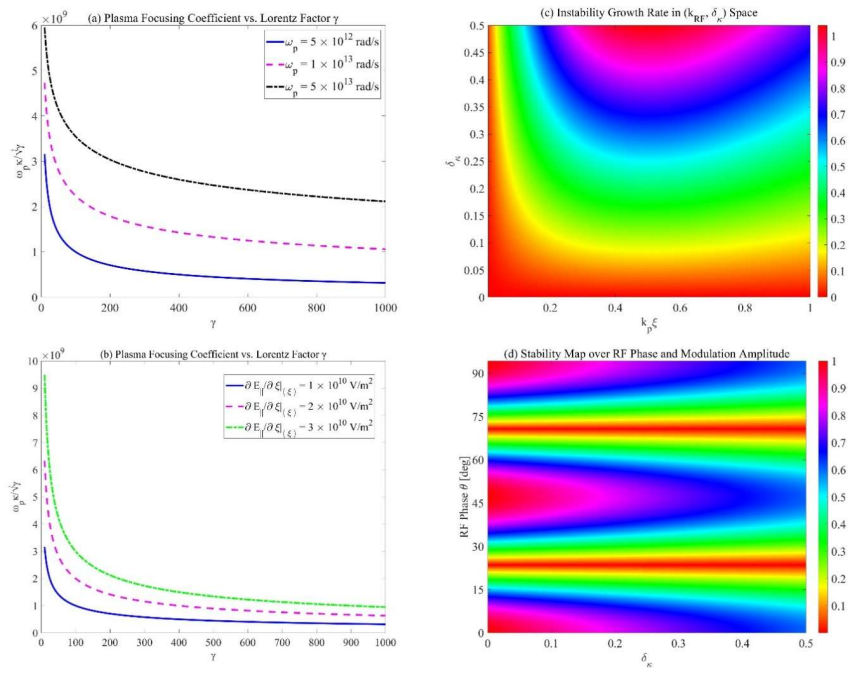
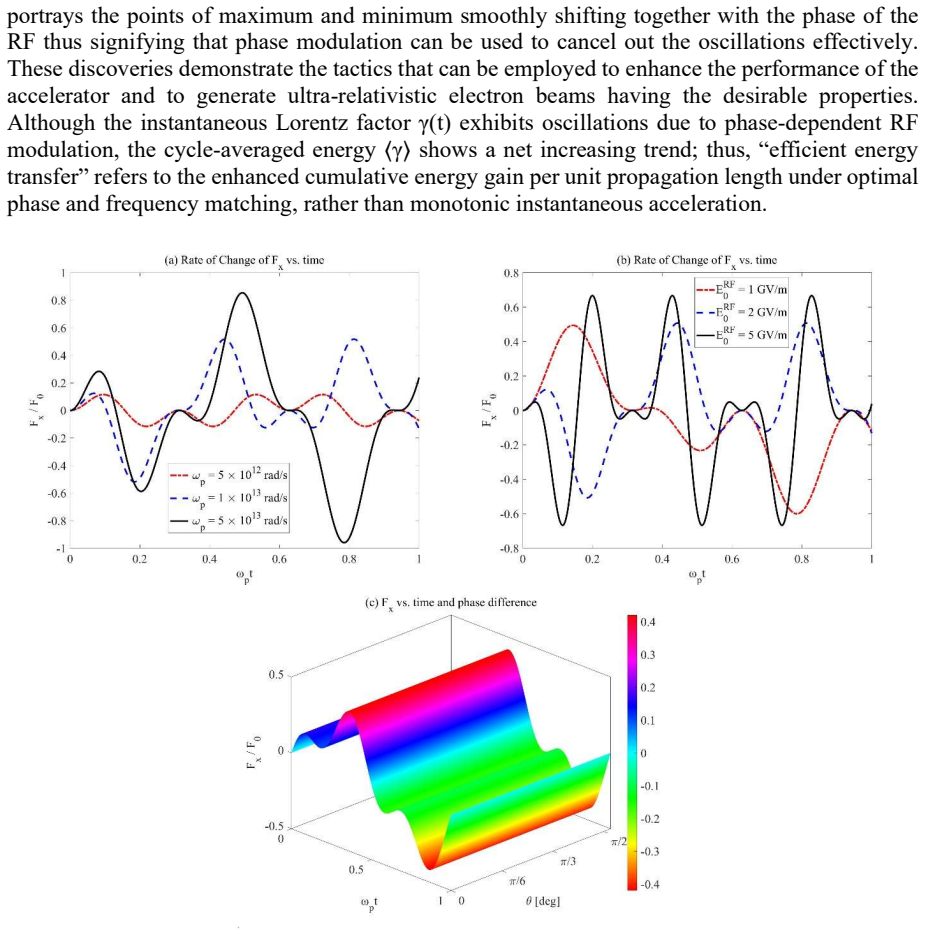
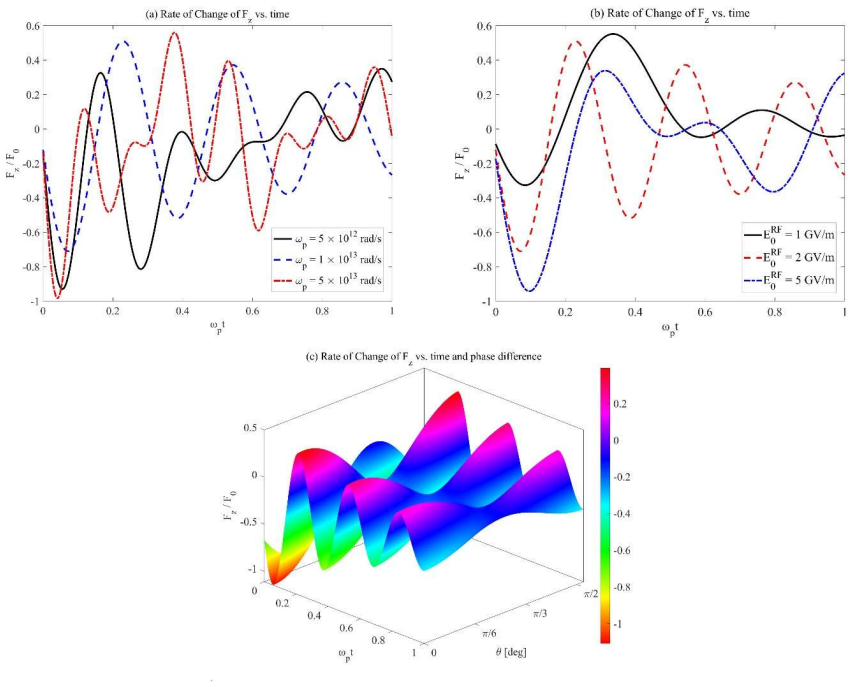
The external RF fields operate as a tunable lattice, allowing exact adjustment of amplitude, frequency, and carrier-envelope phase to regulate transverse focussing gradients and betatron amplitudes. A regime of resonant alignment between RF fields and natural betatron frequencies enhances controlled transverse excursions while diminishing parasitic oscillations via increased radiative damping, resulting in substantial emittance reduction and alleviation of synchrotron-like energy losses. Three-dimensional force landscapes further show that gamma-factor growth rates depend on the interplay between longitudinal field gradients and initial injection conditions.
What carries the argument
Resonant alignment of RF-driven oscillations with natural betatron frequencies, functioning as a tunable lattice that sets transverse focusing gradients and drives radiative damping.
If this is right
- Precise control over betatron oscillation polarisation and beam stability maps becomes available through RF phase tuning.
- Gamma-factor growth rates can be modulated by choosing longitudinal field gradients and injection conditions.
- Ultra-stable electron beams with selectable polarisation states are obtainable for downstream applications.
- Nonlinear resonant and damping events in hybrid accelerators can be mapped in detail to predict beam quality.
Where Pith is reading between the lines
- The same resonant tuning might be applied to other plasma-wakefield schemes to lower emittance without adding new hardware.
- Varying carrier-envelope phase could serve as a handle to produce polarised beams for specific X-ray or collider uses.
- Reduced sensitivity to injection jitter could make hybrid accelerators more practical for user facilities.
- Stronger-field regimes might reveal quantum corrections to the damping that are testable at existing laser-plasma facilities.
Load-bearing premise
The Landau-Lifshitz radiation reaction model with an added quantum parameter accurately captures synchrotron-like losses during betatron oscillations and the 3D PIC simulations fully represent the spatiotemporal plasma wakefield modulation without significant numerical artifacts.
What would settle it
A 3D simulation or experiment in which the RF frequency is set exactly at the betatron resonance yet shows no emittance drop or even an increase in energy loss compared with off-resonance cases would falsify the central claim.
Figures




read the original abstract
Hybrid laser plasma radiofrequency (RF) acceleration architectures signify a promising advancement in addressing the stability challenges associated with traditional laser wakefield accelerators. A thorough theoretical and numerical analysis of the three-dimensional dynamics of ultra-relativistic electron bunches in these hybrid systems is presented, clearly explaining how transverse beam stability, betatron oscillation polarisation, and radiative cooling work. By combining analytical models of spatiotemporal plasma wakefield modulation and phase dependent RF-driven oscillations with fully self-consistent 3D particle in cell (PIC) simulations, incorporating classical radiation reaction (RR) via the Landau Lifshitz model (with quantum parameter to account for synchrotron like losses during betatron oscillations. The findings indicate that the external RF fields operate as a tunable lattice, allowing for exact adjustment of amplitude, frequency, and carrier-envelope phase, which facilitates deterministic regulation of transverse focussing gradients and betatron amplitudes. A regime of resonant alignment between RF fields and natural betatron frequencies is established; this resonance enhances controlled transverse excursions while concurrently diminishing parasitic oscillations via increased radiative damping, resulting in substantial emittance reduction and the alleviation of synchrotron-like energy losses. Also, the detailed stability maps and 3D force landscapes show that the gamma factor growth rates change over time depending on the interaction between longitudinal field gradients and initial injection conditions. The paper's results give a clear picture of the nonlinear, resonant, and damping events that happen in hybrid accelerators. They also make it possible to get ultra stable, high-quality electron beams with the right polarisation states.
Editorial analysis
A structured set of objections, weighed in public.
Referee Report
Summary. The manuscript claims that resonant alignment between external RF fields and natural betatron frequencies in hybrid laser-plasma-RF accelerators provides tunable control over 3D transverse electron dynamics. Analytical models of spatiotemporal wakefield modulation and phase-dependent RF oscillations, combined with self-consistent 3D PIC simulations that incorporate the Landau-Lifshitz radiation-reaction force plus a quantum parameter, are used to show that this resonance increases controlled transverse excursions while enhancing radiative damping, thereby suppressing parasitic oscillations, reducing emittance, and alleviating synchrotron-like energy losses. Stability maps further indicate that gamma-factor growth rates vary with longitudinal field gradients and initial injection conditions.
Significance. If the central results hold, the work offers a promising route to deterministic beam-quality control in plasma accelerators by treating RF fields as a tunable lattice. The combination of analytical resonance conditions with fully 3D self-consistent simulations that include radiation reaction is a clear strength and could inform experimental designs for polarized, low-emittance bunches.
major comments (1)
- The headline claim that resonant RF alignment produces increased radiative damping and consequent emittance reduction rests on the Landau-Lifshitz model (augmented by a quantum parameter) correctly reproducing synchrotron-like losses during large-amplitude betatron motion. The manuscript does not report the quantum parameter χ extracted from the simulated trajectories or compare the classical LL implementation against a stochastic quantum radiation-reaction model. Because the classical LL force is known to underestimate stochastic photon emission once χ exceeds ~0.1, the reported damping and emittance reduction cannot be confirmed as robust predictions rather than model-dependent outcomes.
minor comments (2)
- Abstract: minor grammatical corrections are needed (e.g., “signify a promising advancement” → “signifies”; “radiative cooling work” → “radiative cooling works”).
- Abstract: the statement that “gamma factor growth rates change over time depending on the interaction between longitudinal field gradients and initial injection conditions” is too vague; a brief quantitative illustration or reference to the relevant figure would improve clarity.
Simulated Author's Rebuttal
We thank the referee for their careful reading and the constructive comment on the radiation-reaction modeling. We respond to the major comment below.
read point-by-point responses
-
Referee: The headline claim that resonant RF alignment produces increased radiative damping and consequent emittance reduction rests on the Landau-Lifshitz model (augmented by a quantum parameter) correctly reproducing synchrotron-like losses during large-amplitude betatron motion. The manuscript does not report the quantum parameter χ extracted from the simulated trajectories or compare the classical LL implementation against a stochastic quantum radiation-reaction model. Because the classical LL force is known to underestimate stochastic photon emission once χ exceeds ~0.1, the reported damping and emittance reduction cannot be confirmed as robust predictions rather than model-dependent outcomes.
Authors: We agree that explicit reporting of the quantum parameter χ is necessary to substantiate the applicability of the classical Landau-Lifshitz implementation. We will revise the manuscript to extract and present χ values from representative particle trajectories in both resonant and non-resonant cases (new panel in Figure 5 or dedicated subsection in Section 3). This will allow direct verification that the classical regime holds. A side-by-side comparison against a stochastic quantum radiation-reaction model would require an entirely new set of computationally expensive simulations and lies outside the scope of the present work, which focuses on demonstrating resonant RF control of betatron dynamics. We will, however, expand the methods section with a brief discussion of the validity limits of the LL model and appropriate citations to the literature on the χ threshold. revision: partial
Circularity Check
No significant circularity; results emerge from independent analytical models and PIC simulations
full rationale
The paper derives its claims from a combination of analytical models for spatiotemporal wakefield modulation and phase-dependent RF oscillations, together with fully self-consistent 3D PIC simulations that incorporate the Landau-Lifshitz radiation-reaction force plus a quantum correction. These steps do not reduce to self-definition, fitted inputs renamed as predictions, or load-bearing self-citations; the resonant alignment, emittance reduction, and damping are reported as simulation outcomes under stated initial conditions rather than tautological restatements of the input model. No uniqueness theorems or ansatzes are imported from the authors' prior work in a manner that collapses the central result.
Axiom & Free-Parameter Ledger
free parameters (2)
- RF amplitude, frequency, and carrier-envelope phase
- Quantum parameter in radiation reaction model
axioms (2)
- domain assumption Landau-Lifshitz model with quantum correction accurately describes radiation reaction for ultra-relativistic betatron motion
- domain assumption Spatiotemporal plasma wakefield modulation can be analytically modeled and coupled to phase-dependent RF oscillations
Reference graph
Works this paper leans on
-
[1]
A. Curcio, G. Gatti, “Time-domain study of the synchrotron radiation emitted from electron beams in plasma focusing channels,” Phys. Rev. E, 105, 025201, (2022), DOI: 10.1103/PhysRevE.105.025201
-
[3]
A. M. de la Ossa, R. W. Assmann, M. Bussmann, S. Corde, J. P. C. Cabadağ, A. Debus, A. Döpp, A. F. Pousa, M. F. Gilljohann, T. Heinemann, B. Hidding, A. Irman, S. Karsch, O. Kononenko, T. Kurz, J. Osterhoff, R. Pausch, S. Schöbel, U. Schramm, “Hybrid LWFA-PWFA staging as a beam energy and brightness transformer: conceptual design and simulations,” Philos ...
-
[4]
plasma wakefield accelerator science for high-average-power applications,
R. D'Arcy, et. al, “plasma wakefield accelerator science for high-average-power applications,” Philos Trans A Math Phys Eng Sci, 377, 2151, 20180392, (2019), DOI: 10.1098/rsta.2018.0392
-
[5]
M. Sedaghat, S. Barzegar, A. R. Niknam, “Quasi-phase-matched laser wakefield acceleration of electrons in an axially density-modulated plasma channel,” Sci. Rep., 11, 1, 15207, (2021), DOI: 10.1038/s41598-021- 94751-y
-
[6]
Z. Gong, F. Mackenroth, T. Wang, X. Q. Yan, T. Toncian, A. V. Arefiev, “Direct laser acceleration of electrons assisted by strong laser-driven azimuthal plasma magnetic fields,” Phys. Rev. E, 102, 013206, (2020), DOI:10.1103/PhysRevE.102.013206
-
[7]
Modified Potential Around a Moving Test Charge in Strongly Coupled Dusty Plasma,
M. Shahmansouri,∗ B. Farokhi, and N. Khodabakhshi, “Modified Potential Around a Moving Test Charge in Strongly Coupled Dusty Plasma,” Commun. Theor. Phys. 68 (2017) 111–116, (2017), DOI: 10.1088/0253- 6102/68/1/111
-
[8]
A. A. Molavi Choobini , F. M. Aghamir, “Generation of THz waves through interaction of the wakefield of two-color laser pulses with magnetized plasma,” J. Opt. Soc. Am. B, 42, 4, (2025), DOI: 10.1364/JOSAB.540636
-
[9]
Sh. Zhou, J. Hua, W. An, W. B. Mori, Ch. Joshi, J. Gao, W. Lu, “High Efficiency Uniform Wakefield Acceleration of a Positron Beam Using Stable Asymmetric Mode in a Hollow Channel Plasma,” Phys. Rev. Lett., 127, 17, 174801, (2021), DOI: 10.1103/PhysRevLett.127.174801
-
[10]
Wakefield-induced THz wave generation in a hybrid dielectric- plasma cylindrical waveguide,
A. A. Molavi Choobini , F. M. Aghamir, “Wakefield-induced THz wave generation in a hybrid dielectric- plasma cylindrical waveguide,” Physics Letters A 559, 130910, (2025), DOI: 10.1016/j.physleta.2025.130910. 23
-
[11]
Dephasing-less laser wakefield acceleration in the bubble regime,
K. G. Miller, J. R. Pierce, M. V. Ambat, J. L. Shaw, K. Weichman, W. B. Mori, D. H. Froula, J. P. Palastro, “Dephasing-less laser wakefield acceleration in the bubble regime,” Sci. Rep., 13, 1, 21306, (2023), DOI: 10.1038/s41598-023-48249-4
-
[12]
A. F. Pousa, A. M. de la Ossa, R. W. Assmann, “Intrinsic energy spread and bunch length growth in plasma- based accelerators due to betatron motion,” Sci. Rep., 9, 1, 17690, (2019), DOI: 10.1038/s41598-019-53887- 8
-
[13]
Transverse oscillating bubble enhanced laser-driven betatron X-ray radiation generation,
R. Rakowski, P. Zhang, K. Jensen, B. Kettle, T. Kawamoto, S. Banerjee, C. Fruhling, G. Golovin, D. Haden, M. S. Robinson, D. Umstadter, B. A. Shadwick, M. Fuchs, “Transverse oscillating bubble enhanced laser-driven betatron X-ray radiation generation,” Sci. Rep., 12, 1, 10855, (2022), DOI: 10.1038/s41598-022- 14748-z
-
[15]
Laser wakefield accelerated electron beams and betatron radiation from multijet gas targets,
V. Tomkus, V. Girdauskas, J. Dudutis, P. Gečys, V. Stankevič, G. Račiukaitis, I. G. González, D. Guénot, J. B. Svensson, A. Persson, O . Lundh, “Laser wakefield accelerated electron beams and betatron radiation from multijet gas targets,” Sci. Rep., 10, 16807, (2020), DOI: 10.1038/s41598-020-73805-7
-
[16]
C. Joshi, S. Corde, W. B. Mori, “Perspectives on the generation of electron beams from plasma-based accelerators and their near- and long-term applications,” Phys. Plasmas 27, 070602 (2020), DOI: 10.1063/5.0004039
-
[17]
Direct laser acceleration in varying plasma density profiles,
R. Babjak, B. Martinez, M. Krus, M. Vranic, “Direct laser acceleration in varying plasma density profiles,” New J. Phys. 26, 093002, (2024), DOI: 10.1088/1367-2630/ad7280
-
[18]
Betatron radiation and emittance growth in plasma wakefield accelerators,
P. San Miguel Claveria, E. Adli, L. D. Amorim, W. An, C. E. Clayton, S. Corde, S. Gessner, M. J. Hogan, C. Joshi, O. Kononenko, M. Litos, W. Lu, K. A. Marsh, W. B. Mori, B. O’Shea, G. Raj, D. Storey, N. Vafaei- Najafabadi, G. White, X. Xu, V. Yakimenko, “Betatron radiation and emittance growth in plasma wakefield accelerators,” Phil. Trans. R. Soc. A 377:...
-
[19]
Decoding Sources of Energy Variability in a Laser-Plasma Accelerator
A. R. Maier, N. M. Delbos, T. Eichner, L. Hübner, S. Jalas, L. Jeppe, S. W. Jolly, M. Kirchen, V. Leroux, P. Messner, M. Schnepp, M. Trunk, P. A. Walker, Ch. Werle, P. Winkler, “Decoding Sources of Energy Variability in a Laser-Plasma Accelerator,” Physical Review X, 10, 031039 (2020), DOI: 10.1103/PhysRevX.10.031039
-
[20]
A. Köhler, J. P. Couperus, O. Zarini, A. Jochmann, A. Irman, U. Schramm, “Single-shot betatron source size measurement from a laser-wakefield accelerator,” Nuclear Instruments & Methods in Physics Research A, (2016), DOI: 10.1016/j. nima.2016.02.031i
work page doi:10.1016/j 2016
-
[21]
H. G. Rinderknecht, T. Wang, A. L. Garcia, G. Bruhaug, M. S. Wei, H. J. Quevedo, T. Ditmire, J. Williams, A. Haid, D. Doria, K. M. Spohr, T. Toncian, A . Arefiev, “Relativistically transparent magnetic filaments: scaling laws, initial results and prospects for strong-field QED studies,” New J. Phys. 23, 095009, (2021), DOI: 10.1088/1367-2630/ac22e7
-
[22]
J. Cikhardt, M. Gyrdymov, S. Zähter, P. Tavana, M. M. Günther, N. Bukharskii, N. Borisenko, J. Jacoby, X. F. Shen, A. Pukhov, N. E. Andreev, O. N. Rosmej, “Characterization of bright betatron radiation generated by direct laser acceleration of electrons in plasma of near critical density,” Matter Radiat. Extremes 9, 027201 (2024), DOI: 10.1063/5.0181119
-
[23]
O. N. Rosmej, X. F. Shen, A. Pukhov, L. Antonelli, F. Barbato, M. Gyrdymov, M. M. G ¨ unther, S. Z¨ ahter, V. S. Popov, N. G. Borisenko, N. E. Andreev, “Bright betatron radiation from direct-laseraccelerated electrons at moderate relativistic laser intensity,” Matter Radiat. Extremes, 6, 048401 (2021), DOI: 10.1063/5.0042315
-
[24]
M. Yadav, C. Hansel, B. Naranjo, G. Andonian, P. Manwani, Ö. Apsimon, C. P. Welsch, J. Rosenzweig, “Modeling betatron radiation using particle-in-cell codes for plasma wakefield accelerator diagnostics,” Physical Review Accelerators and Beams, 28, 072801, (2025), DOI: 10.1103/ykrl-45h8. 24
-
[25]
Reconstruction of lateral coherence and 2D emittance in plasma betatron X-ray sources,
A. Curcio, A. Cianchi, G. Costa, A. D. Dotto, F. Demurtas, M. Ferrario, M. D. R. Frías, M. Galletti, J. A. Pérez-Hernández, G. Gatti, “Reconstruction of lateral coherence and 2D emittance in plasma betatron X-ray sources,” Sci. Rep., 14, 1719, (2024), DOI: 10.1038/s41598-024-52231-z
-
[26]
Wakefield regeneration in a plasma accelerator,
J. P. Farmer, G. Zevi Della Porta, “Wakefield regeneration in a plasma accelerator,” Phys. Rev. Research 7, L012055, (2025), DOI: 10.1103/PhysRevResearch.7.L012055
-
[27]
Active energy compression of a laser-plasma electron beam,
P. Winkler, M. Trunk, L. Hübner, A. Martinez de la Ossa, S. Jalas, M. Kirchen, I. Agapov, S. A. Antipov, R. Brinkmann, T. Eichner, A. Ferran Pousa, T. Hülsenbusch, G. Palmer, M. Schnepp, K. Schubert, M. Thévenet, P. A. Walker, C. Werle, W. P. Leemans, A. R. Maie, “Active energy compression of a laser-plasma electron beam,” Nature 640, 907–910 (2025), DOI:...
-
[28]
RF Linear Accelerators,
Th. P. Wangler, “RF Linear Accelerators,” Wiley-VCH, 2nd, Completely Revised and Enlarged, (2008), ISBN-10: 3527406808
2008
-
[29]
E. Esarey, C. B. Schroeder, W. P. Leemans, “Physics of laser-driven plasma-based electron accelerators,” Rev. Mod. Phys. 81, 1229, (2009), DOI: 10.1103/RevModPhys.81.1229
-
[30]
Contemporary particle-in-cell approach to laser-plasma modelling,
T D Arber, et., al, “Contemporary particle-in-cell approach to laser-plasma modelling,” Plasma Phys. Control. Fusion 57 113001, (2015), DOI: 10.1088/0741-3335/57/11/113001
-
[31]
Quantum radiation reaction in head-on laser-electron beam interaction,
Marija Vranic, et., al, “Quantum radiation reaction in head-on laser-electron beam interaction,” New J. Phys. 18 073035, (2016), DOI: 10.1088/1367-2630/18/7/073035
-
[32]
Signatures of quantum effects on radiation reaction in laser–electron-beam collisions,
Ridgers CP, Blackburn TG, et., al, “Signatures of quantum effects on radiation reaction in laser–electron-beam collisions,” Journal of Plasma Physics., 83 (5), 715830502, (2017), DOI:10.1017/S0022377817000642
-
[33]
Acceleration of relativistic beams using laser-generated terahertz pulses,
M. T. Hibberd, A. L. Hearly, D. S. Lake, et., al, “Acceleration of relativistic beams using laser-generated terahertz pulses,” Nat. Photonics 14, 755–759 (2020), DOI: 10.1038/s41566-020-0674-1
-
[34]
Y. X. Wang, et., al, “High-efficiency and frequency-controllable terahertz pulses driven by two-color relativistic laser pulses,” Phys. Plasmas 31, 033111, (2024), DOI: 10.1063/5.0191984
-
[35]
Hard X Rays from Laser-Wakefield Accelerators in Density Tailored Plasmas,
Michaela Kozlova, et., al, “Hard X Rays from Laser-Wakefield Accelerators in Density Tailored Plasmas,” Physical Review X, 10, 011061 (2020), DOI: 10.1103/PhysRevX.10.011061
-
[36]
Transverse oscillating bubble enhanced laser-driven betatron X-ray radiation generation,
Rafal Rakowski, et., al, “Transverse oscillating bubble enhanced laser-driven betatron X-ray radiation generation,” Scientific Reports, 12, 10855, (2022), DOI: 10.1038/s41598-022-14748-z
-
[37]
Controlled Betatron radiation from high-charge electron beams in multiple plasma channels,
Mengyuan Chu, et., al, “Controlled Betatron radiation from high-charge electron beams in multiple plasma channels,” Optics Express, 33, 10, (2025), DOI: 10.1364/OE.557855
-
[38]
S. Y. Kim, et., al, “Witness electron beam injection using an active plasma lens for a proton beam-driven plasma wakefield accelerator,” Physical Review Accelerators and Beams, 24, 121304 (2021), DOI: 10.1103/PhysRevAccelBeams.24.121304
-
[39]
Direct visualization of shock front induced nonlinear laser wakefield dynamics,
Eitan Y. Levine, et., al, “Direct visualization of shock front induced nonlinear laser wakefield dynamics,” Physical Research, 7, L012041, (2025), DOI: 10.1103/PhysRevResearch.7.L012041
-
[40]
Simulation study of betatron radiation in AWAKE Run 2 experiment,
Linbo Liang, et., al, “Simulation study of betatron radiation in AWAKE Run 2 experiment,” arXiv:2204.13199v1
-
[41]
S. Mishra, et., al, “Enhanced betatron x-ray emission in a laser wakefield accelerator and wiggler due to collective oscillations of electrons,” Physical Review Accelerators and Beams, 25, 090703 (2022), DOI: 10.1103/PhysRevAccelBeams.25.090703
-
[42]
Alessandro Curcio, et., al, “Performance Study on a Soft X-ray Betatron Radiation Source Realized in the Self- Injection Regime of Laser-Plasma Wakefield Acceleration,” Appl. Sci., 12, 12471, (2022), DOI: 10.3390/app122312471
-
[43]
Coupling and Acceleration of Externally Injected Electron Beams in Laser-Driven Plasma Wakefields,
Srimanta Maity, et., al, “Coupling and Acceleration of Externally Injected Electron Beams in Laser-Driven Plasma Wakefields,” arXiv:2502.10160
discussion (0)
Sign in with ORCID, Apple, or X to comment. Anyone can read and Pith papers without signing in.