Recognition: unknown
Impurity localization, and collision properties of symbiotic dark-bright solitons in superfluid-impurity system
Pith reviewed 2026-05-07 17:12 UTC · model grok-4.3
The pith
Stable symbiotic dark-bright solitons form in two-dimensional binary Bose-Einstein condensates under repulsive interactions.
A machine-rendered reading of the paper's core claim, the machinery that carries it, and where it could break.
Core claim
In the impurity limit of a two-dimensional binary BEC mixture with repulsive interactions, the coupled Gross-Pitaevskii equations support stable symbiotic dark-bright solitons consisting of a dark density dip in the majority component that traps a bright peak in the minority component. These structures remain intact in simulations, and their collisions produce merging when the bright components are in phase or repulsion when out of phase.
What carries the argument
The symbiotic dark-bright soliton: a paired structure in which the dark soliton of the superfluid component creates an effective potential that localizes the bright soliton of the impurity component through repulsive coupling.
If this is right
- The solitons remain stable without decay during long-time evolution under the mean-field description.
- Collisions between solitons lead to merging or repulsion strictly according to the relative phase of the bright components.
- The impurity component localizes at the density minimum created by the dark soliton.
- Both inter-component and intra-component repulsion are required to sustain the symbiotic pairing.
Where Pith is reading between the lines
- If the mean-field results hold experimentally, phase control could enable targeted impurity positioning in quasi-two-dimensional superfluid setups.
- The observed merging behavior suggests a possible route to studying clustered impurity states through repeated soliton collisions.
- Testing the same repulsive-interaction condition in one or three dimensions would reveal whether the stability is specific to the two-dimensional confinement.
Load-bearing premise
The mean-field coupled Gross-Pitaevskii equations remain accurate for describing soliton stability and collisions in the two-dimensional impurity limit without significant beyond-mean-field corrections.
What would settle it
An experiment or simulation in a two-dimensional BEC impurity system where the dark-bright solitons decay under repulsive interactions or show collision outcomes independent of bright-component phase would falsify the stability and phase-dependent interaction claims.
Figures


read the original abstract
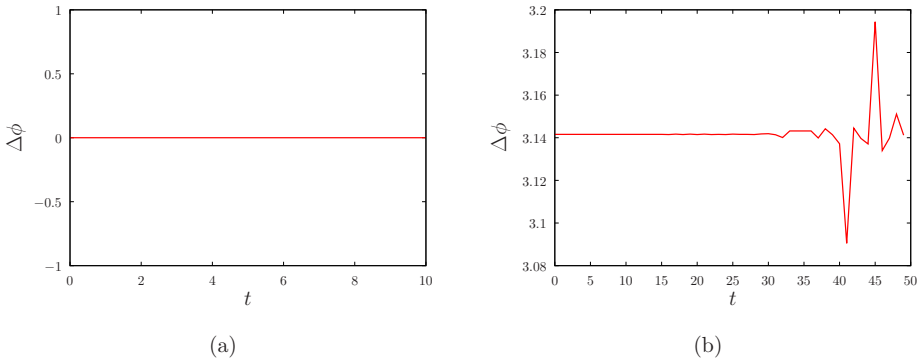
We investigate the dynamics of a binary mixture of Bose-Einstein condensates in the impurity limit -- where one component is dilute enough to be treated like an impurity -- and confined to two dimensions. Using the mean-field coupled Gross-Pitaevskii equations, we find that the binary mixture supports the formation of stable symbiotic dark-bright solitons when the inter- and intra-component interactions are repulsive. We further study the interaction between solitons and observe that the solitons undergo merging and repulsion depending on the relative phase between the bright component of the composite structure.
Editorial analysis
A structured set of objections, weighed in public.
Referee Report
Summary. The paper claims that a binary mixture of Bose-Einstein condensates confined to two dimensions in the impurity limit supports the formation of stable symbiotic dark-bright solitons when both inter- and intra-component interactions are repulsive, as shown by numerical solutions of the mean-field coupled Gross-Pitaevskii equations. It further reports that soliton collisions result in merging or repulsion depending on the relative phase between the bright components of the composite structures.
Significance. If the numerical results hold under the stated model, the work adds to the literature on composite soliton dynamics in low-dimensional quantum fluids and impurity systems, with potential relevance to ultracold-atom experiments. The phase-dependent collision outcomes provide a concrete, testable prediction within the mean-field framework.
major comments (2)
- [Abstract] Abstract: the central claim of stable symbiotic dark-bright soliton formation rests on numerical integration of the coupled Gross-Pitaevskii equations, yet no specific values for the interaction parameters (g11, g22, g12), trap frequencies, or numerical resolution are supplied, preventing independent verification of the reported stability.
- [Numerical results / Discussion] The manuscript does not examine the regime of validity of the mean-field truncation for the dilute impurity component in two dimensions. Near the dark-soliton density notch, where the bright component localizes, two-dimensional fluctuation effects (quantum depletion or Lee-Huang-Yang corrections) can become appreciable; without an estimate of their magnitude or a comparison to beyond-mean-field treatments, the reported stability and phase-dependent collision behavior may be artifacts of the approximation.
minor comments (1)
- The abstract and introduction should explicitly state the range of interaction strengths and densities explored so that readers can immediately assess the repulsive-interaction regime.
Simulated Author's Rebuttal
We thank the referee for their careful reading of our manuscript and for providing constructive feedback. We address each of the major comments in detail below.
read point-by-point responses
-
Referee: [Abstract] Abstract: the central claim of stable symbiotic dark-bright soliton formation rests on numerical integration of the coupled Gross-Pitaevskii equations, yet no specific values for the interaction parameters (g11, g22, g12), trap frequencies, or numerical resolution are supplied, preventing independent verification of the reported stability.
Authors: We agree that specifying the interaction parameters and numerical details would enhance the reproducibility of our results. Although these values are provided in the main text and methods section, we will revise the abstract to include the key interaction strengths (e.g., the ratios g11/g12 and g22/g12) and a reference to the numerical resolution used. This will allow readers to more easily verify the stability claims. revision: yes
-
Referee: [Numerical results / Discussion] The manuscript does not examine the regime of validity of the mean-field truncation for the dilute impurity component in two dimensions. Near the dark-soliton density notch, where the bright component localizes, two-dimensional fluctuation effects (quantum depletion or Lee-Huang-Yang corrections) can become appreciable; without an estimate of their magnitude or a comparison to beyond-mean-field treatments, the reported stability and phase-dependent collision behavior may be artifacts of the approximation.
Authors: This is a valid concern regarding the applicability of the mean-field model in 2D. Our work focuses on the mean-field description via the coupled Gross-Pitaevskii equations, which is appropriate for the dilute limit and has been validated by the long-term stability observed in our simulations. We will include an additional discussion paragraph in the revised manuscript outlining the conditions under which the mean-field approximation holds for 2D BECs with impurities, referencing relevant works on quantum fluctuations in low-dimensional systems. However, performing a full beyond-mean-field calculation or providing a quantitative estimate of depletion effects is outside the scope of the current study. revision: partial
- A quantitative estimate of the magnitude of two-dimensional fluctuation effects near the dark soliton core, as this would necessitate new beyond-mean-field simulations not included in the original work.
Circularity Check
No circularity; results follow from numerical solution of standard external GP equations
full rationale
The paper numerically integrates the established mean-field coupled Gross-Pitaevskii equations for a binary BEC mixture in the impurity limit to identify stable symbiotic dark-bright solitons under repulsive interactions and to characterize their phase-dependent collisions. No parameters are fitted to data and then relabeled as predictions, no self-definitional loops appear in the soliton ansatz or stability criteria, and no load-bearing uniqueness theorems or ansatzes are imported via self-citation. The derivation chain is therefore self-contained against the external GP framework and does not reduce to its own inputs by construction.
Axiom & Free-Parameter Ledger
axioms (1)
- domain assumption Mean-field coupled Gross-Pitaevskii equations accurately capture the dynamics of the binary mixture in the impurity limit in two dimensions
Reference graph
Works this paper leans on
-
[1]
0606 |ψ 2|2 (a) − 10 − 5 0 5 10 x − 10 − 5 0 5 10y
-
[2]
9402 |ψ 1|2 (d) − 10 − 5 0 5 10 x − 10 − 5 0 5 10y 0 1 2 3 4 5 6 7 8 9 10 |ψ 2|2 (b) − 10 − 5 0 5 10 x − 10 − 5 0 5 10y 0
-
[3]
4 |ψ 1|2 (e) − 10 − 5 0 5 10 x − 10 − 5 0 5 10y 0 2 4 6 8 10 12 14 16 18 |ψ 2|2 (c) − 10 − 5 0 5 10 x − 10 − 5 0 5 10y 0
-
[4]
1: Dark-bright soliton formation in the superfluid-impurity sys tem with N 1 N = 0
4 |ψ 1|2 (f) FIG. 1: Dark-bright soliton formation in the superfluid-impurity sys tem with N 1 N = 0. 94 and N2 N = 0. 06. The interaction strength g11 = 50, and the ratio of interaction coefficients α = g12 g11 = 0. 95. (a)-(c) Time evolution showing the formation of bright solitons in the impurity component from the (a) initial homogeneous state. (d)-( f) ...
-
[5]
9402 |ψ 1|2 (d) t=5 − 10 − 5 0 5 10 x − 10 − 5 0 5 10y 0
-
[6]
6 |ψ 1|2 (e) t=10 − 10 − 5 0 5 10 x − 10 − 5 0 5 10y 0
-
[7]
2: Generation of a single DB soliton in the superfluid-impurity sys tem using the initial condition Eq
4 |ψ 1|2 (f) FIG. 2: Generation of a single DB soliton in the superfluid-impurity sys tem using the initial condition Eq. (8). Here, the width of the Gaussian profile is σ = 0. 5, and the impurity fraction N2 N = 0. 06. Upper panel (a)-(c) shows the bright soliton in the impurity component while the lower panel (d)-(f) shows the formation of da rk soliton i...
-
[8]
5 1 0 2 4 6 8 10 ∆φ t (a)
-
[9]
2 0 5 10 15 20 25 30 35 40 45 50 ∆φ t (b) FIG. 4: Relative phase between the bright components of DB soliton s as a function of time when the initial phase difference between the pulses is (a) zero (mer ging of solitons) and (b) π (repelling solitons). For an in-phase collision, overlap between the solitons |ψ 2|2 = (ρ1+ρ2)2 is enhanced, resulting in a str...
-
[10]
P. G. Kevrekidis, D. J. Frantzeskakis, and R. Carretero- Gonz´ alez, eds.,Emergent Nonlinear Phenomena in Bose-Einstein Condensates: Theory and Experime nt (Springer, Berlin, 2007)
2007
-
[11]
Kosevich, B
A. Kosevich, B. Ivanov, and A. Kovalev, Magnetic soliton s, Physics Reports 194, 117 (1990)
1990
-
[12]
Scott, Davydov’s soliton, Physics Reports 217, 1 (1992)
A. Scott, Davydov’s soliton, Physics Reports 217, 1 (1992)
1992
-
[13]
Dauxois and M
T. Dauxois and M. Peyrard, Physics of Solitons (Cambridge University Press, Cambridge, 2006)
2006
-
[14]
M. J. Ablowitz and H. Segur, Solitons and the inverse scattering transform (SIAM, 1981)
1981
-
[15]
Akhmediev and A
N. Akhmediev and A. Ankiewicz, eds., Dissipative Solitons (Springer, 2005)
2005
-
[16]
K. W. Madison, F. Chevy, W. Wohlleben, and J. Dalibard, Vo rtex formation in a stirred bose-einstein condensate, Phys. Rev. Lett. 84, 806 (2000)
2000
-
[17]
A. L. Fetter, Rotating trapped bose-einstein condensat es, Rev. Mod. Phys. 81, 647 (2009)
2009
-
[18]
Yang, Internal oscillations and instability charact eristics of (2 + 1)-dimensional solitons in a saturable nonlinear medium, Phys
J. Yang, Internal oscillations and instability charact eristics of (2 + 1)-dimensional solitons in a saturable nonlinear medium, Phys. Rev. E 66, 026601 (2002)
2002
-
[19]
Y. S. Kivshar and G. P. Agrawal, Optical solitons: from fibers to photonic crystals (Academic press, 2003)
2003
-
[20]
Inouye, M
S. Inouye, M. R. Andrews, J. Stenger, H.-J. Miesner, D. M . Stamper-Kurn, and W. Ketterle, Observation of feshbach resonances in a bose–einstein cond ensate, Nature 392, 151 (1998)
1998
-
[21]
S. L. Cornish, N. R. Claussen, J. L. Roberts, E. A. Cornel l, and C. E. Wieman, Stable 85Rb bose-einstein condensates with widely tunable interactio ns, Phys. Rev. Lett. 85, 1795 (2000)
2000
-
[22]
F. K. Fatemi, K. M. Jones, and P. D. Lett, Observation of o ptically induced feshbach reso- nances in collisions of cold atoms, Phys. Rev. Lett. 85, 4462 (2000)
2000
-
[23]
Blatt, T
S. Blatt, T. L. Nicholson, B. J. Bloom, J. R. Williams, J. W. Thomsen, P. S. Julienne, and J. Ye, Measurement of optical feshbach resonances in an idea l gas, Phys. Rev. Lett. 107, 073202 (2011)
2011
-
[24]
Burger, K
S. Burger, K. Bongs, S. Dettmer, W. Ertmer, K. Sengstock , A. Sanpera, G. V. Shlyapnikov, 17 and M. Lewenstein, Dark solitons in bose-einstein condensa tes, Phys. Rev. Lett. 83, 5198 (1999)
1999
-
[25]
Denschlag, J
J. Denschlag, J. E. Simsarian, D. L. Feder, C. W. Clark, L . A. Collins, J. Cubizolles, L. Deng, E. W. Hagley, K. Helmerson, W. P. Reinhardt, S. L. Rolston, B. I. Schneider, and W. D. Phillips, Generating solitons by phase engineering of a bos e-einstein condensate, Science 287, 97 (2000)
2000
-
[26]
Khaykovich, F
L. Khaykovich, F. Schreck, G. Ferrari, T. Bourdel, J. Cu bizolles, L. D. Carr, Y. Castin, and C. Salomon, Formation of a matter-wave bright soliton, Scie nce 296, 1290 (2002)
2002
-
[27]
Dalfovo and S
F. Dalfovo and S. Stringari, Bosons in anisotropic trap s: Ground state and vortices, Phys. Rev. A 53, 2477 (1996)
1996
-
[28]
M. R. Matthews, B. P. Anderson, P. C. Haljan, D. S. Hall, C . E. Wieman, and E. A. Cornell, Vortices in a bose-einstein condensate, Phys. Rev. Lett. 83, 2498 (1999)
1999
-
[29]
C. J. Myatt, E. A. Burt, R. W. Ghrist, E. A. Cornell, and C. E. Wieman, Production of two overlapping bose-einstein condensates by sympathetic cooling, Phys. Rev. Lett. 78, 586 (1997)
1997
-
[30]
Ho and V
T.-L. Ho and V. B. Shenoy, Binary mixtures of bose conden sates of alkali atoms, Phys. Rev. Lett. 77, 3276 (1996)
1996
-
[31]
Pu and N
H. Pu and N. P. Bigelow, Properties of two-species bose c ondensates, Phys. Rev. Lett. 80, 1130 (1998)
1998
-
[32]
B. D. Esry, C. H. Greene, J. P. Burke, Jr., and J. L. Bohn, H artree-fock theory for double condensates, Phys. Rev. Lett. 78, 3594 (1997)
1997
-
[33]
Busch, J
T. Busch, J. I. Cirac, V. M. P´ erez-Garc ´ ıa, and P. Zoller, Stability and collective excitations of a two-component bose-einstein condensed gas: A moment appr oach, Phys. Rev. A 56, 2978 (1997)
1997
-
[34]
Graham and D
R. Graham and D. Walls, Collective excitations of trapp ed binary mixtures of bose-einstein condensed gases, Phys. Rev. A 57, 484 (1998)
1998
-
[35]
Pu and N
H. Pu and N. P. Bigelow, Collective excitations, metast ability, and nonlinear response of a trapped two-species bose-einstein condensate, Phys. Rev. Lett. 80, 1134 (1998)
1998
-
[36]
B. D. Esry and C. H. Greene, Low-lying excitations of dou ble bose-einstein condensates, Phys. Rev. A 57, 1265 (1998)
1998
-
[37]
K. L. Lee, N. B. Jørgensen, I.-K. Liu, L. Wacker, J. J. Arl t, and N. P. Proukakis, Phase sep- 18 aration and dynamics of two-component bose-einstein conde nsates, Phys. Rev. A 94, 013602 (2016)
2016
-
[38]
D. S. Hall, M. R. Matthews, J. R. Ensher, C. E. Wieman, and E. A. Cornell, Dynamics of component separation in a binary mixture of bose-einstein c ondensates, Phys. Rev. Lett. 81, 1539 (1998)
1998
-
[39]
¨Ohberg and L
P. ¨Ohberg and L. Santos, Dark solitons in a two-component bose- einstein condensate, Phys. Rev. Lett. 86, 2918 (2001)
2001
-
[40]
Busch and J
T. Busch and J. R. Anglin, Dark-bright solitons in inhom ogeneous bose-einstein condensates, Phys. Rev. Lett. 87, 010401 (2001)
2001
-
[41]
Catani, G
J. Catani, G. Lamporesi, D. Naik, M. Gring, M. Inguscio, F. Minardi, A. Kantian, and T. Giamarchi, Quantum dynamics of impurities in a one-dimen sional bose gas, Phys. Rev. A 85, 023623 (2012)
2012
-
[42]
N. B. Jørgensen, L. Wacker, K. T. Skalmstang, M. M. Paris h, J. Levinsen, R. S. Christensen, G. M. Bruun, and J. J. Arlt, Observation of attractive and rep ulsive polarons in a bose-einstein condensate, Phys. Rev. Lett. 117, 055302 (2016)
2016
-
[43]
M.-G. Hu, M. J. Van de Graaff, D. Kedar, J. P. Corson, E. A. Co rnell, and D. S. Jin, Bose polarons in the strongly interacting regime, Phys. Rev. Let t. 117, 055301 (2016)
2016
-
[44]
R. M. Kalas and D. Blume, Interaction-induced localiza tion of an impurity in a trapped bose- einstein condensate, Phys. Rev. A 73, 043608 (2006)
2006
-
[45]
Sacha and E
K. Sacha and E. Timmermans, Self-localized impurities embedded in a one-dimensional bose- einstein condensate and their quantum fluctuations, Phys. R ev. A 73, 063604 (2006)
2006
-
[46]
M. J. Edmonds, J. L. Helm, and T. Busch, Coherent impurit y transport in an attractive binary bose–einstein condensate, New Journal of Physics 21, 053019 (2019)
2019
-
[47]
Edmonds, M
M. Edmonds, M. Eto, and M. Nitta, Synthetic superfluid ch emistry with vortex-trapped quan- tum impurities, Phys. Rev. Res. 3, 023085 (2021)
2021
-
[48]
Spethmann, F
N. Spethmann, F. Kindermann, S. John, C. Weber, D. Mesch ede, and A. Widera, Inserting single cs atoms into an ultracold rb gas, Appl. Phys. B 106, 513 (2012)
2012
-
[49]
Spethmann, F
N. Spethmann, F. Kindermann, S. John, C. Weber, D. Mesch ede, and A. Widera, Dynamics of single neutral impurity atoms immersed in an ultracold ga s, Phys. Rev. Lett. 109, 235301 (2012)
2012
-
[50]
Hohmann, F
M. Hohmann, F. Kindermann, B. G¨ anger, T. Lausch, D. May er, F. Schmidt, and A. Widera, 19 Neutral impurities in a bose-einstein condensate for simul ation of the fr¨ ohlich-polaron, EPJ Quantum Technol. 2, 1 (2015)
2015
-
[51]
L. M. Aycock, H. M. Hurst, D. K. Efimkin, D. Genkina, H.-I. Lu, V. M. Galitski, and I. B. Spielman, Brownian motion of solitons in a bose–einstein co ndensate, Proceedings of the National Academy of Sciences 114, 2503 (2017)
2017
-
[52]
G. I. Stegeman and M. Segev, Optical spatial solitons an d their interactions: Universality and diversity, Science 286, 1518 (1999)
1999
-
[53]
Akram and A
J. Akram and A. Pelster, Numerical study of localized im purity in a bose-einstein condensate, Phys. Rev. A 93, 033610 (2016)
2016
-
[54]
I. A. Bhat and B. Dey, Impurity induced modulational ins tability in bose-einstein condensates, Physics Letters A 461, 128640 (2023)
2023
-
[55]
Theocharis, Z
G. Theocharis, Z. Rapti, P. G. Kevrekidis, D. J. Frantze skakis, and V. V. Konotop, Modu- lational instability of gross-pitaevskii-type equations in 1 + 1 dimensions, Phys. Rev. A 67, 063610 (2003)
2003
-
[56]
Kevrekidis, H
P. Kevrekidis, H. Nistazakis, D. Frantzeskakis, B. A. M alomed, and R. Carretero-Gonz´ alez, Families of matter-waves in two-component bose-einstein c ondensates, Eur. Phys. J. D 28, 181 (2004)
2004
-
[57]
Kasamatsu and M
K. Kasamatsu and M. Tsubota, Modulation instability an d solitary-wave formation in two- component bose-einstein condensates, Phys. Rev. A 74, 013617 (2006)
2006
-
[58]
Dalfovo, S
F. Dalfovo, S. Giorgini, L. P. Pitaevskii, and S. String ari, Theory of bose-einstein condensation in trapped gases, Rev. Mod. Phys. 71, 463 (1999). 20
1999
discussion (0)
Sign in with ORCID, Apple, or X to comment. Anyone can read and Pith papers without signing in.