Recognition: unknown
Explanation Systems for Approval-Based Multiwinner Voting
Pith reviewed 2026-05-07 17:39 UTC · model grok-4.3
The pith
Price systems provide explanations for how approval-based multiwinner committees allocate voter influence, with a new polynomial-time rule satisfying all jointly satisfiable axioms.
A machine-rendered reading of the paper's core claim, the machinery that carries it, and where it could break.
Core claim
Building on priceability, a price system assigns each voter an individual budget spent only on approved candidates in the committee, with every selected candidate purchased at unit price. We initiate an axiomatic study of price systems with requirements for structural coherence, accurate influence attribution, and consistency with proportionality. We introduce a polynomial-time computable rule in which voters continuously gain and exercise influence, and prove it satisfies every collection of axioms that can be satisfied simultaneously. Experiments show these explanations correlate with known proportionality notions and recover cases of unequal influence.
What carries the argument
Price systems that assign individual voter budgets for unit-price purchases of approved committee members, together with the continuous-influence rule for selecting among possible systems.
If this is right
- Each voter's total influence and its breakdown across selected candidates can be read directly from the price system.
- Backing for each elected candidate is expressed as the sum of budgets spent on that candidate.
- Exclusion of non-selected candidates is explained by the budget constraints and approval patterns in the price system.
- The polynomial-time rule guarantees efficient computation while meeting all axioms that are simultaneously satisfiable.
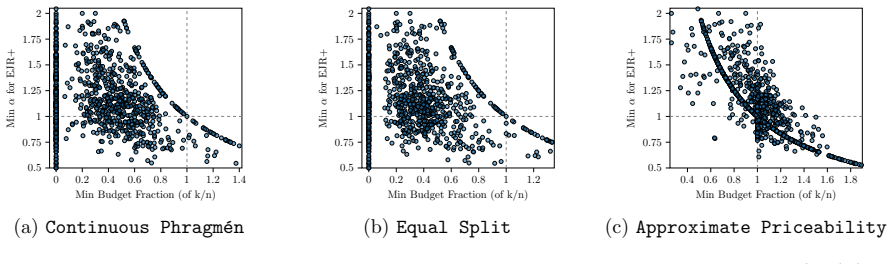
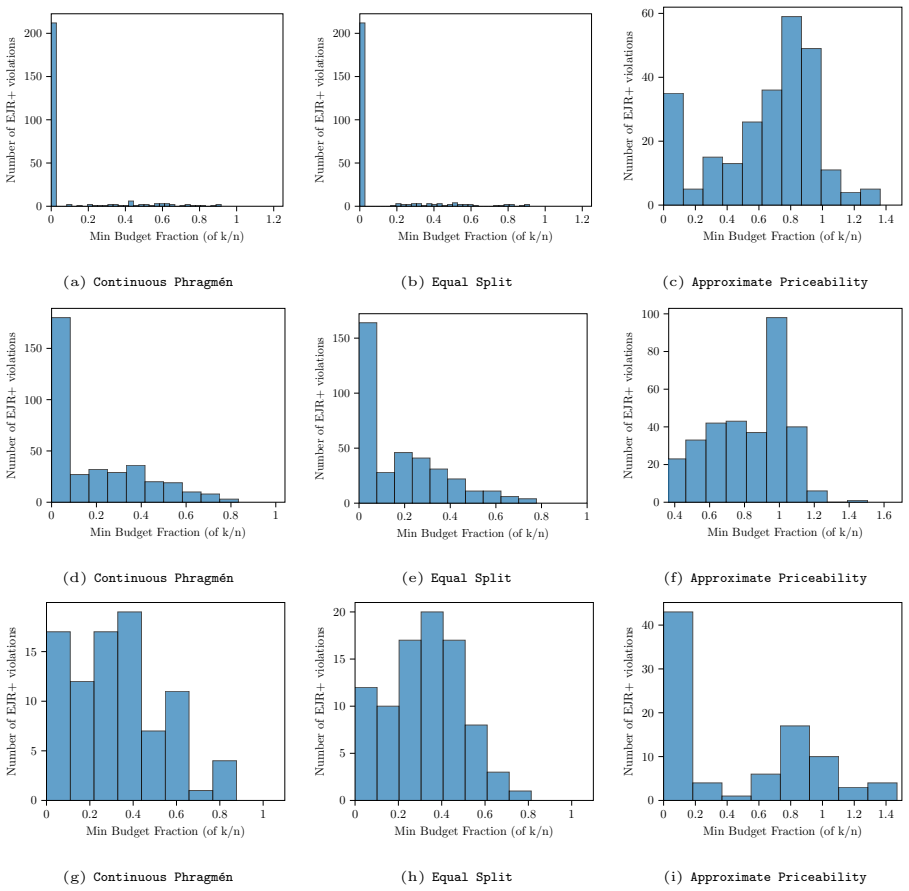
- Explanations produced by the rule correlate with established proportionality axioms on both synthetic and real-world profiles.
Where Pith is reading between the lines
- Price systems could serve as a diagnostic tool to compare different voting rules on the same profile by revealing differences in influence distribution.
- The continuous-influence construction might be adapted to produce explanations for outcomes under other multiwinner rules outside approval ballots.
- Visualization of the resulting budgets and purchases could help election administrators communicate representation details to voters.
Load-bearing premise
Price systems extending the existing notion of priceability can capture fine-grained representation details such as influence allocation and exclusion reasons without adding artifacts unrelated to the voters' approvals.
What would settle it
An approval profile and committee for which the continuous-influence rule outputs a price system that assigns positive influence to a voter for a candidate they disapprove or that violates one of the jointly satisfiable axioms.
Figures





read the original abstract
In approval-based multiwinner voting, voters express approval preferences over a set of candidates, and the goal is to return a winning committee. This model captures a broad range of subset selection problems under preferences. Prior work has focused on the study of binary proportionality axioms that certify whether a given committee is proportionally representative or not. We take a more fine-grained perspective and initiate the study of explanation systems that quantify how a committee represents the electorate, i.e., how much influence each voter exerts, how this influence is allocated across selected candidates, how each candidate is backed by the voters, and why certain candidates were not chosen. Building on the notion of priceability, we propose price systems as a framework for such explanations. A price system assigns each voter an individual budget, which they can spend on selected candidates they approve, and each candidate needs to be purchased at a unit price. Since many price systems can exist for a given outcome, selecting among them requires care. We initiate an axiomatic study of price systems and propose several axioms capturing structural coherence, faithful attribution of influence, and alignment with proportionality. On the algorithmic side, we introduce a polynomial-time computable rule in which voters continuously gain and exercise influence and show that it satisfies all jointly satisfiable axioms. Experiments on synthetic and real-world instances indicate that our explanations correlate with established proportionality notions and can recover unequal influence when it is present.
Editorial analysis
A structured set of objections, weighed in public.
Referee Report
Summary. The paper introduces price systems, extending priceability, as a framework for fine-grained explanations of approval-based multiwinner voting outcomes. These quantify per-voter influence, its allocation across selected candidates, candidate backing by voters, and reasons for excluding others. The authors axiomatize desirable properties of price systems (structural coherence, faithful attribution of influence, and proportionality alignment) and present a polynomial-time continuous-gain rule that selects among price systems while satisfying all jointly satisfiable axioms. Experiments on synthetic and real-world instances show that the resulting explanations correlate with established proportionality notions and can detect unequal influence.
Significance. If the central claims hold, the work meaningfully extends the literature on proportionality in multiwinner voting by moving from binary certification to quantitative, interpretable explanations. The polynomial-time continuous rule and its axiomatic characterization are clear strengths, as are the reproducible experimental correlations. This framework could support practical applications in transparent committee selection and auditing of voting rules.
major comments (2)
- [§4] §4 (Continuous Influence Rule): The claim that the continuous budget accrual and spending process yields faithful attributions (without artifacts from the dynamics) is load-bearing for the explanatory framework. While the rule is shown to satisfy the proposed axioms, it remains unclear whether the final price system and derived explanations (e.g., reasons for exclusion) are uniquely determined by the approval profile or can vary with path-dependent choices in the continuous process. A concrete example or proof that all jointly satisfiable axioms eliminate such artifacts would strengthen the central claim.
- [§3] §3 (Axioms for Price Systems): The axioms for 'faithful attribution of influence' are invoked to address the skeptic concern about artifacts, but the manuscript does not explicitly verify that they rule out attributions depending on the continuous selection mechanism rather than solely on voter approvals. If an alternative price system satisfying the same axioms produces different influence allocations or exclusion reasons, the explanatory reliability is compromised.
minor comments (2)
- [Experiments] The experimental section would benefit from an explicit statement of the number of synthetic instances, the real-world datasets used, and any statistical significance tests on the reported correlations.
- [Preliminaries] Notation for voter budgets and candidate prices is introduced clearly but could include a summary table of all variables to aid readability.
Simulated Author's Rebuttal
We thank the referee for the constructive report and positive assessment of the paper's significance. We address the two major comments below. Both raise important questions about uniqueness and independence from the continuous dynamics; we agree that making this explicit will strengthen the manuscript and will revise accordingly.
read point-by-point responses
-
Referee: [§4] §4 (Continuous Influence Rule): The claim that the continuous budget accrual and spending process yields faithful attributions (without artifacts from the dynamics) is load-bearing for the explanatory framework. While the rule is shown to satisfy the proposed axioms, it remains unclear whether the final price system and derived explanations (e.g., reasons for exclusion) are uniquely determined by the approval profile or can vary with path-dependent choices in the continuous process. A concrete example or proof that all jointly satisfiable axioms eliminate such artifacts would strengthen the central claim.
Authors: We acknowledge that the manuscript does not explicitly demonstrate uniqueness of the price system produced by the continuous-gain rule with respect to potential path dependence. The rule is defined via a deterministic continuous process (voters accrue budget at a uniform rate and spend it instantaneously on approved candidates when possible), which in practice yields a unique outcome, but we agree a formal argument is needed. In the revision we will add to §4 either (i) a short proof that the system of differential equations governing budget accrual and spending admits a unique solution for any approval profile, or (ii) a concrete small example in which two different spending orders are simulated yet produce identical final price systems and exclusion reasons. This will directly address the concern that explanations could contain artifacts from the dynamics. revision: yes
-
Referee: [§3] §3 (Axioms for Price Systems): The axioms for 'faithful attribution of influence' are invoked to address the skeptic concern about artifacts, but the manuscript does not explicitly verify that they rule out attributions depending on the continuous selection mechanism rather than solely on voter approvals. If an alternative price system satisfying the same axioms produces different influence allocations or exclusion reasons, the explanatory reliability is compromised.
Authors: We agree that the current text does not contain an explicit verification that the faithful-attribution axioms eliminate dependence on the continuous mechanism. The axioms (in particular, the combination of budget-exhaustion, support-monotonicity, and proportionality alignment) are intended to ensure that any two price systems satisfying them must agree on influence allocations for a given approval profile and committee. In the revision we will add a short proposition in §3 showing that if two price systems both satisfy the full set of jointly satisfiable axioms, then their per-voter influence vectors and per-candidate backing values coincide; the proof proceeds by contradiction using the proportionality-alignment axiom. This will make explicit that the axioms rule out mechanism-dependent artifacts. revision: yes
Circularity Check
No significant circularity; new axioms and continuous rule are independently defined and verified
full rationale
The paper builds on the prior external notion of priceability to propose price systems as an explanatory framework, then introduces its own axioms for structural coherence and proportionality alignment along with a distinct polynomial-time continuous-gain rule. These elements are defined separately from the inputs, and the rule's satisfaction of the jointly satisfiable axioms is shown via direct algorithmic construction and proof rather than by construction or self-referential reduction. No load-bearing step reduces a prediction or uniqueness claim to a fitted parameter, self-citation chain, or smuggled ansatz; the derivation remains self-contained against external benchmarks such as the approval profile and stated axioms.
Axiom & Free-Parameter Ledger
axioms (1)
- domain assumption Axioms capturing structural coherence, faithful attribution of influence, and alignment with proportionality
invented entities (1)
-
price system
no independent evidence
Reference graph
Works this paper leans on
-
[1]
Justified representation in approval-based committee voting
Haris Aziz, Markus Brill, Vincent Conitzer, Edith Elkind, Rupert Freeman, and Toby Walsh. Justified representation in approval-based committee voting. Social Choice and Welfare, 48 0 (2): 0 461--485, 2017. doi:10.1007/s00355-016-1019-3
-
[2]
On minimal achievable quotas in multiwinner voting
Patrick Becker and Fabian Frank. On minimal achievable quotas in multiwinner voting. In Proceedings of the 25th International Conference on Autonomous Agents and Multiagent Systems (AAMAS), 2026. Forthcoming. Full version: arXiv:2510.19620 https://arxiv.org/abs/2510.19620
-
[3]
Winner robustness via swap- and shift-bribery: Parameterized counting complexity and experiments
Niclas Boehmer, Robert Bredereck, Piotr Faliszewski, and Rolf Niedermeier. Winner robustness via swap- and shift-bribery: Parameterized counting complexity and experiments. In Proceedings of the 30th International Joint Conference on Artificial Intelligence (IJCAI), pages 52--58, 2021. doi:10.24963/ijcai.2021/8
-
[4]
Niclas Boehmer, Markus Brill, Alfonso Cevallos, Jonas Gehrlein, Luis S \'a nchez-Fern \'a ndez, and Ulrike Schmidt-Kraepelin. Approval-based committee voting in practice: A case study of (over-)representation in the P olkadot blockchain. In Proceedings of the 38th AAAI Conference on Artificial Intelligence (AAAI), pages 9519--9527, 2024 a . doi:10.1609/aa...
-
[5]
Guide to numerical experiments on elections in computational social choice
Niclas Boehmer, Piotr Faliszewski, Lukasz Janeczko, Andrzej Kaczmarczyk, Grzegorz Lisowski, Grzegorz Pierczynski, Simon Rey, Dariusz Stolicki, Stanislaw Szufa, and Tomasz Was. Guide to numerical experiments on elections in computational social choice. In Proceedings of the 33rd International Joint Conference on Artificial Intelligence, (IJCAI) , pages 796...
2024
-
[6]
Evaluation of project performance in participatory budgeting
Niclas Boehmer, Piotr Faliszewski, ukasz Janeczko, Dominik Peters, Grzegorz Pierczy \'n ski, S imon Schierreich, Piotr Skowron, and Stanis aw Szufa. Evaluation of project performance in participatory budgeting. In Proceedings of the 33rd International Joint Conference on Artificial Intelligence (IJCAI), pages 2678--2686, 2024 c . doi:10.24963/ijcai.2024/296
-
[7]
Understanding the impact of proportionality in approval-based multiwinner elections
Niclas Boehmer, Lara Glessen, and Jannik Peters. Understanding the impact of proportionality in approval-based multiwinner elections. In Proceedings of the 40th AAAI Conference on Artificial Intelligence (AAAI), 2026. Forthcoming. Full version: arXiv:2511.09479 https://arxiv.org/abs/2511.09479
-
[8]
Automated justification of collective decisions via constraint solving
Arthur Boixel and Ulle Endriss. Automated justification of collective decisions via constraint solving. In Proceedings of the 19th International Conference on Autonomous Agents and Multiagent Systems (AAMAS), pages 168--176, 2020. URL https://www.ifaamas.org/Proceedings/aamas2020/pdfs/p168.pdf
2020
-
[9]
A calculus for computing structured justifications for election outcomes
Arthur Boixel, Ulle Endriss, and Ronald de Haan. A calculus for computing structured justifications for election outcomes. In Proceedings of the 36th AAAI Conference on Artificial Intelligence (AAAI), pages 4859--4866, 2022. doi:10.1609/aaai.v36i5.20414
-
[10]
An experimental view on committees providing justified representation
Robert Bredereck, Piotr Faliszewski, Rolf Niedermeier, and Andrzej Kaczmarczyk. An experimental view on committees providing justified representation. In Proceedings of the 28th International Joint Conference on Artificial Intelligence (IJCAI), pages 109--115, 2019. doi:10.24963/ijcai.2019/16
-
[11]
Robust and verifiable proportionality axioms for multiwinner voting
Markus Brill and Jannik Peters. Robust and verifiable proportionality axioms for multiwinner voting. In Proceedings of the 24th ACM Conference on Economics and Computation (ACM-EC), page 301, 2023. doi:10.1145/3580507.3597785. Full version: arXiv:2302.01989 https://arxiv.org/abs/2302.01989
-
[12]
Arguing about voting rules
Olivier Cailloux and Ulle Endriss. Arguing about voting rules. In Proceedings of the 15th International Conference on Autonomous Agents and Multiagent Systems (AAMAS), pages 287--295, 2016. URL https://www.ifaamas.org/Proceedings/aamas2016/pdfs/p287.pdf
2016
-
[13]
A verifiably secure and proportional committee election rule
Alfonso Cevallos and Alistair Stewart. A verifiably secure and proportional committee election rule. In Foteini Baldimtsi and Tim Roughgarden, editors, Proceedings of the 3rd ACM Conference on Advances in Financial Technologies, (AFT) , pages 29--42, 2021. doi:10.1145/3479722.3480988
-
[14]
Explaining tournament solutions with minimal supports
Cl \'e ment Contet, Umberto Grandi, and J \'e r \^o me Mengin. Explaining tournament solutions with minimal supports. In Proceedings of the 40th AAAI Conference on Artificial Intelligence (AAAI), 2026. Forthcoming. Full version: arXiv:2509.09312 https://arxiv.org/abs/2509.09312
-
[15]
Abhisek Dash, Anurag Shandilya, Arindam Biswas, Kripabandhu Ghosh, Saptarshi Ghosh, and Abhijnan Chakraborty. Summarizing user-generated textual content: Motivation and methods for fairness in algorithmic summaries. Proc. ACM Hum. Comput. Interact. , 3 0 ( CSCW ): 0 172:1--172:28, 2019. doi:10.1145/3359274
-
[16]
Question the Questions: Auditing Representation in Online Deliberative Processes
Soham De, Lodewijk Gelauff, Ashish Goel, Smitha Milli, Ariel D. Procaccia, and Alice Siu. Question the questions: Auditing representation in online deliberative processes. In Proceedings of the 35th ACM W eb C onference (WWW) , 2026. Forthcoming. Full version: arXiv:2511.04588 https://arxiv.org/abs/2511.04588
work page internal anchor Pith review Pith/arXiv arXiv 2026
-
[17]
Deerwester, Susan T
Scott C. Deerwester, Susan T. Dumais, Thomas K. Landauer, George W. Furnas, and Richard A. Harshman. Indexing by latent semantic analysis. J. Am. Soc. Inf. Sci., 41 0 (6): 0 391--407, 1990
1990
-
[18]
Participatory budgeting: Data, tools and analysis
Piotr Faliszewski, Jarosław Flis, Dominik Peters, Grzegorz Pierczyński, Piotr Skowron, Dariusz Stolicki, Stanisław Szufa, and Nimrod Talmon. Participatory budgeting: Data, tools and analysis. In Proceedings of the 32nd International Joint Conference on Artificial Intelligence (IJCAI), pages 2667--2674, 2023. doi:10.24963/ijcai.2023/297
-
[19]
Featuring online customer reviews: A guide for platforms
Federal Trade Commission . Featuring online customer reviews: A guide for platforms. https://www.ftc.gov/business-guidance/resources/featuring-online-customer-reviews-guide-platforms, January 2022. FTC business guidance document
2022
-
[20]
green million
Jaros aw Flis, Piotr Faliszewski, Dominik Peters, Grzegorz Pierczy \'n ski, Piotr Skowron, and Stanis aw Szufa. Wieliczka zielony milion ("green million") 2023. https://equalshares.net/elections/zielony-milion/, April 2023. Participatory budgeting election results using the Method of Equal Shares. Last updated: 2025-02-23
2023
-
[21]
A quantitative version of the gibbard--satterthwaite theorem for three alternatives
Ehud Friedgut, Gil Kalai, Nathan Keller, and Noam Nissan. A quantitative version of the gibbard--satterthwaite theorem for three alternatives. SIAM Journal on Computing, 40 0 (3): 0 934--952, 2011. doi:10.1137/090756740
-
[22]
doi: 10.18653/v1/2021.emnlp-main.552
Tianyu Gao, Xingcheng Yao, and Danqi Chen. Simcse: Simple contrastive learning of sentence embeddings. In Proceedings of the 2021 Conference on Empirical Methods in Natural Language Processing ( EMNLP ) , pages 6894--6910, 2021. URL https://doi.org/10.18653/v1/2021.emnlp-main.552
-
[23]
Committees and equilibria: Multiwinner approval voting through the lens of budgeting games
Adrian Haret, Sophie Klumper, Jan Maly, and Guido Sch \"a fer. Committees and equilibria: Multiwinner approval voting through the lens of budgeting games. In Proceedings of the 25th ACM Conference on Economics and Computation (ACM-EC), pages 51--70, 2024. doi:10.1145/3670865.3673484
-
[24]
Vijay Keswani and L. Elisa Celis. Dialect diversity in text summarization on twitter. In 30th Web Conference (WWW), pages 3802--3814, 2021. doi:10.1145/3442381.3450108
-
[25]
Martin Lackner and Piotr Skowron. Multi-Winner Voting with Approval Preferences. Springer, 2023. doi:10.1007/978-3-031-09016-5
-
[26]
abcvoting: A P ython package for approval-based multi-winner voting rules
Martin Lackner, Peter Regner, and Benjamin Krenn. abcvoting: A P ython package for approval-based multi-winner voting rules. Journal of Open Source Software, 8 0 (81): 0 4880, 2023. doi:10.21105/joss.04880
-
[27]
A generalised theory of proportionality in collective decision making
Tom \'a s Masa r \' k, Grzegorz Pierczy \'n ski, and Piotr Skowron. A generalised theory of proportionality in collective decision making. In Proceedings of the 25th ACM Conference on Economics and Computation (ACM-EC), pages 734--754, 2024. doi:10.1145/3670865.3673619
-
[28]
A graph-based algorithm for the automated justification of collective decisions
Oliviero Nardi, Arthur Boixel, and Ulle Endriss. A graph-based algorithm for the automated justification of collective decisions. In Proceedings of the 21st International Conference on Autonomous Agents and Multiagent Systems (AAMAS), pages 935--943, 2022. URL https://www.ifaamas.org/Proceedings/aamas2022/pdfs/p935.pdf
2022
-
[29]
Proportionality and the limits of welfarism
Dominik Peters and Piotr Skowron. Proportionality and the limits of welfarism. In Proceedings of the 21st ACM Conference on Economics and Computation (ACM-EC), pages 793--794, 2020. doi:10.1145/3391403.3399465. Full version: arXiv:1911.11747 https://arxiv.org/abs/1911.11747
-
[30]
Procaccia, Alexandros Psomas, and Zixin Zhou
Dominik Peters, Ariel D. Procaccia, Alexandros Psomas, and Zixin Zhou. Explainable voting. In Proceedings of the 34th Conference on Neural Information Processing Systems (NeurIPS), pages 1525--1534, 2020. URL https://proceedings.neurips.cc/paper/2020/file/10c72a9d42dd07a028ee910f7854da5d-Paper.pdf
2020
-
[31]
Market-based explanations of collective decisions
Dominik Peters, Grzegorz Pierczy \'n ski, Nisarg Shah, and Piotr Skowron. Market-based explanations of collective decisions. In Proceedings of the 35th AAAI Conference on Artificial Intelligence (AAAI), pages 5656--5663, 2021 a . doi:10.1609/aaai.v35i6.16710
-
[32]
Proportional participatory budgeting with additive utilities
Dominik Peters, Grzegorz Pierczy \'n ski, and Piotr Skowron. Proportional participatory budgeting with additive utilities. In Proceedings of the 34th Conference on Neural Information Processing Systems (NeurIPS), pages 12726--12737, 2021 b . URL https://proceedings.neurips.cc/paper/2021/hash/69f8ea31de0c00502b2ae571fbab1f95-Abstract.html
2021
-
[33]
Open polis data
Polis. Open polis data. https://github.com/compdemocracy/openData, 2026. Accessed: 2026-02-03
2026
-
[34]
Manish Raghavan, Solon Barocas, Jon M. Kleinberg, and Karen Levy. Mitigating bias in algorithmic hiring: evaluating claims and practices. In Proceedings of the 2020 Conference on Fairness, Accountability, and Transparency, pages 469--481, 2020. doi:10.1145/3351095.3372828
-
[35]
Luis S \' a nchez Fern \' a ndez , Norberto Fern \' a ndez Garc \' a , Jes \' u s A. Fisteus, and Markus Brill. The maximin support method: an extension of the d'hondt method to approval-based multiwinner elections. Math. Program., 203 0 (1): 0 107--134, 2024. doi:10.1007/s10107-022-01805-8
-
[36]
Correlation coefficients: appropriate use and interpretation
Patrick Schober, Christa Boer, and Lothar A Schwarte. Correlation coefficients: appropriate use and interpretation. Anesthesia & analgesia, 126 0 (5): 0 1763--1768, 2018
2018
-
[37]
Fairness of extractive text summarization
Anurag Shandilya, Kripabandhu Ghosh, and Saptarshi Ghosh. Fairness of extractive text summarization. In Proceedings of the 27th Web Conference (WWW), pages 97--98, 2018. doi:10.1145/3184558.3186947
-
[38]
Proportionality degree of multiwinner rules
Piotr Skowron. Proportionality degree of multiwinner rules. In Proceedings of the 22nd ACM Conference on Economics and Computation (ACM-EC), pages 820--840, 2021. doi:10.1145/3465456.3467641
-
[39]
Explainability in mechanism design: Recent advances and the road ahead
Sharadhi Alape Suryanarayana, David Sarne, and Sarit Kraus. Explainability in mechanism design: Recent advances and the road ahead. In Proceedings of the 19th European Conference on Multi-Agent Systems, pages 364--382, 2022. doi:10.1007/978-3-031-20614-6_21
-
[40]
Selecting a comprehensive set of reviews
Panayiotis Tsaparas, Alexandros Ntoulas, and Evimaria Terzi. Selecting a comprehensive set of reviews. In Proceedings of the 17th ACM SIGKDD International Conference on Knowledge Discovery and Data Mining, pages 168--176, 2011. doi:10.1145/2020408.2020440
-
[41]
Computing the margin of victory for various voting rules
Lirong Xia. Computing the margin of victory for various voting rules. In Proceedings of the 13th ACM Conference on Economics and Computation (ACM-EC), pages 982--999, 2012. doi:10.1145/2229012.2229086
-
[42]
The impact of a coalition: Assessing the likelihood of voter influence in large elections
Lirong Xia. The impact of a coalition: Assessing the likelihood of voter influence in large elections. In Proceedings of the 24th ACM Conference on Economics and Computation (ACM-EC), page 1156, 2023 a . Full version: arXiv:2202.06411 https://arxiv.org/abs/2202.06411
-
[43]
Semi-random impossibilities of condorcet criterion
Lirong Xia. Semi-random impossibilities of condorcet criterion. In Proceedings of the 37th AAAI Conference on Artificial Intelligence (AAAI), pages 5867--5875, 2023 b . doi:10.1609/aaai.v37i5.25727
discussion (0)
Sign in with ORCID, Apple, or X to comment. Anyone can read and Pith papers without signing in.