Recognition: unknown
BIMStruct3D: A Fully Automated Hybrid Learning Scan-to-BIM Pipeline with Integrated Topology Refinement
Pith reviewed 2026-05-08 04:37 UTC · model grok-4.3
The pith
A hybrid pipeline combines learning-based segmentation with topology-aware reconstruction to generate IFC-compliant BIM models from 3D point clouds.
A machine-rendered reading of the paper's core claim, the machinery that carries it, and where it could break.
Core claim
The central claim is that a hybrid system of learning-based semantic segmentation followed by topology-aware geometric reconstruction produces complete, IFC-compliant BIM models that are more accurate and scalable than RANSAC baselines, as measured on the new DeKH dataset and the existing CV4AEC benchmark.
What carries the argument
The hybrid pipeline that performs learning-based semantic segmentation on point clouds then applies topology refinement during geometric reconstruction to enforce structural connectivity in the final IFC model.
If this is right
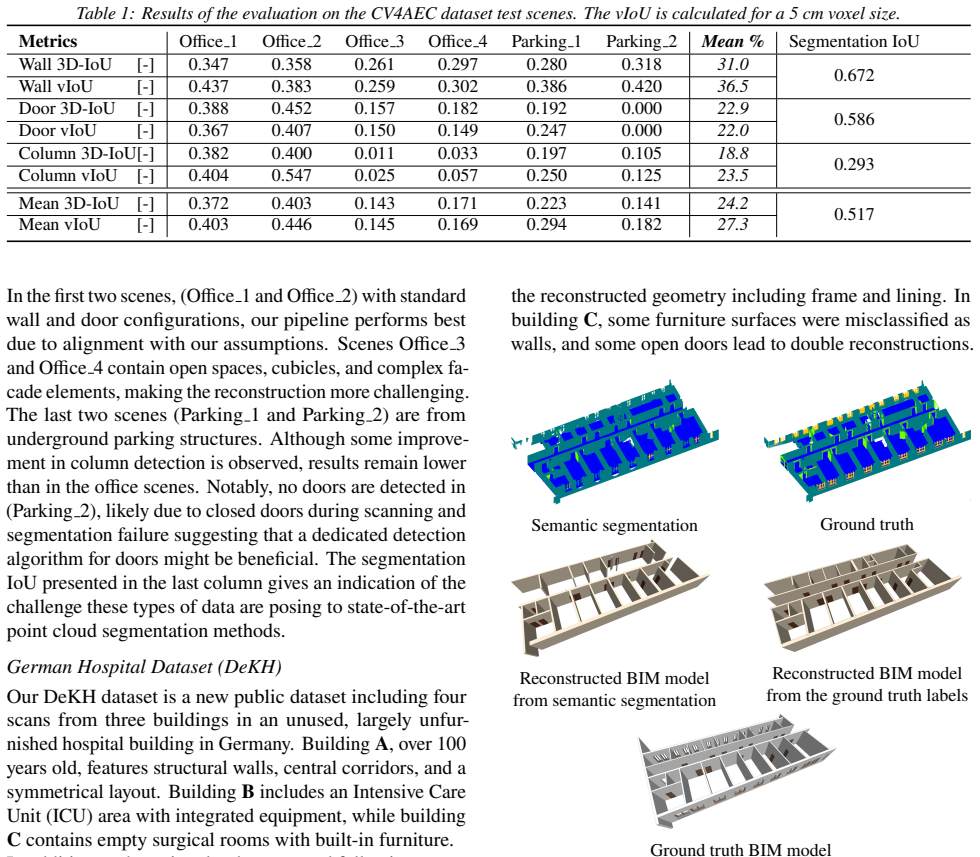
- The method produces BIM models with higher accuracy and completeness than RANSAC-based reconstruction on both the DeKH and CV4AEC datasets.
- The pipeline operates fully automatically and scales to large building scans without manual corrections.
- The vIoU metric allows direct, instance-matching-free comparison between reconstructed BIM models and ground-truth data.
- Release of the DeKH dataset with point clouds, semantic labels, and ground-truth BIMs supports further research in automated Scan-to-BIM.
Where Pith is reading between the lines
- If the pipeline works reliably, it could be embedded in commercial construction software to shorten the time from laser scan to usable digital model.
- The same hybrid pattern of learned labels plus connectivity rules might apply to other 3D reconstruction tasks such as indoor scene modeling or infrastructure inspection.
- Success on structural elements suggests later extensions could add non-structural components like HVAC or furniture while keeping the topology rules intact.
Load-bearing premise
The hybrid combination of learned segmentation and topology refinement will correctly identify and connect structural elements in real-world scans without failing on complex or irregular building topologies.
What would settle it
Running the pipeline on a point cloud of a building with non-standard or damaged structural elements and finding the output BIM has missing walls, wrong connections, or requires manual fixes.
Figures



read the original abstract
Automatic generation of Building Information Models (BIM) from building scans is a key challenge in architecture and construction. We present a modular pipeline for generating IFC-compliant BIM from 3D point clouds. The hybrid approach combines learning-based semantic segmentation with topology-aware geometric reconstruction to model structural elements accurately. We propose vIoU, adapting voxel-based overlap evaluation to Scan-to-BIM by enabling holistic, instance-matching-free comparison of reconstructed and ground-truth models. We release the German Hospital dataset (DeKH), including high-resolution point clouds, ground truth BIMs, and semantic annotations. Experiments on DeKH and CV4AEC datasets show significant improvements over a RANSAC-based baseline, demonstrating robustness and scalability.
Editorial analysis
A structured set of objections, weighed in public.
Referee Report
Summary. The paper presents BIMStruct3D, a modular hybrid pipeline for automatic generation of IFC-compliant BIM models from 3D point clouds. It combines learning-based semantic segmentation with topology-aware geometric reconstruction, introduces the vIoU metric for holistic model evaluation without instance matching, and releases the DeKH dataset (high-resolution point clouds, ground-truth BIMs, and semantic annotations). Experiments on DeKH and CV4AEC datasets report improvements over a RANSAC-based baseline, claiming robustness and scalability.
Significance. If the reported gains hold under the provided quantitative tables and controls, the work offers a practical advance in Scan-to-BIM automation by reducing reliance on manual corrections through integrated topology refinement. The release of the DeKH dataset and the vIoU metric are clear community contributions that could support reproducible benchmarking; the hybrid design builds on established components without introducing circularity or unstated parameter fitting.
minor comments (3)
- [Abstract] Abstract: the claim of 'significant improvements' would be more informative if it included at least one key quantitative result (e.g., vIoU or IoU delta) and dataset sizes rather than remaining purely qualitative.
- [§4] §4 (Experiments): while tables are present, adding error bars or standard deviations across multiple runs would strengthen the robustness claim against the RANSAC baseline.
- [Figure 3] Figure 3 or 4 (pipeline overview): the topology refinement module would benefit from an explicit equation or pseudocode block showing the geometric operations applied after segmentation.
Simulated Author's Rebuttal
We thank the referee for the positive assessment of BIMStruct3D, the recognition of our hybrid pipeline's practical value, the vIoU metric, and the release of the DeKH dataset. We are pleased with the recommendation for minor revision and will incorporate any minor suggestions into the revised manuscript.
Circularity Check
No significant circularity; derivation is self-contained
full rationale
The paper describes a modular hybrid pipeline that combines established learning-based semantic segmentation with topology-aware geometric reconstruction, introduces the vIoU metric as an adaptation of voxel overlap for instance-free evaluation, releases a new dataset (DeKH), and reports empirical improvements over a RANSAC baseline on DeKH and CV4AEC. No load-bearing step reduces by construction to a fitted parameter, self-definition, or self-citation chain; the central claims rest on concrete geometric operations, dataset descriptions, and quantitative tables that are independently verifiable. The approach builds on prior techniques without smuggling ansatzes or renaming known results as novel derivations.
Axiom & Free-Parameter Ledger
Reference graph
Works this paper leans on
-
[1]
Agnew, W., Xie, C., Walsman, A., Murad, O., Wang, Y., Domingos, P., and Srinivasa, S. (2021). Amodal 3d reconstruction for robotic manipulation via stability and connectivity. In Conference on robot learning. PMLR. Anagnostopoulos, I., Belsky, M., and Brilakis, I. (2016). Object boundaries and room detection in as-is bim mod- els from point cloud data. In...
work page Pith review arXiv 2021
-
[2]
scene name mapping. Short Name CV4AEC Scene Office 1 08 ShortOffice 01 F1 Office 2 08 ShortOffice 01 F2 Office 3 11 MedOffice 05 F2 Office 4 11 MedOffice 05 F4 Parking 1 25 Parking 01 F1 Parking 2 25 Parking 01 F2 The CV4AEC challenge comprises of two challenges, a 2D and 3D one. Here we use the test data of the 3D challenge for evaluation. The training d...
2023
discussion (0)
Sign in with ORCID, Apple, or X to comment. Anyone can read and Pith papers without signing in.