Recognition: 2 theorem links
· Lean TheoremScalar, electromagnetic, and Dirac perturbations of regular black holes constituting primordial dark matter
Pith reviewed 2026-05-14 22:15 UTC · model grok-4.3
The pith
Larger regularity in phantom DBI black holes shifts quasinormal spectra to lower frequencies and damping rates
A machine-rendered reading of the paper's core claim, the machinery that carries it, and where it could break.
Core claim
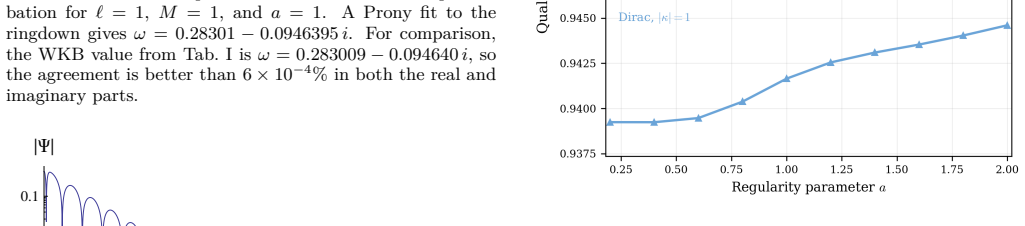
The exact asymptotically flat regular black hole supported by a phantom Dirac-Born-Infeld scalar produces quasinormal frequencies for massless scalar, electromagnetic, and Dirac perturbations that shift toward smaller oscillation frequencies and damping rates as the regularity scale increases, with the quality factor changing only weakly. The spectral shifts remain well above the estimated numerical uncertainty, showing that the DBI regularity scale leaves a robust spin-dependent imprint on ringdown.
What carries the argument
The effective potentials for scalar, electromagnetic, and Dirac perturbations on the regular metric, with the DBI regularity scale as the parameter that alters the potential shape and thus the quasinormal spectrum, computed via Padé-improved WKB and verified by Prony fitting.
If this is right
- Ringdown signals from these black holes would exhibit lower oscillation frequencies and slower damping than those of the Schwarzschild solution.
- The size of the shift depends on perturbation spin, producing distinct signatures for scalar, electromagnetic, and Dirac fields.
- The nearly constant quality factor implies that the number of observable cycles before damping remains comparable across regularity values.
- Precise measurements of ringdown in gravitational wave events could in principle reveal or constrain the presence of such regularity scales.
Where Pith is reading between the lines
- Gravitational wave observatories might extract bounds on the DBI regularity parameter from high-signal-to-noise ringdown events if the predicted shifts hold.
- If the assumed linear stability fails for certain regularity values, these objects would be ruled out as stable dark matter constituents.
- Applying the same perturbation analysis to other families of regular black holes could test whether the downward frequency shift is a general feature of regularity or tied to the DBI construction.
Load-bearing premise
The regular black hole solution is stable under the linear perturbations considered and the Padé-improved WKB method combined with Prony fitting accurately extracts the fundamental modes without missing significant corrections from the regularity scale.
What would settle it
A time-domain evolution or higher-order calculation on the same regular metric that yields fundamental quasinormal frequencies whose real and imaginary parts do not decrease with increasing regularity scale, or that reveals an instability for large regularity.
Figures


read the original abstract
We study massless scalar, electromagnetic, and Dirac perturbations of the exact asymptotically flat regular black hole supported by a phantom Dirac--Born--Infeld scalar. Using the Pad\'e-improved WKB method, with a time-domain Prony check for the scalar fundamental mode, we compute representative quasinormal frequencies and find that larger regularity shifts the spectrum toward smaller oscillation frequencies and damping rates, whereas the quality factor changes only weakly. The spectral shifts remain well above the estimated numerical uncertainty, demonstrating that the DBI regularity scale leaves a robust spin-dependent imprint on ringdown.
Editorial analysis
A structured set of objections, weighed in public.
Referee Report
Summary. The manuscript computes quasinormal modes for massless scalar, electromagnetic, and Dirac perturbations of an asymptotically flat regular black hole sourced by a phantom Dirac-Born-Infeld scalar. Using the Padé-improved WKB method (with a time-domain Prony validation reported only for the scalar fundamental mode), the authors find that increasing the DBI regularity scale shifts oscillation frequencies and damping rates downward while the quality factor changes only weakly; these shifts are stated to exceed estimated numerical uncertainties and to exhibit a spin-dependent imprint.
Significance. If the numerical accuracy and error estimates hold, the result would indicate that the regularity scale imprints a robust, observable signature on the ringdown spectrum of these black holes, potentially allowing gravitational-wave observations to constrain or rule out such objects as primordial dark matter candidates.
major comments (1)
- [Numerical method and results sections] The central claim that spectral shifts exceed numerical uncertainty and constitute a 'robust spin-dependent imprint' rests on the accuracy of the Padé-improved WKB results for all three fields. However, the time-domain Prony check is reported only for the scalar fundamental mode; no convergence tests, residual error estimates, or cross-validation against continued-fraction or direct-integration methods are described for the electromagnetic or Dirac cases, where the modified effective potentials (altered peak location, width, and tails) could introduce O(regularity-scale) corrections not captured by the WKB truncation.
minor comments (2)
- [Results] Clarify in the text how the 'estimated numerical uncertainty' is quantified (e.g., variation with WKB order, Prony fitting window, or grid resolution) and provide explicit comparison tables or figures for all three perturbation types.
- [Introduction or setup] Ensure that the stability of the background solution under the considered perturbations is explicitly stated or referenced, as assumed in the analysis.
Simulated Author's Rebuttal
We thank the referee for the careful reading of our manuscript and for the constructive comments on the numerical validation of our quasinormal mode results. We address the concern regarding the scope of the time-domain checks and error estimates below.
read point-by-point responses
-
Referee: [Numerical method and results sections] The central claim that spectral shifts exceed numerical uncertainty and constitute a 'robust spin-dependent imprint' rests on the accuracy of the Padé-improved WKB results for all three fields. However, the time-domain Prony check is reported only for the scalar fundamental mode; no convergence tests, residual error estimates, or cross-validation against continued-fraction or direct-integration methods are described for the electromagnetic or Dirac cases, where the modified effective potentials (altered peak location, width, and tails) could introduce O(regularity-scale) corrections not captured by the WKB truncation.
Authors: We agree that extending the validation beyond the scalar fundamental mode would strengthen the robustness of our claims. The Padé-improved WKB method has been widely tested in the literature for black-hole perturbation problems with potentials of comparable shape, and the observed shifts are consistent in sign and magnitude across the three fields. Nevertheless, to address the referee's point directly, in the revised manuscript we will add explicit convergence tests with respect to WKB order for representative electromagnetic and Dirac modes, together with residual error estimates. Where computationally feasible we will also include a limited set of time-domain Prony analyses or direct-integration cross-checks for the lowest-lying modes of each field. These additions will allow us to quantify any potential O(regularity-scale) corrections arising from changes in the effective-potential peak and tails. revision: yes
Circularity Check
No circularity: numerical QNM computation on fixed background is independent
full rationale
The paper solves the perturbation equations for scalar, electromagnetic, and Dirac fields on the given regular black-hole metric using Padé-improved WKB (with Prony validation only for the scalar mode). The regularity parameter enters solely through the background metric functions; the computed frequencies and damping rates are outputs of the numerical scheme, not inputs or fitted quantities. No self-citation chain, ansatz smuggling, or redefinition of the regularity scale in terms of the quasinormal spectrum occurs. The derivation chain therefore remains self-contained against external benchmarks.
Axiom & Free-Parameter Ledger
free parameters (1)
- DBI regularity scale
axioms (2)
- domain assumption The background metric is an exact solution of the Einstein equations coupled to the phantom DBI scalar.
- standard math Massless scalar, electromagnetic, and Dirac fields propagate on the fixed background without back-reaction.
Lean theorems connected to this paper
-
IndisputableMonolith/Foundation/RealityFromDistinction.leanreality_from_one_distinction unclearUsing the Padé-improved WKB method... we compute representative quasinormal frequencies and find that larger regularity shifts the spectrum toward smaller oscillation frequencies and damping rates
-
IndisputableMonolith/Cost/FunctionalEquation.leanwashburn_uniqueness_aczel uncleareffective potential Vs(r) = f(r)[ℓ(ℓ+1)/R²(r) + ...]
Forward citations
Cited by 2 Pith papers
-
Scattering of scalar, electromagnetic, and Dirac fields in an asymptotically flat regular black hole supported by primordial dark matter
Raising the regularity parameter in this regular black-hole spacetime lowers the single-barrier potentials for all three fields, shifts transmission to lower frequencies, increases absorption cross sections, and produ...
-
Hawking Temperature, Sparsity and Energy Emission Rate of Regular Black Holes Supported by Primordial Dark Matter
The primordial dark matter scale suppresses Hawking temperature and spectral energy emission rate relative to Schwarzschild while the heat capacity stays negative and the sparsity parameter receives a small negative c...
Reference graph
Works this paper leans on
-
[1]
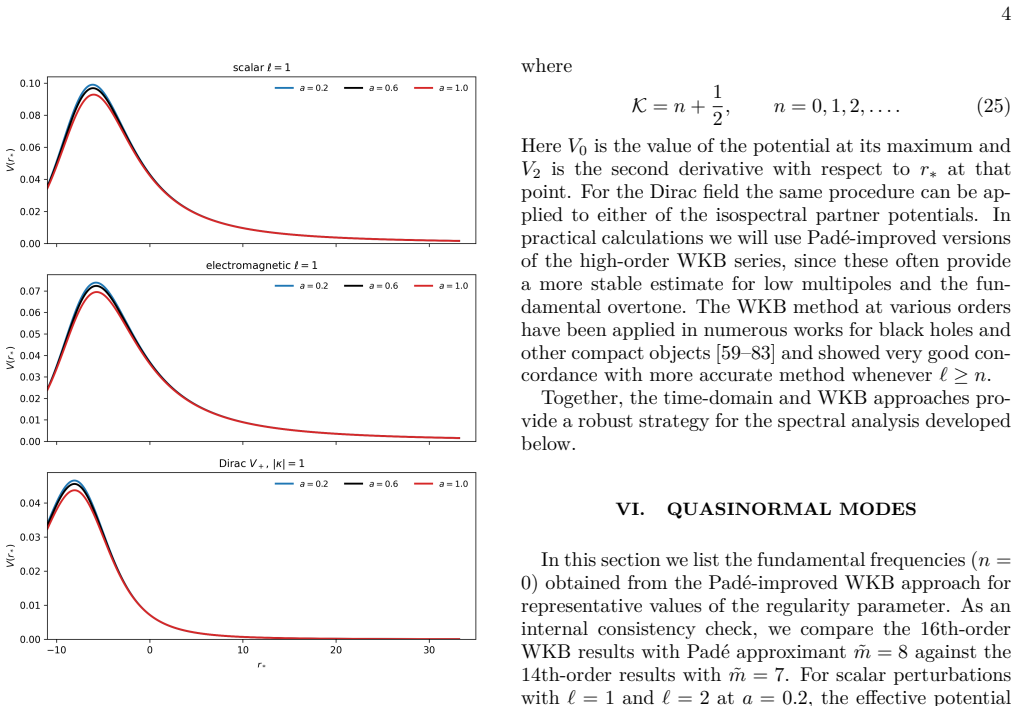
obtained from the Padé-improved WKB approach for representative values of the regularity parameter. As an internal consistency check, we compare the 16th-order WKB results with Padé approximant ˜m = 8 against the 14th-order results with ˜m = 7 . For scalar perturbations with ℓ = 1 and ℓ = 2 at a = 0 .2, the effective potential has no barrier maximum, and i...
-
[2]
0.104535 − 0.101138i 0.104552 − 0.100903i 0.163% (b) ℓ = 1 a WKB16 ( ˜m = 8) WKB14 ( ˜m = 7) difference 0.2 no peak found 0.4 0 .291260 − 0.097149i 0.291260 − 0.097149i 0% 0.6 0 .289214 − 0.096526i 0.289214 − 0.096526i 0% 0.8 0 .286438 − 0.095681i 0.286438 − 0.095681i < 10−4%
-
[3]
0.283009 − 0.094640i 0.283009 − 0.094640i 0% 1.2 0 .279019 − 0.093429i 0.279019 − 0.093429i 0% 1.4 0 .274561 − 0.092079i 0.274561 − 0.092079i < 10−4% 1.6 0 .269730 − 0.090618i 0.269730 − 0.090618i 0% 1.8 0 .264614 − 0.089073i 0.264614 − 0.089073i 0%
-
[4]
0.259297 − 0.087470i 0.259297 − 0.087469i 0.0003% (c) ℓ = 2 a WKB16 ( ˜m = 8) WKB14 ( ˜m = 7) difference 0.2 no peak found 0.4 0 .481021 − 0.096255i 0.481021 − 0.096255i 0% 0.6 0 .477816 − 0.095639i 0.477816 − 0.095639i 0% 0.8 0 .473462 − 0.094802i 0.473462 − 0.094802i 0%
-
[5]
0.468076 − 0.093767i 0.468076 − 0.093767i 0% 1.2 0 .461793 − 0.092560i 0.461793 − 0.092560i 0% 1.4 0 .454758 − 0.091209i 0.454758 − 0.091209i 0% 1.6 0 .447113 − 0.089741i 0.447113 − 0.089741i 0% 1.8 0 .438997 − 0.088183i 0.438997 − 0.088183i 0%
-
[6]
0.430536 − 0.086557i 0.430536 − 0.086557i 0% The significance of this shift becomes especially clear once it is compared with the numerical uncertainty es- timated from the difference between the WKB16 and WKB14 Padé-improved results. For the fundamental modes with ℓ ≥ 1 or |κ| ≥ 2, this difference is typi- cally zero in the quoted digits and, when nonzero, ...
-
[7]
0.240480 − 0.089460i 0.240480 − 0.089461i 0.0001% 1.2 0 .237329 − 0.088235i 0.237329 − 0.088236i 0.0001% 1.4 0 .233794 − 0.086862i 0.233794 − 0.086862i 0.0001% 1.6 0 .229946 − 0.085367i 0.229946 − 0.085367i 0% 1.8 0 .225851 − 0.083777i 0.225850 − 0.083778i < 10−4%
-
[8]
0.221572 − 0.082118i 0.221572 − 0.082118i 0.0001% (b) ℓ = 2 a WKB16 ( ˜m = 8) WKB14 ( ˜m = 7) difference 0.2 0 .456985 − 0.094875i 0.456985 − 0.094875i 0% 0.4 0 .455172 − 0.094491i 0.455172 − 0.094491i 0% 0.6 0 .452208 − 0.093863i 0.452208 − 0.093863i 0% 0.8 0 .448177 − 0.093010i 0.448177 − 0.093010i 0%
-
[9]
0.443185 − 0.091953i 0.443185 − 0.091953i 0% 1.2 0 .437355 − 0.090719i 0.437355 − 0.090719i 0% 1.4 0 .430815 − 0.089336i 0.430815 − 0.089336i 0% 1.6 0 .423697 − 0.087830i 0.423697 − 0.087830i 0% 1.8 0 .416126 − 0.086230i 0.416126 − 0.086230i 0%
-
[10]
Even for the higher electromagnetic overtones in Tab
0.408219 − 0.084559i 0.408219 − 0.084559i 0% mains at the level 10−4%– 10−3%. Even for the higher electromagnetic overtones in Tab. IV, the discrepancy does not exceed 8.82 × 10⁻³%. The least favorable fun- damental cases are the Dirac mode with |κ| = 1 , where the internal spread reaches about 0.13%, and the scalar monopole, where it is about 0.25%. Yet ...
-
[11]
0.177181 − 0.094080i 0.177002 − 0.093919i 0.120% 1.2 0 .174805 − 0.092730i 0.174632 − 0.092619i 0.104% 1.4 0 .172111 − 0.091248i 0.171969 − 0.091159i 0.0860% 1.6 0 .169172 − 0.089648i 0.169066 − 0.089569i 0.0688% 1.8 0 .166052 − 0.087948i 0.165977 − 0.087879i 0.0544%
-
[12]
0.162804 − 0.086176i 0.162750 − 0.086116i 0.0438% (b) |κ| = 2 a WKB16 ( ˜m = 8) WKB14 ( ˜m = 7) difference 0.2 0 .379527 − 0.096275i 0.379527 − 0.096275i 0% 0.4 0 .378014 − 0.095887i 0.378014 − 0.095887i 0% 0.6 0 .375540 − 0.095255i 0.375540 − 0.095255i 0% 0.8 0 .372176 − 0.094394i 0.372176 − 0.094394i 0%
-
[13]
0.368009 − 0.093328i 0.368010 − 0.093328i 0% 1.2 0 .363143 − 0.092084i 0.363143 − 0.092084i 0% 1.4 0 .357686 − 0.090688i 0.357686 − 0.090688i 0% 1.6 0 .351746 − 0.089170i 0.351746 − 0.089170i 0% 1.8 0 .345429 − 0.087556i 0.345429 − 0.087556i 0%
-
[14]
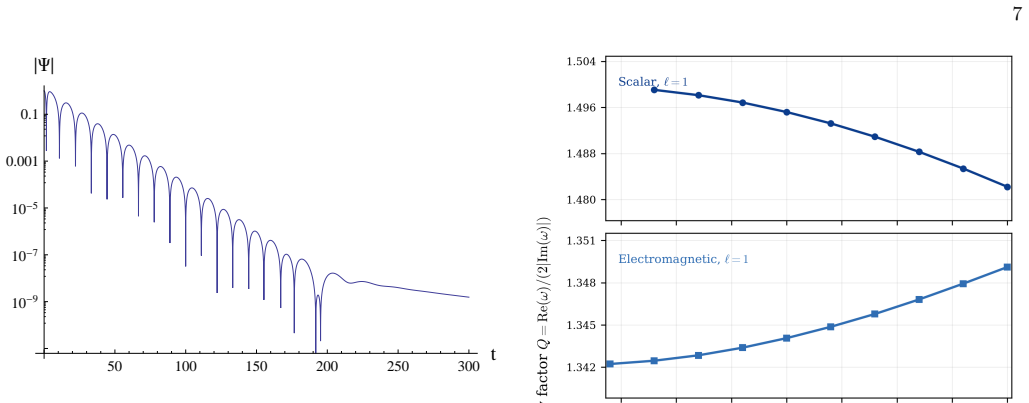
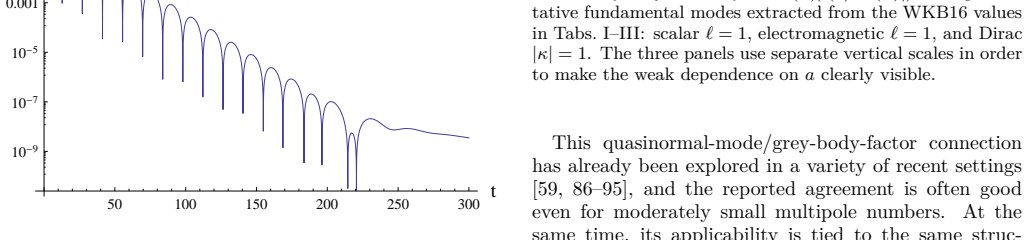
0.338832 − 0.085870i 0.338832 − 0.085870i 0% scalar fundamental mode, Fig. 3 shows the waveform for ℓ = 1 , M = 1 , and a = 1 , for which the Prony fit is in excellent agreement with the WKB result listed in Tab. I. An analogous electromagnetic profile is shown in Fig. 4 for ℓ = 1 , M = 1 , and a = 2 . In this case the Prony fit gives ω = 0 .221573 − 0.08211...
-
[15]
0.422851 − 0.281364i 0.422851 − 0.281364i 0% 1.2 0 .417301 − 0.277582i 0.417301 − 0.277582i 0% 1.4 0 .411071 − 0.273338i 0.411071 − 0.273338i 0% 1.6 0 .404282 − 0.268719i 0.404282 − 0.268719i 0% 1.8 0 .397053 − 0.263805i 0.397053 − 0.263805i 0%
-
[16]
0.389494 − 0.258673i 0.389494 − 0.258673i 0% (b) n = 2 a WKB16 ( ˜m = 8) WKB14 ( ˜m = 7) difference 0.2 0 .400661 − 0.500903i 0.400659 − 0.500902i 0.00021% 0.4 0 .399096 − 0.498871i 0.399096 − 0.498871i 0.00010% 0.6 0 .396537 − 0.495550i 0.396536 − 0.495550i 0.00013% 0.8 0 .393048 − 0.491030i 0.393047 − 0.491029i 0.00030%
-
[17]
0.388715 − 0.485428i 0.388714 − 0.485426i 0.00039% 1.2 0 .383635 − 0.478876i 0.383634 − 0.478875i 0.0001% 1.4 0 .377916 − 0.471522i 0.377915 − 0.471522i 0.00023% 1.6 0 .371667 − 0.463508i 0.371662 − 0.463509i 0.00088% 1.8 0 .364993 − 0.454977i 0.364985 − 0.454977i 0.00137%
-
[18]
0.357993 − 0.446060i 0.357984 − 0.446058i 0.00165% (c) n = 3 a WKB16 ( ˜m = 8) WKB14 ( ˜m = 7) difference 0.2 0 .362130 − 0.729199i 0.362123 − 0.729224i 0.00318% 0.4 0 .360742 − 0.726235i 0.360707 − 0.726255i 0.00496% 0.6 0 .358468 − 0.721388i 0.358431 − 0.721398i 0.00479% 0.8 0 .355357 − 0.714786i 0.355319 − 0.714792i 0.00482%
-
[19]
0.351473 − 0.706597i 0.351437 − 0.706599i 0.00447% 1.2 0 .346887 − 0.697013i 0.346864 − 0.697016i 0.00295% 1.4 0 .341688 − 0.686252i 0.341684 − 0.686254i 0.00059% 1.6 0 .335986 − 0.674524i 0.335984 − 0.674525i 0.00035% 1.8 0 .329866 − 0.662016i 0.329848 − 0.662035i 0.00350%
-
[20]
0.323403 − 0.648926i 0.323354 − 0.648967i 0.00882% can also be employed to approximate the corresponding grey-body factors. The reason is that, for single-barrier effective potentials, the WKB scattering quantity Kℓ(Ω) entering the transmission probability can be related di- rectly to the dominant quasinormal frequencies. In the standard notation the parti...
work page 2025
-
[21]
K. D. Kokkotas and B. G. Schmidt, Living Rev. Rel. 2, 2 (1999), arXiv:gr-qc/9909058
work page internal anchor Pith review Pith/arXiv arXiv 1999
-
[22]
Quasinormal modes of black holes and black branes
E. Berti, V. Cardoso, and A. O. Starinets, Class. Quant. Grav. 26, 163001 (2009), arXiv:0905.2975 [gr-qc]
work page internal anchor Pith review Pith/arXiv arXiv 2009
-
[23]
R. A. Konoplya and A. Zhidenko, Rev. Mod. Phys. 83, 793 (2011), arXiv:1102.4014 [gr-qc]
work page internal anchor Pith review Pith/arXiv arXiv 2011
- [24]
-
[25]
Quasinormal modes of regular black holes
A. Flachi and J. P. S. Lemos, Phys. Rev. D 87, 024034 (2013), arXiv:1211.6212 [gr-qc]
work page internal anchor Pith review Pith/arXiv arXiv 2013
- [26]
- [27]
- [28]
-
[29]
X.-C. Cai and Y.-G. Miao, Phys. Rev. D 103, 124050 (2021), arXiv:2104.09725 [gr-qc]
-
[30]
J. Li, K. Lin, and N. Yang, Eur. Phys. J. C 75, 131 (2015), arXiv:1409.5988 [gr-qc]
work page internal anchor Pith review Pith/arXiv arXiv 2015
- [31]
- [32]
- [33]
-
[34]
B.-H. Huang, H.-W. Hu, and L. Zhao, JCAP 03, 053 (2024), arXiv:2311.12286 [gr-qc]
- [35]
-
[36]
Quasinormal Modes of Bardeen Black Hole: Scalar Perturbations
S. Fernando and J. Correa, Phys. Rev. D 86, 064039 (2012), arXiv:1208.5442 [gr-qc]. 9
work page internal anchor Pith review Pith/arXiv arXiv 2012
-
[37]
D. Mahdavian Yekta, M. Karimabadi, and S. A. Alavi, Annals Phys. 434, 168603 (2021), arXiv:1912.12017 [hep-th]
- [38]
- [39]
- [40]
- [41]
- [42]
-
[43]
P. Dutta Roy and S. Kar, Phys. Rev. D 106, 044028 (2022), arXiv:2206.04505 [gr-qc]
-
[44]
O. Pedraza, L. A. López, R. Arceo, and I. Cabrera- Munguia, Mod. Phys. Lett. A 37, 2250057 (2022), arXiv:2111.06488 [gr-qc]
-
[45]
K. Lin, J. Li, and S. Yang, Int. J. Theor. Phys. 52, 3771 (2013)
work page 2013
-
[46]
Quasinormal modes from EFT of black hole perturbations with timelike scalar profile,
S. Mukohyama, K. Takahashi, K. Tomikawa, and V. Yingcharoenrat, JCAP 07, 050 (2023), arXiv:2304.14304 [gr-qc]
- [47]
-
[48]
A. Held, R. Gold, and A. Eichhorn, JCAP 06, 029 (2019), arXiv:1904.07133 [gr-qc]
work page internal anchor Pith review Pith/arXiv arXiv 2019
- [49]
- [50]
-
[51]
S. V. Bolokhov, Phys. Rev. D 109, 064017 (2024)
work page 2024
-
[52]
Skvortsova, (2026), arXiv:2603.28415 [gr-qc]
M. Skvortsova, (2026), arXiv:2603.28415 [gr-qc]
- [53]
-
[54]
Exact, non-singular black holes from a phantom DBI Field as primordial dark matter
T. Parvez and S. Shankaranarayanan, arXiv e-prints (2025), arXiv:2511.14047 [gr-qc]
work page internal anchor Pith review Pith/arXiv arXiv 2025
-
[55]
Late-Time Behavior of Stellar Collapse and Explosions: I. Linearized Perturbations
C. Gundlach, R. H. Price, and J. Pullin, Phys. Rev. D 49, 883 (1994), arXiv:gr-qc/9307009
work page internal anchor Pith review Pith/arXiv arXiv 1994
- [56]
-
[57]
Z. Malik, Int. J. Theor. Phys. 63, 199 (2024), arXiv:2308.10412 [gr-qc]
-
[58]
M. Skvortsova, Fortsch. Phys. 72, 2400132 (2024), arXiv:2405.06390 [gr-qc]
- [59]
-
[60]
R. A. Konoplya and A. Zhidenko, Phys. Rev. D 89, 024011 (2014), arXiv:1309.7667 [hep-th]
work page internal anchor Pith review Pith/arXiv arXiv 2014
- [61]
-
[62]
A. Dubinsky and A. F. Zinhailo, EPL 149, 69004 (2025), arXiv:2410.15232 [gr-qc]
-
[63]
Evolution of massive fields around a black hole in Horava gravity
N. Varghese and V. C. Kuriakose, Gen. Rel. Grav. 43, 2757 (2011), arXiv:1011.6608 [gr-qc]
work page internal anchor Pith review Pith/arXiv arXiv 2011
-
[64]
M. Skvortsova, Fortsch. Phys. 72, 2400036 (2024), arXiv:2311.11650 [gr-qc]
- [65]
-
[66]
Scalar field propagation in higher dimensional black holes at a Lifshitz point
E. Abdalla, O. P. F. Piedra, F. S. Nuñez, and J. de Oliveira, Phys. Rev. D 88, 064035 (2013), arXiv:1211.3390 [gr-qc]
work page internal anchor Pith review Pith/arXiv arXiv 2013
- [67]
- [68]
-
[69]
M. Skvortsova, Grav. Cosmol. 30, 279 (2024), arXiv:2405.15807 [gr-qc]
-
[70]
Z. Malik, Annals Phys. 479, 170046 (2025), arXiv:2409.01561 [gr-qc]
-
[71]
A. Dubinsky, Int. J. Grav. Theor. Phys. 1, 2 (2025), arXiv:2507.00256 [gr-qc]
- [72]
- [73]
- [74]
- [75]
-
[76]
R. A. Konoplya, Phys. Rev. D 68, 024018 (2003), arXiv:gr-qc/0303052
work page internal anchor Pith review Pith/arXiv arXiv 2003
-
[77]
Quasinormal modes of black holes. The improved semianalytic approach
J. Matyjasek and M. Opala, Phys. Rev. D 96, 024011 (2017), arXiv:1704.00361 [gr-qc]
work page internal anchor Pith review Pith/arXiv arXiv 2017
-
[78]
J. Matyjasek, R. A. Konoplya, and A. Zhidenko, Int. J. Grav. Theor. Phys. 2, 5 (2026), arXiv:2603.12466 [gr- qc]
-
[79]
R. A. Konoplya and A. Zhidenko, Phys. Rev. D 82, 084003 (2010), arXiv:1004.3772 [hep-th]
work page internal anchor Pith review Pith/arXiv arXiv 2010
-
[80]
Z. Malik, Int. J. Grav. Theor. Phys. 1, 6 (2025), arXiv:2509.15995 [gr-qc]
discussion (0)
Sign in with ORCID, Apple, or X to comment. Anyone can read and Pith papers without signing in.