Exact, non-singular black holes from a phantom DBI Field as primordial dark matter
Pith reviewed 2026-05-17 21:29 UTC · model grok-4.3
The pith
Phantom DBI scalar field sources exact non-singular black holes that leave gram-mass relics after evaporation.
A machine-rendered reading of the paper's core claim, the machinery that carries it, and where it could break.
Core claim
We present an exact, non-singular black hole solution sourced exclusively by the phantom branch of a DBI scalar field. The solution is asymptotically flat, carries non-trivial scalar hair, and replaces the central singularity with a regular 2-sphere through a mechanism of dynamical kinetic stiffness. These black holes evaporate completely to a non-singular relic whose mass is of order one gram, thereby providing a viable channel for light primordial black holes to constitute dark matter.
What carries the argument
The phantom branch of the DBI action, which supplies a dynamical kinetic stiffness that resolves the singularity and evades classical no-hair theorems.
Load-bearing premise
The central claim requires that the phantom branch of the DBI action is physically allowed and stable, without being ruled out by energy conditions or stability criteria.
What would settle it
A direct demonstration that the phantom DBI energy density forces a singularity to reappear under small perturbations or that the evaporation process produces no stable relic would falsify the non-singular remnant claim.
Figures


read the original abstract
We present the first exact, non-singular black hole solution in General Relativity sourced by a Dirac-Born-Infeld (DBI) scalar field. Crucially, the solution is exclusively supported by \emph{the phantom branch of the DBI action}, dynamically replacing the central singularity with a regular core. The solution is asymptotically flat, possesses non-trivial scalar hair, and replaces the central singularity with a regular 2-sphere. The mechanism for singularity resolution is a dynamical \emph{kinetic stiffness} which also explains the evasion of classical no-hair theorems. We show these black holes evaporate to a non-singular relic with mass of the order of a gram. This provides a robust mechanism to evade standard evaporation constraints, opening a vast, previously forbidden mass window for light \emph{Primordial Black Holes} to constitute dark matter. The model is testable via distinctive gravitational-wave signatures from its scalar hair.
Editorial analysis
A structured set of objections, weighed in public.
Referee Report
Summary. The manuscript presents an exact, non-singular black hole solution in general relativity sourced by a phantom branch of the Dirac-Born-Infeld (DBI) scalar field. It claims that this solution is asymptotically flat, features non-trivial scalar hair, replaces the central singularity with a regular 2-sphere via dynamical kinetic stiffness that evades no-hair theorems, and that such black holes evaporate to non-singular relics with masses of order one gram, thereby allowing light primordial black holes to serve as dark matter candidates testable through gravitational wave signatures.
Significance. Should the derivation and claims be verified, this result would offer a novel mechanism for singularity resolution in black holes using a phantom DBI field and significantly impact the parameter space for primordial black holes as dark matter by evading standard evaporation limits. The potential for distinctive gravitational wave signals from the scalar hair adds to its observational relevance.
major comments (3)
- The central claim of an exact non-singular solution supported exclusively by the phantom DBI branch requires explicit presentation of the field equations, the metric ansatz, and the scalar field profile φ(r). Without these, it is difficult to assess whether the kinetic stiffness indeed resolves the singularity or if it is an artifact. The manuscript should include the derivation steps to confirm the solution satisfies the Einstein equations with the DBI stress-energy tensor.
- The phantom branch of the DBI action is known to violate the null energy condition. The paper must demonstrate explicitly, perhaps in a dedicated subsection or appendix, that the stress-energy tensor components do not lead to inconsistencies with the claimed regularity at the core, or explain how the violation is compatible with the dynamical replacement of the singularity. Cite the specific equation for T_μν and check T_μν k^μ k^ν for null vectors k in the core region.
- The assertion that the black holes evaporate to a non-singular relic with mass of the order of a gram is load-bearing for the dark matter application. This requires a detailed calculation of the Hawking evaporation process modified by the scalar hair and the regular core; the current presentation lacks the steps leading to this specific mass scale, which should be provided with error estimates or parameter dependence.
minor comments (2)
- Ensure all equations are numbered and referenced consistently throughout the text.
- Clarify the distinction between the phantom and standard branches of the DBI action with explicit Lagrangian forms in the introduction.
Simulated Author's Rebuttal
We thank the referee for their careful reading and constructive comments on our manuscript. We address each major comment point by point below, indicating the revisions we will implement.
read point-by-point responses
-
Referee: The central claim of an exact non-singular solution supported exclusively by the phantom DBI branch requires explicit presentation of the field equations, the metric ansatz, and the scalar field profile φ(r). Without these, it is difficult to assess whether the kinetic stiffness indeed resolves the singularity or if it is an artifact. The manuscript should include the derivation steps to confirm the solution satisfies the Einstein equations with the DBI stress-energy tensor.
Authors: We agree that greater explicitness in the derivation will improve accessibility. Although the solution is obtained by solving the Einstein equations sourced by the phantom DBI stress-energy tensor, we will add a dedicated subsection that states the full field equations, specifies the static spherically symmetric metric ansatz, gives the explicit scalar profile φ(r), and walks through the substitution that verifies satisfaction of the equations. This will make the role of kinetic stiffness transparent. revision: yes
-
Referee: The phantom branch of the DBI action is known to violate the null energy condition. The paper must demonstrate explicitly, perhaps in a dedicated subsection or appendix, that the stress-energy tensor components do not lead to inconsistencies with the claimed regularity at the core, or explain how the violation is compatible with the dynamical replacement of the singularity. Cite the specific equation for T_μν and check T_μν k^μ k^ν for null vectors k in the core region.
Authors: The null-energy-condition violation is a necessary feature of the phantom branch that permits both the non-trivial hair and the regular core. We will insert a new subsection that writes the explicit DBI stress-energy tensor T_μν, evaluates its components on the solution, and computes the contraction T_μν k^μ k^ν for representative null vectors k inside the core region. We will also clarify how the dynamical kinetic stiffness renders the geometry regular despite the NEC violation. revision: yes
-
Referee: The assertion that the black holes evaporate to a non-singular relic with mass of the order of a gram is load-bearing for the dark matter application. This requires a detailed calculation of the Hawking evaporation process modified by the scalar hair and the regular core; the current presentation lacks the steps leading to this specific mass scale, which should be provided with error estimates or parameter dependence.
Authors: We accept that the evaporation argument needs to be expanded for the dark-matter claim to be fully convincing. The gram-scale relic arises when the regular core and scalar hair alter the Hawking temperature and halt evaporation. In the revision we will supply the explicit steps of the modified evaporation calculation, the resulting mass expression with its dependence on the DBI scale, and order-of-magnitude error estimates associated with the semiclassical approximation. revision: yes
Circularity Check
No circularity: exact solution derived from Einstein-DBI equations with phantom branch choice
full rationale
The paper constructs an exact solution by solving the Einstein equations sourced by the stress-energy tensor of a phantom DBI scalar field. The phantom branch is an explicit sign choice in the DBI Lagrangian that produces the required negative kinetic contribution for regularity at the core. This is a standard ansatz-driven construction in scalar-tensor theories and does not reduce to a fitted parameter, self-definition, or load-bearing self-citation. The asymptotic flatness, non-trivial hair, and evaporation to a gram-scale relic follow directly from integrating the field equations with the chosen branch; no step equates the output to the input by construction. The derivation remains self-contained against the Einstein-DBI system.
Axiom & Free-Parameter Ledger
free parameters (1)
- DBI action parameters
axioms (1)
- domain assumption Phantom branch of the DBI action is permitted and dynamically stable
Lean theorems connected to this paper
-
IndisputableMonolith/Cost/FunctionalEquation.leanwashburn_uniqueness_aczel unclear?
unclearRelation between the paper passage and the cited Recognition theorem.
the solution is exclusively supported by the phantom branch of the DBI action... dynamical kinetic stiffness... 1 + 2X/Λ⁴ >0
-
IndisputableMonolith/Foundation/AlexanderDuality.leanalexander_duality_circle_linking unclear?
unclearRelation between the paper passage and the cited Recognition theorem.
regular 2-sphere of finite area at its core... f(r) = 1 + 3GM/a [r/a − ρ²/a² arctan(a/r)]
What do these tags mean?
- matches
- The paper's claim is directly supported by a theorem in the formal canon.
- supports
- The theorem supports part of the paper's argument, but the paper may add assumptions or extra steps.
- extends
- The paper goes beyond the formal theorem; the theorem is a base layer rather than the whole result.
- uses
- The paper appears to rely on the theorem as machinery.
- contradicts
- The paper's claim conflicts with a theorem or certificate in the canon.
- unclear
- Pith found a possible connection, but the passage is too broad, indirect, or ambiguous to say the theorem truly supports the claim.
Forward citations
Cited by 5 Pith papers
-
The Gravitational Spectral Radio Forest: A Signature of Primordial Black Holes
Asteroid-mass primordial black holes induce a Riemann tidal splitting of the 2P_{3/2} hydrogen state, turning the 9.9 GHz line into a ~2 GHz bandwidth gravitational spectral radio forest in H II regions with accretion...
-
Scalar, electromagnetic, and Dirac perturbations of regular black holes constituting primordial dark matter
Larger DBI regularity scale in an asymptotically flat regular black hole shifts quasinormal frequencies and damping rates downward with only weak change in quality factor, above numerical uncertainty.
-
Scattering of scalar, electromagnetic, and Dirac fields in an asymptotically flat regular black hole supported by primordial dark matter
Raising the regularity parameter in this regular black-hole spacetime lowers the single-barrier potentials for all three fields, shifts transmission to lower frequencies, increases absorption cross sections, and produ...
-
Massive scalar quasinormal modes of an asymptotically flat regular black hole supported by a phantom Dirac--Born--Infeld field
Massive scalar quasinormal modes in this DBI-supported regular black hole show higher oscillation frequencies and lower damping as field mass increases, with larger regularity scales producing softer and longer-lived ringing.
-
Scalar, electromagnetic, and Dirac perturbations of regular black holes constituting primordial dark matter
Larger DBI regularity in this regular black hole model reduces quasinormal frequencies and damping rates for scalar, electromagnetic, and Dirac perturbations while the quality factor stays nearly constant, producing a...
Reference graph
Works this paper leans on
-
[1]
We make the ansatzρ(r) = √ r2 +a 2, which defines a minimal 2-sphere atr= 0 with area 4πa2
Solving forf(r) For the metric ansatz (A3), the Einstein equationG t t −G θ θ = 0 takes the following form 1 ρ2(r) ρ2(r)f ′′ 2 −f ρρ ′′ + 1−f(r)(ρ ′(r))2 = 0.(B1) The absence of the scalar fieldϕin the above equation allows us to solve the geometry first. We make the ansatzρ(r) = √ r2 +a 2, which defines a minimal 2-sphere atr= 0 with area 4πa2. Eq. (B1) ...
-
[2]
Solving forϕ(r) In this subsection, we solve for the DBI scalar field. For the metric ansatz (A3), the scalar field EOM (A1) takes the following form 1 ρ2(r) d dr ρ2(r)f(r)ϕ ′(r)q 1− f(r)(ϕ ′(r))2 Λ4 = 0.(B6) Upon integrating the above equation, we obtain ρ2(r)f(r)(ϕ ′(r))q 1− f(r)(ϕ ′(r))2 Λ4 =B ,(B7) whereBis a dimensionless integration constant. We wri...
-
[3]
The scalar field is regular at the core, withϕ(r= 0) = 0 for all mass regimes, consistent with our solution (B15)
-
[4]
In the unitsa=B= G= 1 (whereκ 2 = 8π), the scalar field approachesϕ(r→ ∞) = 1 8πϵ(π−6M)
The asymptotic value of the scalar hair depends on the massM. In the unitsa=B= G= 1 (whereκ 2 = 8π), the scalar field approachesϕ(r→ ∞) = 1 8πϵ(π−6M). The 15 asymptotic value for the scalar field approaches a negative value for the non-extremal Black Hole (M > M relic) and a positive value for the extremal Black Hole (M=M relic) and the horizon-less regul...
-
[5]
Ricci scalar (R) The expression of the Ricci scalar is as follows R= 2 a3(a2 +r 2)2 h 9GM a2 +r 2 a2 + 2r2 tan−1 a r −21a 3GM r−a 5 −18aGM r 3 i .(D1) To check the regularity of the Ricci scalar atr= 0, we evaluate the above expression at r= 0. lim r→0 R= 9πGM−2a a3 .(D2) 16 From the above expression, we infer that the Ricci scalar is finite and non-diver...
-
[6]
Ricci tensor squared (R µνRµν) We write the expression for the square of the Ricci tensor,R µνRµν. RµνRµν = 4 a6(a2 +r 2)4 " a2 189a2G2M 2r4 + 9a4GM r2(13GM+r) + 15a 6GM r+a 8 + 81G2M 2r6 + 9GM(a2 +r 2)2 tan−1 a r 3GM(3a 2r2 +a 4 + 3r4) ×tan −1 a r −9GM a(a 2 +r 2) (D4) −9GM a(a 2 +r 2) tan−1 a r (12a2GM r+a 4 + 18GM r3) # . To check the regularity ofR µν...
-
[7]
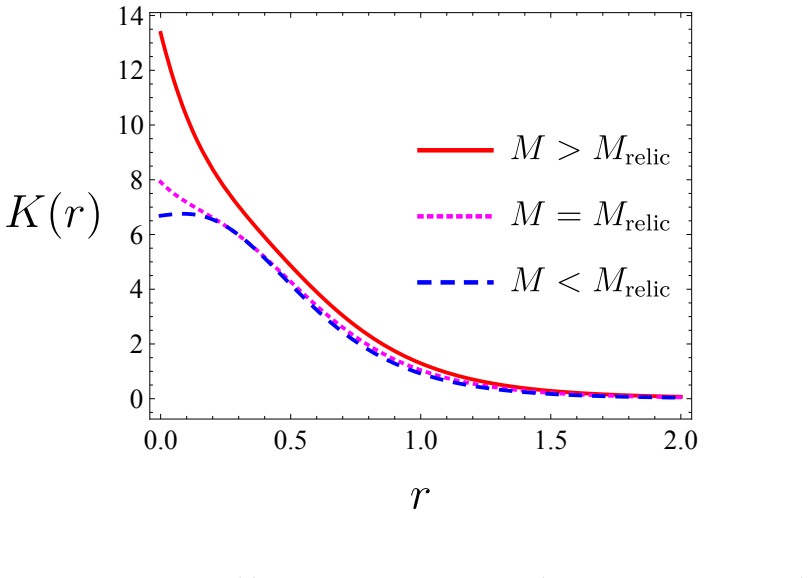
Kretschmann scalar (K) We also write the expression of the Kretschmann scalarK=R µναβ Rµναβ. K= 12 a6(a2 +r 2)4 " a2 42a2G2M 2r4 (D7) +a 4GM r2(33GM+ 2r) + 8a 6GM r+a 8 + 18G2M 2r6 + 9G2M 2(a2 +r 2)2(2a2r2 +a 4 + 2r4) × h tan−1 a r i2 −2aGM(a 2 +r 2) tan−1 a r × 30a2GM r3 +a 4r(15GM+r) + 2a 6 + 18GM r5 # To check the regularity ofKatr= 0, we evaluate the ...
-
[8]
From (D8), we see that the value of the Kretschmann scalar increases withMin the r→0 limit. Hence, the value of the Kretschmann scalar is large for the extremal Black Hole (M > M relic) compared to the case of the extremal Black Hole (M=M relic) and the horizon-less regular objectM < M relic in ther→0 limit
-
[9]
For all mass regimes, the Kretschmann scalar asymptotically approaches 0 as expected from (D9). Appendix E: Energy Condition: Sign of T t t A critical check for any classical solution is its adherence to fundamental energy con- ditions. The Weak Energy Condition (WEC) states that the energy densityρmust be 18 0.0 0.5 1.0 1.5 2.0 0 2 4 6 8 10 12 14 FIG. 3....
-
[10]
Horizon Radius To calculate the Hawking temperature, we must first find the precise location of the event horizonr h by solvingf(r h) = 0. 1− 2GM rh + 2GM a2 5r3 h ≈0.(F3) We assume a perturbative ansatzr h = 2GM+δ, whereδis a small correction of order O(a2). Substituting this into the horizon condition: 1− 2GM 2GM+δ + 2GM a2 5(2GM+δ) 3 ≈0 =⇒ δ 2GM ≈ − a2...
-
[11]
This shows our black hole is slightly cooler than a Schwarzschild black hole of the same mass
Hawking Temperature The Hawking temperature is defined by the surface gravityκ s at the horizon: TH = κs 2π = f ′(rh) 4π .(F6) First, we compute the derivative of the expanded metric function: f ′(r)≈ d dr 1−2GM r −1 + 2GM a2 5 r−3 (F7) = 2GM r2 − 6GM a2 5r4 .(F8) Now, we evaluate this at the corrected horizonr h ≈2GM: f ′(rh)≈ 2GM (2GM− a2 10GM )2 − 6GM ...
-
[12]
Evaporation rate The evaporation rate (Power,P) is set by the Stefan-Boltzmann law,P∝A hT 4 H. The area of the horizonA h is given by the area of the minimal sphere atr h, which isA h = 4πρ(rh)2 = 4π(r2 h +a 2). Ah = 4π 2GM− a2 10GM 2 +a 2 ! =A S 1 + 3a2 20(GM) 2 .(F12) whereA S = 16πG2M 2 is the Schwarzschild area. The evaporation rate is then: P∝A h(TH)...
-
[13]
Penrose, Gravitational collapse and space-time singularities, Phys
R. Penrose, Gravitational collapse and space-time singularities, Phys. Rev. Lett.14, 57 (1965)
work page 1965
-
[14]
S. W. Hawking and R. Penrose, The Singularities of gravitational collapse and cosmology, Proc. Roy. Soc. Lond. A314, 529 (1970)
work page 1970
-
[15]
S. Shankaranarayanan and J. P. Johnson, Modified theories of gravity: Why, how and what?, Gen. Rel. Grav.54, 44 (2022), arXiv:2204.06533 [gr-qc]
-
[16]
S. Mandal and S. Shankaranarayanan, Modified gravity theories at different curvature scales, inEncyclopedia of Astrophysics (First Edition), edited by I. Mandel (Elsevier, Oxford, 2026) first edition ed., pp. 73–111, arXiv:2502.07437 [gr-qc]
-
[17]
P. Szekeres and V. Iyer, Spherically symmetric singularities and strong cosmic censorship, Phys. Rev. D47, 4362 (1993)
work page 1993
-
[18]
M.-N. Celerier and P. Szekeres, Time - like and null focusing singularities in spherical symme- try: A Solution to the cosmological horizon problem and a challenge to the cosmic censorship hypothesis, Phys. Rev. D65, 123516 (2002), arXiv:gr-qc/0203094
work page internal anchor Pith review Pith/arXiv arXiv 2002
-
[19]
S. W. Hawking and G. F. R. Ellis,The Large Scale Structure of Space-Time, Cambridge Monographs on Mathematical Physics (Cambridge University Press, 2023)
work page 2023
-
[20]
J. M. M. Senovilla and D. Garfinkle, The 1965 Penrose singularity theorem, Class. Quant. Grav.32, 124008 (2015), arXiv:1410.5226 [gr-qc]
work page internal anchor Pith review Pith/arXiv arXiv 1965
-
[21]
J. Bardeen, Non-singular general relativistic gravitational collapse, inProceedings of the 5th International Conference on Gravitation and the Theory of Relativity(1968) p. 87
work page 1968
-
[22]
Dymnikova, Vacuum nonsingular black hole, Gen
I. Dymnikova, Vacuum nonsingular black hole, Gen. Rel. Grav.24, 235 (1992)
work page 1992
-
[23]
S. A. Hayward, Formation and evaporation of regular black holes, Phys. Rev. Lett.96, 031103 (2006), arXiv:gr-qc/0506126
work page internal anchor Pith review Pith/arXiv arXiv 2006
-
[24]
Non-singular black-holes on the brane
S. Shankaranarayanan and N. Dadhich, Nonsingular black holes on the brane, Int. J. Mod. Phys. D13, 1095 (2004), arXiv:gr-qc/0306111
work page internal anchor Pith review Pith/arXiv arXiv 2004
-
[25]
Regular black holes in quadratic gravity
W. Berej, J. Matyjasek, D. Tryniecki, and M. Woronowicz, Regular black holes in quadratic gravity, Gen. Rel. Grav.38, 885 (2006), arXiv:hep-th/0606185
work page internal anchor Pith review Pith/arXiv arXiv 2006
-
[26]
Regular Black Hole in General Relativity Coupled to Nonlinear Electrodynamics
E. Ayon-Beato and A. Garcia, Regular black hole in general relativity coupled to nonlinear 25 electrodynamics, Phys. Rev. Lett.80, 5056 (1998), arXiv:gr-qc/9911046
work page internal anchor Pith review Pith/arXiv arXiv 1998
-
[27]
Falkowski, Lectures on SMEFT, Eur
A. Falkowski, Lectures on SMEFT, Eur. Phys. J. C83, 656 (2023)
work page 2023
-
[28]
Weinberg, Phenomenological Lagrangians, Physica A96, 327 (1979)
S. Weinberg, Phenomenological Lagrangians, Physica A96, 327 (1979)
work page 1979
-
[29]
Georgi, Effective field theory, Ann
H. Georgi, Effective field theory, Ann. Rev. Nucl. Part. Sci.43, 209 (1993)
work page 1993
-
[30]
C. P. Burgess, Introduction to Effective Field Theory, Ann. Rev. Nucl. Part. Sci.57, 329 (2007), arXiv:hep-th/0701053
work page internal anchor Pith review Pith/arXiv arXiv 2007
-
[31]
R. Penco, An Introduction to Effective Field Theories, arXiv 10.48550/arXiv.2006.16285 (2020), arXiv:2006.16285 [hep-th]
-
[32]
N. H. Barth and S. M. Christensen, Quantizing Fourth Order Gravity Theories. 1. The Func- tional Integral, Phys. Rev. D28, 1876 (1983)
work page 1983
-
[33]
J. Z. Simon, Higher Derivative Lagrangians, Nonlocality, Problems and Solutions, Phys. Rev. D41, 3720 (1990)
work page 1990
-
[34]
M. Born and L. Infeld, Foundations of the new field theory, Proc. Roy. Soc. Lond. A144, 425 (1934)
work page 1934
-
[35]
P. A. M. Dirac, An Extensible model of the electron, Proc. Roy. Soc. Lond. A268, 57 (1962)
work page 1962
-
[36]
C. Armendariz-Picon, T. Damour, and V. F. Mukhanov, k - inflation, Phys. Lett. B458, 209 (1999), arXiv:hep-th/9904075
work page internal anchor Pith review Pith/arXiv arXiv 1999
-
[37]
C. G. Callan and J. M. Maldacena, Brane death and dynamics from the Born-Infeld action, Nucl. Phys. B513, 198 (1998), arXiv:hep-th/9708147
work page internal anchor Pith review Pith/arXiv arXiv 1998
-
[38]
Kluson, Proposal for nonBPS D-brane action, Phys
J. Kluson, Proposal for nonBPS D-brane action, Phys. Rev. D62, 126003 (2000), arXiv:hep- th/0004106
-
[39]
G. W. Gibbons, K. Hori, and P. Yi, String fluid from unstable D-branes, Nucl. Phys. B596, 136 (2001), arXiv:hep-th/0009061
work page internal anchor Pith review Pith/arXiv arXiv 2001
-
[40]
Sen, Field theory of tachyon matter, Mod
A. Sen, Field theory of tachyon matter, Mod. Phys. Lett. A17, 1797 (2002), arXiv:hep- th/0204143
-
[41]
Resummation of Massive Gravity
C. de Rham, G. Gabadadze, and A. J. Tolley, Resummation of Massive Gravity, Phys. Rev. Lett.106, 231101 (2011), arXiv:1011.1232 [hep-th]
work page internal anchor Pith review Pith/arXiv arXiv 2011
-
[42]
Scalar Speed Limits and Cosmology: Acceleration from D-cceleration
E. Silverstein and D. Tong, Scalar speed limits and cosmology: Acceleration from D- cceleration, Phys. Rev. D70, 103505 (2004), arXiv:hep-th/0310221
work page internal anchor Pith review Pith/arXiv arXiv 2004
-
[43]
M. Alishahiha, E. Silverstein, and D. Tong, DBI in the sky, Phys. Rev. D70, 123505 (2004), arXiv:hep-th/0404084. 26
work page internal anchor Pith review Pith/arXiv arXiv 2004
-
[44]
Warp Features in DBI Inflation
V. Miranda, W. Hu, and P. Adshead, Warp Features in DBI Inflation, Phys. Rev. D86, 063529 (2012), arXiv:1207.2186 [astro-ph.CO]
work page internal anchor Pith review Pith/arXiv arXiv 2012
-
[45]
C. G. Callan, Jr., S. R. Coleman, J. Wess, and B. Zumino, Structure of phenomenological Lagrangians. 2., Phys. Rev.177, 2247 (1969)
work page 1969
-
[46]
Ghost Condensation and a Consistent Infrared Modification of Gravity
N. Arkani-Hamed, H.-C. Cheng, M. A. Luty, and S. Mukohyama, Ghost condensation and a consistent infrared modification of gravity, JHEP05, 074, arXiv:hep-th/0312099
work page internal anchor Pith review Pith/arXiv arXiv
-
[47]
T. Parvez and S. Shankaranarayanan, Mathematica notebook for ”an exact, non-singular black hole solution for primordial dark matter” (2025)
work page 2025
-
[48]
Black-bounce to traversable wormhole
A. Simpson and M. Visser, Black-bounce to traversable wormhole, JCAP02, 042, arXiv:1812.07114 [gr-qc]
work page internal anchor Pith review Pith/arXiv arXiv
-
[49]
M. S. Morris and K. S. Thorne, Wormholes in space-time and their use for interstellar travel: A tool for teaching general relativity, Am. J. Phys.56, 395 (1988)
work page 1988
-
[50]
M. Visser, The Quantum physics of chronology protection, inWorkshop on Conference on the Future of Theoretical Physics and Cosmology in Honor of Steven Hawking’s 60th Birthday (2002) pp. 161–176, arXiv:gr-qc/0204022
work page internal anchor Pith review Pith/arXiv arXiv 2002
-
[51]
Shoshany, Lectures on Faster-Than-Light Travel and Time Travel, SciPost Phys
B. Shoshany, Lectures on Faster-than-Light Travel and Time Travel, SciPost Phys. Lect. Notes 10, 1 (2019), arXiv:1907.04178 [gr-qc]
-
[52]
J. Borissova, S. Liberati, and M. Visser, Violations of the null convergence condition in kine- matical transitions between singular and regular black holes, horizonless compact objects, and bounces, Phys. Rev. D111, 104054 (2025), arXiv:2502.00548 [gr-qc]
-
[53]
S. W. Hawking, Particle Creation by Black Holes, Commun. Math. Phys.43, 199 (1975), [Erratum: Commun.Math.Phys. 46, 206 (1976)]
work page 1975
-
[54]
D. N. Page, Particle Emission Rates from a Black Hole: Massless Particles from an Uncharged, Nonrotating Hole, Phys. Rev. D13, 198 (1976)
work page 1976
-
[55]
Primordial Black Holes as Dark Matter: Recent Developments
B. Carr and F. Kuhnel, Primordial Black Holes as Dark Matter: Recent Developments, Ann. Rev. Nucl. Part. Sci.70, 355 (2020), arXiv:2006.02838 [astro-ph.CO]
work page internal anchor Pith review Pith/arXiv arXiv 2020
-
[56]
J. D. Bekenstein, Transcendence of the law of baryon-number conservation in black hole physics, Phys. Rev. Lett.28, 452 (1972)
work page 1972
-
[57]
S. W. Hawking, Black holes in the Brans-Dicke theory of gravitation, Commun. Math. Phys. 25, 167 (1972)
work page 1972
-
[58]
J. D. Bekenstein, Black holes: Classical properties, thermodynamics and heuristic quantiza- 27 tion, in9th Brazilian School of Cosmology and Gravitation(1998) arXiv:gr-qc/9808028
work page internal anchor Pith review Pith/arXiv arXiv 1998
-
[59]
T. P. Sotiriou and V. Faraoni, Black holes in scalar-tensor gravity, Phys. Rev. Lett.108, 081103 (2012), arXiv:1109.6324 [gr-qc]
work page internal anchor Pith review Pith/arXiv arXiv 2012
-
[60]
C. A. R. Herdeiro and E. Radu, Asymptotically flat black holes with scalar hair: a review, Int. J. Mod. Phys. D24, 1542014 (2015), arXiv:1504.08209 [gr-qc]
work page internal anchor Pith review Pith/arXiv arXiv 2015
-
[61]
Evasion of No-Hair Theorems and Novel Black-Hole Solutions in Gauss-Bonnet Theories
G. Antoniou, A. Bakopoulos, and P. Kanti, Evasion of No-Hair Theorems and Novel Black-Hole Solutions in Gauss-Bonnet Theories, Phys. Rev. Lett.120, 131102 (2018), arXiv:1711.03390 [hep-th]
work page internal anchor Pith review Pith/arXiv arXiv 2018
-
[62]
D. D. Doneva and S. S. Yazadjiev, New Gauss-Bonnet Black Holes with Curvature-Induced Scalarization in Extended Scalar-Tensor Theories, Phys. Rev. Lett.120, 131103 (2018), arXiv:1711.01187 [gr-qc]
work page internal anchor Pith review Pith/arXiv arXiv 2018
-
[63]
H. O. Silva, J. Sakstein, L. Gualtieri, T. P. Sotiriou, and E. Berti, Spontaneous scalarization of black holes and compact stars from a Gauss-Bonnet coupling, Phys. Rev. Lett.120, 131104 (2018), arXiv:1711.02080 [gr-qc]
work page internal anchor Pith review Pith/arXiv arXiv 2018
-
[64]
G. Astarita and G. Marrucci,Principles of non-Newtonian fluid mechanics(McGraw-Hill, London, 1974)
work page 1974
-
[65]
Bohme,Non-Newtonian fluid mechanics(North-Holland, Amsterdam, 1987)
G. Bohme,Non-Newtonian fluid mechanics(North-Holland, Amsterdam, 1987)
work page 1987
-
[66]
Testing General Relativity with Present and Future Astrophysical Observations
E. Bertiet al., Testing General Relativity with Present and Future Astrophysical Observations, Class. Quant. Grav.32, 243001 (2015), arXiv:1501.07274 [gr-qc]
work page internal anchor Pith review Pith/arXiv arXiv 2015
-
[67]
Testing the nature of dark compact objects: a status report
V. Cardoso and P. Pani, Testing the nature of dark compact objects: a status report, Living Rev. Rel.22, 4 (2019), arXiv:1904.05363 [gr-qc]
work page internal anchor Pith review Pith/arXiv arXiv 2019
-
[68]
A Horizon Study for Cosmic Explorer: Science, Observatories, and Community
M. Evanset al., A Horizon Study for Cosmic Explorer: Science, Observatories, and Commu- nity, arXiv (2021), arXiv:2109.09882 [astro-ph.IM]
work page internal anchor Pith review Pith/arXiv arXiv 2021
-
[69]
E. D. Hall, Cosmic Explorer: A Next-Generation Ground-Based Gravitational-Wave Obser- vatory, Galaxies10, 90 (2022)
work page 2022
-
[70]
Science with the Einstein Telescope: a comparison of different designs
M. Branchesiet al., Science with the Einstein Telescope: a comparison of different designs, JCAP07, 068, arXiv:2303.15923 [gr-qc]
work page internal anchor Pith review arXiv
-
[71]
The Science of the Einstein Telescope
A. Abacet al.(ET), The Science of the Einstein Telescope, arXiv (2025), arXiv:2503.12263 [gr-qc]
work page internal anchor Pith review Pith/arXiv arXiv 2025
-
[72]
M. Bojowald, E. I. Duque, and S. Shankaranarayanan, Scalar quasinormal modes in emergent modified gravity, Phys. Rev. D111, 024051 (2025), arXiv:2410.17501 [gr-qc]. 28
-
[73]
B. P. Abbottet al.(LIGO Scientific, Virgo), GWTC-1: A Gravitational-Wave Transient Catalog of Compact Binary Mergers Observed by LIGO and Virgo during the First and Second Observing Runs, Phys. Rev. X9, 031040 (2019), arXiv:1811.12907 [astro-ph.HE]
work page internal anchor Pith review Pith/arXiv arXiv 2019
-
[74]
R. Abbottet al.(KAGRA, VIRGO, LIGO Scientific), GWTC-3: Compact Binary Coales- cences Observed by LIGO and Virgo during the Second Part of the Third Observing Run, Phys. Rev. X13, 041039 (2023), arXiv:2111.03606 [gr-qc]
work page internal anchor Pith review Pith/arXiv arXiv 2023
-
[75]
A. Arbey and J. Auffinger, BlackHawk: A public code for calculating the Hawking evaporation spectra of any black hole distribution, Eur. Phys. J. C79, 693 (2019), arXiv:1905.04268 [gr-qc]
-
[76]
J. Auffinger, Primordial black hole constraints with Hawking radiation—A review, Prog. Part. Nucl. Phys.131, 104040 (2023), arXiv:2206.02672 [astro-ph.CO]. 29
discussion (0)
Sign in with ORCID, Apple, or X to comment. Anyone can read and Pith papers without signing in.