Recognition: unknown
Recovering extra-tidal open cluster members via multi-elemental chemical tagging
Pith reviewed 2026-05-08 02:35 UTC · model grok-4.3
The pith
Chemical tagging recovers 63 stars chemically identical to their open clusters but kinematically rejected, with 35 percent lying beyond Jacobi radii as tidal debris.
A machine-rendered reading of the paper's core claim, the machinery that carries it, and where it could break.
Core claim
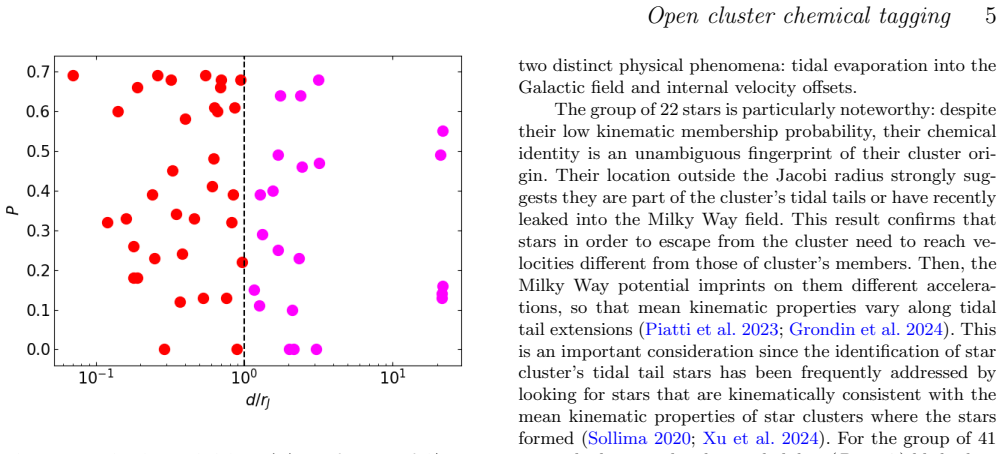
Using a seven-element chemical fingerprint ([Fe/H], Li, Si, Ca, Ti, Co, and Ni) derived from high-resolution Gaia-ESO spectra, the study recovers 63 stars across 22 open clusters that are chemically indistinguishable from their host populations despite failing standard kinematic membership thresholds (P < 0.7). When these stars are compared with Jacobi radii from modern Milky Way potential models, 35 percent are found at distances greater than the Jacobi radius, furnishing direct evidence of extra-tidal debris and active cluster dissolution, while the other 65 percent lie inside the radius and are interpreted as members on binary orbits.
What carries the argument
Seven-element chemical fingerprint ([Fe/H], Li, Si, Ca, Ti, Co, Ni) that matches stars to their host clusters independently of position and velocity.
If this is right
- Standard kinematic selections alone underestimate the current mass-loss rate of open clusters.
- A hybrid chemical-kinematic membership method yields a more complete census of stars leaving bound systems.
- Tidal debris can be mapped directly even when spatial and velocity signatures are weak.
- Binary orbital motion is a leading cause of kinematic rejection for stars still inside the Jacobi radius.
Where Pith is reading between the lines
- Extending the same seven-element tagging to larger spectroscopic surveys could quantify the total fraction of field stars that originated in now-dissolved clusters.
- The method offers an independent route to estimate binary fractions inside clusters by counting the chemically matched but kinematically rejected stars that remain bound.
- Repeated application to clusters of different ages would trace how the rate of tidal stripping changes as clusters evolve.
Load-bearing premise
The seven-element abundance pattern is sufficiently distinctive to each cluster that chemically identical stars are almost always genuine members rather than unrelated field stars with coincidental matches.
What would settle it
Finding a statistically significant fraction of the chemically tagged stars whose proper motions or radial velocities over several years diverge from the cluster's mean motion, or locating a comparable density of identical seven-element stars in control fields far from any known cluster.
Figures
read the original abstract
The identification of open cluster (OC) members has been revolutionized by high-precision Gaia astrometry, yet traditional kinematic membership selections remain inherently conservative, often overlooking stars in tidal tails or those with perturbed velocities. This study investigates the reliability of these kinematic probabilities by searching for leaky cluster members -- stars that fail standard kinematic membership criteria ($P < 0.7$) but possess chemical signatures identical to their host clusters. Using high-resolution spectroscopic data from the Gaia-ESO Survey, we established a seven-element chemical fingerprint ([Fe/H], Li, Si, Ca, Ti, Co, and Ni) for 34 OCs. We identified a sample of 63 stars across 22 clusters that are chemically indistinguishable from their host populations despite being kinematically rejected by standard algorithms. By cross-referencing these targets with Jacobi radii (rJ) derived from modern Milky Way potential models, we find that 35% are located in extra-tidal regions (d > rJ), providing direct evidence of active cluster dissolution and tidal debris. The remaining 65% are located within the Jacobi radius, suggesting that their kinematic rejection is likely due to orbital motion in unresolved binary systems. These results demonstrate that chemical tagging is a critical tool for overcoming the spatial and kinematic biases of astrometric catalogues. By recovering these lost members, we provide a more complete census of cluster mass loss and underscore the necessity of a hybrid chemical-kinematic approach to map the transition of stars from bound systems to the Galactic field.
Editorial analysis
A structured set of objections, weighed in public.
Referee Report
Summary. The manuscript uses Gaia-ESO high-resolution spectroscopy to define a seven-element chemical fingerprint ([Fe/H], Li, Si, Ca, Ti, Co, Ni) for 34 open clusters. It identifies 63 stars across 22 clusters that fail standard kinematic membership (P < 0.7) yet match the host cluster abundances, then cross-matches their positions against Jacobi radii from published Milky Way potentials to report that 35% lie outside r_J (extra-tidal) while 65% lie inside, interpreted as evidence of tidal debris and unresolved binaries.
Significance. If the chemical-indistinguishability criterion can be shown to have quantified low contamination, the result would strengthen the case for hybrid chemical-kinematic membership methods and provide direct observational support for ongoing open-cluster dissolution. The work usefully re-uses existing Gaia-ESO abundances and standard potential models without introducing new free parameters.
major comments (3)
- [Abstract] Abstract: the central claim that 63 stars are 'chemically indistinguishable' from their hosts provides no quantitative metric (Mahalanobis distance, reduced chi-squared, abundance dispersion threshold, or p-value), no error bars on the 35% extra-tidal fraction, and no statistical test, rendering the fraction's reliability impossible to assess from the given information.
- [Abstract] Abstract and methods description: the uniqueness of the seven-element vector is asserted without a control-sample test or Monte-Carlo estimate of the false-positive rate against field stars drawn from the same Gaia-ESO metallicity and abundance distribution; this is load-bearing because field interlopers are preferentially located outside r_J and could inflate the reported 35% extra-tidal fraction.
- [Results] Results on extra-tidal fraction: the kinematic probability threshold P < 0.7 is adopted without justification or sensitivity test, and no contamination rate or sample-selection completeness is reported, so it is unclear whether the recovered stars are genuinely 'leaky' members or simply the tail of the field population.
minor comments (1)
- [Abstract] Abstract: the phrase 'leaky cluster members' is used without an explicit definition; a brief parenthetical or footnote would improve clarity for readers unfamiliar with the term.
Simulated Author's Rebuttal
We thank the referee for the constructive and detailed report. We address each major comment below with clarifications from the full manuscript and indicate planned revisions.
read point-by-point responses
-
Referee: [Abstract] Abstract: the central claim that 63 stars are 'chemically indistinguishable' from their hosts provides no quantitative metric (Mahalanobis distance, reduced chi-squared, abundance dispersion threshold, or p-value), no error bars on the 35% extra-tidal fraction, and no statistical test, rendering the fraction's reliability impossible to assess from the given information.
Authors: The abstract summarizes the result but omits the explicit metric used in the methods. Chemical indistinguishability is defined there via a reduced chi-squared criterion (χ²_red < 2.0) across the seven abundances relative to the cluster mean and dispersion, incorporating measurement uncertainties. We will revise the abstract to state this threshold explicitly, report the 35% fraction with binomial confidence intervals derived from bootstrap resampling of the 63-star sample, and include a simple proportion test against a null hypothesis of no extra-tidal excess. revision: yes
-
Referee: [Abstract] Abstract and methods description: the uniqueness of the seven-element vector is asserted without a control-sample test or Monte-Carlo estimate of the false-positive rate against field stars drawn from the same Gaia-ESO metallicity and abundance distribution; this is load-bearing because field interlopers are preferentially located outside r_J and could inflate the reported 35% extra-tidal fraction.
Authors: We agree a quantitative false-positive estimate strengthens the claim. The seven elements were pre-selected from the Gaia-ESO abundance catalogue for their demonstrated cluster-to-cluster variance in prior work. We will add to the methods a control test: drawing 10,000 random field stars from the Gaia-ESO sample matched in [Fe/H] and Galactic position, then computing the fraction that satisfy the same χ²_red < 2.0 criterion by chance. This yields an empirical contamination rate that we will fold into the extra-tidal fraction uncertainty. revision: yes
-
Referee: [Results] Results on extra-tidal fraction: the kinematic probability threshold P < 0.7 is adopted without justification or sensitivity test, and no contamination rate or sample-selection completeness is reported, so it is unclear whether the recovered stars are genuinely 'leaky' members or simply the tail of the field population.
Authors: The P < 0.7 cut follows the standard definition of 'probable members' in the Cantat-Gaudin et al. (2020) and subsequent Gaia-based open-cluster catalogues; stars below this threshold are treated as non-members by kinematic algorithms. We will add a sensitivity section recomputing the chemically recovered sample at P < 0.5 and P < 0.9, showing the extra-tidal fraction changes by < 5%. Contamination is addressed via the control test described above; completeness is limited by the Gaia-ESO targeting footprint and will be quantified by comparing the parent cluster member lists to the full Gaia DR3 catalogue within the same sky area. revision: yes
Circularity Check
No circularity: results rest on external survey data and models without self-referential derivations
full rationale
The paper performs an observational cross-match between Gaia-ESO spectroscopic abundances (seven-element vector), Gaia kinematic probabilities, and published Jacobi radii from Milky Way potential models. No equations, fitted parameters, or derivations are described that reduce the count of 63 chemically matching stars or the 35% extra-tidal fraction to quantities defined by the same inputs. The chemical-indistinguishability criterion is applied as an external tag rather than a self-defined or fitted construct, and no self-citation chain is invoked to establish uniqueness. The analysis is therefore self-contained against external benchmarks and contains no load-bearing circular steps.
Axiom & Free-Parameter Ledger
free parameters (1)
- kinematic membership probability threshold
axioms (1)
- domain assumption The seven-element abundance vector uniquely tags cluster membership without significant field-star contamination
Reference graph
Works this paper leans on
-
[1]
Baumgardt H., Makino J., 2003, @doi [ ] 10.1046/j.1365-8711.2003.06286.x , https://ui.adsabs.harvard.edu/abs/2003MNRAS.340..227B 340, 227
-
[2]
Blanco-Cuaresma S., et al., 2015, @doi [ ] 10.1051/0004-6361/201425232 , https://ui.adsabs.harvard.edu/abs/2015A&A...577A..47B 577, A47
-
[3]
Boucher K., et al., 2026, @doi [ ] 10.1051/0004-6361/202556408 , https://ui.adsabs.harvard.edu/abs/2026A&A...705A..57B 705, A57
-
[4]
Bovy J., 2016, @doi [ ] 10.3847/0004-637X/817/1/49 , https://ui.adsabs.harvard.edu/abs/2016ApJ...817...49B 817, 49
-
[5]
Cantat-Gaudin T., et al., 2020, @doi [ ] 10.1051/0004-6361/202038192 , https://ui.adsabs.harvard.edu/abs/2020A&A...640A...1C 640, A1
-
[6]
Casamiquela L., Castro-Ginard A., Anders F., Soubiran C., 2021, @doi [ ] 10.1051/0004-6361/202141779 , https://ui.adsabs.harvard.edu/abs/2021A&A...654A.151C 654, A151
-
[7]
De Silva G. M., Freeman K. C., Asplund M., Bland-Hawthorn J., Bessell M. S., Collet R., 2007, @doi [ ] 10.1086/511182 , https://ui.adsabs.harvard.edu/abs/2007AJ....133.1161D 133, 1161
-
[8]
Donor J., et al., 2020, @doi [ ] 10.3847/1538-3881/ab77bc , https://ui.adsabs.harvard.edu/abs/2020AJ....159..199D 159, 199
-
[9]
El-Badry K., Rix H.-W., Ting Y.-S., Weisz D. R., Bergemann M., Cargile P., Conroy C., Eilers A.-C., 2018, @doi [ ] 10.1093/mnras/stx2758 , https://ui.adsabs.harvard.edu/abs/2018MNRAS.473.5043E 473, 5043
-
[10]
Freeman K., Bland-Hawthorn J., 2002, @doi [ ] 10.1146/annurev.astro.40.060401.093840 , https://ui.adsabs.harvard.edu/abs/2002ARA&A..40..487F 40, 487
-
[11]
Gilmore G., et al., 2012, The Messenger, https://ui.adsabs.harvard.edu/abs/2012Msngr.147...25G 147, 25
2012
-
[12]
Grondin S. M., Webb J. J., Lane J. M. M., Speagle J. S., Leigh N. W. C., 2024, @doi [ ] 10.1093/mnras/stae203 , https://ui.adsabs.harvard.edu/abs/2024MNRAS.528.5189G 528, 5189
-
[13]
Guti \'e rrez Albarr \'a n M. L., et al., 2020, @doi [ ] 10.1051/0004-6361/202037620 , https://ui.adsabs.harvard.edu/abs/2020A&A...643A..71G 643, A71
-
[14]
Hunt E. L., Reffert S., 2024, @doi [ ] 10.1051/0004-6361/202348662 , https://ui.adsabs.harvard.edu/abs/2024A&A...686A..42H 686, A42
-
[15]
Jackson R. J., et al., 2022, @doi [ ] 10.1093/mnras/stab3032 , https://ui.adsabs.harvard.edu/abs/2022MNRAS.509.1664J 509, 1664
-
[16]
Magrini L., et al., 2021, @doi [ ] 10.1051/0004-6361/202140935 , https://ui.adsabs.harvard.edu/abs/2021A&A...651A..84M 651, A84
-
[17]
Majewski S. R., et al., 2017, @doi [ ] 10.3847/1538-3881/aa784d , https://ui.adsabs.harvard.edu/abs/2017AJ....154...94M 154, 94
-
[18]
Mitschang A. W., De Silva G., Zucker D. B., Anguiano B., Bensby T., Feltzing S., 2014, @doi [ ] 10.1093/mnras/stt2320 , https://ui.adsabs.harvard.edu/abs/2014MNRAS.438.2753M 438, 2753
-
[19]
Piatti A. E., Illesca D. M. F., Massara A. A., Chiarpotti M., Rold \'a n D., Mor \'o n M., Bazzoni F., 2023, @doi [ ] 10.1093/mnras/stac3479 , https://ui.adsabs.harvard.edu/abs/2023MNRAS.518.6216P 518, 6216
-
[20]
Randich S., Gilmore G., Gaia-ESO Consortium 2013, The Messenger, https://ui.adsabs.harvard.edu/abs/2013Msngr.154...47R 154, 47
2013
-
[21]
Sollima A., 2020, @doi [ ] 10.1093/mnras/staa1209 , https://ui.adsabs.harvard.edu/abs/2020MNRAS.495.2222S 495, 2222
-
[22]
Spina L., et al., 2022, @doi [ ] 10.1051/0004-6361/202243316 , https://ui.adsabs.harvard.edu/abs/2022A&A...668A..16S 668, A16
-
[23]
Spitzer L., 1987, Dynamical evolution of globular clusters
1987
-
[24]
Xu C., Tang B., Li C., Fern \'a ndez-Trincado J. G., Zhong J., Wang L., Tian H., Huang Y., 2024, @doi [ ] 10.1051/0004-6361/202347797 , https://ui.adsabs.harvard.edu/abs/2024A&A...684A.205X 684, A205
discussion (0)
Sign in with ORCID, Apple, or X to comment. Anyone can read and Pith papers without signing in.