Recognition: unknown
DYMAPIA: A Multi-Domain Framework for Detecting AI-based Video Manipulation
Pith reviewed 2026-05-08 04:32 UTC · model grok-4.3
The pith
DYMAPIA builds dynamic anomaly masks from Fourier spectra, textures, edges and optical flow to guide a compact DistXCNet classifier that reaches over 99 percent accuracy on standard deepfake benchmarks.
A machine-rendered reading of the paper's core claim, the machinery that carries it, and where it could break.
Core claim
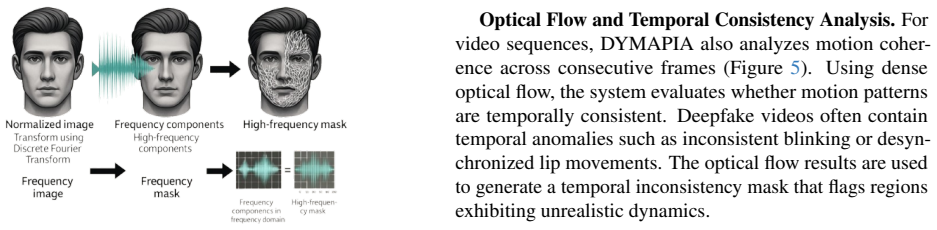
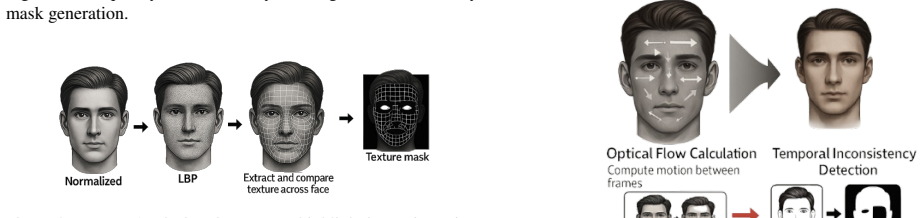
DYMAPIA fuses spatial, spectral and temporal cues to construct dynamic anomaly masks from Fourier spectra, local texture descriptors, edge irregularities and optical flow consistency; these masks then focus DistXCNet, a lightweight classifier obtained by distilling Xception and replacing standard convolutions with depthwise separable ones, delivering accuracy and F1 scores above 99 percent on FF++, Celeb-DF and VDFD while remaining compact enough for real-time use and outperforming prior full-frame and multi-domain detectors.
What carries the argument
Dynamic anomaly masks assembled from Fourier spectra, texture descriptors, edge irregularities and optical-flow consistency, which steer the distilled DistXCNet classifier toward tampered regions.
If this is right
- The system outperforms both full-frame and existing multi-domain detectors on the reported benchmarks.
- Model size stays small enough to support real-time forensic checks.
- Fine-grained spatial localization of tampered areas becomes available for downstream verification tasks.
- The same joint design can be applied directly to media verification, misinformation defense and secure content filtering.
Where Pith is reading between the lines
- Similar mask-generation logic could be tried on audio or still-image forgeries where spectral and temporal cues are also available.
- The emphasis on region-focused classification may reduce the compute cost of retraining when new manipulation techniques appear.
- Deployment on edge devices could let platforms screen uploads before they spread.
Load-bearing premise
The masks isolate manipulation traces reliably without excessive false positives on genuine video or missed subtle forgeries, and the benchmark results generalize to videos outside the three tested datasets.
What would settle it
Running the masks on a fresh collection of authentic videos and observing whether they flag large numbers of untampered regions as anomalous, or testing accuracy on deepfakes produced by entirely new generation methods not represented in FF++, Celeb-DF or VDFD.
Figures



read the original abstract
AI-generated media are advancing rapidly, raising pressing concerns for content authenticity and digital trust. We introduce DYMAPIA, a multi-domain Deepfake detection framework that fuses spatial, spectral, and temporal cues to capture subtle traces of manipulation in visual data. The system builds dynamic anomaly masks by combining evidence from Fourier spectra, local texture descriptors, edge irregularities, and optical flow consistency, which highlight tampered regions with fine spatial accuracy. These masks guide DistXCNet, a lightweight classifier distilled from Xception and optimized with depthwise separable convolutions for fast, region-focused classification. This joint design achieves state-of-the-art results, with accuracy and F1-scores exceeding 99\% on FF++, Celeb-DF, and VDFD benchmarks, while keeping the model compact enough for real-time use. Beyond outperforming existing full-frame and multidomain detectors, DYMAPIA demonstrates deployment readiness for time-critical forensic tasks, including media verification, misinformation defense, and secure content filtering.
Editorial analysis
A structured set of objections, weighed in public.
Referee Report
Summary. The manuscript introduces DYMAPIA, a multi-domain deepfake detection framework that constructs dynamic anomaly masks by fusing Fourier spectra, local texture descriptors, edge irregularities, and optical flow consistency to highlight tampered regions. These masks guide DistXCNet, a lightweight classifier distilled from Xception using depthwise separable convolutions, for region-focused classification. The paper claims this design yields state-of-the-art accuracy and F1-scores exceeding 99% on the FF++, Celeb-DF, and VDFD benchmarks while remaining compact enough for real-time deployment in forensic applications.
Significance. If the performance claims and generalization are rigorously validated, the work could contribute meaningfully to practical deepfake detection by demonstrating an efficient multi-cue anomaly-masking approach that balances accuracy with computational lightness. The focus on deployment readiness for time-critical tasks such as media verification adds practical value, provided the masks reliably isolate manipulation traces rather than dataset artifacts.
major comments (4)
- [Abstract] Abstract: The headline claim of accuracy and F1-scores exceeding 99% on FF++, Celeb-DF, and VDFD is presented without any reference to experimental protocol, train/test splits, baseline comparisons, cross-validation procedure, or error analysis, rendering the state-of-the-art assertion impossible to evaluate from the given information.
- [Method] Method section on dynamic anomaly mask construction: No quantitative validation is supplied for the masks themselves (e.g., precision/recall on pristine video subsets, false-positive rates under compression or natural motion, or stability across datasets), which is load-bearing because the entire performance claim rests on the masks successfully isolating genuine forgery traces without excessive false positives on authentic content.
- [Experiments] Experimental results section: Evaluation is confined to the same widely used public benchmarks (FF++, Celeb-DF, VDFD) that prior detectors are trained and tested on, with no mention of an independent held-out corpus or real-world video collection; this circularity risk directly undermines the multi-domain robustness and generalization assertions.
- [Method] DistXCNet description: The distillation hyperparameters and anomaly-mask fusion thresholds are listed as free parameters, yet no ablation study isolating the contribution of mask guidance (versus full-frame classification) or sensitivity analysis on those thresholds is reported, leaving open whether reported gains derive from the claimed joint design or from benchmark-specific tuning.
minor comments (2)
- [Method] The acronym DistXCNet is introduced without an explicit expansion or diagram clarifying its relation to the parent Xception network and the mask input pathway.
- Figure captions for the anomaly-mask examples should include quantitative metrics (e.g., overlap with ground-truth forgery regions) rather than qualitative description alone.
Simulated Author's Rebuttal
We thank the referee for the constructive feedback, which helps us improve the clarity and rigor of the manuscript. We address each major comment below and will incorporate revisions accordingly.
read point-by-point responses
-
Referee: [Abstract] Abstract: The headline claim of accuracy and F1-scores exceeding 99% on FF++, Celeb-DF, and VDFD is presented without any reference to experimental protocol, train/test splits, baseline comparisons, cross-validation procedure, or error analysis, rendering the state-of-the-art assertion impossible to evaluate from the given information.
Authors: We agree that the abstract should provide more context on the evaluation setup. In the revised version, we will expand the abstract to reference the standard train/test splits used on these benchmarks, the 5-fold cross-validation procedure, key baseline comparisons, and note that detailed error analysis appears in Section 4. revision: yes
-
Referee: [Method] Method section on dynamic anomaly mask construction: No quantitative validation is supplied for the masks themselves (e.g., precision/recall on pristine video subsets, false-positive rates under compression or natural motion, or stability across datasets), which is load-bearing because the entire performance claim rests on the masks successfully isolating genuine forgery traces without excessive false positives on authentic content.
Authors: We acknowledge this gap. We will add a dedicated subsection in the Experiments section reporting quantitative validation of the anomaly masks, including precision/recall against available manipulation ground truth, false-positive rates on pristine subsets under compression and natural motion, and stability metrics across the three datasets. revision: yes
-
Referee: [Experiments] Experimental results section: Evaluation is confined to the same widely used public benchmarks (FF++, Celeb-DF, VDFD) that prior detectors are trained and tested on, with no mention of an independent held-out corpus or real-world video collection; this circularity risk directly undermines the multi-domain robustness and generalization assertions.
Authors: We recognize the concern regarding generalization. While these are the standard benchmarks in the field, we will add cross-dataset evaluation results (training on one benchmark and testing on the others) to the revised Experiments section to better support the robustness claims. We will also explicitly discuss the limitations of relying solely on public benchmarks and the absence of a fully independent real-world corpus. revision: partial
-
Referee: [Method] DistXCNet description: The distillation hyperparameters and anomaly-mask fusion thresholds are listed as free parameters, yet no ablation study isolating the contribution of mask guidance (versus full-frame classification) or sensitivity analysis on those thresholds is reported, leaving open whether reported gains derive from the claimed joint design or from benchmark-specific tuning.
Authors: We agree that ablation studies are necessary to substantiate the design choices. In the revision, we will include a new ablation study subsection that isolates the contribution of the anomaly-mask guidance versus full-frame classification, along with sensitivity analysis on the fusion thresholds and distillation hyperparameters. revision: yes
Circularity Check
No circularity in derivation chain
full rationale
The paper presents a design combining multi-domain anomaly masks (Fourier, texture, edges, optical flow) to guide a distilled Xception-based classifier (DistXCNet), then reports empirical accuracy/F1 on public external benchmarks. No equations, self-definitional steps, fitted parameters renamed as predictions, or load-bearing self-citations are present that would reduce the claimed results or method to its inputs by construction. Evaluation on FF++, Celeb-DF, and VDFD is standard external testing, not internal tautology.
Axiom & Free-Parameter Ledger
free parameters (2)
- anomaly mask fusion thresholds
- DistXCNet distillation hyperparameters
axioms (2)
- domain assumption AI-manipulated videos exhibit consistent anomalies in Fourier spectra, local texture, edge structure, and optical flow
- domain assumption Standard benchmark datasets (FF++, Celeb-DF, VDFD) are representative of real-world manipulation
invented entities (1)
-
DistXCNet
no independent evidence
Reference graph
Works this paper leans on
-
[1]
Mesonet: a compact facial video forgery detection network
Darius Afchar, Vincent Nozick, Junichi Yamagishi, and Isao Echizen. Mesonet: a compact facial video forgery detection network. In2018 IEEE International Workshop on Informa- tion Forensics and Security (WIFS), pages 1–7, 2018. 2, 6, 7
2018
-
[2]
The state of deepfakes: Landscape, threats, and impact
Henry Ajder, Giorgio Patrini, Francesco Cavalli, and Lau- rence Cullen. The state of deepfakes: Landscape, threats, and impact. Technical report, Deeptrace, 2019. 1
2019
-
[3]
Multi- modaltrace: Deepfake detection using audiovisual representa- tion learning
Muhammad Anas Raza and Khalid Mahmood Malik. Multi- modaltrace: Deepfake detection using audiovisual representa- tion learning. In2023 IEEE/CVF Conference on Computer Vision and Pattern Recognition Workshops (CVPRW), pages 993–1000, 2023. 3
2023
-
[4]
Enhancing practi- cality and efficiency of deepfake detection.Scientific Reports, 14(1):82223, 2024
Ismael Balafrej and Mohamed Dahmane. Enhancing practi- cality and efficiency of deepfake detection.Scientific Reports, 14(1):82223, 2024. 3
2024
-
[5]
Deep fakes: A loom- ing challenge for privacy, democracy, and national security
Bobby Chesney and Danielle Citron. Deep fakes: A loom- ing challenge for privacy, democracy, and national security. California Law Review, 107(6):1753–1820, 2019. 3
2019
-
[6]
Xception: Deep learning with depthwise separable convolutions.CoRR, abs/1610.02357, 2016
Franc ¸ois Chollet. Xception: Deep learning with depthwise separable convolutions.CoRR, abs/1610.02357, 2016. 1, 6, 7
-
[7]
Audio-visual person-of-interest deepfake detection
Davide Cozzolino, Alessandro Pianese, Matthias Nießner, and Luisa Verdoliva. Audio-visual person-of-interest deepfake detection. In2023 IEEE/CVF Conference on Computer Vision and Pattern Recognition Workshops (CVPRW), pages 943– 952, 2023. 3
2023
-
[8]
The DeepFake Detection Challenge (DFDC) Dataset
Brian Dolhansky, Joanna Bitton, Ben Pflaum, Jikuo Lu, Russ Howes, Menglin Wang, and Cristian Canton Ferrer. The deepfake detection challenge (dfdc) dataset.arXiv preprint arXiv:2006.07397, 2020. 3
work page internal anchor Pith review arXiv 2006
-
[9]
Unmasking deepfakes with simple features,
Ricard Durall, Margret Keuper, Franz-Josef Pfreundt, and Janis Keuper. Unmasking deepfakes with simple features,
-
[10]
Generative adversarial networks.Commun
Ian Goodfellow, Jean Pouget-Abadie, Mehdi Mirza, Bing Xu, David Warde-Farley, Sherjil Ozair, Aaron Courville, and Yoshua Bengio. Generative adversarial networks.Commun. ACM, 63(11):139–144, 2020. 1
2020
-
[11]
David G¨uera and Edward J. Delp. Deepfake video detection using recurrent neural networks. In2018 15th IEEE Inter- national Conference on Advanced Video and Signal Based Surveillance (AVSS), pages 1–6, 2018. 2
2018
-
[12]
Deep residual learning for image recognition
Kaiming He, Xiangyu Zhang, Shaoqing Ren, and Jian Sun. Deep residual learning for image recognition. In2016 IEEE Conference on Computer Vision and Pattern Recognition (CVPR), pages 770–778, 2016. 6, 7
2016
-
[13]
Mask r-cnn, 2018
Kaiming He, Georgia Gkioxari, Piotr Doll ´ar, and Ross Gir- shick. Mask r-cnn, 2018. 3
2018
-
[14]
Weinberger
Gao Huang, Zhuang Liu, Laurens Van Der Maaten, and Kil- ian Q. Weinberger. Densely Connected Convolutional Net- works . In2017 IEEE Conference on Computer Vision and Pattern Recognition (CVPR), pages 2261–2269, Los Alami- tos, CA, USA, 2017. IEEE Computer Society. 6, 7
2017
-
[15]
Understanding the local binary pattern (lbp): A powerful method for texture analysis in computer vision, 2025
Anusha Ihalapathirana. Understanding the local binary pattern (lbp): A powerful method for texture analysis in computer vision, 2025. Accessed: 2025-03-15. 1, 4
2025
-
[16]
A style-based gen- erator architecture for generative adversarial networks.IEEE Transactions on Pattern Analysis and Machine Intelligence, 43(12):4217–4228, 2021
Tero Karras, Samuli Laine, and Timo Aila. A style-based gen- erator architecture for generative adversarial networks.IEEE Transactions on Pattern Analysis and Machine Intelligence, 43(12):4217–4228, 2021. 1
2021
-
[17]
Deep video portraits.ACM Transactions on Graphics, 37(4), 2018
Hyeongwoo Kim, Pablo Garrido, Ayush Tewari, Weipeng Xu, Justus Thies, Matthias Niessner, Patrick P´erez, Christian Richardt, Michael Zollh¨ofer, and Christian Theobalt. Deep video portraits.ACM Transactions on Graphics, 37(4), 2018. 1
2018
-
[18]
Face x-ray for more general face forgery detection
Lingzhi Li, Jianmin Bao, Ting Zhang, Hao Yang, Dong Chen, Fang Wen, and Baining Guo. Face x-ray for more general face forgery detection. InProceedings of the IEEE/CVF conference on computer vision and pattern recognition, pages 5001–5010, 2020. 6, 7
2020
-
[19]
Face x-ray for more general face forgery detection
Lingzhi Li, Jianmin Bao, Ting Zhang, Hao Yang, Dong Chen, Fang Wen, and Baining Guo. Face x-ray for more general face forgery detection. In2020 IEEE/CVF Conference on Computer Vision and Pattern Recognition (CVPR), pages 5000–5009, 2020. 2
2020
-
[20]
In ictu oculi: Exposing ai created fake videos by detecting eye blinking
Yuezun Li, Ming-Ching Chang, and Siwei Lyu. In ictu oculi: Exposing ai created fake videos by detecting eye blinking. In 2018 IEEE International Workshop on Information Forensics and Security (WIFS), pages 1–7, 2018. 2
2018
-
[21]
Celeb-df: A large-scale challenging dataset for deepfake forensics
Yuezun Li, Xin Yang, Pu Sun, Honggang Qi, and Siwei Lyu. Celeb-df: A large-scale challenging dataset for deepfake forensics. InProceedings of the IEEE/CVF conference on computer vision and pattern recognition, pages 3207–3216,
-
[22]
The creation and detection of deepfakes: A survey.ACM Computing Surveys, 54(1), 2021
Yisroel Mirsky and Wenke Lee. The creation and detection of deepfakes: A survey.ACM Computing Surveys, 54(1), 2021. 3
2021
-
[23]
Capsule-forensics: Using capsule networks to detect forged images and videos
Huy H Nguyen, Junichi Yamagishi, and Isao Echizen. Capsule-forensics: Using capsule networks to detect forged images and videos. InICASSP 2019-2019 IEEE Interna- tional Conference on Acoustics, Speech and Signal Process- ing (ICASSP), pages 2307–2311. IEEE, 2019. 6, 7
2019
-
[24]
Thanh Thi Nguyen, Quoc Viet Hung Nguyen, Dung Tien Nguyen, Duc Thanh Nguyen, Thien Huynh-The, Saeid Naha- vandi, Thanh Tam Nguyen, Quoc-Viet Pham, and Cuong M. Nguyen. Deep learning for deepfakes creation and detection: A survey.Comput. Vis. Image Underst., 223(C), 2022. 1, 2
2022
-
[25]
The state of deepfakes: Reality under attack
Giorgio Patrini, Francesco Cavalli, and Henry Ajder. The state of deepfakes: Reality under attack. Technical report, Deeptrace, 2018. 1
2018
-
[26]
Thinking in frequency: Face forgery detection by mining frequency-aware clues
Yuyang Qian, Guojun Yin, Lu Sheng, Zixuan Chen, and Jing Shao. Thinking in frequency: Face forgery detection by mining frequency-aware clues. InEuropean conference on computer vision, pages 86–103. Springer, 2020. 6, 7
2020
-
[27]
Md Shohel Rana and Andrew H. Sung. Deepfake detection: A tutorial. InProceedings of the 9th ACM International Work- shop on Security and Privacy Analytics, page 55–56, New York, NY , USA, 2023. Association for Computing Machinery. 2
2023
-
[28]
Md Shohel Rana and Andrew H. Sung. Advanced deepfake detection using machine learning algorithms: A statistical analysis and performance comparison. In2024 7th Interna- tional Conference on Information and Computer Technologies (ICICT), pages 75–81, 2024. 2
2024
-
[29]
Shohel Rana, Beddhu Murali, and Andrew H
Md. Shohel Rana, Beddhu Murali, and Andrew H. Sung. Deepfake detection using machine learning algorithms. In 2021 10th International Congress on Advanced Applied In- formatics (IIAI-AAI), pages 458–463, 2021. 2, 6
2021
-
[30]
Md Shohel Rana, Mohammad Nur Nobi, Beddhu Murali, and Andrew H. Sung. Deepfake detection: A systematic literature review.IEEE Access, 10:25494–25513, 2022. 2
2022
-
[31]
Deepfakes – reality under threat? In2024 IEEE 14th Annual Computing and Communication Workshop and Conference (CCWC), pages 0721–0727, 2024
Md Shohel Rana, Md Solaiman, Charan Gudla, and Md Fahimuzzman Sohan. Deepfakes – reality under threat? In2024 IEEE 14th Annual Computing and Communication Workshop and Conference (CCWC), pages 0721–0727, 2024. 2
2024
-
[32]
Faceforen- sics++: Learning to detect manipulated facial images
Andreas R¨ossler, Davide Cozzolino, Luisa Verdoliva, Chris- tian Riess, Justus Thies, and Matthias Niessner. Faceforen- sics++: Learning to detect manipulated facial images. In 2019 IEEE/CVF International Conference on Computer Vi- sion (ICCV), pages 1–11, 2019. 2, 6
2019
-
[33]
First order motion model for im- age animation
Aliaksandr Siarohin, St´ephane Lathuili`ere, Sergey Tulyakov, Elisa Ricci, and Nicu Sebe. First order motion model for im- age animation. InAdvances in Neural Information Processing Systems. Curran Associates, Inc., 2019. 2
2019
-
[34]
Seitz, and Ira Kemelmacher-Shlizerman
Supasorn Suwajanakorn, Steven M. Seitz, and Ira Kemelmacher-Shlizerman. Synthesizing obama: learning lip sync from audio.ACM Transactions on Graphics (TOG), 36(4), 2017. 1
2017
- [35]
-
[36]
Face2face: Real-time face capture and reenactment of rgb videos
Justus Thies, Michael Zollh¨ofer, Marc Stamminger, Christian Theobalt, and Matthias Nießner. Face2face: Real-time face capture and reenactment of rgb videos. In2016 IEEE Confer- ence on Computer Vision and Pattern Recognition (CVPR), pages 2387–2395, 2016. 1
2016
-
[37]
Neural voice puppetry: Audio-driven facial reenactment
Justus Thies, Mohamed Elgharib, Ayush Tewari, Christian Theobalt, and Matthias Nießner. Neural voice puppetry: Audio-driven facial reenactment. InComputer Vision – ECCV 2020, pages 716–731, Cham, 2020. Springer International Publishing. 2
2020
-
[38]
Visual deep- fake detection: Review of techniques, tools, limitations, and future prospects.IEEE Access, 13:1923–1961, 2025
Naveed Ur Rehman Ahmed, Afzal Badshah, Hanan Adeel, Ayesha Tajammul, Ali Daud, and Tariq Alsahfi. Visual deep- fake detection: Review of techniques, tools, limitations, and future prospects.IEEE Access, 13:1923–1961, 2025. 3
1923
-
[39]
Media forensics and deepfakes: An overview
Luisa Verdoliva. Media forensics and deepfakes: An overview. IEEE Journal of Selected Topics in Signal Processing, 14(5): 910–932, 2020. 3
2020
-
[40]
Jun-Yan Zhu, Taesung Park, Phillip Isola, and Alexei A. Efros. Unpaired image-to-image translation using cycle-consistent adversarial networks. In2017 IEEE International Conference on Computer Vision (ICCV), pages 2242–2251, 2017. 1
2017
discussion (0)
Sign in with ORCID, Apple, or X to comment. Anyone can read and Pith papers without signing in.