Recognition: unknown
Reflector-Free, Highly Confined Love-Like SAWs Enabled by a Phononic Metasurface for Real-Time Monitoring of Cell Dynamics
Pith reviewed 2026-05-07 17:34 UTC · model grok-4.3
The pith
Phononic metasurfaces create reflector-free shear-horizontal surface acoustic waves with strong lateral confinement and zero radiation losses.
A machine-rendered reading of the paper's core claim, the machinery that carries it, and where it could break.
Core claim
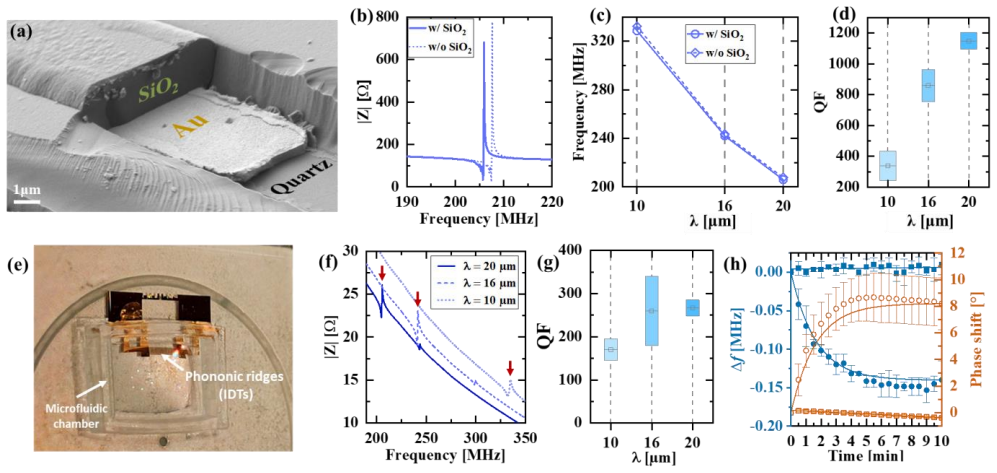
By integrating a phononic metasurface with tailored electromechanical properties of the substrate, we generate shear-horizontal surface resonance modes that exhibit strong lateral confinement and zero radiation into both the substrate bulk and the free surface. This eliminates the need for reflectors and leads to significantly higher quality factors than conventional SAW devices, particularly in water-loaded conditions. Fabrication and experimental validation confirm the resonator's effectiveness for real-time monitoring of cellular death.
What carries the argument
Phononic metasurface with tailored electromechanical properties that supports Love-like shear-horizontal surface resonance modes exhibiting zero radiation losses and strong lateral confinement.
Load-bearing premise
The phononic metasurface can be fabricated precisely enough to achieve the exact electromechanical tailoring required for zero radiation losses and strong confinement without adding damping, defects, or unwanted mode conversion.
What would settle it
Experimental observation of measurable energy leakage into the substrate bulk or quality factors that fail to exceed those of conventional SAW devices under water loading would disprove the zero-radiation and confinement claims.
Figures
read the original abstract
Surface acoustic wave (SAW) devices are widely used in sensing and biosensing but generally suffer from strong attenuation in liquid environments. Conventional approaches rely on reflectors to reduce these losses, yet these components remain difficult to optimize: limited device miniaturization, and increase fabrication complexity. Here, we introduce an innovative design strategy that integrates a phononic metasurface with tailored electromechanical properties of the substrate to generate a type of shear-horizontal (SH) surface resonance modes that exhibit strong lateral confinement and zero radiation into both the substrate bulk and the free surface, eliminating the need for reflectors. This approach enables highly tailorable surface acoustic resonances with distinctive enhanced dynamic strain-energy confinement leading to significantly higher quality factors than conventional SAW devices, particularly in water-loaded conditions. We show the fabrication and experimental validation of the proposed phononic metasurface-based SAW resonator and showcase its biosensing capabilities through real-time monitoring of cellular death.
Editorial analysis
A structured set of objections, weighed in public.
Referee Report
Summary. The manuscript introduces a phononic metasurface integrated with a piezoelectric substrate to support reflector-free, laterally confined shear-horizontal (Love-like) surface acoustic resonances. These modes are claimed to exhibit zero radiation into the substrate bulk and the liquid-loaded free surface due to tailored electromechanical properties and bandgap engineering, resulting in significantly higher quality factors than conventional SAW devices especially under water loading. The work includes design strategy, fabrication, experimental validation of the resonator, and demonstration of real-time biosensing via monitoring of cellular death dynamics.
Significance. If substantiated, the approach could enable more compact, reflector-free SAW biosensors with improved performance in liquid environments by achieving strong confinement and eliminating radiation losses. The experimental fabrication and cell-monitoring demonstration provide practical value and falsifiable predictions for Q-factor enhancement. Strengths include the focus on application-relevant validation, though the absence of direct quantitative benchmarks against optimized conventional devices limits the assessed advance.
major comments (2)
- [§3.2] §3.2 (dispersion analysis): The central claim of zero radiation into both substrate bulk and water-loaded surface requires explicit verification that the resonance lies inside a complete omnidirectional stopband, with no propagating solutions below the bulk shear-wave line and decoupled from liquid compressional waves. The presented dispersion curves do not overlay the relevant sound lines or confirm the absence of leakage channels in the radiation continuum, leaving the 'zero radiation' assertion as an untested modeling assumption that is load-bearing for the Q-factor advantage.
- [§5] §5 (experimental validation): The manuscript asserts fabrication and higher Q-factors in water but provides no quantitative data (measured Q values with error bars), direct comparisons to baseline conventional Love-wave devices with reflectors on the same substrate, or experimental verification of confinement (e.g., spatial decay profiles or far-field radiation measurements). This undermines support for the claim of significantly enhanced performance and real-time cell dynamics monitoring.
minor comments (2)
- [Figure 1] Figure 1 (device schematic): The metasurface unit-cell geometry lacks explicit scale bars, piezoelectric coefficient annotations, and boundary condition labels, hindering reproducibility of the tailored electromechanical properties.
- [Introduction] Introduction: The distinction between the proposed 'Love-like' modes and standard Love waves is not clearly defined; a short clarification of how the metasurface modifies the shear-horizontal polarization and confinement would improve accessibility.
Simulated Author's Rebuttal
We thank the referee for their constructive and detailed comments, which have helped identify areas where the manuscript can be strengthened. We provide point-by-point responses below and will incorporate revisions to address the concerns raised.
read point-by-point responses
-
Referee: [§3.2] §3.2 (dispersion analysis): The central claim of zero radiation into both substrate bulk and water-loaded surface requires explicit verification that the resonance lies inside a complete omnidirectional stopband, with no propagating solutions below the bulk shear-wave line and decoupled from liquid compressional waves. The presented dispersion curves do not overlay the relevant sound lines or confirm the absence of leakage channels in the radiation continuum, leaving the 'zero radiation' assertion as an untested modeling assumption that is load-bearing for the Q-factor advantage.
Authors: We agree that explicit verification is essential to substantiate the zero-radiation claim. In the revised manuscript, we will update the dispersion plots in §3.2 to overlay the bulk shear-wave line and the liquid compressional wave line. This will demonstrate that the resonance lies within a complete omnidirectional stopband with no propagating solutions below these lines, confirming the absence of leakage channels into the substrate bulk or water-loaded surface. We will also add a short discussion clarifying how the tailored electromechanical properties and bandgap engineering ensure decoupling from the radiation continuum. revision: yes
-
Referee: [§5] §5 (experimental validation): The manuscript asserts fabrication and higher Q-factors in water but provides no quantitative data (measured Q values with error bars), direct comparisons to baseline conventional Love-wave devices with reflectors on the same substrate, or experimental verification of confinement (e.g., spatial decay profiles or far-field radiation measurements). This undermines support for the claim of significantly enhanced performance and real-time cell dynamics monitoring.
Authors: We acknowledge that additional quantitative experimental details are needed to fully support the performance claims. In the revision, we will include measured Q-factor values with error bars from repeated fabrications and measurements, direct side-by-side comparisons of Q-factors (in water) against conventional Love-wave devices with reflectors fabricated on the same substrate, and experimental spatial decay profiles together with far-field radiation data to verify lateral confinement. The real-time cell death monitoring results will be augmented with quantitative metrics on frequency shifts and Q-factor evolution. revision: yes
Circularity Check
No significant circularity; design claims rest on simulation-validated metasurface geometry and experimental Q-factor measurements.
full rationale
The paper proposes a metasurface geometry to enforce stopbands for SH modes, demonstrates zero radiation via FEM dispersion analysis, fabricates the device, and measures higher Q in liquid. No step reduces a prediction to a fitted parameter by construction, nor does any load-bearing premise collapse to a self-citation chain or ansatz smuggled from prior work by the same authors. The derivation chain is self-contained against external benchmarks (dispersion curves, measured resonance spectra).
Axiom & Free-Parameter Ledger
axioms (1)
- domain assumption Phononic metasurfaces can be engineered with specific electromechanical properties to support confined shear-horizontal modes exhibiting zero radiation into bulk and surface.
Reference graph
Works this paper leans on
-
[1]
Tadesse, S. A. & Li, M. Sub -optical wavelength acoustic wave modulation of integrated photonic resonators at microwave frequencies. Nat. Commun. 5, 5402 (2014)
2014
-
[2]
Munk, D. et al. Surface acoustic wave photonic devices in silicon on insulator. Nat. Commun. 10, 4214 (2019)
2019
-
[3]
& Rinaldi, M
Giribaldi, G., Colombo, L., Simeoni, P. & Rinaldi, M. Compact and wideband nanoacoustic pass -band filters for future 5G and 6G cellular radios. Nat. Commun. 15, 304 (2024)
2024
-
[4]
Yang, Q. et al. Review of surface acoustic wave-based gas sensors. Sens. Int. 7, 100348 (2026)
2026
-
[5]
Ji, J. et al. An aptamer-based shear horizontal surface acoustic wave biosensor with a CVD-grown single- layered graphene film for high -sensitivity detection of a label -free endotoxin. Microsyst. Nanoeng. 6, 4 (2020)
2020
-
[6]
Huang, Y., Das, P. Kr. & Bhethanabotla, V. R. Surface acoustic waves in biosensing applications. Sens. Actuators Rep. 3, 100041 (2021)
2021
-
[7]
Ding, X. et al. Surface acoustic wave microfluidics. Lab. Chip 13, 3626–3649 (2013)
2013
-
[8]
Shilton, R. J. et al. Rapid and Controllable Digital Microfluidic Heating by Surface Acoustic Waves. Adv. Funct. Mater. 25, 5895 (2015)
2015
-
[9]
Liu, X. et al. Surface acoustic wave based microfluidic devices for biological applications. Sens. Diagn. 2, 507 (2023)
2023
-
[10]
Cha, B. et al. Rapid acoustofluidic mixing by ultrasonic surface acoustic wave-induced acoustic streaming flow. Ultrason. Sonochem. 99, 106575 (2023)
2023
-
[11]
Manenti, R. et al. Circuit quantum acoustodynamics with surface acoustic waves. Nat. Commun. 8, 975 (2017)
2017
-
[12]
Patel, S. D. et al. Surface Acoustic Wave Cavity Optomechanics with Atomically Thin ℎ -BN and WSe2 Single-Photon Emitters. PRX Quantum 5, 010330 (2024)
2024
-
[13]
Zhang, Q. et al. Gigahertz topological valley Hall effect in nanoelectromechanical phononic crystals. Nat. Electron. 5, 157–163 (2022)
2022
-
[14]
Xu, X. -B. et al. Gigahertz topological phononic circuits based on micrometre -scale unsuspended waveguide arrays. Nat. Electron. 8, 689–697 (2025)
2025
-
[15]
D., Gronewold, T
Schlensog, M. D., Gronewold, T. M. A., Tewes, M., Famulok, M. & Quandt, E. A Love -wave biosensor using nucleic acids as ligands. Sens. Actuators B Chem. 101, 308–315 (2004)
2004
-
[16]
& Gizeli, E
Saitakis, M., Dellaporta, A. & Gizeli, E. Measurement of Two -Dimensional Binding Constants between Cell-Bound Major Histocompatibility Complex and Immobilized Antibodies with an Acoustic Biosensor. Biophys. J. 95, 4963–4971 (2008)
2008
-
[17]
& Bhethanabotla, V
Li, S., Wan, Y., Su, Y., Fan, C. & Bhethanabotla, V. R. Gold nanoparticle -based low limit of detection Love wave biosensor for carcinoembryonic antigens. Biosens. Bioelectron. 95, 48–54 (2017)
2017
-
[18]
Wu, H., Zu, H., Wang, J. H.-C. & Wang, Q.-M. A study of Love wave acoustic biosensors monitoring the adhesion process of tendon stem cells (TSCs). Eur. Biophys. J. 48, 249–260 (2019)
2019
-
[19]
S., Schnitzler, L
Brugger, M. S., Schnitzler, L. G., Nieberle, T., Wixforth, A. & Westerhausen, C. Shear-horizontal surface acoustic wave sensor for non-invasive monitoring of dynamic cell spreading and attachment in wound healing assays. Biosens. Bioelectron. 173, 112807 (2021)
2021
-
[20]
H., Enoch, S
Brûlé, S., Javelaud, E. H., Enoch, S. & Guenneau, S. Experiments on Seismic Metamaterials: Molding Surface Waves. Phys. Rev. Lett. 112, 133901 (2014)
2014
-
[21]
& Craster, R
Colombi, A., Roux, P., Guenneau, S., Gueguen, P. & Craster, R. V. Forests as a natural seismic metamaterial: Rayleigh wave bandgaps induced by local resonances. Sci. Rep. 6, 19238 (2016)
2016
-
[22]
J ., Deng, Y
Oudich, M., Gerard, N. J ., Deng, Y. & Jing, Y. Tailoring Structure -Borne Sound through Bandgap Engineering in Phononic Crystals and Metamaterials: A Comprehensive Review. Adv. Funct. Mater. 33, 2206309 (2023)
2023
-
[23]
& Körner, C
Warmuth, F., Wormser, M. & Körner, C. Single phase 3D phononic band gap material. Sci. Rep. 7, 3843 (2017)
2017
-
[24]
& Jing, Y
Ji, J., Heo, H., Zhong, J., Oudich, M. & Jing, Y. Metamaterial-enabled wireless and contactless ultrasonic power transfer and data transmission through a metallic wall. Phys. Rev. Appl. 21, 014059 (2024)
2024
-
[25]
Kalaee, M. et al. Quantum electromechanics of a hypersonic crystal. Nat. Nanotechnol. 14, 334 –339 (2019)
2019
-
[26]
C., Chatterjee, E., Kindel, W
Taylor, J. C., Chatterjee, E., Kindel, W. F., Soh, D. & Eichenfield, M. Reconfigurable quantum phononic circuits via piezo-acoustomechanical interactions. Npj Quantum Inf. 8, 19 (2022)
2022
-
[27]
Kuruma, K. et al. Controlling interactions between high-frequency phonons and single quantum systems using phononic crystals. Nat. Phys. 21, 77–82 (2025)
2025
-
[28]
& Huang, Z
Wu, T.-T., Wu, L.-C. & Huang, Z. -G. Frequency band-gap measurement of two-dimensional air/silicon phononic crystals using layered slanted finger interdigital transducers. J. Appl. Phys. 97, 094916 (2005)
2005
-
[29]
-Y., Robert, L
Benchabane, S., Khelif, A., Rauch, J. -Y., Robert, L. & Laude, V. Evidence for complete surface wave band gap in a piezoelectric phononic crystal. Phys. Rev. E 73, 065601 (2006)
2006
-
[30]
& Laude, V
Achaoui, Y., Khelif, A., Benchabane, S., Robert, L. & Laude, V. Experimental observation of locally - resonant and Bragg band gaps for surface guided waves in a phononic crystal of pillars. Phys. Rev. B 83, 104201 (2011)
2011
-
[31]
Yudistira, D. et al. Nanoscale pillar hypersonic surface phononic crystals. Phys. Rev. B 94, 094304 (2016)
2016
-
[32]
Bonhomme, J. et al. Micropillared Surface to Enhance the Sensitivity of a Love-Wave Sensor. Phys. Rev. Appl. 17, 064024 (2022)
2022
-
[33]
& Badreddine Assouar, M
Oudich, M. & Badreddine Assouar, M. Surface acoustic wave band gaps in a diamond -based two - dimensional locally resonant phononic crystal for high frequency applications. J. Appl. Phys. 111, 014504 (2012)
2012
-
[34]
& Khelif, A
Gao, F., Benchabane, S., Bermak, A., Dong, S. & Khelif, A. On -Chip Tightly Confined Guiding and Splitting of Surface Acoustic Waves Using Line Defects in Phononic Crystals. Adv. Funct. Mater . 33, 2213625 (2023)
2023
-
[35]
Bonhomme, J. et al. Love waves dispersion by phononic pillars for nano -particle mass sensing. Appl. Phys. Lett. 114, 013501 (2019)
2019
-
[36]
& Khelif, A
Gao, F., Bermak, A., Benchabane, S., Robert, L. & Khelif, A. Acoustic radiation -free surface phononic crystal resonator for in-liquid low-noise gravimetric detection. Microsyst. Nanoeng. 7, 8 (2021)
2021
-
[37]
& Huang, C.-Y
Sung, C.-C. & Huang, C.-Y. Properties of pseudomode surface acoustic waves on ST-cut quartz substrates and the effects of the thicknesses of metallic films. Acoust. Phys. 52, 338–343 (2006)
2006
-
[38]
Mata, A., Fleischman, A. J. & Roy, S. Characterization of Polydimethylsiloxane (PDMS) Properties for Biomedical Micro/Nanosystems. Biomed. Microdevices 7, 281–293 (2005)
2005
-
[39]
Sun, C. et al. Acoustically accelerated neural differentiation of human embryonic stem cells. Acta Biomater. 151, 333–345 (2022)
2022
-
[40]
& Tabrizian, M
Martinez Villegas, K., Rasouli, R. & Tabrizian, M. Enhancing metabolic activity and differentiation potential in adipose mesenchymal ste m cells via high -resolution surface -acoustic-wave contactless patterning. Microsyst. Nanoeng. 8, 79 (2022)
2022
discussion (0)
Sign in with ORCID, Apple, or X to comment. Anyone can read and Pith papers without signing in.