Recognition: unknown
An archive of reduced and telluric-corrected CRIRES+ L- and M-band spectra with slit-tilt and wavelength calibrations
Pith reviewed 2026-05-07 17:20 UTC · model grok-4.3
The pith
A public archive supplies 5649 wavelength-calibrated and telluric-corrected CRIRES+ spectra in the L and M bands.
A machine-rendered reading of the paper's core claim, the machinery that carries it, and where it could break.
Core claim
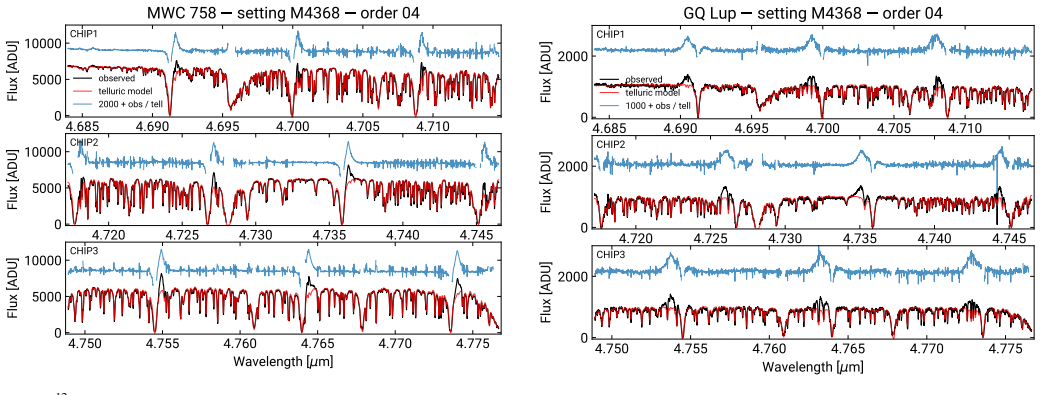
We present a uniformly reprocessed archive of all public CRIRES+ L/M science observations obtained between September 2021 and March 2025, totalling 11 131 raw frames. We use the telluric modelling tool viper that fits a model to the plethora of atmospheric absorption features that exist around these wavelengths. We calibrate the slit tilt from the wavelength solutions for the nodding A and B frames and update the static inputs to the data reduction system. Subsequently, we derive new wavelength scales for each observation from telluric fits on the spectra themselves, additionally interpolating the solutions for spectra that have no tellurics. The resulting 5649 extracted, calibrated and tell
What carries the argument
The viper telluric-modelling tool that fits atmospheric absorption features to derive both wavelength solutions and slit-tilt corrections for L- and M-band nodding observations.
If this is right
- Astronomers obtain ready-to-use calibrated spectra for 156 targets without repeating the telluric fitting step themselves.
- The updated slit-tilt values can be adopted as new static inputs for future reductions of CRIRES+ L/M data with the standard pipeline.
- The public web archive allows immediate inspection of data quality for every dataset before download.
- Observations lacking sufficient tellurics now inherit interpolated wavelength solutions from nearby frames that do contain them.
Where Pith is reading between the lines
- The same telluric-fitting approach could be tested on other high-resolution infrared spectrographs that lack calibration lamps in their longest bands.
- The archive may shorten the time needed to combine multiple L/M-band epochs for variability or orbital-motion studies.
- Future public releases could automatically incorporate new observations as they enter the ESO archive.
Load-bearing premise
Fitting telluric absorption lines with viper produces wavelength and slit-tilt calibrations that are accurate enough for scientific use and free of systematic offsets that would need separate verification.
What would settle it
A comparison of the viper-derived wavelength scales against the known rest wavelengths of a set of isolated telluric or stellar lines in a bright standard star observed in the same bands would reveal whether residual offsets exceed the claimed precision.
Figures




read the original abstract
The high-resolution near-infrared spectrograph CRIRES+ at ESO VLT covers the Y, J, H, K, L and M bands. The U-Ne and Fabry-Perot calibration light sources, however, only work up to the K-band, leaving the bands L and M without wavelength calibration, and without a way to measure the inclination of the long slit relative to the detector frame. To remedy this, we present here a uniformly reprocessed archive of all public CRIRES+ L/M science observations obtained between September 2021 and March 2025, totalling 11 131 raw frames. We use the telluric modelling tool viper that fits a model to the plethora of atmospheric absorption features that exist around these wavelengths. We calibrate the slit tilt from the wavelength solutions for the nodding A and B frames that have the target in the lower and upper half of the slit, respectively. We then update the static inputs to the data reduction system with the slit tilt information and reduce the data with the standard pipeline recipes. Subsequently, we derive new wavelength scales for each observation from telluric fits on the spectra themselves, additionally interpolating the solutions for spectra that have no tellurics from the ones that have. The resulting 5649 extracted, calibrated and telluric-fitted AB nod-pair spectra, spanning 156 unique targets from 68 ESO programmes, are served through an interactive web archive at https://www.astro.uu.se/crires-lm that offers data downloads and figures for all datasets that allow an initial judgement of the data quality.
Editorial analysis
A structured set of objections, weighed in public.
Referee Report
Summary. The paper describes a uniform reprocessing of all public CRIRES+ L- and M-band observations (11 131 raw frames from September 2021 to March 2025) to produce an archive of 5649 extracted, telluric-corrected AB nod-pair spectra for 156 targets. Wavelength calibration and slit-tilt corrections are derived by fitting telluric absorption features with the viper tool on the science frames themselves (since U-Ne and Fabry-Perot calibrators do not reach these bands), with interpolation for frames lacking sufficient tellurics; the resulting products are served via an interactive web archive at https://www.astro.uu.se/crires-lm.
Significance. If the viper-derived calibrations prove accurate at the level required for high-resolution work, the archive supplies a substantial, uniformly processed resource that enables scientific exploitation of CRIRES+ L/M data previously limited by the absence of standard wavelength solutions. The public release with per-dataset figures for quality inspection is a clear strength and directly addresses community needs for accessible infrared spectroscopy.
major comments (1)
- [Calibration and reduction procedure (abstract and associated methods description)] The central claim that the delivered spectra are scientifically usable rests on the accuracy of the viper telluric fits for wavelength solutions and the derived A/B-nod slit-tilt corrections. However, the manuscript supplies no quantitative validation: no RMS residuals of the fits, no error budgets on the wavelength scales, no comparison against independent standards or other instruments, and no cross-checks on the interpolated solutions. This omission is load-bearing for the usability assertion.
minor comments (2)
- [Abstract] The abstract states the total numbers of frames and spectra but does not break them down by band (L vs. M) or by the fraction of observations that required interpolation; adding such a summary table would improve transparency.
- [Archive description] The web archive is described as offering 'figures for all datasets that allow an initial judgement of the data quality,' but the manuscript does not specify what diagnostic plots (e.g., fit residuals, telluric model overlays) are included; a brief enumeration would help readers anticipate the quality-assessment tools.
Simulated Author's Rebuttal
We thank the referee for their positive summary and recommendation of minor revision. The single major comment identifies a genuine gap in the current manuscript that we will address through targeted additions.
read point-by-point responses
-
Referee: [Calibration and reduction procedure (abstract and associated methods description)] The central claim that the delivered spectra are scientifically usable rests on the accuracy of the viper telluric fits for wavelength solutions and the derived A/B-nod slit-tilt corrections. However, the manuscript supplies no quantitative validation: no RMS residuals of the fits, no error budgets on the wavelength scales, no comparison against independent standards or other instruments, and no cross-checks on the interpolated solutions. This omission is load-bearing for the usability assertion.
Authors: We agree that the absence of quantitative validation metrics weakens the usability claim. In the revised manuscript we will add a dedicated validation subsection (or expand the methods) that reports: (i) RMS residuals from the viper telluric fits across a representative sample of the 5649 spectra, (ii) a concise error budget for the derived wavelength scales that includes contributions from telluric-model uncertainties, line-list precision, and interpolation, (iii) direct cross-checks of interpolated solutions against neighbouring frames that possess sufficient tellurics for independent fits, and (iv) quantitative assessment of the A/B-nod slit-tilt corrections via the reduction in residual misalignment after correction. We will also discuss the inherent limitation that no laboratory or standard-lamp wavelength references exist for CRIRES+ in the L and M bands; where feasible we will include comparisons to high-resolution synthetic telluric spectra and to any overlapping observations from other facilities. These additions will be supported by new figures showing residual distributions and example wavelength-solution overlays. revision: yes
Circularity Check
No circularity: empirical data archive produced by external-tool pipeline
full rationale
The paper describes an observational data-reduction pipeline that ingests public raw CRIRES+ frames, applies the external viper tool to fit telluric absorption for wavelength solutions and slit-tilt calibration, updates pipeline static inputs, runs standard ESO recipes, and interpolates solutions where needed. The delivered archive of 5649 spectra is the direct empirical output of this processing applied to 11131 frames. No derived quantity is defined in terms of itself, no fitted parameter is relabeled as a prediction, and no load-bearing premise rests on self-citation. The work is self-contained against external benchmarks (raw ESO data and the viper code base) and contains no theoretical derivation chain that could reduce to its inputs by construction.
Axiom & Free-Parameter Ledger
axioms (1)
- domain assumption Telluric absorption features can be modeled accurately enough by the viper tool to derive wavelength scales and slit tilts in the L and M bands.
Reference graph
Works this paper leans on
-
[1]
, " * write output.state after.block = add.period write newline
ENTRY address archiveprefix author booktitle chapter edition editor howpublished institution eprint journal key month note number organization pages publisher school series title type volume year label extra.label sort.label short.list INTEGERS output.state before.all mid.sentence after.sentence after.block FUNCTION init.state.consts #0 'before.all := #1 ...
-
[2]
write newline
" write newline "" before.all 'output.state := FUNCTION n.dashify 't := "" t empty not t #1 #1 substring "-" = t #1 #2 substring "--" = not "--" * t #2 global.max substring 't := t #1 #1 substring "-" = "-" * t #2 global.max substring 't := while if t #1 #1 substring * t #2 global.max substring 't := if while FUNCTION word.in bbl.in " " * FUNCTION format....
-
[3]
2026, Claude Opus 4.6 System Card , https://www-cdn.anthropic.com/14e4fb01875d2a69f646fa5e574dea2b1c0ff7b5.pdf
Anthropic . 2026, Claude Opus 4.6 System Card , https://www-cdn.anthropic.com/14e4fb01875d2a69f646fa5e574dea2b1c0ff7b5.pdf
2026
-
[4]
J., Anglada-Escud \'e , G., Baade , D., et al
Dorn , R. J., Anglada-Escud \'e , G., Baade , D., et al. 2023, , 671, A24
2023
-
[5]
2023, CRIRES+ Pipeline User Manual , ESO document VLT-MAN-ESO-14200-6490, https://www.eso.org/sci/software/pipelines/cr2res/cr2res-pipe-recipes.html
ESO . 2023, CRIRES+ Pipeline User Manual , ESO document VLT-MAN-ESO-14200-6490, https://www.eso.org/sci/software/pipelines/cr2res/cr2res-pipe-recipes.html
2023
-
[6]
& Fischer , W
Komarova , O. & Fischer , W. J. 2020, Research Notes of the American Astronomical Society, 4, 6
2020
-
[7]
2002, , 384, 473
Lenorzer , A., Vandenbussche , B., Morris , P., et al. 2002, , 384, 473
2002
-
[8]
Marquart , T. & Lavail , A. 2026 a , CRIRES+ L/M-band reduction code , Zenodo, https://doi.org/10.5281/zenodo.19754514
-
[9]
Marquart , T. & Lavail , A. 2026 b , CRIRES+ L/M-band reprocessed spectra , Zenodo, https://doi.org/10.5281/zenodo.19675664
-
[10]
2015, , 576, A77
Smette , A., Sana , H., Noll , S., et al. 2015, , 576, A77
2015
-
[11]
2021, GNU Parallel 20210822 ('Kabul') , Zenodo, https://doi.org/10.5281/zenodo.5233953
Tange , O. 2021, GNU Parallel 20210822 ('Kabul') , Zenodo, https://doi.org/10.5281/zenodo.5233953
-
[12]
2021, viper: Velocity and IP EstimatoR , Astrophysics Source Code Library, record ascl:2108.006, https://ui.adsabs.harvard.edu/abs/2021ascl.soft08006Z
Zechmeister , M., K \"o hler , J., & Chamarthi , S. 2021, viper: Velocity and IP EstimatoR , Astrophysics Source Code Library, record ascl:2108.006, https://ui.adsabs.harvard.edu/abs/2021ascl.soft08006Z
2021
discussion (0)
Sign in with ORCID, Apple, or X to comment. Anyone can read and Pith papers without signing in.