Recognition: unknown
Improving Zero-Noise Extrapolation via Physically Bounded Models
Pith reviewed 2026-05-08 04:12 UTC · model grok-4.3
The pith
Physically bounding the zero-noise estimate during fitting reduces unphysical predictions in zero-noise extrapolation.
A machine-rendered reading of the paper's core claim, the machinery that carries it, and where it could break.
Core claim
By reparameterizing the extrapolation function so that the zero-noise estimate appears as an explicit parameter that is then constrained to the physical interval during optimization, bounded models for zero-noise extrapolation substantially reduce unphysical predictions and improve stability for exponential and polynomial-exponential families relative to their unconstrained counterparts.
What carries the argument
Physically bounded extrapolation models, formed by isolating the zero-noise term as a free parameter that is clamped to the valid observable range [0,1] (or equivalent) inside the fitting procedure.
If this is right
- Bounded extrapolation cuts unphysical predictions across the 180,000-circuit synthetic benchmark.
- Exponential and polynomial-exponential models gain measurable stability; polynomial models show little change.
- On real hardware the bounded variants avoid pathological extrapolations and give a more usable accuracy-coverage trade-off.
- The method slots into existing ZNE pipelines with only a change to the optimizer constraints.
Where Pith is reading between the lines
- The same reparameterization trick could be applied to other extrapolation-based mitigation techniques that currently ignore physical bounds.
- Device-specific calibration data could be used to set tighter, non-uniform bounds rather than the universal [0,1] interval.
- The observed gap between simulation and hardware suggests that bounded models may help surface when noise models are incomplete.
Load-bearing premise
Constraining the zero-noise estimate to the physical interval during optimization does not systematically bias the extrapolated value away from the true noise-free result under realistic device noise.
What would settle it
On small circuits whose exact noise-free expectation value is known classically, measure whether the mean squared error of bounded-model predictions is not materially larger than that of unbounded models while the fraction of unphysical outputs drops sharply.
Figures


read the original abstract
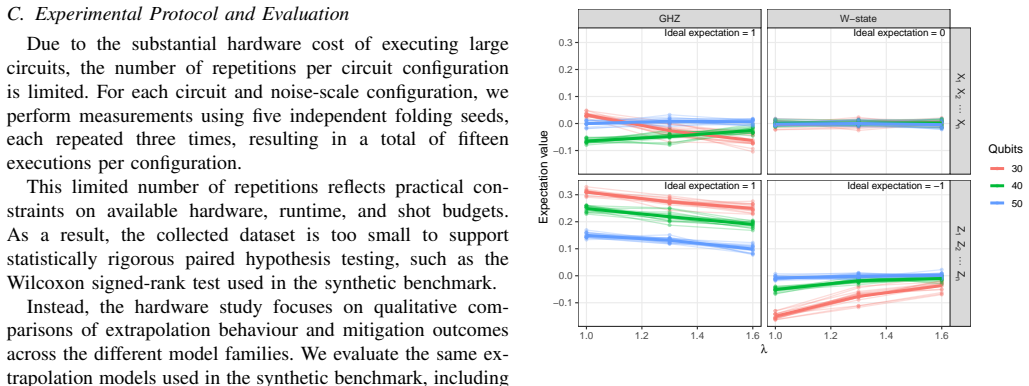
Zero-noise extrapolation (ZNE) mitigates errors in near-term quantum devices by extrapolating measurements obtained at amplified noise levels to estimate noise-free expectation values. In practice, commonly used extrapolation models are fitted without enforcing physical constraints, which can yield predictions outside the valid range of quantum observables. In this work, we introduce physically bounded variants of polynomial, exponential, and polynomial--exponential extrapolation models by explicitly parameterizing the zero-noise estimate and constraining it during optimization. We evaluate the approach using a large synthetic benchmark comprising 180,000 circuits and approximately 3.6 million ZNE experiments generated under realistic device noise models derived from IBM quantum backends. We also perform preliminary validation on real quantum hardware using GHZ and W-state circuits. Across the synthetic benchmark, bounded extrapolation substantially reduces unphysical predictions and improves the stability of exponential- and polynomial--exponential-family models, whereas polynomial models show little difference between bounded and unbounded variants. Hardware experiments show similar qualitative behaviour: bounded models generally avoid pathological extrapolations and often provide a more reliable balance between accuracy and usable coverage. At the same time, the results highlight practical limitations of current devices, including stronger-than-expected noise effects and variability not fully captured by simulation models. These results suggest that enforcing physical constraints during extrapolation improves the reliability of ZNE and that this approach can be incorporated into existing workflows with minimal modification.
Editorial analysis
A structured set of objections, weighed in public.
Referee Report
Summary. The paper introduces physically bounded variants of polynomial, exponential, and polynomial-exponential extrapolation models for zero-noise extrapolation (ZNE) by explicitly parameterizing the zero-noise estimate and constraining it to the physical interval during optimization. It evaluates the approach on a large synthetic benchmark of 180,000 circuits and 3.6 million ZNE experiments generated from realistic IBM-derived noise models, plus preliminary hardware tests on GHZ and W-state circuits. Key results show that bounded models substantially reduce unphysical predictions and improve stability for exponential and poly-exponential families (with little difference for polynomials), and exhibit similar qualitative behavior on hardware despite device limitations.
Significance. If the results hold, this provides a practical, low-overhead improvement to ZNE, a widely used error-mitigation technique for near-term quantum devices. The scale of the synthetic benchmark (with known ground truth) supplies robust statistical support for reduced unphysical extrapolations and enhanced stability in specific model families. The method integrates easily into existing workflows. Hardware results, though preliminary, add relevance while underscoring gaps between simulation and real devices.
minor comments (4)
- Abstract and results: the synthetic benchmark size is given as 'approximately 3.6 million' experiments; report the exact count and breakdown by model family and noise level in the methods or results section for reproducibility.
- Results section: define the stability metric explicitly (e.g., variance of extrapolated values across amplification factors or bootstrap resampling) and report quantitative effect sizes or statistical tests for the claimed improvements in stability and reduction of unphysical predictions.
- Hardware experiments: the validation is described as preliminary; include the exact number of circuits, shots per circuit, and quantitative metrics (e.g., fraction of unphysical predictions) to allow direct comparison with the synthetic benchmark.
- Methods: provide the explicit parameterization of the zero-noise estimate and the form of the constrained optimization objective (e.g., via Lagrange multipliers or reparameterization) to enable straightforward implementation by readers.
Simulated Author's Rebuttal
We thank the referee for their positive summary of our manuscript and for recommending minor revision. The assessment correctly identifies the core contribution—physically bounded extrapolation models that reduce unphysical predictions—and the value of the large-scale synthetic benchmark. We will incorporate minor editorial improvements and clarifications in the revised version.
Circularity Check
No significant circularity identified
full rationale
The paper's contribution consists of defining bounded variants of standard extrapolation models (by explicitly parameterizing the zero-noise estimate and adding constraints to the optimizer) followed by an empirical comparison against unbounded variants. This comparison is performed on a synthetic benchmark with known ground-truth noise-free values (180k circuits, 3.6M experiments), so reported improvements in stability and reduction of unphysical outputs are measured directly rather than derived from the fitted parameters themselves. No load-bearing derivation, self-citation chain, or ansatz reduces any claimed result to an input quantity by construction. The work is therefore self-contained against external benchmarks.
Axiom & Free-Parameter Ledger
axioms (1)
- domain assumption Quantum observables have expectation values strictly bounded in [-1, 1]
Reference graph
Works this paper leans on
-
[1]
Quantum computing in the NISQ era and beyond,
J. Preskill, “Quantum computing in the NISQ era and beyond,”Quan- tum, vol. 2, p. 79, 2018
2018
-
[2]
Noisy intermediate- scale quantum algorithms,
K. Bharti, A. Cervera-Lierta, T. H. Kyaw, T. Haug, S. Alperin-Lea, A. Anand, M. Degroote, H. Heimonen, J. S. Kottmann, T. Menke, W.-K. Mok, S. Sim, L.-C. Kwek, and A. Aspuru-Guzik, “Noisy intermediate- scale quantum algorithms,”Reviews of Modern Physics, vol. 94, no. 1, p. 015004, 2022
2022
-
[3]
Quantum error mitigation,
Z. Cai, R. Babbush, S. C. Benjamin, S. Endo, W. J. Huggins, Y . Li, J. R. McClean, and T. E. O’Brien, “Quantum error mitigation,”Reviews of Modern Physics, vol. 95, no. 4, p. 045005, 2023
2023
-
[4]
Error mitigation for short- depth quantum circuits,
K. Temme, S. Bravyi, and J. M. Gambetta, “Error mitigation for short- depth quantum circuits,”Physical Review Letters, vol. 119, no. 18, p. 180509, 2017
2017
-
[5]
Efficient variational quantum simulator incorporating active error minimization,
Y . Li and S. C. Benjamin, “Efficient variational quantum simulator incorporating active error minimization,”Physical Review X, vol. 7, no. 2, p. 021050, 2017
2017
-
[6]
Digital zero noise extrapolation for quantum error mitigation,
T. Giurgica-Tiron, Y . Hindy, R. LaRose, A. Mari, and W. J. Zeng, “Digital zero noise extrapolation for quantum error mitigation,” in2020 IEEE International Conference on Quantum Computing and Engineer- ing (QCE). IEEE, 2020, pp. 306–316
2020
-
[7]
Mitiq: A software package for error mitigation on noisy quantum computers,
R. LaRose, A. Mari, S. Kaiser, N. Stamatopoulos, A. Shabani, G. Salton, V . Kurilovich, V . Shefeev, R. Shaydulin, W. J. Zenget al., “Mitiq: A software package for error mitigation on noisy quantum computers,” Quantum, vol. 6, p. 774, 2022
2022
-
[8]
MQT Bench: Bench- marking software and design automation tools for quantum computing,
N. Quetschlich, L. Burgholzer, and R. Wille, “MQT Bench: Bench- marking software and design automation tools for quantum computing,” Quantum, vol. 7, p. 1062, 2023
2023
-
[9]
Improving Zero-Noise Extrapolation via Physically Bounded Models
A. Miranskyy, A. Sorrenti, J. Thind, and C. Gravel. (2026) Dataset for “Improving Zero-Noise Extrapolation via Physically Bounded Models”’. [Online]. Available: https://doi.org/10.5281/zenodo.19712079
-
[10]
(2026) Sample code for ”improving zero-noise extrapolation via physically bounded models”
——. (2026) Sample code for ”improving zero-noise extrapolation via physically bounded models”. Available at https://github.com/miranska/ zne-replication-package, archied at https://doi.org/10.5281/zenodo.197 95688
-
[11]
Practical quantum error mitigation for near-future applications,
S. Endo, S. C. Benjamin, and Y . Li, “Practical quantum error mitigation for near-future applications,”Physical Review X, vol. 8, no. 3, p. 031027, 2018
2018
-
[12]
Rivero, F
P. Rivero, F. Metz, A. Hasan, A. M. Bra ´nczyk, and C. Johnson. (2024) prototype-zne: Zero noise extrapolation prototype. Version 1.3.1. [Online]. Available: https://github.com/qiskit-community/prototype-zne
2024
-
[13]
Best practices for quantum error mitigation with digital zero-noise extrapola- tion,
R. Majumdar, P. Rivero, F. Metz, A. Hasan, and D. S. Wang, “Best practices for quantum error mitigation with digital zero-noise extrapola- tion,” in2023 IEEE International Conference on Quantum Computing and Engineering (QCE), vol. 1. IEEE, 2023, pp. 881–887
2023
-
[14]
A limited memory algo- rithm for bound constrained optimization,
R. H. Byrd, P. Lu, J. Nocedal, and C. Zhu, “A limited memory algo- rithm for bound constrained optimization,”SIAM Journal on Scientific Computing, vol. 16, no. 5, pp. 1190–1208, 1995
1995
-
[15]
SciPy 1.0: Fundamental algorithms for scientific computing in Python,
P. Virtanen, R. Gommers, T. E. Oliphant, M. Haberland, T. Reddy, D. Cournapeau, E. Burovski, P. Peterson, W. Weckesser, J. Bright, S. J. van der Walt, M. Brett, J. Wilson, K. J. Millman, N. Mayorov, A. R. J. Nelson, E. Jones, R. Kern, E. Larson, C. J. Carey, ˙I. Polat, Y . Feng, E. W. Moore, J. VanderPlas, D. Laxalde, J. Perktold, R. Cimrman, I. Henriksen...
2020
-
[16]
A. Javadi-Abhari, M. Treinish, K. Krsulich, C. J. Wood, J. Lishman, J. Gacon, S. Martiel, P. D. Nation, L. S. Bishop, A. W. Crosset al., “Quantum computing with Qiskit,”arXiv preprint arXiv:2405.08810, 2024
work page internal anchor Pith review arXiv 2024
-
[17]
Poly- nomial interpolation via mapped bases without resampling,
S. De Marchi, F. Marchetti, E. Perracchione, and D. Poggiali, “Poly- nomial interpolation via mapped bases without resampling,”Journal of Computational and Applied Mathematics, vol. 364, p. 112347, 2020
2020
-
[18]
Ridge regression: Biased estimation for nonorthogonal problems,
A. E. Hoerl and R. W. Kennard, “Ridge regression: Biased estimation for nonorthogonal problems,”Technometrics, vol. 12, no. 1, pp. 55–67, 1970
1970
-
[19]
Regression shrinkage and selection via the lasso,
R. Tibshirani, “Regression shrinkage and selection via the lasso,”Jour- nal of the Royal Statistical Society: Series B (Methodological), vol. 58, no. 1, pp. 267–288, 1996
1996
-
[20]
Support-vector networks,
C. Cortes and V . Vapnik, “Support-vector networks,”Machine Learning, vol. 20, no. 3, pp. 273–297, 1995
1995
-
[21]
Breiman, J
L. Breiman, J. H. Friedman, R. A. Olshen, and C. J. Stone,Classification and Regression Trees. Belmont, CA: Wadsworth, 1984
1984
-
[22]
Random forests,
L. Breiman, “Random forests,”Machine Learning, vol. 45, no. 1, pp. 5–32, 2001
2001
-
[23]
XGBoost: A scalable tree boosting system,
T. Chen and C. Guestrin, “XGBoost: A scalable tree boosting system,” inProceedings of the 22nd ACM SIGKDD International Conference on Knowledge Discovery and Data Mining. ACM, 2016, pp. 785–794
2016
-
[24]
Individual comparisons by ranking methods,
F. Wilcoxon, “Individual comparisons by ranking methods,”Biometrics Bulletin, vol. 1, no. 6, pp. 80–83, 1945
1945
-
[25]
A simple sequentially rejective multiple test procedure,
S. Holm, “A simple sequentially rejective multiple test procedure,” Scandinavian Journal of Statistics, vol. 6, no. 2, pp. 65–70, 1979
1979
-
[26]
Cohen,Statistical Power Analysis for the Behavioral Sciences, 2nd ed
J. Cohen,Statistical Power Analysis for the Behavioral Sciences, 2nd ed. Hillsdale, NJ: Lawrence Erlbaum Associates, 1988
1988
-
[27]
[Online]
(2026) Processor types — IBM Quantum Documentation. [Online]. Available: https://quantum.cloud.ibm.com/docs/en/guides/processor-typ es
2026
-
[28]
Going beyond Bell’s theorem,
D. M. Greenberger, M. A. Horne, and A. Zeilinger, “Going beyond Bell’s theorem,” inBell’s Theorem, Quantum Theory and Conceptions of the Universe, M. Kafatos, Ed. Dordrecht: Kluwer Academic, 1989, pp. 69–72
1989
-
[29]
Three qubits can be entangled in two inequivalent ways,
W. D ¨ur, G. Vidal, and J. I. Cirac, “Three qubits can be entangled in two inequivalent ways,”Physical Review A, vol. 62, no. 6, p. 062314, 2000
2000
-
[30]
M. A. Nielsen and I. L. Chuang,Quantum Computation and Quantum Information, 10th ed. Cambridge: Cambridge University Press, 2010
2010
-
[31]
Scalable error mitigation for noisy quan- tum circuits produces competitive expectation values,
Y . Kim, C. J. Wood, T. J. Yoder, S. T. Merkel, J. M. Gambetta, K. Temme, and A. Kandala, “Scalable error mitigation for noisy quan- tum circuits produces competitive expectation values,”Nature Physics, vol. 19, no. 5, pp. 752–759, 2023
2023
-
[32]
Machine learning for practical quantum error mitigation,
H. Liao, D. S. Wang, I. Sitdikov, C. Salcedo, A. Seif, and Z. K. Minev, “Machine learning for practical quantum error mitigation,”Nature Machine Intelligence, vol. 6, no. 12, pp. 1478–1486, 2024. APPENDIXA REPRESENTATIVEHARDWARELAYOUTSTATISTICS For completeness, we report representative statistics of the physical qubits and couplings selected after calibr...
2024
discussion (0)
Sign in with ORCID, Apple, or X to comment. Anyone can read and Pith papers without signing in.