Recognition: unknown
Adjusted connections on non-abelian bundle gerbes
Pith reviewed 2026-05-07 17:44 UTC · model grok-4.3
The pith
Equipping 2-groups with adjustments creates a full theory of connections on non-abelian bundle gerbes that lifts to abelian 2-gerbes.
A machine-rendered reading of the paper's core claim, the machinery that carries it, and where it could break.
Core claim
The paper presents a comprehensive theory of adjusted connections on non-abelian bundle gerbes, classified by an adjusted version of non-abelian differential cohomology. This theory enables a new coordinate-independent formulation of the lifting theorem, establishing a correspondence between adjusted connections on non-abelian bundle gerbes and connections on abelian bundle 2-gerbes.
What carries the argument
The adjustment added to 2-groups, which permits the definition of adjusted connections classified by adjusted non-abelian differential cohomology and supports the lifting correspondence.
Load-bearing premise
That the adjustments placed on 2-groups are sufficient to resolve all extension problems outside the fake-flat sector and to support the full classification and lifting correspondence without further hidden conditions.
What would settle it
An explicit non-abelian bundle gerbe equipped with an adjusted connection that fails to correspond to any connection on an abelian bundle 2-gerbe would show the lifting theorem does not hold in general.
Figures


read the original abstract
Higher gauge theory for non-abelian structure 2-groups faces significant challenges when extending beyond the fake-flat sector, which suffers from limited applicability in physical models. A promising resolution involves equipping 2-groups with additional structure, known as adjustments. We present a comprehensive theory of adjusted connections on non-abelian bundle gerbes, classified by Saemann's adjusted version of non-abelian differential cohomology. This theory enables, in particular, a new coordinate-independent formulation of Tellez-Dominguez' lifting theorem, establishing a correspondence between adjusted connections on non-abelian bundle gerbes and connections on abelian bundle 2-gerbes.
Editorial analysis
A structured set of objections, weighed in public.
Referee Report
Summary. The manuscript develops a theory of adjusted connections on non-abelian bundle gerbes, classified by Saemann's adjusted non-abelian differential cohomology. It gives a coordinate-independent reformulation of Tellez-Dominguez' lifting theorem that establishes a bijection between such adjusted connections and connections on abelian bundle 2-gerbes.
Significance. If the constructions are rigorous, the work supplies a concrete extension of higher gauge theory beyond the fake-flat sector by means of adjustments on 2-groups. The coordinate-free lifting theorem is a clear technical improvement over prior formulations and directly links non-abelian gerbe data to abelian 2-gerbe data. The paper properly attributes the classification to Saemann and the original lifting result to Tellez-Dominguez.
major comments (2)
- [§3.2] §3.2, Definition 3.4 and Theorem 3.9: The adjusted curvature and parallel-transport functors are defined via the adjustment map on the 2-group, yet the argument that this eliminates all extension obstructions (including those arising from non-trivial Postnikov invariants) is only sketched for the fake-curvature component; no explicit cocycle computation is given for a general 2-group in the non-fake-flat sector.
- [§5] §5, Theorem 5.1: The lifting correspondence is asserted to be bijective for arbitrary adjusted 2-groups, but the proof reduces the non-abelian data to abelian 2-gerbe data without verifying that the adjustment map surjects onto the full set of obstruction classes in H^3; this step is load-bearing for the headline claim.
minor comments (2)
- [§2] The notation for the adjusted 2-group structure (e.g., the maps α and β) is introduced in §2 but reused with slight variations in §4; a single consolidated table of symbols would improve readability.
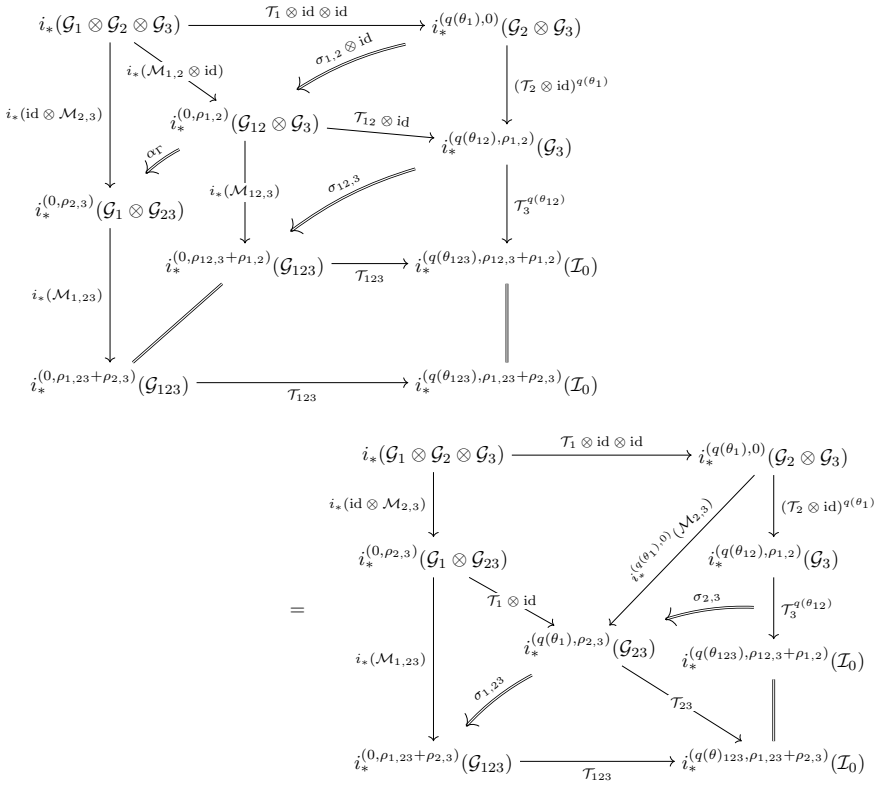
- [§4.1] Several diagrams in §4.1 are too small to read the labels on the 2-morphisms; increasing the font size or splitting the figures would aid comprehension.
Simulated Author's Rebuttal
We thank the referee for the careful reading of our manuscript and the constructive major comments. We address each point below and indicate the revisions that will be incorporated.
read point-by-point responses
-
Referee: [§3.2] §3.2, Definition 3.4 and Theorem 3.9: The adjusted curvature and parallel-transport functors are defined via the adjustment map on the 2-group, yet the argument that this eliminates all extension obstructions (including those arising from non-trivial Postnikov invariants) is only sketched for the fake-curvature component; no explicit cocycle computation is given for a general 2-group in the non-fake-flat sector.
Authors: We agree that the argument in Theorem 3.9 is presented at a sketch level for the elimination of extension obstructions beyond the fake-curvature component. While the adjustment map is constructed precisely to cancel these obstructions (including those from non-trivial Postnikov invariants) in the framework of Saemann's adjusted differential cohomology, an explicit cocycle-level verification for a general 2-group would improve clarity. In the revised manuscript we will expand the proof of Theorem 3.9 with a detailed cocycle computation demonstrating the cancellation in the non-fake-flat sector. revision: yes
-
Referee: [§5] §5, Theorem 5.1: The lifting correspondence is asserted to be bijective for arbitrary adjusted 2-groups, but the proof reduces the non-abelian data to abelian 2-gerbe data without verifying that the adjustment map surjects onto the full set of obstruction classes in H^3; this step is load-bearing for the headline claim.
Authors: The proof of Theorem 5.1 proceeds by reducing the adjusted non-abelian data to the abelian 2-gerbe setting via the adjustment map. We acknowledge that an explicit verification that this map is surjective onto all obstruction classes in H^3 is required to establish bijectivity for arbitrary adjusted 2-groups. We will add a supporting lemma in the revised version that proves this surjectivity, thereby confirming the headline claim. revision: yes
Circularity Check
No significant circularity; theory extends external classifications
full rationale
The paper attributes its classification of adjusted connections directly to Saemann's prior adjusted non-abelian differential cohomology and reformulates Tellez-Dominguez' lifting theorem without deriving those results internally. No equations or definitions reduce by construction to fitted parameters, self-citations, or renamed inputs within the manuscript. The central claims rest on external attributions rather than self-referential fitting or uniqueness theorems imported from the author's own prior work. This is the standard case of an honest extension paper whose derivation chain remains independent of its own outputs.
Axiom & Free-Parameter Ledger
axioms (2)
- domain assumption Non-abelian differential cohomology admits an adjusted version that classifies adjusted connections
- ad hoc to paper Adjustments on 2-groups resolve extension issues beyond the fake-flat sector
Reference graph
Works this paper leans on
-
[1]
Grothendieck construction for bicategories
[arxiv:hep-th/0312154]. [Bak] Igor Bakovi´ c, “Grothendieck construction for bicategories”. Unpublished. [BL04] John C. Baez and Aaron D. Lauda, “Higher-dimensional algebra V: 2-groups”. Theory Appl. Categ., 12:423–491,
-
[2]
Differential geometry of gerbes
[arxiv:math/0307200]. [BM05] Lawrence Breen and William Messing, “Differential geometry of gerbes”. Adv. Math., 198(2):732–846,
-
[3]
[arxiv:math.AG/0106083]. [BS07] John C. Baez and Urs Schreiber, “Higher gauge theory”. In Alexei Davydov, Michael Batanin, Michael Johnson, Stephen Lack, and Amnon Neeman, editors, Categories in Algebra, Geometry and Mathematical Physics , Proc. Contemp. Math. AMS, Providence, Rhode Island,
-
[4]
[arxiv:math/0511710]. [CJM02] Alan L. Carey, Stuart Johnson, and Michael K. Murray, “Holonomy on D-branes”. J. Geom. Phys., 52(2):186–216,
-
[5]
Bundle gerbes for Chern-Simons and Wess-Zumino-Witten theories
[arxiv:hep-th/0204199]. [CJM+05] Alan L. Carey, Stuart Johnson, Michael K. Murray, Danny Stevenson, and Bai-Ling Wang, “Bundle gerbes for Chern-Simons and Wess-Zumino-Witten theories”. Commun. Math. Phys. , 259(3):577–613,
work page internal anchor Pith review arXiv
- [6]
-
[7]
Higher Poincar´ e lemma and integrability
[arxiv:hep-th/9711133]. [DS15] Getachew Alemu Demessie and Christian Saemann, “Higher Poincar´ e lemma and integrability”. J. Math. Phys. , 56(082902),
-
[8]
Cech cocycles for differential characteristic classes – An infinity-Lie theoretic construction
[arxiv:1406.5342]. [FSS12] Domenico Fiorenza, Urs Schreiber, and Jim Stasheff, “Cech cocycles for differential characteristic classes – An infinity-Lie theoretic construction”. Adv. Theor. Math. Phys. , 16:149–250,
-
[9]
Canonical gauges in higher gauge theory
[arxiv:1011.4735]. – 81 – [Gas20] Andreas Gastel, “Canonical gauges in higher gauge theory”. Commun. Math. Phys. , 376:1053–1071,
-
[10]
Conformal field theory: a case study
Available as: https://www.arxiv.org/abs/1810.06278 . [Gaw00] Krzysztof Gaw¸ edzki, “Conformal field theory: a case study”. In Y. Nutku, C. Saclioglu, and T. Turgut, editors, Conformal field theory: new non-perturbative methods in string and field theory. Perseus Publishing,
-
[11]
[arxiv:hep-th/9904145]. [GR02] Krzysztof Gaw¸ edzki and Nuno Reis, “WZW branes and gerbes”. Rev. Math. Phys. , 14(12):1281–1334,
-
[12]
Basic gerbe over non simply connected compact groups
[arxiv:hep-th/0205233]. [GR03] Krzysztof Gaw¸ edzki and Nuno Reis, “Basic gerbe over non simply connected compact groups”. J. Geom. Phys., 50(1–4):28–55,
-
[13]
[Joh02] Stuart Johnson, Constructions with bundle gerbes
[arxiv:math.dg/0307010]. [Joh02] Stuart Johnson, Constructions with bundle gerbes . PhD thesis, University of Adelaide,
-
[14]
[JY21] Niles Johnson and Donald Yau, 2-Dimensional Categories
[arxiv:math/0312175]. [JY21] Niles Johnson and Donald Yau, 2-Dimensional Categories. Oxford Univ. Press,
-
[15]
[arxiv:2002.06055]. [KLW25] Peter Kristel, Matthias Ludewig, and Konrad Waldorf, “2-vector bundles”. Higher Structures, 9(1):36–87,
-
[16]
Non-geometric T-duality as higher groupoid bundles with connections
[arxiv:2106.12198]. [KS] Hyungrok Kim and Christian Saemann, “Non-geometric T-duality as higher groupoid bundles with connections”. Preprint. [arxiv:2204.01783]. [KS20] Hyungrok Kim and Christian Saemann, “Adjusted parallel transport for higher gauge theories”. J. Phys. A , 52:445206,
-
[17]
[Lur09] Jacob Lurie, Higher topos theory
[arxiv:1911.06390]. [Lur09] Jacob Lurie, Higher topos theory. Number 109 in Annals of Mathematics Studies. Princeton University Press,
-
[18]
The classification of adjustments
[LW] Matthias Ludewig and Konrad Waldorf, “The classification of adjustments”. Preprint. [arxiv:2510.19607]. [MS00] Michael K. Murray and Daniel Stevenson, “Bundle gerbes: stable isomorphism and local theory”. J. Lond. Math. Soc. , 62:925–937,
-
[19]
[arxiv:math/9908135]. [Mur96] Michael K. Murray, “Bundle gerbes”. J. Lond. Math. Soc. , 54:403–416,
-
[20]
Non-abelian extensions of infinite-dimensional Lie groups
[arxiv:dg-ga/9407015]. [Nee05] Karl-Herrmann Neeb, “Non-abelian extensions of infinite-dimensional Lie groups”. Preprint. [arxiv:math/0504295]. [NS11] Thomas Nikolaus and Christoph Schweigert, “Equivariance in higher geometry”. Adv. Math., 226(4):3367–3408,
-
[21]
Four equivalent versions of non-abelian gerbes
[arxiv:1004.4558]. [NW13a] Thomas Nikolaus and Konrad Waldorf, “Four equivalent versions of non-abelian gerbes”. Pacific J. Math., 264(2):355–420,
-
[22]
[arxiv:1103.4815]. [NW13b] Thomas Nikolaus and Konrad Waldorf, “Lifting problems and transgression for non-abelian gerbes”. Adv. Math., 242:50–79,
-
[23]
Explicit Non-Abelian Gerbes with Connections
[arxiv:1112.4702]. [RSW26] Dominik Rist, Christian Saemann, and Martin Wolf, “Explicit Non-Abelian Gerbes with Connections”. J. Phys. A , 59(3),
-
[24]
Central extensions of smooth 2-groups and a finite-dimensional string 2-group
[arxiv:2203.00092]. [SP11] Chris Schommer-Pries, “Central extensions of smooth 2-groups and a finite-dimensional string 2-group”. Geom. Topol., 15:609–676,
-
[25]
Towards an M5-Brane Model II: Metric String Structures
[arxiv:0911.2483]. [SS20] Christian Saemann and Lennart Schmidt, “Towards an M5-Brane Model II: Metric String Structures”. Fortschr. Phys., 68:2000051,
-
[26]
L ∞-algebra connections and applications to string- and Chern-Simons n-transport
[arxiv:1908.08086]. [SSS09] Hisham Sati, Urs Schreiber, and James D. Stasheff, “L ∞-algebra connections and applications to string- and Chern-Simons n-transport”. In B. Fauser, J. Tolksdorf, and E. Zeidler, editors, Quantum Field Theory , pages 303–424. Birkh¨ auser,
-
[27]
[arxiv:0801.3480]. – 82 – [Ste04] Daniel Stevenson, “Bundle 2-gerbes”. Proc. Lond. Math. Soc., 88:405–435,
-
[28]
Smooth functors vs. differential forms
[arxiv:math/0106018]. [SW11] Urs Schreiber and Konrad Waldorf, “Smooth functors vs. differential forms”. Homology, Homotopy Appl., 13(1):143–203,
-
[29]
Connections on non-abelian gerbes and their holonomy
[arxiv:0802.0663]. [SW13] Urs Schreiber and Konrad Waldorf, “Connections on non-abelian gerbes and their holonomy”. Theory Appl. Categ., 28(17):476–540,
-
[30]
Local theory for 2-functors on path 2-groupoids
[arxiv:0808.1923]. [SW16] Urs Schreiber and Konrad Waldorf, “Local theory for 2-functors on path 2-groupoids”. J. Homotopy Relat. Struct. , pages 1–42,
-
[31]
Chern correspondence for higher principal bundles
[arxiv:1303.4663]. [TD25] Roberto T´ ellez-Dom´ ınguez, “Chern correspondence for higher principal bundles”. Commun. Math. Phys., 406(313),
-
[32]
More morphisms between bundle gerbes
[arxiv:2310.12738]. [Wal07] Konrad Waldorf, “More morphisms between bundle gerbes”. Theory Appl. Categ., 18(9):240–273,
-
[33]
Multiplicative bundle gerbes with connection
[arxiv:math.CT/0702652]. [Wal10] Konrad Waldorf, “Multiplicative bundle gerbes with connection”. Differential Geom. Appl., 28(3):313–340,
-
[34]
A construction of string 2-group models using a transgression-regression technique
[arxiv:0804.4835v4]. [Wal12] Konrad Waldorf, “A construction of string 2-group models using a transgression-regression technique”. In Clara L. Aldana, Maxim Braverman, Bruno Iochum, and Carolina Neira-Jim´ enez, editors, Analysis, Geometry and Quantum Field Theory , volume 584 of Contemp. Math., pages 99–115. AMS,
-
[35]
[arxiv:1201.5052]. [Wal13] Konrad Waldorf, “String connections and Chern-Simons theory”. Trans. Amer. Math. Soc., 365(8):4393–4432,
-
[36]
A global perspective to connections on principal 2-bundles
[arxiv:0906.0117]. [Wal17] Konrad Waldorf, “A global perspective to connections on principal 2-bundles”. Forum Math., 30(4):809–843,
-
[37]
Universit¨ at Greifswald Institut f¨ ur Mathematik und Informatik Walther-Rathenau-Str
[arxiv:1608.00401]. Universit¨ at Greifswald Institut f¨ ur Mathematik und Informatik Walther-Rathenau-Str. 47 D-17487 Greifswald konrad.waldorf@uni-greifswald.de – 83 –
discussion (0)
Sign in with ORCID, Apple, or X to comment. Anyone can read and Pith papers without signing in.