Recognition: unknown
Tests of scalar polarizations with multi-messenger events
Pith reviewed 2026-05-08 01:59 UTC · model grok-4.3
The pith
Multi-messenger data from GW170817 yields mild evidence for a scalar polarization mode when electromagnetic polarization constraints are added.
A machine-rendered reading of the paper's core claim, the machinery that carries it, and where it could break.
Core claim
We perform a parameterized test of GR using the parameterized post-Einsteinian framework applied to GW170817, incorporating for the first time the polarization angle constraints from the gamma-ray burst afterglow alongside other electromagnetic counterpart information. We extend the GR waveform by adding a scalar breathing mode and modifications to the tensor modes, introducing three non-GR parameters. We perform Bayesian inference for both quadrupole ℓ = |m|= 2 and dipole ℓ = |m|= 1 angular harmonics, with two frequency evolution models. For ℓ = |m|= 2, we find mild preference for a scalar mode (scalar amplitude deviates from zero at ∼ 2 σ), while for the ℓ = |m|= 1, we find no preference.
What carries the argument
Parameterized post-Einsteinian waveform extended by a scalar breathing mode whose amplitude and phase are jointly constrained with electromagnetic polarization angle limits.
If this is right
- Scalar modes, if confirmed, would require metric gravity theories with more than two tensor degrees of freedom.
- Electromagnetic polarization follow-up can improve bounds on scalar and tensor amplitude modifications by 30 to 60 percent compared with gravitational-wave data alone.
- The quadrupole harmonic carries more sensitivity to the scalar mode than the dipole harmonic under the same analysis setup.
- Repeated application to future events with long-term afterglow monitoring would produce progressively tighter limits or detections.
Where Pith is reading between the lines
- Routine long-term gamma-ray burst monitoring could become a standard tool for sharpening polarization tests of gravity.
- The same joint-analysis technique could be applied to other polarization states, such as vector modes, once corresponding electromagnetic observables are identified.
- If the two-sigma preference persists across additional events, it would motivate targeted searches for correlated scalar signals in the existing catalog of binary mergers.
Load-bearing premise
The polarization angle measured from the gamma-ray burst afterglow can be applied directly to the gravitational wave signal without large systematic errors from the burst emission or propagation.
What would settle it
A new multi-messenger event with a comparably precise gamma-ray burst polarization angle measurement that returns a scalar amplitude fully consistent with zero at greater than 3 sigma significance.
Figures





read the original abstract
Gravitational wave (GW) observations provide a unique opportunity to test Einstein's General Relativity (GR) in the strong-field regime. While GR predicts only two tensor polarization modes, generic metric theories allow up to six independent modes. We perform a parameterized test of GR using the parameterized post-Einsteinian (PPE) framework applied to GW170817, incorporating for the first time the polarization angle constraints from the gamma-ray burst afterglow alongside other electromagnetic (EM) counterpart information. We extend the GR waveform by adding a scalar breathing mode and modifications to the tensor modes, introducing three non-GR parameters. We perform Bayesian inference for both quadrupole $\ell = |m|= 2$ and dipole $\ell = |m|= 1$ angular harmonics, with two frequency evolution models. For $\ell = |m|= 2$ , we find mild preference for a scalar mode (scalar amplitude deviates from zero at $\sim 2 \sigma$), while for the $\ell = |m|= 1$, we find no preference for a scalar mode. The EM constraint on the polarization angle places very tight bounds on non-GR parameters; for instance, in the case $\ell = |m| = 2$, the bound on the scalar (tensor) amplitude modification parameter improves by roughly $60\%$ $(30\%)$, highlighting the impact that long-term follow up of GW events can have on tests of gravity.
Editorial analysis
A structured set of objections, weighed in public.
Referee Report
Summary. The paper claims to perform the first parameterized post-Einsteinian (PPE) analysis of GW170817 that folds in electromagnetic polarization-angle constraints from the associated gamma-ray burst afterglow. The waveform is extended by a scalar breathing mode plus tensor modifications (three non-GR parameters total); Bayesian inference is carried out for both quadrupole (ℓ = |m| = 2) and dipole (ℓ = |m| = 1) angular harmonics under two frequency-evolution models. The authors report a mild ~2σ preference for a non-zero scalar amplitude in the ℓ = 2 case, no such preference for ℓ = 1, and substantial tightening (∼60 % for the scalar amplitude parameter, ∼30 % for the tensor one) of the non-GR bounds once the EM angle constraint is included.
Significance. If the mapping between EM and GW polarization angles is robust, the work usefully illustrates how long-term multi-messenger follow-up can tighten polarization tests of gravity beyond what GW data alone provide. The use of actual observational constraints rather than simulated signals is a concrete strength. The reported preference remains only marginal (2σ), however, so the primary advance lies in the demonstrated bound improvement rather than in evidence for new physics.
major comments (1)
- [Likelihood construction and EM-data incorporation] The central quantitative claims—the ∼2σ scalar deviation for ℓ = |m| = 2 and the 60 %/30 % bound tightenings—rest on treating the GRB-afterglow polarization angle as a tight, unbiased prior on the GW polarization angle inside the PPE likelihood. The manuscript does not quantify possible systematics arising from jet geometry, magnetic-field orientation, or differential propagation in the presence of a scalar breathing mode or modified tensor propagation; any offset or inflation of the angle uncertainty would directly shift the posterior on the scalar-amplitude parameter and weaken the reported improvements. A dedicated robustness check or systematic-error budget for this mapping is required before the headline results can be considered secure.
minor comments (2)
- [Abstract] The abstract states that three non-GR parameters and two frequency-evolution models are introduced but does not name them; spelling out the explicit parameter definitions and the two models would aid immediate comprehension.
- [Results section] The percentage improvements are given without the corresponding numerical 90 % credible-interval widths before and after the EM constraint; tabulating the actual bounds would make the improvement claim directly verifiable.
Simulated Author's Rebuttal
We thank the referee for their careful reading and constructive feedback on our manuscript. We address the major comment regarding likelihood construction and EM-data incorporation below, outlining the revisions we will implement to strengthen the analysis.
read point-by-point responses
-
Referee: [Likelihood construction and EM-data incorporation] The central quantitative claims—the ∼2σ scalar deviation for ℓ = |m| = 2 and the 60 %/30 % bound tightenings—rest on treating the GRB-afterglow polarization angle as a tight, unbiased prior on the GW polarization angle inside the PPE likelihood. The manuscript does not quantify possible systematics arising from jet geometry, magnetic-field orientation, or differential propagation in the presence of a scalar breathing mode or modified tensor propagation; any offset or inflation of the angle uncertainty would directly shift the posterior on the scalar-amplitude parameter and weaken the reported improvements. A dedicated robustness check or systematic-error budget for this mapping is required before the headline results can be considered secure.
Authors: We agree that a more explicit treatment of potential systematics in the EM-GW polarization mapping would improve the manuscript. Our current analysis adopts the observed GRB afterglow polarization angle as a Gaussian prior on the GW polarization angle, following standard assumptions for the jet geometry and propagation in the GR limit. We acknowledge that non-GR effects (such as a scalar breathing mode or modified tensor propagation) could in principle introduce additional uncertainties from differential propagation or altered magnetic-field alignments, though these are expected to be subdominant for the small deviations considered. In the revised version, we will add a dedicated subsection discussing these possible systematics and include a robustness check in which the EM angle uncertainty is inflated by a conservative factor (e.g., 2–3) before re-running the Bayesian inference; the resulting shifts in the scalar-amplitude posterior and bound improvements will be reported to quantify the sensitivity. revision: yes
Circularity Check
No significant circularity; results arise from direct Bayesian inference on GW170817 and EM data.
full rationale
The paper applies the standard parameterized post-Einsteinian framework to extend the GR waveform with three non-GR parameters (scalar breathing mode plus tensor modifications) and performs Bayesian inference on the GW170817 event, using EM afterglow polarization angle as an external constraint on the likelihood. No equations are self-definitional, no fitted parameters are relabeled as predictions, and no load-bearing steps reduce to self-citations or ansatzes imported from the authors' prior work. The central claims (2σ scalar preference for ℓ=|m|=2 and bound improvements) are outputs of the data fit rather than tautological re-expressions of the inputs.
Axiom & Free-Parameter Ledger
free parameters (3)
- scalar amplitude modification parameter
- tensor amplitude modification parameter
- third non-GR parameter
axioms (2)
- domain assumption The parameterized post-Einsteinian (PPE) framework accurately parameterizes deviations from GR in gravitational waveforms.
- domain assumption The gamma-ray burst afterglow polarization angle provides an independent and reliable constraint on the GW polarization modes.
invented entities (1)
-
scalar breathing mode
no independent evidence
Reference graph
Works this paper leans on
-
[1]
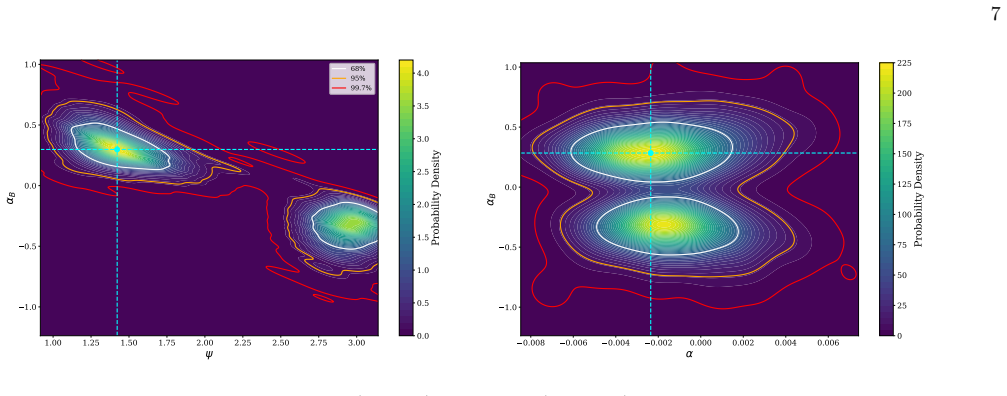
All”. In the leftmost panel of Fig. 2, the posterior distributions of the parameterα are shown. In the case “All
Frequency evolution:a T =−2,b=−7,a S =−2 We first analyzed the most studied parameter set in the literature, fixinga T =−2,b=−7, anda S =−2. Param- eter estimation was initially performed using only the GW data (case “GW only”), and then refined by incorporating priors from the EM observations. Fig. 2 shows the posterior distributions of the three PPE par...
-
[2]
All” case in Fig. 4. Here also the breathing mode amplitude parameterα B has dou- ble peaks for the case “Sky+d L+ι
Frequency evolution:a T =−2,b=−7,a S = 0 Analogously to the previous section, we analyze the pos- terior distribution of the three PPE parameters (α, β, α B) when the breathing mode has a quadrupolar angular de- pendence. The difference is that now the frequency evolu- tion of the scalar waveform has a powera S = 0 instead of aS =−2. Notice that the tenso...
-
[3]
5 shows the PPE parameter distributions for the “All” scenario
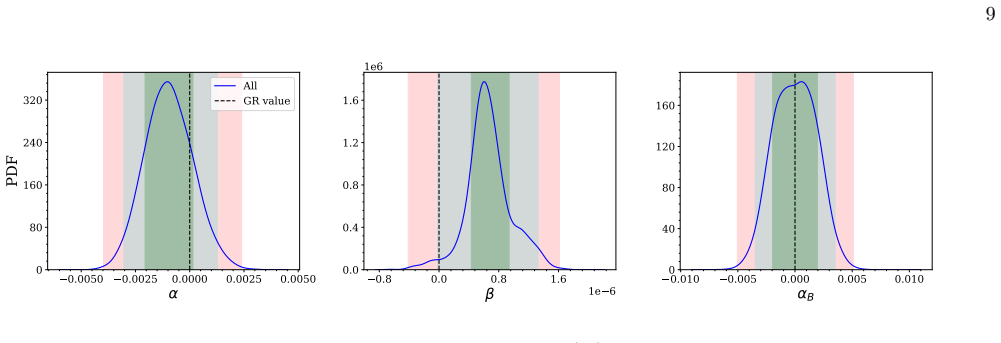
Frequency evolution:a T =−2,b=−7,a S =−2 Fig. 5 shows the PPE parameter distributions for the “All” scenario. We obtainα= (−0.987 +2.265 −2.047)×10 −3 and β= 6.41 +6.87 −6.61 ×10 −7 (both at 95% CI), withβcompa- rable to theℓ=|m|= 2 case. The scalar amplitude αB = 0.01+3.50 −3.50 ×10 −3 (95% CI) shows significant improve- ment over theℓ=|m|= 2 case. All p...
-
[4]
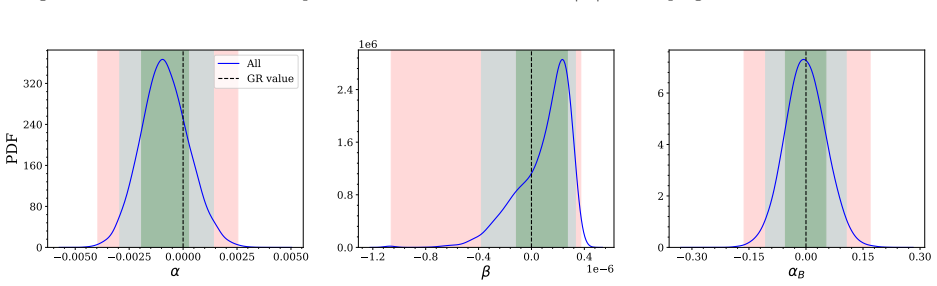
Frequency evolution:a T =−2,b=−7,a S = 0 We repeated the analysis witha S = 0, incorporating all information via priors as in theℓ=|m|= 2 case. Fig. 6 shows the resulting PPE parameter distributions. The parameterαis constrained to−0.878 +2.284 −2.056 ×10 −3 (95% CI), a 23% improvement over the corresponding case ofℓ=|m|= 2, whileβ= 1.505 +1.819 −5.289 ×1...
-
[5]
C. M. Will, Living Rev. Rel.17, 4 (2014), arXiv:1403.7377 [gr-qc]
work page internal anchor Pith review arXiv 2014
- [6]
-
[7]
N. Yunes and X. Siemens, Living Reviews in Relativity16 (2013), 10.12942/lrr-2013-9
-
[8]
N. Yunes, K. Yagi, and F. Pretorius, Physical Review D 94(2016), 10.1103/physrevd.94.084002
-
[9]
J. M. Ezquiaga and M. Zumalac´ arregui, Frontiers in Astronomy and Space Sciences5(2018), 10.3389/fs- pas.2018.00044
work page doi:10.3389/fs- 2018
-
[10]
J. Aasi, B. P. Abbott, R. Abbott,et al., Classical and Quantum Gravity32, 074001 (2015)
2015
-
[11]
Acernese, M
F. Acernese, M. Agathos, K. Agatsuma,et al., Classical and Quantum Gravity32, 024001 (2014)
2014
-
[12]
Somiya, Classical and Quantum Gravity29, 124007 (2012)
K. Somiya, Classical and Quantum Gravity29, 124007 (2012)
2012
-
[13]
T. G. F. Li, W. Del Pozzo, S. Vitale, C. Van Den Broeck, M. Agathos, J. Veitch, K. Grover, T. Sidery, R. Stu- rani, and A. Vecchio, Physical Review D85(2012), 10.1103/physrevd.85.082003
-
[14]
L. Sampson, N. Cornish, and N. Yunes, Physical Review D87(2013), 10.1103/physrevd.87.102001
-
[15]
M. Agathos, W. Del Pozzo, T. Li, C. Van Den Broeck, J. Veitch, and S. Vitale, Physical Review D89(2014), 10.1103/physrevd.89.082001
-
[16]
B. P. Abbottet al.(LIGO Scientific and Virgo Collabora- tions), Physical Review Letters116, 221101 (2016)
2016
-
[17]
T. Baker, E. Bellini, P. Ferreira, M. Lagos, J. Noller, and I. Sawicki, Physical Review Letters119(2017), 10.1103/physrevlett.119.251301
-
[18]
M. Isi, M. Pitkin, and A. J. Weinstein, Physical Review D96(2017), 10.1103/physrevd.96.042001
-
[19]
Probing gravitational wave polarizations with signals from compact binary coalescences
M. Isi and A. J. Weinstein, “Probing gravitational wave polarizations with signals from compact binary coales- cences,” (2017), arXiv:1710.03794 [gr-qc]
work page Pith review arXiv 2017
-
[20]
T. Callister, A. S. Biscoveanu, N. Christensen, M. Isi, A. Matas, O. Minazzoli, T. Regimbau, M. Sakellariadou, J. Tasson, and E. Thrane, Physical Review X7(2017), 10.1103/physrevx.7.041058
-
[21]
E. Berti, K. Yagi, H. Yang, and N. Yunes, General Rel- ativity and Gravitation50(2018), 10.1007/s10714-018- 2372-6
-
[22]
2018, PhRvD, 98, 022008, doi: 10.1103/PhysRevD.98.022008
H. Takeda, A. Nishizawa, Y. Michimura, K. Nagano, K. Komori, M. Ando, and K. Hayama, Physical Review D98(2018), 10.1103/physrevd.98.022008
-
[23]
B. P. Abbott and et al., Physical Review D100(2019), 10.1103/physrevd.100.104036
-
[24]
R. e. a. Abbott, Physical Review D103(2021), 10.1103/physrevd.103.122002
-
[25]
A. K. Mehta, A. Buonanno, R. Cotesta, A. Ghosh, N. Sen- nett, and J. Steinhoff, Physical Review D107(2023), 10.1103/physrevd.107.044020
-
[26]
E. M. S¨ anger, S. Roy, M. Agathos, O. Birnholtz, A. Buo- nanno,et al., “Tests of general relativity with gw230529: a neutron star merging with a lower mass-gap compact object,” (2024), arXiv:2406.03568 [gr-qc]
work page internal anchor Pith review arXiv 2024
-
[27]
Abbottet al.(The LIGO Scientific Collaboration, the Virgo Collaboration, and the KAGRA Collaboration), Phys
R. Abbottet al.(The LIGO Scientific Collaboration, the Virgo Collaboration, and the KAGRA Collaboration), Phys. Rev. D112, 084080 (2025)
2025
-
[28]
S. S. Madekar, N. Johnson-McDaniel, A. Gupta, and A. Ghosh, Classical and Quantum Gravity (2025), 10.1088/1361-6382/adf02a
-
[29]
D. Kumar, I. Gupta, and B. Sathyaprakash, “Accelerating parameter estimation for parameterized tests of general relativity with gravitational-wave observations,” (2025), arXiv:2511.16879 [gr-qc]
work page internal anchor Pith review Pith/arXiv arXiv 2025
-
[30]
GWTC-4.0: Tests of General Relativ- 10 ity. II. Parameterized Tests,
T. L. S. Collaboration, the Virgo Collaboration, and the KAGRA Collaboration et al., “Gwtc-4.0: Tests of general relativity. ii. parameterized tests,” (2026), arXiv:2603.19020 [gr-qc]
-
[31]
A. G. Abac, I. Abouelfettouh, F. Acernese, K. Ackley, C. Adamcewicz, S. Adhicary, D. Adhikari, N. Adhikari, R. X. Adhikari, V. K. Adkins,et al.(The LIGO Scientific Collaboration, The Virgo Collaboration, and The KAGRA Collaboration), Phys. Rev. Lett.136, 041403 (2026)
2026
-
[32]
Punturoet al., Class
M. Punturoet al., Class. Quant. Grav.27, 194002 (2010)
2010
-
[33]
Reitzeet al., Bull
D. Reitzeet al., Bull. Am. Astron. Soc.51, 035 (2019)
2019
-
[34]
D. A. Shaddock, Publications of the Astronomical Society of Australia26, 128–132 (2009). 11
2009
-
[35]
Weinberg,Gravitation and Cosmology(Wiley, 1972)
S. Weinberg,Gravitation and Cosmology(Wiley, 1972)
1972
-
[36]
C. W. Misner, K. S. Thorne, and J. A. Wheeler,Gravi- tation(W. H. Freeman, 1973)
1973
-
[37]
D. M. Eardley, D. L. Lee, and A. P. Lightman, Phys. Rev. D8, 3308 (1973)
1973
-
[38]
C. M. Will,Theory and Experiment in Gravitational Physics(Cambridge University Press, 1993)
1993
-
[39]
Maggiore,Gravitational Waves, Volume 1: Theory and Experiments(Oxford Univ
M. Maggiore,Gravitational Waves, Volume 1: Theory and Experiments(Oxford Univ. Press, 2008)
2008
-
[40]
B. F. Schutz,A First Course in General Relativity, 2nd ed. (Cambridge Univ. Press, 2009)
2009
-
[41]
J. D. Bekenstein, Phys. Rev. D70, 083509 (2004)
2004
- [42]
-
[43]
Jacobson and D
T. Jacobson and D. Mattingly, Phys. Rev. D70, 024003 (2004)
2004
-
[44]
C. Eling, T. Jacobson, and D. Mattingly, “Einstein-aether theory,” (2005), arXiv:gr-qc/0410001 [gr-qc]
work page internal anchor Pith review arXiv 2005
-
[45]
Einstein-aether gravity: a status report,
T. Jacobson, “Einstein-aether gravity: a status report,” (2008), arXiv:0801.1547 [gr-qc]
-
[46]
K. Chatziioannou, N. Yunes, and N. Cornish, Phys. Rev. D86, 022004 (2012), [Erratum: Phys.Rev.D 95, 129901 (2017)], arXiv:1204.2585 [gr-qc]
work page Pith review arXiv 2012
-
[47]
A. P. Lightman and D. L. Lee, Phys. Rev. D8, 3293 (1973)
1973
-
[49]
GW170817: Observation of Gravitational Waves from a Binary Neutron Star Inspiral
B. Abbottet al.(LIGO Scientific, Virgo), Phys. Rev. Lett. 119, 161101 (2017), arXiv:1710.05832 [gr-qc]
work page internal anchor Pith review arXiv 2017
-
[50]
K. P. Mooley, A. T. Deller, O. Gottlieb, E. Nakar, G. Hal- linan, S. Bourke, D. A. Frail, A. Horesh, A. Corsi, and K. Hotokezaka, Nature561, 355 (2018), arXiv:1806.09693 [astro-ph.HE]
work page Pith review arXiv 2018
-
[51]
Compact radio emission indicates a structured jet was produced by a binary neutron star merger
G. Ghirlandaet al., Science363, 968 (2019), arXiv:1808.00469 [astro-ph.HE]
work page Pith review arXiv 2019
-
[54]
B. P. A. et. al., The Astrophysical Journal Letters848, L12 (2017)
2017
-
[55]
Tests of General Relativity with GWTC-3
R. Abbottet al.(LIGO Scientific, VIRGO, KAGRA), (2021), arXiv:2112.06861 [gr-qc]
work page internal anchor Pith review arXiv 2021
-
[56]
B. e. a. Abbott, Physical Review Letters119(2017), 10.1103/physrevlett.119.161101
-
[57]
B. P. Abbottet al.(LIGO Scientific, Virgo), Phys. Rev. Lett.119, 141101 (2017), arXiv:1709.09660 [gr-qc]
work page Pith review arXiv 2017
-
[58]
Y. Hagihara, N. Era, D. Iikawa, and H. Asada, Physical Review D98(2018), 10.1103/physrevd.98.064035
-
[59]
B. e. a. Abbott, Physical Review Letters123(2019), 10.1103/physrevlett.123.011102
-
[61]
Takeda, S
H. Takeda, S. Morisaki, and A. Nishizawa, Phys. Rev. D 103, 064037 (2021)
2021
-
[62]
A. A. Svidzinsky and R. C. Hilborn, Eur. Phys. J. Spec. Top. (2021), 10.1140/epjs/s11734-021-00080-6
- [64]
-
[65]
H. Takeda, S. Morisaki, and A. Nishizawa, Physical Re- view D105(2022), 10.1103/physrevd.105.084019
-
[66]
D. M. Eardley, D. L. Lee, A. P. Lightman, R. V. Wagoner, and C. M. Will, Phys. Rev. Lett.30, 884 (1973)
1973
-
[67]
N. Yunes and F. Pretorius, Physical Review D80(2009), 10.1103/physrevd.80.122003
-
[68]
B. S. Sathyaprakash and B. F. Schutz, Living Reviews in Relativity12(2009), 10.12942/lrr-2009-2
-
[69]
Aasiet al., Classical and Quantum Gravity32, 074001 (2015)
J. Aasiet al., Classical and Quantum Gravity32, 074001 (2015)
2015
-
[70]
Acerneseet al., Classical and Quantum Gravity32, 024001 (2014)
F. Acerneseet al., Classical and Quantum Gravity32, 024001 (2014)
2014
-
[71]
Y. Aso, Y. Michimura, K. Somiya, M. Ando, O. Miyakawa, T. Sekiguchi, D. Tatsumi, and H. Yamamoto (The KA- GRA Collaboration), Phys. Rev. D88, 043007 (2013)
2013
-
[72]
Chatziioannou, N
K. Chatziioannou, N. Yunes, and N. Cornish, Phys. Rev. D86, 022004 (2012)
2012
-
[73]
Capozziello, C
S. Capozziello, C. Corda, and M. F. De Laurentis, Physics Letters B669, 255–259 (2008)
2008
-
[74]
K. J. Lee, F. A. Jenet, and R. H. Price, The Astrophysical Journal685, 1304 (2008)
2008
-
[75]
S. J. Chamberlin and X. Siemens, Phys. Rev. D85, 082001 (2012)
2012
-
[76]
Akamaet al.(LISA Cosmology Working Group), (2026), arXiv:2603.03165 [astro-ph.CO]
S. Akamaet al.(LISA Cosmology Working Group), (2026), arXiv:2603.03165 [astro-ph.CO]
-
[77]
Damour and G
T. Damour and G. Esposito-Far` ese, Physical Review D 54, 1474 (1996)
1996
-
[78]
B. P. Abbottet al.(LIGO Scientific, Virgo), Phys. Rev. Lett.116, 061102 (2016), arXiv:1602.03837 [gr-qc]
work page internal anchor Pith review arXiv 2016
-
[79]
S. Tahura and K. Yagi, Phys. Rev. D98, 084042 (2018), [Erratum: Phys.Rev.D 101, 109902 (2020)], arXiv:1809.00259 [gr-qc]
- [80]
- [82]
-
[83]
S. Khan, S. Husa, M. Hannam, F. Ohme, M. P¨ urrer, X. J. Forteza, and A. Boh´ e, Physical Review D93(2016), 10.1103/physrevd.93.044007
-
[84]
doi:10.1103/PhysRevD.80.084043 , eid =
A. Buonanno, B. R. Iyer, E. Ochsner, Y. Pan, and B. S. Sathyaprakash, Physical Review D80(2009), 10.1103/physrevd.80.084043
-
[85]
Entanglement entropy and the fermi surface,
K. Schumacher, S. E. Perkins, A. Shaw, K. Yagi, and N. Yunes, Physical Review D108(2023), 10.1103/phys- revd.108.104053
-
[86]
M. Piarulli, S. Marsat, E. M. S¨ anger, A. Buonanno, J. Steinhoff, and N. Tamanini, Physical Review D112 (2025), 10.1103/59zd-qvbd
discussion (0)
Sign in with ORCID, Apple, or X to comment. Anyone can read and Pith papers without signing in.