Recognition: unknown
Private Private Information in Second-Price Auction
Pith reviewed 2026-05-07 17:18 UTC · model grok-4.3
The pith
A seller can implement full surplus extraction in a second-price auction via a private private information structure that admits a Bayes-Nash equilibrium.
A machine-rendered reading of the paper's core claim, the machinery that carries it, and where it could break.
Core claim
We first show that the seller optimal efficient outcome with full surplus extraction can always be implemented by a private private information structure that admits a Bayes Nash equilibrium. However, this equilibrium may not be stable. We then further construct a private private information structure that achieves revenue arbitrarily close to maximum welfare while admitting a strict equilibrium. At the same time, we establish an impossibility result: under private private information, in general, bidder surplus cannot achieve maximal welfare exactly, and we characterize necessary and sufficient conditions on the prior distribution under which bidder surplus can be made arbitrarily close to
What carries the argument
Private private information structure, in which bidders receive signals that are independent ex ante while sharing a symmetric and arbitrarily correlated prior distribution over their valuations.
If this is right
- Full surplus extraction becomes achievable in equilibrium under private private information.
- Revenue can approach maximum welfare arbitrarily closely while supporting a strict equilibrium.
- Bidder surplus cannot reach its exact maximum under private private information except under specific prior conditions.
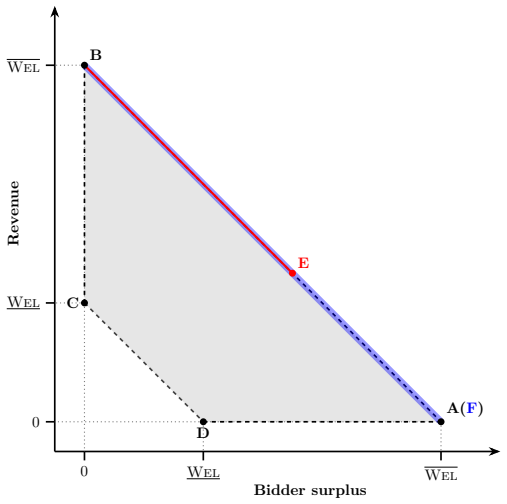
- A complete characterization exists for all achievable pairs of bidder surplus and seller revenue under general information structures.
- Other efficient outcomes beyond full extraction can be implemented under private private information.
Where Pith is reading between the lines
- Platforms could use similar independent-signal designs to improve revenue in existing auction formats without changing payment rules.
- The stability distinction between equilibria suggests that information design should prioritize strict equilibria when bidder behavior is uncertain.
- The characterization of achievable surplus-revenue pairs may help identify when private private structures suffice versus when more correlated signals are required.
Load-bearing premise
The seller can credibly commit to the private private information structure and bidders will play the Bayes-Nash equilibrium it induces.
What would settle it
An experiment in which bidders given the constructed independent signals and shared prior deviate from the predicted equilibrium bids and produce revenue measurably below the claimed near-maximum level.
Figures

read the original abstract
Classic results show that even an arbitrarily small correlation across bidders' information can enable full surplus extraction in auctions and related mechanism design settings. Motivated by this fragility, we study the information independence in a second-price auction when the seller commits to a private private information structure, meaning bidders' signals are independent ex ante, while bidders share a symmetric and arbitrarily correlated prior distribution over their valuations. We first show that the seller optimal efficient outcome with full surplus extraction can always be implemented by a private private information structure that admits a Bayes Nash equilibrium. However, this equilibrium may not be stable. We then further construct a private private information structure that achieves revenue arbitrarily close to maximum welfare while admitting a strict equilibrium. At the same time, we establish an impossibility result: under private private information, in general, bidder surplus cannot achieve maximal welfare exactly, and we characterize necessary and sufficient conditions on the prior distribution under which bidder surplus can be made arbitrarily close to maximal welfare. We then explore which other efficient outcomes are achievable under private private information. Finally, moving beyond private private information, we provide a complete characterization of the achievable pairs (bidder surplus, seller revenue) under general information structures.
Editorial analysis
A structured set of objections, weighed in public.
Referee Report
Summary. The paper studies private private information structures in second-price auctions, where bidders' signals are independent ex ante but drawn from a symmetric correlated prior over valuations. It shows that the seller-optimal efficient outcome with full surplus extraction can always be implemented by such a structure admitting a Bayes-Nash equilibrium (though this equilibrium may not be stable). It further constructs a private private information structure achieving revenue arbitrarily close to maximum welfare while admitting a strict equilibrium. An impossibility result establishes that bidder surplus cannot achieve maximal welfare exactly under private private information, with a characterization of necessary and sufficient conditions on the prior for arbitrarily close approximation. The paper also explores other efficient outcomes achievable under private private information and provides a complete characterization of achievable (bidder surplus, seller revenue) pairs under general information structures.
Significance. If the constructions, equilibrium arguments, and characterizations hold, the paper makes a valuable contribution to auction theory and information design by clarifying the limits imposed by ex ante signal independence on full surplus extraction and revenue maximization. The explicit constructions separating unstable from strict equilibria, the impossibility result with prior characterization, and the full characterization under general structures provide precise boundaries that strengthen understanding of robustness in mechanism design. These results are particularly relevant given classic findings on the power of even small correlations.
minor comments (3)
- [Abstract] Abstract: The term 'private private information structure' is used without a brief inline definition or reference to its formal definition in the introduction; adding this would improve readability for a broad audience.
- [Abstract] Abstract: The sentence describing the first construction notes that 'this equilibrium may not be stable' but does not indicate where in the manuscript the instability is demonstrated (e.g., via counterexample or proof); a forward reference would help.
- [Abstract] The abstract claims a 'complete characterization' of achievable (bidder surplus, seller revenue) pairs under general information structures; ensure the main text explicitly states the precise mathematical form of this characterization (e.g., as a convex set or via linear inequalities) to allow verification.
Simulated Author's Rebuttal
We thank the referee for their positive assessment of the paper and the recommendation for minor revision. The referee's summary accurately reflects our main results on private private information structures in second-price auctions, including the Bayes-Nash implementation of full surplus extraction, the strict-equilibrium construction for revenue arbitrarily close to maximum welfare, the impossibility result for exact bidder-surplus maximization, and the characterization under general information structures.
Circularity Check
No significant circularity in derivation chain
full rationale
The paper derives results via explicit constructions of private private information structures for second-price auctions, along with equilibrium existence, stability analysis, impossibility results, and characterizations of achievable surplus/revenue pairs. These steps rely on standard tools from Bayesian mechanism design and game theory (Bayes-Nash equilibria, information structures with independent signals but correlated priors). No load-bearing step reduces by construction to a fitted parameter, self-definition, or self-citation chain; the abstract and high-level argument explicitly flag limitations such as equilibrium instability, confirming the derivations are not tautological. The central claims remain independent of the paper's own inputs.
Axiom & Free-Parameter Ledger
axioms (2)
- standard math Existence of Bayes-Nash equilibrium in the finite games induced by the constructed information structures
- domain assumption Symmetry of the prior distribution over valuations
invented entities (1)
-
Private private information structure
no independent evidence
Reference graph
Works this paper leans on
-
[1]
high region
or fails to implement the efficient allocation(Cases 2 and 3). Thus, no such private private information structure exists. Proof of Proposition 4.2.Notethatitiswithoutlosstofocusontruthfulbiddingastheequilibrium. We first prove the sufficiency direction, and the necessity direction. The⇐directionWe first prove the sufficiency of the conditions by construc...
-
[2]
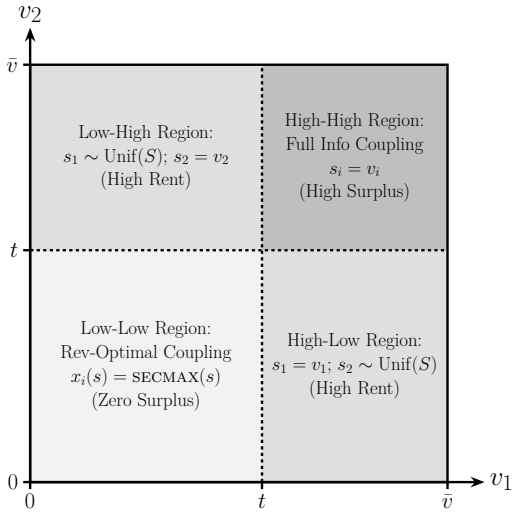
Ifv i < tfor all biddersi, the signal profile is drawn according to the local construction: s∼πt low(·|v)
-
[3]
•For every bidderjwithv j <t, we setsj =γj(vj,rj), whererj∼Unif[0,1]is an auxiliary random variable drawn independently across bidders
If there exists at least one bidder withvi>t, the signals are determined deterministically (or independently) as follows: •For every bidderiwithv i>t, we setsi =v i. •For every bidderjwithv j <t, we setsj =γj(vj,rj), whererj∼Unif[0,1]is an auxiliary random variable drawn independently across bidders. Sinceγi(vi,ri)∼Unif((s,¯s)), it is obvious that the sig...
-
[4]
Both the winner (with valuev(1)) and the second highest bidder (with valuev(2)) are in the high region (sincev(1)≥v(2))
Case 1:v (2) is in the high region. Both the winner (with valuev(1)) and the second highest bidder (with valuev(2)) are in the high region (sincev(1)≥v(2)). Thus, their signals reveal their true values:s (1) =v (1) ands (2) =v (2). The winner pays the second highest bid s(2) =v (2). The realized surplus isv(1)−v(2)
-
[5]
Thewinnerhassignals (1) =v (1)
Case2:v (1) isinthehighregion, andv (2) isinthelowregion. Thewinnerhassignals (1) =v (1). All other bidders are in the low region and have signals inSlow. The payment is determined by the highest competing signalmaxj̸=winnersj, which lies inSlow = [ω(t,q)−ε,ω(t,q) +ε]. As we takeε→0, this payment converges toω(t,q). The realized surplus converges to v(1)−ω(t,q)
-
[6]
All bidders are in the low region
Case 3:v (1) is in the low region. All bidders are in the low region. The mechanism behaves as a full surplus extraction mechanism for these types, so the bidder surplus is 0. Thus, taking expectations over valuations, the total bidder surplus is given by: B(t,q) =E [ (v(1)−v(2))·1 { v(2)∈High }] +E [ (v(1)−ω(t,q))·1 { v(1)∈High,v(2)∈Low }] .(18) Since th...
-
[7]
Therefore, the allocation is fully efficient, and the total generated welfare isWEL
Efficiency: The item is always allocated to bidderi ∗who holds the maximum valuation max(v). Therefore, the allocation is fully efficient, and the total generated welfare isWEL
-
[8]
Consequently, the seller’s revenue isRev(I,σ) = 0for every realized signal profile
Revenue and Surplus: The winning bid ismax(v)and the second-highest bid is always0. Consequently, the seller’s revenue isRev(I,σ) = 0for every realized signal profile. The bidders’ surplus is the total welfare minus revenue: BS(I,σ) =WEL−0 =WEL. This completes the proof. Proof of Proposition 5.5.Weprovethepropositionbyexplicitlyconstructingtheinformations...
-
[9]
The expected total welfare is minimized atE[minjvj] =WEL
Efficiency: The item is always allocated to a bidder who holds the lowest valuation. The expected total welfare is minimized atE[minjvj] =WEL
-
[10]
The revenue is Rev(I,σ) = 0
Revenue and Surplus: The winning bid is¯vand the second-highest bid is0. The revenue is Rev(I,σ) = 0. The bidders’ surplus isWEL−0 =WEL. This completes the proof. Proof of Proposition 5.6.Weprovethepropositionbyexplicitlyconstructingtheinformationstruc- tureIand verifying the equilibrium properties. Recall that¯v≜maxVbe the maximum value among all possibl...
-
[11]
If bidderkdeviates tob= ¯v, then they tie with bidderi∗; conditional on winning, the price is¯vand 45 the payoff isvk−¯v≤0
If bidderkdeviates to any bidb <¯v, they still lose to bidderi∗’s bid and obtain payoff0. If bidderkdeviates tob= ¯v, then they tie with bidderi∗; conditional on winning, the price is¯vand 45 the payoff isvk−¯v≤0. Thus, no deviation yields a strictly positive payoff, and bidding0is a best response. Therefore, the bidding strategy defined in Eqn. (20) is i...
-
[12]
The expected total welfare is minimized atE[minjvj] =WEL
Efficiency:The item is always allocated to a bidder who holds the lowest valuation. The expected total welfare is minimized atE[minjvj] =WEL
-
[13]
TherevenueisE[min jvj] =WEL
RevenueandSurplus: Thewinningbidderalwayspaysv i∗. TherevenueisE[min jvj] =WEL . The bidder surplus isvi∗−vi∗= 0. This completes the proof. 46
discussion (0)
Sign in with ORCID, Apple, or X to comment. Anyone can read and Pith papers without signing in.