Recognition: unknown
Remotely programming the weights of a spintronic neural network by a radiofrequency broadcast signal
Pith reviewed 2026-05-07 17:00 UTC · model grok-4.3
The pith
Broadcast RF signals can remotely set binary synaptic weights in spintronic networks by frequency-selective vortex-core reversal.
A machine-rendered reading of the paper's core claim, the machinery that carries it, and where it could break.
Core claim
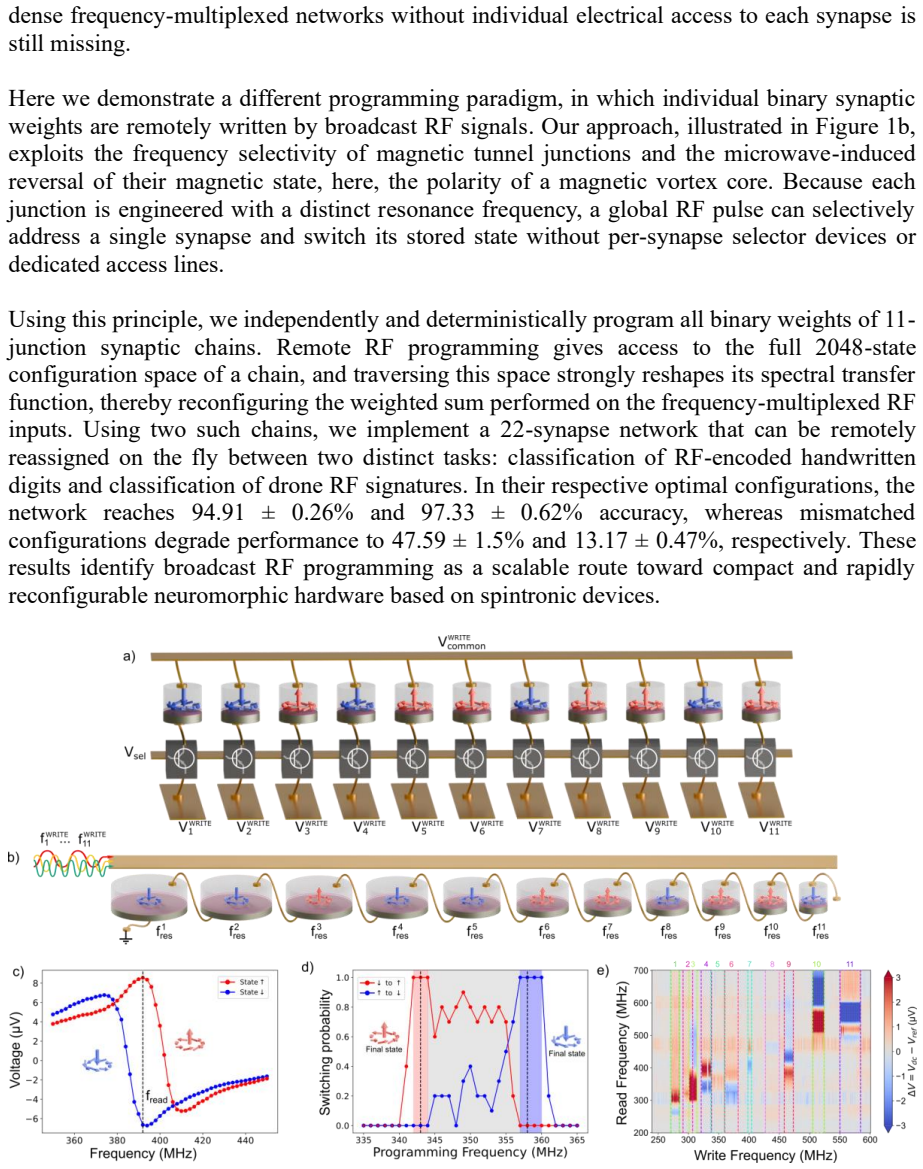
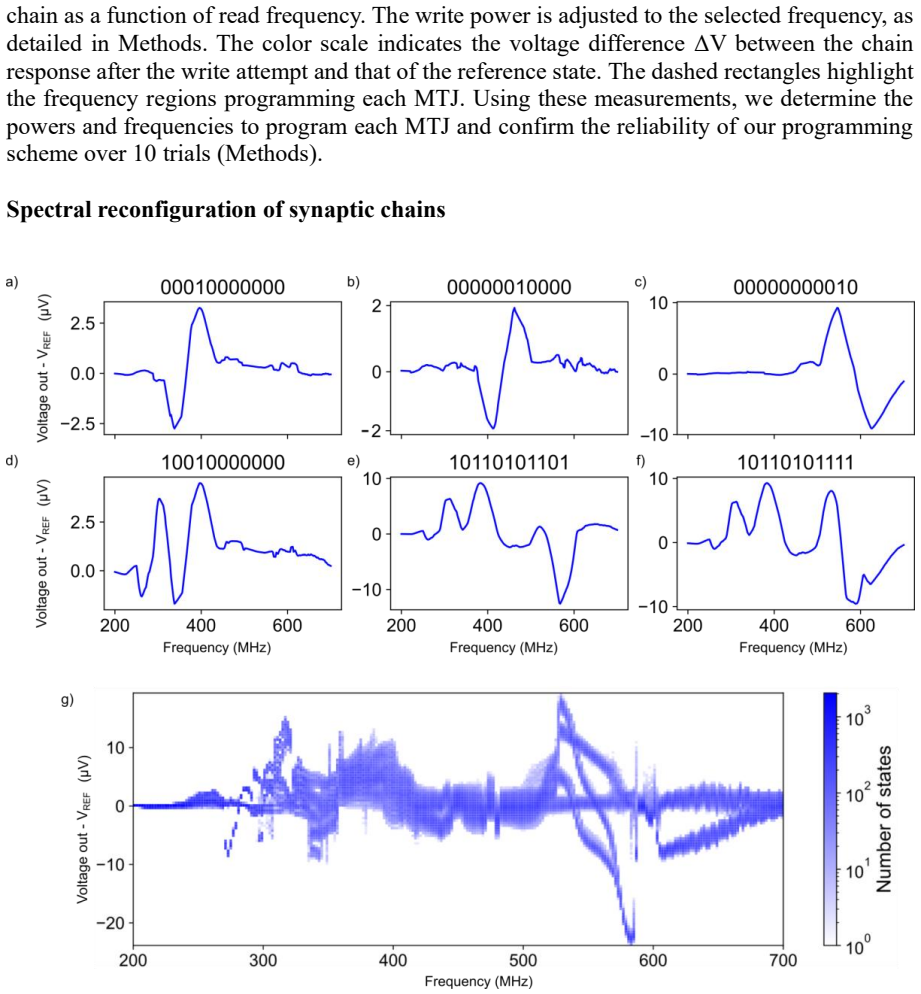
The authors establish that frequency-selective reversal of the vortex-core polarity in vortex-based magnetic tunnel junctions allows remote programming of synaptic weights in series-connected chains using a shared strip line. This enables reshaping the weighted sums performed on frequency-multiplexed RF inputs. In a demonstration with two such 11-junction chains forming a 22-synapse network, the hardware is reconfigured to achieve 94.91 percent accuracy on digit classification in one setting and 97.33 percent on drone RF-signature identification in another, with cross-task performance dropping to 13.17 percent and 47.59 percent respectively.
What carries the argument
Frequency-selective reversal of the vortex-core polarity, which sets and maintains binary weight states in series-connected chains of vortex-based magnetic tunnel junctions.
If this is right
- Large numbers of non-volatile synaptic weights can be programmed selectively without individual access lines.
- The same hardware can be remotely reconfigured for different tasks by changing binary states of the chains.
- Weighted sums on frequency-multiplexed RF inputs can be reshaped through broadcast signals.
- Compact neuromorphic hardware becomes possible without selector devices for weight programming.
Where Pith is reading between the lines
- This approach may support denser synapse integration in chips by removing per-device programming wiring.
- Dynamic RF signals could enable real-time task adaptation in portable devices if applied continuously.
- Extension to longer chains might allow multi-task processors with low programming overhead.
Load-bearing premise
Vortex-core polarity reversal can be performed reliably and repeatedly in series-connected chains based on frequency, with negligible crosstalk, device variation, or degradation.
What would settle it
If repeated RF programming cycles produce state drift or unintended flips in other junctions, or if accuracy on the optimized task falls below 80 percent after reconfiguration, the reliability of frequency-selective control would be falsified.
Figures

read the original abstract
Selectively programming large number of non-volatile synaptic weights without compromising scalability is a key challenge for in-memory computing. Here, we demonstrate remote programming of synaptic weights in series-connected chains of 11 vortex-based magnetic tunnel junctions using broadcast radiofrequency signals applied through a shared strip line. The programming relies on frequency-selective reversal of the vortex-core polarity and therefore does not require individual access lines or selector devices. By reconfiguring the binary states of these chains, we reshape the weighted sums they perform on frequency-multiplexed RF inputs. Using a 22-synapse network composed of two such chains, we remotely reconfigure the same hardware to perform two distinct tasks: handwritten-digit classification and drone RF-signature identification. The digit-optimized configuration reaches 94.91 +/- 0.26% accuracy on handwritten digits but only 13.17 +/- 0.47% on drone RF signatures, whereas the drone-optimized configuration reaches 97.33 +/- 0.62% on drones but only 47.59 +/- 1.5% on digits. Broadcast RF programming thus provides a compact and scalable route to rapidly reconfigurable spintronic neuromorphic hardware.
Editorial analysis
A structured set of objections, weighed in public.
Referee Report
Summary. The manuscript experimentally demonstrates remote programming of binary synaptic weights in series-connected chains of 11 vortex-based magnetic tunnel junctions (MTJs) via frequency-selective reversal of vortex-core polarity, using broadcast radiofrequency signals applied through a shared stripline without individual access lines or selectors. A 22-synapse network formed by two such chains is reconfigured to perform two tasks: handwritten-digit classification (94.91 ± 0.26% accuracy in the digit-optimized configuration) and drone RF-signature identification (97.33 ± 0.62% accuracy in the drone-optimized configuration), with substantially lower cross-task accuracies (13.17 ± 0.47% and 47.59 ± 1.5%, respectively), thereby showing task-specific reshaping of weighted sums on frequency-multiplexed RF inputs.
Significance. If the frequency-selective programming and state stability hold under the reported conditions, the work offers a compact, scalable route to reconfigurable spintronic neuromorphic hardware that addresses the challenge of programming large numbers of non-volatile weights. The concrete dual-task accuracies with error bars provide direct, falsifiable evidence of successful hardware reconfiguration, and the absence of fitted parameters or ad-hoc adjustments in the core demonstration strengthens the result as a physical proof-of-concept.
major comments (2)
- [experimental results on chain programming and dual-task performance] The central claim that broadcast RF signals can set distinct binary weight states across 11-MTJ chains via frequency selectivity alone requires that each junction responds only to its assigned frequency with negligible off-resonance excitation, crosstalk, or device-to-device variation. The reported task accuracies are consistent with successful reconfiguration but the manuscript does not provide direct quantification of programming yield, resonance variation statistics, or crosstalk measurements in the series-chain geometry (see the experimental results on chain programming and the dual-task performance section).
- [network reconfiguration and inference measurements] State retention and stability under the exact RF input conditions used for inference are load-bearing for the claim that the programmed weights remain fixed for the duration of the tasks. No data on drift, retention time, or reset behavior after programming are presented for the 11-MTJ chains (see the section describing the network reconfiguration and inference measurements).
minor comments (2)
- [abstract and results] The number of experimental trials or the precise statistical method used to compute the reported accuracies and error bars is not stated, which would aid reproducibility assessment.
- [figures and methods] Figure captions and text could more explicitly label the frequency assignments and corresponding weight patterns for each chain to clarify the mapping from broadcast signal to binary states.
Simulated Author's Rebuttal
We thank the referee for their detailed and constructive feedback on our manuscript. We appreciate the positive assessment of the significance of our work. Below we provide point-by-point responses to the major comments, and we have made revisions to the manuscript to address the concerns raised.
read point-by-point responses
-
Referee: [experimental results on chain programming and dual-task performance] The central claim that broadcast RF signals can set distinct binary weight states across 11-MTJ chains via frequency selectivity alone requires that each junction responds only to its assigned frequency with negligible off-resonance excitation, crosstalk, or device-to-device variation. The reported task accuracies are consistent with successful reconfiguration but the manuscript does not provide direct quantification of programming yield, resonance variation statistics, or crosstalk measurements in the series-chain geometry (see the experimental results on chain programming and the dual-task performance section).
Authors: We agree that direct quantification of programming yield, resonance variation statistics, or crosstalk measurements would strengthen the demonstration of frequency-selective programming in the series-chain geometry. The dual-task results, with high accuracy in the optimized configuration and substantially lower accuracy in the cross-task, serve as indirect but strong evidence of successful distinct weight setting. To directly address this, we have revised the manuscript to include new data on these aspects in the experimental results section. revision: yes
-
Referee: [network reconfiguration and inference measurements] State retention and stability under the exact RF input conditions used for inference are load-bearing for the claim that the programmed weights remain fixed for the duration of the tasks. No data on drift, retention time, or reset behavior after programming are presented for the 11-MTJ chains (see the section describing the network reconfiguration and inference measurements).
Authors: We agree that data on state retention and stability under inference conditions is important. The successful performance of the tasks after programming implies stability during the inference measurements. We have revised the manuscript to add retention and drift measurements for the 11-MTJ chains under the relevant RF conditions, as well as characterization of reset behavior. revision: yes
Circularity Check
No circularity: purely experimental demonstration with independent physical measurements
full rationale
The paper reports an experimental demonstration of frequency-selective vortex-core polarity reversal in series-connected MTJ chains to reconfigure binary synaptic weights via broadcast RF signals. It shows task-specific accuracies (94.91% on digits vs. 13.17% on drones for one configuration, and vice versa for the other) measured on physical hardware. No mathematical derivation chain, equations, fitted parameters, or self-citations are present that reduce any claim to a prior definition or input by construction. The central results rest on direct device behavior and measured performance, which are externally falsifiable and do not rely on self-referential logic.
Axiom & Free-Parameter Ledger
axioms (1)
- domain assumption Vortex core polarity in MTJs can be selectively reversed by frequency-tuned RF fields applied through a shared line
Reference graph
Works this paper leans on
-
[1]
& Eleftheriou, E
Sebastian, A., Le Gallo, M., Khaddam-Aljameh, R. & Eleftheriou, E. Memory devices and applications for in-memory computing. Nat. Nanotechnol. 15, 529–544 (2020)
2020
-
[2]
Lanza, M. et al. The growing memristor industry. Nature 640, 613–622 (2025)
2025
-
[3]
Hua, S. et al. An integrated large-scale photonic accelerator with ultralow latency. Nature 640, 361–367 (2025)
2025
-
[4]
& Bhaskaran, H
Farmakidis, N., Dong, B. & Bhaskaran, H. Integrated photonic neuromorphic computing: opportunities and challenges. Nat. Rev. Electr. Eng. 1, 358–373 (2024)
2024
-
[5]
S., Bhattacharya, T., Kwon, D
Choi, S., Bezugam, S. S., Bhattacharya, T., Kwon, D. & Strukov, D. B. Wafer-scale fabrication of memristive passive crossbar circuits for brain-scale neuromorphic computing. Nat. Commun. 16, 8757 (2025)
2025
-
[6]
R., Nili, H
Kim, H., Mahmoodi, M. R., Nili, H. & Strukov, D. B. 4K-memristor analog-grade passive crossbar circuit. Nat. Commun. 12, 5198 (2021)
2021
-
[7]
Jung, S. et al. A crossbar array of magnetoresistive memory devices for in-memory computing. Nature 601, 211–216 (2022)
2022
-
[8]
Wen, T.-H. et al. Fusion of memristor and digital compute-in-memory processing for energy-efficient edge computing. Science 384, 325–332 (2024)
2024
-
[9]
Li, H. et al. A lossless and fully parallel spintronic compute-in-memory macro for artificial intelligence chips. Nat. Electron. 8, 1046–1058 (2025)
2025
-
[10]
Marquez, B. A. et al. Fully-integrated photonic tensor core for image convolutions. Nanotechnology 34, 395201 (2023)
2023
-
[11]
Bai, B. et al. Microcomb-based integrated photonic processing unit. Nat. Commun. 14, 66 (2023)
2023
-
[12]
Tait, A. N. et al. Neuromorphic photonic networks using silicon photonic weight banks. Sci. Rep. 7, 7430 (2017)
2017
-
[13]
Luan, E. et al. Towards a high-density photonic tensor core enabled by intensity- modulated microrings and photonic wire bonding. Sci. Rep. 13, 1260 (2023)
2023
-
[14]
D., Bhaskaran, H
Feldmann, J., Youngblood, N., Wright, C. D., Bhaskaran, H. & Pernice, W. H. P. All- optical spiking neurosynaptic networks with self-learning capabilities. Nature 569, 208– 214 (2019)
2019
-
[15]
Bandyopadhyay, S. et al. Single-chip photonic deep neural network with forward-only training. Nat. Photonics 18, 1335–1343 (2024)
2024
-
[16]
Ross, A. et al. Multilayer spintronic neural networks with radiofrequency connections. Nat. Nanotechnol. 18, 1273–1280 (2023)
2023
-
[17]
Zeng, K. et al. Radio-frequency-modulated artificial synapses based on magnetic tunnel junctions with perpendicular magnetic anisotropy. Phys. Rev. Appl. 21, 014020 (2024)
2024
-
[18]
Leroux, N. et al. Hardware realization of the multiply and accumulate operation on radio- frequency signals with magnetic tunnel junctions. Neuromorphic Comput. Eng. 1, 011001 (2021)
2021
-
[19]
Leroux, N. et al. Radio-Frequency Multiply-and-Accumulate Operations with Spintronic Synapses. Phys. Rev. Appl. 15, 034067 (2021)
2021
-
[20]
Wang, Z. et al. Radiofrequency Spintronic Neural Network Enabled by Electrically Modulated Magnetic Tunnel Junctions. Adv. Mater. 38, e10319 (2026)
2026
-
[21]
Leroux, N. et al. Classification of multi-frequency RF signals by extreme learning, using magnetic tunnel junctions as neurons and synapses. APL Mach. Learn. 1, 036109 (2023)
2023
-
[22]
Leroux, N. et al. Convolutional neural networks with radio-frequency spintronic nano- devices. Neuromorphic Comput. Eng. 2, 034002 (2022)
2022
-
[23]
Tulapurkar, A. A. et al. Spin-torque diode effect in magnetic tunnel junctions. Nature 438, 339–342 (2005)
2005
-
[24]
Finocchio, G. et al. Perspectives on spintronic diodes. Appl. Phys. Lett. 118, 160502 (2021)
2021
-
[25]
Pigeau, B. et al. A frequency-controlled magnetic vortex memory. Appl. Phys. Lett. 96, 132506 (2010)
2010
-
[26]
Jenkins, A. S. et al. Controlling the chirality and polarity of vortices in magnetic tunnel junctions. Appl. Phys. Lett. 105, 172403 (2014)
2014
-
[27]
Pigeau, B. et al. Optimal control of vortex-core polarity by resonant microwave pulses. Nat. Phys. 7, 26–31 (2011)
2011
-
[28]
E. Alpaydin, Fevzi. A. Pen-Based Recognition of Handwritten Digits. UCI Machine Learning Repository https://doi.org/10.24432/C5MG6K (1996)
-
[29]
Basak, S., Rajendran, S., Pollin, S. & Scheers, B. Drone classification from RF fingerprints using deep residual nets. in 2021 International Conference on COMmunication Systems NETworkS (COMSNETS) 548–555 (2021). doi:10.1109/COMSNETS51098.2021.9352891
-
[30]
Ambrogio, S. et al. An analog-AI chip for energy-efficient speech recognition and transcription. Nature 620, 768–775 (2023)
2023
-
[31]
& Duan, C
Shi, L., Zheng, G., Tian, B., Dkhil, B. & Duan, C. Research progress on solutions to the sneak path issue in memristor crossbar arrays. Nanoscale Adv. 2, 1811–1827 (2020)
2020
-
[32]
Huang, C. et al. Demonstration of scalable microring weight bank control for large-scale photonic integrated circuits. APL Photonics 5, 040803 (2020)
2020
-
[33]
Lu, C. et al. Self-Rectifying All-Optical Modulated Optoelectronic Multistates Memristor Crossbar Array for Neuromorphic Computing. Nano Lett. 24, 1667–1672 (2024)
2024
-
[34]
Photonic neuromorphic technologies in optical communications
Argyris, A. Photonic neuromorphic technologies in optical communications. Nanophotonics 11, 897–916 (2022)
2022
-
[35]
Yu., Scholz, W., Chantrell, R
Guslienko, K. Yu., Scholz, W., Chantrell, R. W. & Novosad, V . V ortex-state oscillations in soft magnetic cylindrical dots. Phys. Rev. B 71, 144407 (2005)
2005
-
[37]
Buchanan, K. S. et al. Soliton-pair dynamics in patterned ferromagnetic ellipses. Nat. Phys. 1, 172–176 (2005)
2005
-
[38]
Hata, H. et al. Coupled oscillations of vortex cores confined in a ferromagnetic elliptical disk. Phys. Rev. B 90, 104418 (2014)
2014
-
[39]
Suto, H. et al. Layer-Selective Switching of a Double-Layer Perpendicular Magnetic Nanodot Using Microwave Assistance. Phys. Rev. Appl. 5, 014003 (2016)
2016
-
[40]
Piraux, L. et al. Giant magnetoresistance in magnetic multilayered nanowires. Appl. Phys. Lett. 65, 2484–2486 (1994)
1994
-
[41]
Liu, S. et al. A CMOS-compatible, scalable and compact magnetoelectric spin-torque microwave detector. Nat. Nanotechnol. 21, 546–553 (2026)
2026
-
[42]
Skalli, A. et al. Annealing-inspired training of an optical neural network with ternary weights. Commun. Phys. 8, 68 (2025)
2025
-
[43]
D., Gonzalez-Mendoza, M., Chang, L., Ochoa-Ruiz, G
Suarez-Ramirez, C. D., Gonzalez-Mendoza, M., Chang, L., Ochoa-Ruiz, G. & Duran- Vega, M. A. A Bop and Beyond: A Second Order Optimizer for Binarized Neural Networks. in 1273–1281 (2021)
2021
-
[45]
Lee, K.-S. et al. Universal Criterion and Phase Diagram for Switching a Magnetic V ortex Core in Soft Magnetic Nanodots. Phys. Rev. Lett. 101, 267206 (2008)
2008
-
[46]
Petit-Watelot, S. et al. Commensurability and chaos in magnetic vortex oscillations. Nat. Phys. 8, 682–687 (2012)
2012
-
[47]
Guslienko, K. Yu. et al. Eigenfrequencies of vortex state excitations in magnetic submicron-size disks. J. Appl. Phys. 91, 8037–8039 (2002)
2002
-
[48]
Novosad, V . et al. Magnetic vortex resonance in patterned ferromagnetic dots. Phys. Rev. B 72, 024455 (2005)
2005
-
[49]
V ., Slavin, A
Khvalkovskiy, A. V ., Slavin, A. N., Grollier, J., Zvezdin, K. A. & Guslienko, K. Yu. Critical velocity for the vortex core reversal in perpendicular bias magnetic field. Appl. Phys. Lett. 96, 022504 (2010)
2010
-
[50]
Guslienko, K. Yu. Low-frequency vortex dynamic susceptibility and relaxation in mesoscopic ferromagnetic dots. Appl. Phys. Lett. 89, 022510 (2006)
2006
discussion (0)
Sign in with ORCID, Apple, or X to comment. Anyone can read and Pith papers without signing in.