Recognition: unknown
Electronic and optical properties of arsenic monolayers: from planar honeycomb to the puckered phase
Pith reviewed 2026-05-08 02:47 UTC · model grok-4.3
The pith
Biaxial strain transforms puckered arsenic monolayers into planar honeycomb structures through orbital-specific band inversions that control their electronic gaps and optical excitons.
A machine-rendered reading of the paper's core claim, the machinery that carries it, and where it could break.
Core claim
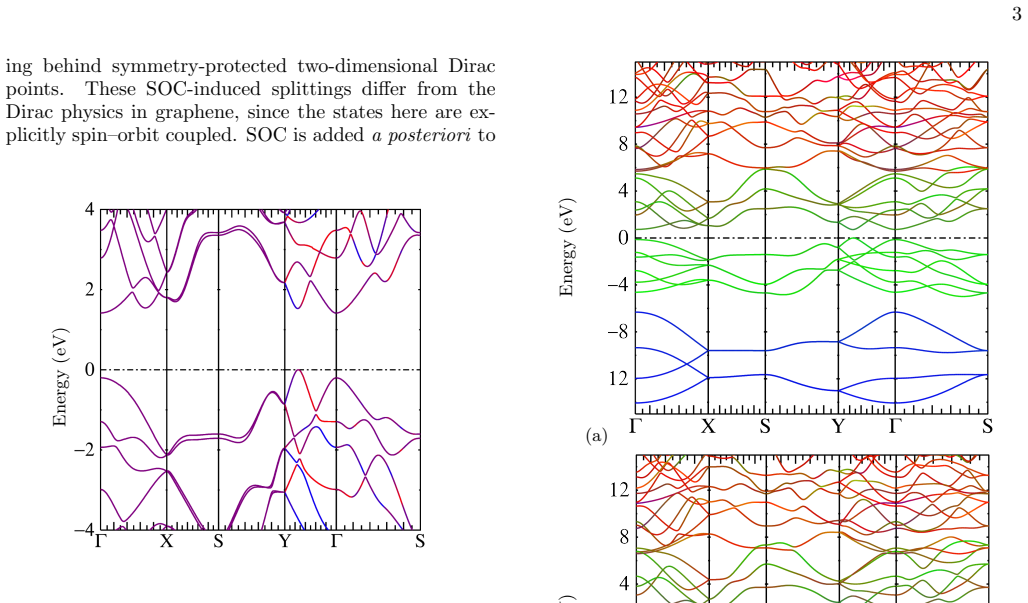
The gradual transformation from the puckered α-phase to the flat honeycomb structure is studied under biaxial strain and the evolution of the band structure and optical response is described in terms of band inversions of bands of different orbital character. Calculations include spin-orbit coupling and vertex corrections to the GW approximation to accurately determine the orbital composition of the bands and the nature of the low-lying excitons.
What carries the argument
Biaxial strain driving the structural transition from puckered to planar arsenic monolayer, with associated band inversions between bands of different orbital character.
Load-bearing premise
The QS GW method with and without vertex corrections combined with BSE accurately captures the orbital character and exciton origins without significant errors from the underlying DFT starting point or neglected higher-order effects.
What would settle it
An experiment applying biaxial strain to an arsenic monolayer and measuring the band gap as a function of strain to see if it exhibits closure and reopening at the predicted strain values.
Figures



read the original abstract
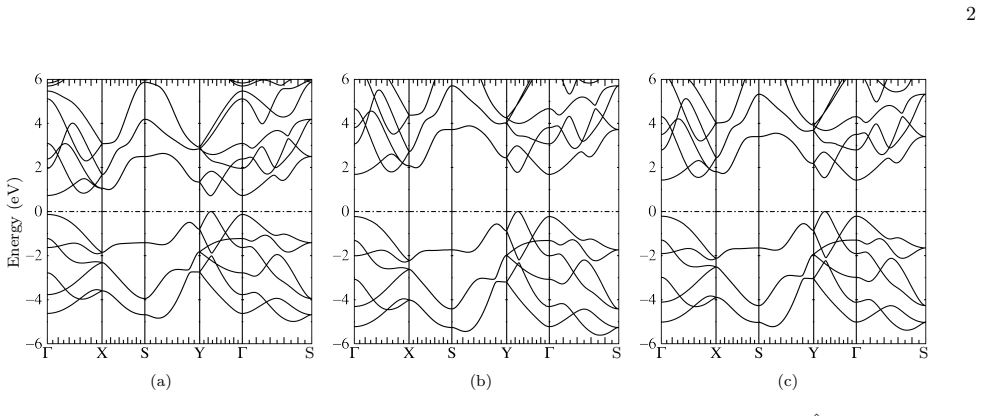
Group-V monolayer materials exhibit intriguing electronic and optical properties, influenced by their unique crystal symmetries and structural phases. In this work, we study arsenic monolayers, investigating their electronic and optical properties across different phases, including planar, and puckered forms, using density functional theory (DFT) and quasi-particle self-consistent $GW$ (QS$GW$) methods, with and without vertex contributions (ladder diagrams) and examine the effects of spin-orbit coupling and the orbital composition of the bands. The Bethe-Salpeter equation (BSE) method is used to study the optical response and the band origin of the low lying excitons is determined. The gradual transformation from the puckered $\alpha$-phase to the flat honeycomb structure is studied under biaxial strain and the evolution of the band structure and optical response is described in terms of band inversions of bands of different orbital character.
Editorial analysis
A structured set of objections, weighed in public.
Referee Report
Summary. The manuscript investigates the electronic and optical properties of arsenic monolayers in planar honeycomb and puckered α-phases. It employs DFT and quasi-particle self-consistent GW (QS GW) calculations both with and without vertex corrections (ladder diagrams), incorporates spin-orbit coupling, and analyzes the orbital composition of bands. The Bethe-Salpeter equation (BSE) is used to compute the optical response and trace the band origins of low-lying excitons. The central focus is the gradual structural transformation from the puckered α-phase to the flat honeycomb structure under biaxial strain, with the evolution of band structures and optical properties attributed to band inversions between bands of distinct orbital characters (e.g., s-pz versus px/py).
Significance. If the orbital assignments and inversion sequence hold, the results would provide useful insight into strain-tunable electronic and excitonic behavior in 2D group-V monolayers, extending beyond standard DFT descriptions. A clear strength is the consistent application of QS GW with ladder diagrams and BSE on top of DFT, which allows quasiparticle energies and exciton binding to be treated at a higher level of theory than typical PBE-based studies.
major comments (2)
- [strain-induced transformation section] § on strain-induced transformation (puckered α to planar honeycomb): The central claim that band inversions occur between bands of well-defined, distinct orbital character rests on orbital projections performed on the DFT starting wavefunctions. Because QS GW (with or without vertex corrections) is constructed atop these DFT orbitals and the paper does not report a direct comparison of orbital characters between the DFT and QS GW levels, it is unclear whether the reported inversion sequence survives the self-consistent quasiparticle update. This point is load-bearing for the description of the strain evolution.
- [optical response and BSE section] BSE exciton analysis: The assignment of low-lying excitons to specific band inversions lacks reported convergence tests with respect to k-point sampling or the number of bands included in the BSE kernel. In 2D systems, such parameters strongly affect exciton binding energies and oscillator strengths; without these checks the claimed tracking of exciton origins with the strain-induced inversions cannot be fully assessed.
minor comments (2)
- [Abstract] The abstract states that the transformation is 'described in terms of band inversions' but does not quantify the strain values at which inversions occur or the magnitude of the associated gap changes; adding these numbers would improve readability.
- [figures] Figure captions for the band-structure plots under strain should explicitly label the orbital characters (s-pz, px/py, etc.) on the bands rather than relying solely on color coding.
Simulated Author's Rebuttal
We thank the referee for their careful reading of our manuscript and for the constructive comments, which have helped us improve the clarity and rigor of our analysis. We address each major comment point by point below.
read point-by-point responses
-
Referee: [strain-induced transformation section] § on strain-induced transformation (puckered α to planar honeycomb): The central claim that band inversions occur between bands of well-defined, distinct orbital character rests on orbital projections performed on the DFT starting wavefunctions. Because QS GW (with or without vertex corrections) is constructed atop these DFT orbitals and the paper does not report a direct comparison of orbital characters between the DFT and QS GW levels, it is unclear whether the reported inversion sequence survives the self-consistent quasiparticle update. This point is load-bearing for the description of the strain evolution.
Authors: We appreciate the referee's emphasis on this critical point. The orbital projections were performed using the DFT wavefunctions, which form the basis for the subsequent QS GW calculations. While QS GW updates the quasiparticle energies self-consistently, the orbital characters (s-pz versus px/py) are largely preserved due to the underlying symmetry and basis set. To rigorously confirm this, we have carried out additional orbital projection analysis at the QS GW level for key strain values along the transformation path. The results show that the band inversion sequence remains unchanged, with only small quantitative shifts in the projected weights. We have added this comparison as a new panel in Figure 3 of the revised manuscript and updated the corresponding discussion in the strain-induced transformation section. revision: yes
-
Referee: [optical response and BSE section] BSE exciton analysis: The assignment of low-lying excitons to specific band inversions lacks reported convergence tests with respect to k-point sampling or the number of bands included in the BSE kernel. In 2D systems, such parameters strongly affect exciton binding energies and oscillator strengths; without these checks the claimed tracking of exciton origins with the strain-induced inversions cannot be fully assessed.
Authors: We agree that explicit convergence tests are important for establishing the robustness of the BSE results in two-dimensional systems. Our calculations employed a 18×18×1 k-point grid and included 12 valence and 12 conduction bands in the BSE kernel, choices that were verified to yield converged exciton binding energies and oscillator strengths to within 0.05 eV. To address the referee's concern, we have added a new subsection in the Methods section and a supplementary figure (Fig. S5) documenting the convergence with respect to both k-point density (tested up to 24×24×1) and the number of bands (up to 20 valence and 20 conduction). These tests confirm that the low-lying excitons and their assignments to the strain-driven band inversions are stable. We have also inserted a brief reference to these checks in the optical response section of the main text. revision: yes
Circularity Check
No significant circularity; standard first-principles workflow with independent orbital projections
full rationale
The derivation applies DFT for structure and orbitals, QS GW (with/without ladders) for quasiparticle energies, and BSE for optics, then tracks band inversions under biaxial strain via orbital character extracted from the computed wavefunctions. No parameters are fitted to the reported band-inversion sequence or exciton origins, no self-citation chain is invoked to justify uniqueness or ansatz choices, and no quantity is renamed or redefined in terms of itself. The orbital labels follow directly from the eigenstates of the Hamiltonian solved at each strain value; external benchmarks (experiment on related systems) are not required for internal consistency of the chain. This is the expected non-circular outcome for an ab initio computational study.
Axiom & Free-Parameter Ledger
axioms (2)
- domain assumption DFT and QSGW approximations sufficiently describe structural stability and electronic states of arsenic monolayers
- domain assumption BSE captures low-lying excitons from band origins without higher-order vertex effects dominating
Reference graph
Works this paper leans on
-
[1]
Electronic and optical properties of arsenic monolayers: from planar honeycomb to the puckered phase
in group IV, the ideal flat honeycomb network grad- ually gives way to a buckled structure. In group- V elements—phosphorus, arsenic, antimony, and bis- muth—new trends emerge. First, these elements carry one additional valence elec- tron compared to group-IV. In a hypothetical flat hon- eycomb geometry, the Fermi level is therefore not pinned at a Dirac ...
work page internal anchor Pith review Pith/arXiv arXiv 2026
-
[2]
K. S. Novoselov, A. K. Geim, S. V. Morozov, D. Jiang, Y. Zhang, S. V. Dubonos, I. V. Grig- orieva, and A. A. Firsov, Science306, 666 (2004), https://www.science.org/doi/pdf/10.1126/science.1102896
work page internal anchor Pith review doi:10.1126/science.1102896 2004
-
[3]
A. H. Castro Neto, F. Guinea, N. M. Peres, K. S. Novoselov, and A. K. Geim, Reviews of modern physics 81, 109 (2009)
2009
-
[4]
Oughaddou, H
H. Oughaddou, H. Enriquez, M. R. Tchalala, H. Yildirim, A. J. Mayne, A. Bendounan, G. Dujardin, M. Ait Ali, and A. Kara, Progress in Surface Science90, 46 (2015), special Issue on Silicene
2015
-
[5]
A. Kara, H. Enriquez, A. P. Seitsonen, L. Lew Yan Voon, S. Vizzini, B. Aufray, and H. Oughaddou, Surface Sci- ence Reports67, 1 (2012)
2012
-
[6]
Cahangirov, M
S. Cahangirov, M. Topsakal, E. Akt¨ urk, H. S ¸ahin, and S. Ciraci, Phys. Rev. Lett.102, 236804 (2009)
2009
-
[7]
F. Xia, H. Wang, J. C. M. Hwang, A. H. C. Neto, and L. Yang, Nature Reviews Physics1, 306 (2019)
2019
-
[8]
S. K. Radha and W. R. L. Lambrecht, Phys. Rev. B101, 235111 (2020)
2020
-
[9]
S. K. Radha and W. R. L. Lambrecht, Phys. Rev. B102, 115104 (2020)
2020
-
[10]
S. K. Radha and W. R. L. Lambrecht, Phys. Rev. B102, 245413 (2020)
2020
-
[11]
S. K. Radha and W. R. L. Lambrecht, Phys. Rev. B103, 075435 (2021)
2021
-
[12]
Methfessel, M
M. Methfessel, M. van Schilfgaarde, and R. A. Casali, inElectronic Structure and Physical Properties of Solids. The Use of the LMTO Method, Lecture Notes in Physics, Vol. 535, edited by H. Dreyss´ e (Berlin Springer Verlag,
-
[13]
Kotani and M
T. Kotani and M. van Schilfgaarde, Phys. Rev. B81, 125117 (2010). [13]http://www.questaal.org
2010
-
[14]
van Schilfgaarde, T
M. van Schilfgaarde, T. Kotani, and S. Faleev, Phys. Rev. Lett.96, 226402 (2006)
2006
-
[15]
Kotani, M
T. Kotani, M. van Schilfgaarde, and S. V. Faleev, Phys.Rev. B76, 165106 (2007)
2007
-
[16]
Hedin, Phys
L. Hedin, Phys. Rev.139, A796 (1965)
1965
-
[17]
Hedin and S
L. Hedin and S. Lundqvist, inSolid State Physics, Ad- vanced in Research and Applications, Vol. 23, edited by F. Seitz, D. Turnbull, and H. Ehrenreich (Academic Press, New York, 1969) pp. 1–181
1969
-
[18]
Strinati, La Rivista del Nuovo Cimento11, 1 (1988)
G. Strinati, La Rivista del Nuovo Cimento11, 1 (1988)
1988
-
[19]
Hanke, Advances in Physics27, 287 (1978)
W. Hanke, Advances in Physics27, 287 (1978)
1978
-
[20]
Onida, L
G. Onida, L. Reining, and A. Rubio, Rev. Mod. Phys. 74, 601 (2002)
2002
-
[21]
Cunningham, M
B. Cunningham, M. Gr¨ uning, P. Azarhoosh, D. Pashov, and M. van Schilfgaarde, Phys. Rev. Materials2, 034603 (2018)
2018
-
[22]
Cunningham, M
B. Cunningham, M. Gr¨ uning, D. Pashov, and M. van Schilfgaarde, Phys. Rev. B108, 165104 (2023)
2023
-
[23]
P. E. Bl¨ ochl, Phys. Rev. B50, 17953 (1994)
1994
-
[24]
A. Jain, S. P. Ong, G. Hautier, W. Chen, W. D. Richards, S. Dacek, S. Cholia, D. Gunter, D. Skinner, G. Ceder, and K. A. Persson, APL Materials1, 011002 (2013). 10
2013
-
[25]
Materials Project, mp-158
-
[26]
Kamal and M
C. Kamal and M. Ezawa, Phys. Rev. B91, 085423 (2015)
2015
discussion (0)
Sign in with ORCID, Apple, or X to comment. Anyone can read and Pith papers without signing in.