Recognition: 2 theorem links
· Lean TheoremWorkplace Demands and Emotional Expression Among Early Childhood Educators: A Computational Analysis of Professional Online Discourse
Pith reviewed 2026-05-12 02:04 UTC · model grok-4.3
The pith
Online posts by early childhood educators focus more on job demands than on resources or support.
A machine-rendered reading of the paper's core claim, the machinery that carries it, and where it could break.
Core claim
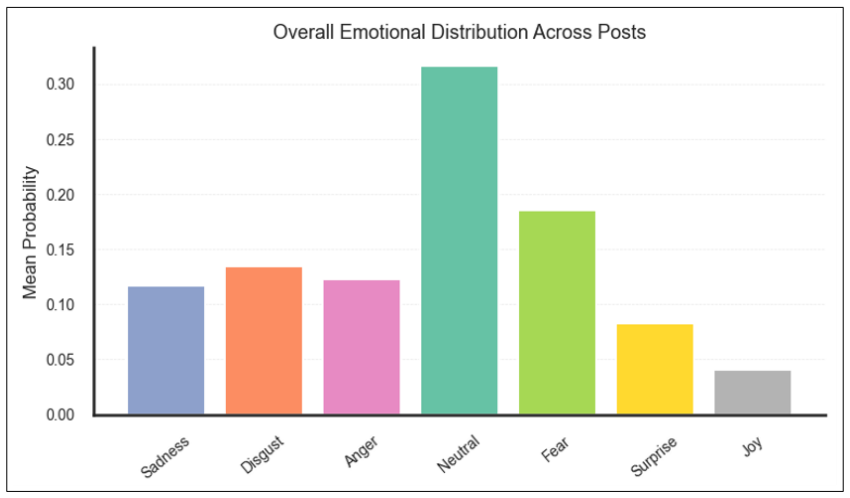
In the corpus of 7,506 posts, 56.7 percent centered on demands when task-level and core job demands were combined, compared with 33.6 percent focused on resources and 9.6 percent on career conditions. Emotion estimates showed a broadly neutral tone overall, yet fear emerged as the most prominent non-neutral emotion. Demand-related categories exhibited higher levels of sadness and anger than resource-related categories. These patterns indicate that professional online discourse in early childhood education reflects a work environment structured more around strain than support.
What carries the argument
An adapted Job Demands-Resources framework that classifies posts into demand-focused, resource-focused, and career-condition themes after computer-assisted thematic coding and transformer-based emotion classification.
If this is right
- Professional online forums can serve as large-scale indicators of the balance between job demands and resources in early childhood education.
- Interventions aimed at educator well-being should prioritize addressing the specific demand themes that dominate the discourse.
- Emotion detection on professional texts can reveal strains such as elevated fear, sadness, and anger that remain hidden in an overall neutral tone.
Where Pith is reading between the lines
- The same computational workflow could be applied to online communities in other high-strain occupations to compare demand-resource balances across fields.
- If the subreddit sample over-represents vocal complainers, targeted outreach to quieter educators might shift the observed proportions.
- Longitudinal tracking of the same forum could test whether changes in policy or pay alter the share of demand-centered posts over time.
Load-bearing premise
That posts from one subreddit accurately represent the broader population of early childhood educators and that the automated classifiers reliably capture real occupational experiences without distortion from self-selection or platform norms.
What would settle it
A large representative survey of early childhood educators that directly measures the proportion of daily concerns centered on demands versus resources and finds the opposite balance would contradict the central claim.
Figures

read the original abstract
Early childhood educators work in settings characterized by heavy regulation, emotional labor, staffing instability, and low pay. Although these conditions are well documented in survey-based research, less is known about how they manifest in the day-to-day language educators use in peer spaces. This study examines 7,506 posts from r/ECEProfessionals, a large online community used by early childhood education practitioners. Using a structured, computer-assisted thematic coding workflow and transformer-based emotion classification, posts were organized into 15 themes and mapped onto an adapted Job Demands-Resources (JD-R) framework. Across the corpus, 56.7% of posts centered on demands when task-level and core job demands were combined, compared with 33.6% focused on resources and 9.6% on career conditions. Emotion estimates indicated a broadly neutral tone overall; however, fear emerged as the most prominent non-neutral emotion. Demand-related categories also exhibited higher levels of sadness and anger than resource-related categories. These findings suggest that professional online discourse in early childhood education reflects a work environment structured more around strain than support. The study offers a practical framework for examining how occupational conditions are discussed and emotionally experienced in large-scale professional texts.
Editorial analysis
A structured set of objections, weighed in public.
Referee Report
Summary. The manuscript analyzes 7,506 posts from the r/ECEProfessionals subreddit using a computer-assisted thematic coding workflow into 15 themes and transformer-based emotion classification. These are mapped onto an adapted Job Demands-Resources (JD-R) framework, yielding 56.7% of posts centered on demands (task-level and core job combined), 33.6% on resources, and 9.6% on career conditions. Emotion estimates show a broadly neutral tone with fear as the most prominent non-neutral emotion, and higher sadness and anger in demand-related categories. The central claim is that professional online discourse in early childhood education reflects a work environment structured more around strain than support.
Significance. If the methodological details and bias corrections hold, the work offers a scalable computational complement to survey research on occupational conditions in early childhood education by applying the JD-R model to large-scale peer discourse. The corpus size and structured coding workflow are assets that could support future studies of emotional expression in professional online spaces. The findings on fear and differential negative emotions in demand posts provide concrete, falsifiable patterns that could inform targeted interventions if validated.
major comments (2)
- [Abstract] Abstract: The central claim that thematic frequencies (56.7% demands vs. 33.6% resources) indicate a work environment 'structured more around strain than support' treats subreddit post distributions as a direct proxy for JD-R balance. This interpretation is load-bearing but does not address the documented tendency for online forums to overrepresent problem-focused or venting content due to advice-seeking norms, which could produce the observed imbalance even if the underlying occupational environment is balanced.
- [Methods] Methods (thematic coding and classification workflow): No inter-rater reliability statistics, validation metrics for the transformer emotion classifier, or details on handling subreddit selection bias are reported. These omissions undermine the reported percentages and emotion differences, as the central claim depends on the reliability of the automated and computer-assisted labels.
minor comments (1)
- [Abstract] Abstract: The exact mapping of the 15 themes onto the three JD-R categories (demands, resources, career conditions) is not specified, making it difficult to assess how task-level and core job demands were combined to reach 56.7%.
Simulated Author's Rebuttal
We thank the referee for their constructive and detailed feedback. We have revised the manuscript to strengthen the framing of our claims, improve methodological transparency, and explicitly address potential biases in online discourse data. Our responses to the major comments are provided below.
read point-by-point responses
-
Referee: [Abstract] Abstract: The central claim that thematic frequencies (56.7% demands vs. 33.6% resources) indicate a work environment 'structured more around strain than support' treats subreddit post distributions as a direct proxy for JD-R balance. This interpretation is load-bearing but does not address the documented tendency for online forums to overrepresent problem-focused or venting content due to advice-seeking norms, which could produce the observed imbalance even if the underlying occupational environment is balanced.
Authors: We agree that the original framing could be read as treating post distributions as a direct proxy for workplace conditions, and that online forums often overrepresent problem-focused content. The study focuses on patterns within professional online discourse rather than claiming to measure the underlying JD-R balance across the occupation. In the revised manuscript, we have updated the abstract to clarify that the findings describe how occupational conditions are reflected in peer online discussions. We have also added a dedicated paragraph in the Discussion section acknowledging selection biases, including advice-seeking and venting norms in subreddit communities, and their implications for interpreting the demand-resource imbalance. These changes temper the central claim while preserving the value of the observed patterns in the corpus. revision: yes
-
Referee: [Methods] Methods (thematic coding and classification workflow): No inter-rater reliability statistics, validation metrics for the transformer emotion classifier, or details on handling subreddit selection bias are reported. These omissions undermine the reported percentages and emotion differences, as the central claim depends on the reliability of the automated and computer-assisted labels.
Authors: We acknowledge that the original submission lacked these details. The revised manuscript now includes: inter-rater reliability statistics for the computer-assisted thematic coding (Krippendorff's alpha), performance metrics and validation procedures for the transformer-based emotion classifier (including accuracy, precision, recall, and F1 on a held-out set), and an expanded Methods subsection plus Limitations discussion on subreddit selection bias, including how the r/ECEProfessionals community was chosen and potential impacts on representativeness. These additions directly address the reliability concerns and allow readers to evaluate the labels supporting the reported percentages and emotion differences. revision: yes
Circularity Check
No circularity: empirical analysis of external corpus with no derivations or self-referential loops
full rationale
The paper collects 7,506 posts from an external subreddit, applies computer-assisted thematic coding into 15 themes, maps them to an adapted JD-R framework, and runs transformer-based emotion classification. It reports observed frequencies (56.7% demands vs 33.6% resources) and emotion distributions, then interprets these as evidence that discourse reflects a strain-heavy environment. No equations, fitted parameters, predictions, or self-citations appear in the derivation chain. The central claim is an interpretive summary of corpus statistics rather than a result that reduces to its inputs by construction. The analysis is self-contained against the external data and standard NLP tools.
Axiom & Free-Parameter Ledger
axioms (2)
- domain assumption Reddit posts in r/ECEProfessionals reflect authentic workplace experiences of early childhood educators
- domain assumption Transformer-based emotion classification produces valid estimates of emotional tone in professional text
Lean theorems connected to this paper
-
IndisputableMonolith/Cost/FunctionalEquation.leanwashburn_uniqueness_aczel unclear?
unclearRelation between the paper passage and the cited Recognition theorem.
posts were organized into 15 themes and mapped onto an adapted Job Demands-Resources (JD-R) framework... 56.7% of posts centered on demands... 33.6% focused on resources
-
IndisputableMonolith/Foundation/AbsoluteFloorClosure.leanabsolute_floor_iff_bare_distinguishability unclear?
unclearRelation between the paper passage and the cited Recognition theorem.
transformer-based emotion classification... j-hartmann/emotion-english-distilroberta-base
What do these tags mean?
- matches
- The paper's claim is directly supported by a theorem in the formal canon.
- supports
- The theorem supports part of the paper's argument, but the paper may add assumptions or extra steps.
- extends
- The paper goes beyond the formal theorem; the theorem is a base layer rather than the whole result.
- uses
- The paper appears to rely on the theorem as machinery.
- contradicts
- The paper's claim conflicts with a theorem or certificate in the canon.
- unclear
- Pith found a possible connection, but the passage is too broad, indirect, or ambiguous to say the theorem truly supports the claim.
Reference graph
Works this paper leans on
-
[1]
Agyapong, B., Obuobi-Donkor, G., Burback, L., & Wei, Y. (2022). Stress, burnout, anxiety and depression among teachers: A scoping review.International Journal of Environmental Research and Public Health, 19(17), 10706.https://doi.org/10.3390/ijerph191710706 10
-
[2]
Ahmed, S. K., Mohammed, R. A., Nashwan, A. J., et al. (2025). Using thematic analysis in qualitative research.Journal of Medicine, Surgery, and Public Health, 6, 100198.https: //doi.org/10.1016/j.glmedi.2025.100198
-
[3]
Bakker, A. B., & Demerouti, E. (2007). The job demands-resources model: State of the art.Journal of Managerial Psychology, 22(3), 309–328.https://doi.org/10.1108/ 02683940710733115
work page 2007
-
[4]
Carey, S., & Sutton, A. (2024). Early childhood teachers’ emotional labour: The role of job and personal resources in protecting well-being.Teaching and Teacher Education, 148, 104699. https://doi.org/10.1016/j.tate.2024.104699
-
[5]
Dan, E., Zhu, J., & Jin, R. (2025). Exploring suicide factors in online discourse: Sentiment and thematic analysis of Reddit.ACM Transactions on the Web, 19(4), Article 39.https: //doi.org/10.1145/3716546
-
[6]
De Choudhury, M., Counts, S., & Horvitz, E. (2013). Social media as a measurement tool of depression in populations. InProceedings of the 5th Annual ACM Web Science Conference(pp. 47–56). Association for Computing Machinery.https://doi.org/10.1145/2464464.2464480
-
[7]
B., Nachreiner, F., & Schaufeli, W
Demerouti, E., Bakker, A. B., Nachreiner, F., & Schaufeli, W. B. (2001). The job demands- resources model of burnout.Journal of Applied Psychology, 86(3), 499–512.https://doi.org/ 10.1037/0021-9010.86.3.499
-
[8]
K., Fenech, M., & Stratigos, T
Dickerson, M. K., Fenech, M., & Stratigos, T. (2025). Working with families: An investigation of early childhood educators’ emotional labour and wellbeing.Early Years, 45(3–4), 593–609. https://doi.org/10.1080/09575146.2024.2393143
-
[9]
Fuentes-Vilugron, G., Baeza-Vargas, Y., Fuentes-Fuentes, D., et al. (2025). Mental health and burnout levels of early childhood education pedagogical teams in Chile.Frontiers in Education, 10, 1680412.https://doi.org/10.3389/feduc.2025.1680412
-
[10]
Grant, A. A., Jeon, L., & Buettner, C. K. (2019). Relating early childhood teachers’ working conditions and well-being to their turnover intentions.Educational Psychology, 39(3), 294–312. https://doi.org/10.1080/01443410.2018.1543856
-
[11]
(2022, October 2).j-hartmann/emotion-english-distilroberta-base
Hartmann, J. (2022, October 2).j-hartmann/emotion-english-distilroberta-base. Hugging Face. https://huggingface.co/j-hartmann/emotion-english-distilroberta-base
work page 2022
-
[12]
Jogi, A., Aulen, A., Pakarinen, E., & Lerkkanen, M. (2023). Teachers’ daily physiological stress and positive affect in relation to their general occupational well-being.British Journal of Educational Psychology, 93(1), 368–385.https://doi.org/10.1111/bjep.12561
-
[13]
Madigan, D. J., & Kim, L. E. (2021). Towards an understanding of teacher attrition: A meta- analysis of burnout, job satisfaction, and teachers’ intentions to quit.Teaching and Teacher Education, 105, 103425.https://doi.org/10.1016/j.tate.2021.103425
-
[14]
Oosterhoff, A., Oenema-Mostert, I., & Minnaert, A. (2020). Constrained or sustained by de- mands? Perceptions of professional autonomy in early childhood education.Contemporary Issues in Early Childhood, 21(2), 138–152.https://doi.org/10.1177/1463949120929464 11
-
[15]
Purper, C.J., Thai, Y., Frederick, T.V., &Farris, S.(2023).Exploringthechallengeofteachers’ emotional labor in early childhood settings.Early Childhood Education Journal, 51(4), 781– 789.https://doi.org/10.1007/s10643-022-01345-y
-
[16]
Schaufeli, W. B., & Taris, T. W. (2014). A critical review of the Job Demands-Resources Model: Implications for improving work and health. In G. F. Bauer & O. Hammig (Eds.), Bridging occupational, organizational and public health(pp. 43–68). Springer.https://doi. org/10.1007/978-94-007-5640-3_4
-
[17]
Schlueter, L., McGee, D., Link, T., Badanes, L., Dmitrieva, J., & Watamura, S. (2024). Physiologic stress in the classroom: Does teacher’s cortisol expression influence children’s afternoon rise in cortisol at childcare?Psychology in the Schools, 61, 2240–2254.https: //doi.org/10.1002/pits.23163
-
[18]
Stein, R., Garay, M., & Nguyen, A. (2022). It matters: Early childhood mental health, educator stress, and burnout.Early Childhood Education Journal. Advance online publication.https: //doi.org/10.1007/s10643-022-01438-8
-
[19]
Tummers, L. G., & Bakker, A. B. (2021). Leadership and Job Demands-Resources Theory: A systematic review.Frontiers in Psychology, 12, 722080.https://doi.org/10.3389/fpsyg. 2021.722080
-
[20]
Wiltshire, C. A. (2024). Early childhood education teacher workforce: Stress in relation to identity and choices.Early Childhood Education Journal, 52(4), 655–668.https://doi.org/ 10.1007/s10643-023-01468-w
-
[21]
Zhu, J., Yalamanchi, N., Jin, R., Kenne, D. R., & Phan, N. (2023). Investigating COVID-19’s impact on mental health: Trend and thematic analysis of Reddit users’ discourse.Journal of Medical Internet Research, 25, e46867.https://doi.org/10.2196/46867 12
discussion (0)
Sign in with ORCID, Apple, or X to comment. Anyone can read and Pith papers without signing in.