Recognition: unknown
Dynamical preparation of U(1) quantum spin liquids in an analogue quantum simulator
Pith reviewed 2026-05-07 17:19 UTC · model grok-4.3
The pith
Ultracold atoms in an optical superlattice dynamically prepare large regions of U(1) quantum spin liquids with observed many-body coherence.
A machine-rendered reading of the paper's core claim, the machinery that carries it, and where it could break.
Core claim
The paper claims that non-equilibrium preparation protocols in an analog quantum simulator can create and make observable extended U(1) quantum spin liquid regions, as evidenced by direct observation of large-scale coherence between many-body configurations in a system of over 3000 sites, along with supporting signatures like Gauss's law compliance and pinch points.
What carries the argument
Round-trip interferometric protocols that probe coherence between different many-body configurations while respecting the gauge constraints.
Load-bearing premise
The interpretation that the measured coherence and correlations arise from the quantum spin liquid's many-body superpositions rather than from experimental noise, finite size, or imperfect enforcement of the gauge constraints.
What would settle it
If repeating the round-trip interferometry on larger systems shows the coherence length saturating well below 100 sites or the signal vanishing, that would indicate the regions are not truly extended quantum spin liquids.
Figures


read the original abstract
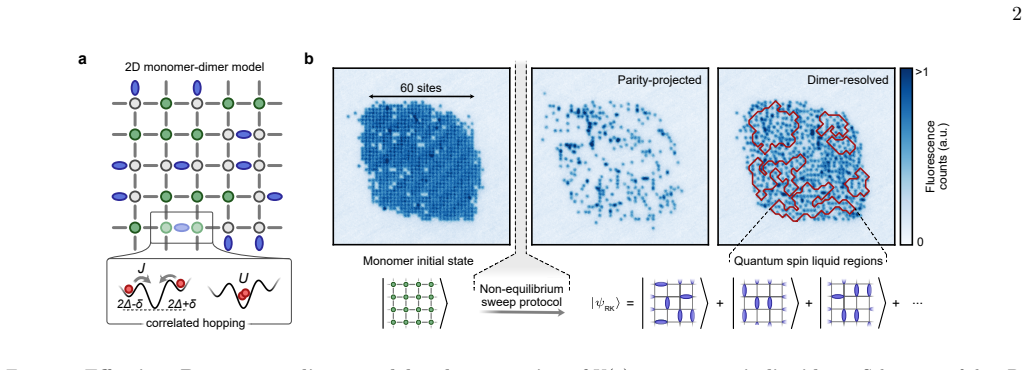
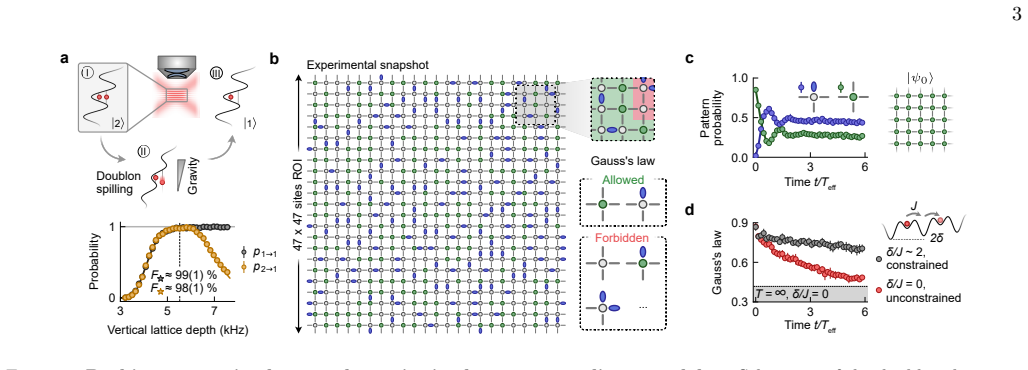
Locally constrained gauge theories underpin our understanding of fundamental interactions in particle physics and the emergent behaviour of quantum materials. In strongly correlated systems, they can give rise to quantum spin liquids that lack conventional order and are defined by coherent superpositions of an extensive number of many-body configurations. Realising and probing such exotic states experimentally is an outstanding challenge both in solid-state and synthetic quantum systems, not least due to the difficulty of detecting the fragile coherences between many-body states. Here, we report a large-scale (>3,000 sites) realisation of a two-dimensional U(1) lattice gauge theory with ultracold atoms in a square optical superlattice and demonstrate non-equilibrium preparation of extended regions of U(1) quantum spin liquids. We demonstrate Gauss's law validity in a quench experiment, enabled by a new microscopy technique for detecting doubly occupied sites. We observe characteristic real-space correlations and momentum-space pinch points, hallmarks of the emergent U(1) gauge structure. Using round-trip interferometric protocols, we directly observe large-scale coherence between many-body configurations, providing strong evidence for quantum spin liquid regions extending over ~100 lattice sites. Our results establish non-equilibrium quantum simulation protocols as a powerful route for accessing and probing exotic, highly-entangled states beyond those hosted by the engineered Hamiltonian in thermal equilibrium.
Editorial analysis
A structured set of objections, weighed in public.
Referee Report
Summary. The manuscript reports a large-scale (>3000 sites) experimental realization of a 2D U(1) lattice gauge theory using ultracold atoms in a square optical superlattice. It demonstrates non-equilibrium dynamical preparation of extended U(1) quantum spin liquid regions, validates Gauss's law via a new microscopy technique detecting double occupancies, observes real-space correlations and momentum-space pinch points as signatures of the emergent gauge structure, and employs round-trip interferometric protocols to directly measure large-scale coherence between many-body configurations, interpreted as evidence for QSL regions spanning ~100 lattice sites.
Significance. If the central claims on coherence and gauge structure hold, this work would be significant for quantum simulation of gauge theories and frustrated magnetism. It establishes scalable non-equilibrium protocols for preparing and probing highly entangled states inaccessible in equilibrium, with direct many-body coherence measurements and a new detection method for constraint violations. The system size enables observation of extended regions, providing a platform for studying emergent U(1) physics.
major comments (1)
- [Abstract and interferometric protocol results] The central claim of QSL regions extending over ~100 lattice sites rests on the round-trip interferometric visibility (abstract and main results on interferometry). The protocol is stated to project onto the gauge-invariant subspace, but the manuscript validates Gauss's law only in a separate quench experiment using the new microscopy; no spatially resolved constraint-fidelity data are tied to the specific interferometry runs. This leaves open the possibility that observed coherence arises from mixtures with residual gauge violations (e.g., percent-level double occupancies or hopping-induced defects) rather than pure many-body superpositions within the U(1) sector, directly affecting the interpretation of the ~100-site scale.
minor comments (2)
- [Figures on momentum-space correlations] Figure clarity: the momentum-space pinch-point plots would benefit from explicit overlays of theoretical pinch-point locations or quantitative line cuts to allow direct comparison with the observed features.
- [Methods or results on interferometry] Notation: the definition of the round-trip interferometric phase or visibility metric should be stated explicitly with an equation, as it is central to the coherence claim.
Simulated Author's Rebuttal
We thank the referee for their positive evaluation of the significance of our work and for the detailed and constructive comment. We address the concern about linking the interferometric coherence measurements to the Gauss-law validation below. We believe a partial revision, including clarifications and additional supporting analysis, will strengthen the manuscript.
read point-by-point responses
-
Referee: [Abstract and interferometric protocol results] The central claim of QSL regions extending over ~100 lattice sites rests on the round-trip interferometric visibility (abstract and main results on interferometry). The protocol is stated to project onto the gauge-invariant subspace, but the manuscript validates Gauss's law only in a separate quench experiment using the new microscopy; no spatially resolved constraint-fidelity data are tied to the specific interferometry runs. This leaves open the possibility that observed coherence arises from mixtures with residual gauge violations (e.g., percent-level double occupancies or hopping-induced defects) rather than pure many-body superpositions within the U(1) sector, directly affecting the interpretation of the ~100-site scale.
Authors: We appreciate the referee raising this point on the interpretation of the interferometric visibility. The round-trip protocol is constructed to measure many-body coherence by evolving the prepared state forward under the gauge-theory Hamiltonian and then reversing the evolution to project back onto the initial configuration; only components within the gauge-invariant subspace contribute constructively to the observed interference. The preparation sequence for the extended U(1) regions is identical in both the quench and interferometry experiments, and the new microscopy technique was used to characterize the dominant gauge violations (double occupancies) under these conditions. In the revised manuscript we will add a dedicated paragraph and supplementary figure that directly compares the double-occupancy fractions measured in the interferometry datasets with those from the quench runs, showing they remain at the sub-percent level. We will also note that any significant residual gauge violations would introduce defects that do not participate coherently in the round-trip interference, thereby reducing visibility; the high observed visibility is therefore inconsistent with substantial mixing outside the U(1) sector. While we do not possess run-by-run spatially resolved constraint maps for every interferometry realization, the aggregate statistics and identical preparation conditions provide a robust link between the two datasets. revision: partial
Circularity Check
No significant circularity: purely experimental report with no derivation chain
full rationale
This is an experimental paper reporting the realization of a 2D U(1) lattice gauge theory and non-equilibrium preparation of U(1) quantum spin liquid regions in an ultracold-atom simulator. The central results rest on direct observations: a new microscopy technique to validate Gauss's law via quench dynamics, real-space correlations, momentum-space pinch points, and round-trip interferometry to detect large-scale coherence over ~100 sites. No theoretical derivation, prediction, or ansatz is presented that reduces by the paper's own equations to a fitted parameter, self-referential quantity, or self-citation chain. All claims are grounded in measured data and established experimental protocols rather than internal mathematical closure. The report is therefore self-contained against external benchmarks with no load-bearing circular steps.
Axiom & Free-Parameter Ledger
axioms (2)
- domain assumption The engineered optical superlattice and interactions realize the desired two-dimensional U(1) lattice gauge theory
- domain assumption The observed pinch points and interferometric coherence are signatures of the emergent U(1) gauge structure rather than artifacts
Reference graph
Works this paper leans on
-
[1]
Savary and L
L. Savary and L. Balents, Rep. Prog. Phys.80, 016502 (2017)
2017
-
[2]
Wen,Quantum Field Theory of Many-Body Sys- tems(Oxford University Press, 2007)
X.-G. Wen,Quantum Field Theory of Many-Body Sys- tems(Oxford University Press, 2007)
2007
-
[3]
Anderson, Mater
P. Anderson, Mater. Res. Bull.8, 153 (1973)
1973
-
[4]
D. S. Rokhsar and S. A. Kivelson, Phys. Rev. Lett.61, 2376 (1988)
1988
-
[5]
Moessner, S
R. Moessner, S. L. Sondhi, and E. Fradkin, Phys. Rev. B 65, 024504 (2001)
2001
-
[8]
Broholm, R
C. Broholm, R. J. Cava, S. A. Kivelson, D. G. Nocera, M. R. Norman, and T. Senthil, Science367, eaay0668 (2020). 1
2020
-
[9]
A. T. Breidenbach, A. C. Campello, J. Wen, H.-C. Jiang, D. M. Pajerowski, R. W. Smaha, and Y. S. Lee, Nat. Phys.21, 1957 (2025)
1957
- [10]
-
[11]
Bernien, S
H. Bernien, S. Schwartz, A. Keesling, H. Levine, A. Om- ran, H. Pichler, S. Choi, A. S. Zibrov, M. Endres, M. Greiner, V. Vuleti´ c, and M. D. Lukin, Nature551, 579 (2017)
2017
-
[12]
F. M. Surace, P. P. Mazza, G. Giudici, A. Lerose, A. Gambassi, and M. Dalmonte, Phys. Rev. X10, 021041 (2020)
2020
-
[13]
B. Yang, H. Sun, R. Ott, H.-Y. Wang, T. V. Zache, J. C. Halimeh, Z.-S. Yuan, P. Hauke, and J.-W. Pan, Nature 587, 392 (2020)
2020
-
[14]
J. C. Halimeh, M. Aidelsburger, F. Grusdt, P. Hauke, and B. Yang, Nat. Phys.21, 25 (2025)
2025
-
[15]
M. Kebriˇ c, L. Su, A. Douglas, M. Szurek, O. Markovi´ c, U. Schollw¨ ock, A. Bohrdt, M. Greiner, and F. Grusdt, arXiv:2509.16200 (2025)
-
[16]
P. R. Datla, L. Zhao, W. W. Ho, N. Klco, and H. Loh, Nat. Phys.22, 355 (2026)
2026
-
[17]
T. A. Cochranet al., Nature642, 315 (2025)
2025
-
[18]
Gonz´ alez-Cuadra, M
D. Gonz´ alez-Cuadra, M. Hamdan, T. V. Zache, B. Braverman, M. Kornjaˇ ca, A. Lukin, S. H. Cant´ u, F. Liu, S.-T. Wang, A. Keesling, M. D. Lukin, P. Zoller, and A. Bylinskii, Nature642, 321 (2025)
2025
- [19]
-
[20]
M. Meth, J. Zhang, J. F. Haase, C. Edmunds, L. Postler, A. J. Jena, A. Steiner, L. Dellantonio, R. Blatt, P. Zoller, T. Monz, P. Schindler, C. Muschik, and M. Ringbauer, Nat. Phys.21, 570 (2025)
2025
-
[21]
Digital quantum magnetism on a trapped-ion quantum computer
R. Haghshenaset al., arXiv:2503.20870 (2025)
work page internal anchor Pith review Pith/arXiv arXiv 2025
- [22]
-
[23]
Semeghini, H
G. Semeghini, H. Levine, A. Keesling, S. Ebadi, T. T. Wang, D. Bluvstein, R. Verresen, H. Pichler, M. Kali- nowski, R. Samajdar, A. Omran, S. Sachdev, A. Vish- wanath, M. Greiner, V. Vuleti´ c, and M. D. Lukin, Science 374, 1242 (2021)
2021
-
[24]
K. J. Satzingeret al., Science374, 1237 (2021)
2021
-
[25]
Zhou, G.-X
Z.-Y. Zhou, G.-X. Su, J. C. Halimeh, R. Ott, H. Sun, P. Hauke, B. Yang, Z.-S. Yuan, J. Berges, and J.-W. Pan, Science377, 311 (2022)
2022
-
[26]
Wang, W.-Y
H.-Y. Wang, W.-Y. Zhang, Z. Yao, Y. Liu, Z.-H. Zhu, Y.- G. Zheng, X.-K. Wang, H. Zhai, Z.-S. Yuan, and J.-W. Pan, Phys. Rev. Lett.131, 050401 (2023)
2023
-
[27]
J. J. Osborne, I. P. McCulloch, B. Yang, P. Hauke, and J. C. Halimeh, Commun. Phys.8, 273 (2025)
2025
-
[28]
Horn, Phys
D. Horn, Phys. Lett. B100, 149 (1981)
1981
-
[29]
Orland and D
P. Orland and D. Rohrlich, Nucl. Phys. B338, 647 (1990)
1990
-
[30]
Chandrasekharan and U.-J
S. Chandrasekharan and U.-J. Wiese, Nucl. Phys. B492, 455 (1997)
1997
-
[31]
Wiese, Ann
U.-J. Wiese, Ann. Phys.525, 777 (2013)
2013
-
[32]
Dalmonte and S
M. Dalmonte and S. Montangero, Contemp. Phys.57, 388 (2016)
2016
-
[33]
Giudici, M
G. Giudici, M. D. Lukin, and H. Pichler, Phys. Rev. Lett. 129, 090401 (2022)
2022
- [34]
- [35]
-
[37]
S. V. Isakov, K. Gregor, R. Moessner, and S. L. Sondhi, Phys. Rev. Lett.93, 167204 (2004)
2004
-
[38]
Fennell, P
T. Fennell, P. P. Deen, A. R. Wildes, K. Schmalzl, D. Prabhakaran, A. T. Boothroyd, R. J. Aldus, D. F. McMorrow, and S. T. Bramwell, Science326, 415 (2009)
2009
-
[39]
D. J. P. Morris, D. A. Tennant, S. A. Grigera, B. Klemke, C. Castelnovo, R. Moessner, C. Czternasty, M. Meiss- ner, K. C. Rule, J.-U. Hoffmann, K. Kiefer, S. Gerischer, D. Slobinsky, and R. S. Perry, Science326, 411 (2009)
2009
-
[42]
Fradkin and S
E. Fradkin and S. Kivelson, Mod. Phys. Lett. B04, 225 (1990)
1990
-
[43]
W. S. Bakr, J. I. Gillen, A. Peng, S. F¨ olling, and M. Greiner, Nature462, 74 (2009)
2009
-
[44]
J. F. Sherson, C. Weitenberg, M. Endres, M. Cheneau, I. Bloch, and S. Kuhr, Nature467, 68 (2010)
2010
-
[45]
Gross and W
C. Gross and W. S. Bakr, Nat. Phys.17, 1316 (2021)
2021
-
[46]
L. Su, A. Douglas, M. Szurek, A. H. H´ ebert, A. Krahn, R. Groth, G. A. Phelps, O. Markovi´ c, and M. Greiner, Nat. Commun.16, 1017 (2025)
2025
-
[47]
S. T. Bramwell and M. J. P. Gingras, Science294, 1495 (2001)
2001
-
[48]
M. J. Harris, S. T. Bramwell, D. F. McMorrow, T. Zeiske, and K. W. Godfrey, Phys. Rev. Lett.79, 2554 (1997)
1997
-
[49]
A. P. Ramirez, A. Hayashi, R. J. Cava, R. Siddharthan, and B. S. Shastry, Nature399, 333 (1999)
1999
-
[50]
Pomaranski, L
D. Pomaranski, L. R. Yaraskavitch, S. Meng, K. A. Ross, H. M. L. Noad, H. A. Dabkowska, B. D. Gaulin, and J. B. Kycia, Nat. Phys.9, 353 (2013)
2013
-
[51]
M. J. P. Gingras, P. A. McClarty, and J. G. Rau, in Spin Ice, Vol. 197, edited by M. Udagawa and L. Jaubert (Springer International Publishing, Cham, 2021) pp. 1– 18
2021
-
[52]
B. Gao, F. Desrochers, D. W. Tam, D. M. Kirschbaum, P. Steffens, A. Hiess, D. H. Nguyen, Y. Su, S.-W. Cheong, S. Paschen, Y. B. Kim, and P. Dai, Nat. Phys.21, 1203 (2025)
2025
- [54]
-
[55]
Dirac Spin Liquid Candidate in a Rydberg Quantum Simulator
G. Bornet, M. Bintz, C. Chen, G. Emperauger, D. Barredo, S. Chatterjee, V. S. Liu, T. Lahaye, M. P. Zaletel, N. Y. Yao, and A. Browaeys, arXiv:2602.14323 (2026). Supplementary Information for: Dynamical preparation ofU(1)quantum spin liquids in an analogue quantum simulator CONTENTS I. Experimental details 2 A. Experimental setup 2 B. Experimental sequenc...
work page internal anchor Pith review Pith/arXiv arXiv 2026
-
[56]
Initial state preparation. The initial state is prepared by first ramping the long lattices to 35E l r over 220 ms (atϕ∼ −0.05π), and then increasing the short lattice depth to 45E s r over 20 ms, lo- calizing the atoms at the lowest-energy site of the 2×2 unit cell. Here,E s,l r =h 2/(8ma2 s,l) is the recoil energy of the short and long horizontal lattic...
-
[57]
unphysical
Non-equilibrium dynamics. The diagonal tilt is implemented by applying a quadrupole field using a pair of coils along thez-direction and rotating the offset field into the diagonal direction in the horizontal plane. During this rotation, the offset field magnitude is also ramped up to 42.0 G, increasing the scattering length toa∼800a 0. The following expe...
2020
-
[58]
Impertro, J
A. Impertro, J. F. Wienand, S. H¨ afele, H. von Raven, S. Hubele, T. Klostermann, C. R. Cabrera, I. Bloch, and M. Aidelsburger, Commun. Phys.6, 1 (2023)
2023
-
[59]
J. F. Wienand, S. Karch, A. Impertro, C. Schweizer, E. McCulloch, R. Vasseur, S. Gopalakrishnan, M. Aidels- burger, and I. Bloch, Nat. Phys.20, 1732 (2024)
2024
-
[60]
Impertro, S
A. Impertro, S. Karch, J. F. Wienand, S. Huh, C. Schweizer, I. Bloch, and M. Aidelsburger, Phys. Rev. Lett.133, 063401 (2024)
2024
-
[61]
Impertro, S
A. Impertro, S. Huh, S. Karch, J. F. Wienand, I. Bloch, and M. Aidelsburger, Nat. Phys.21, 895 (2025)
2025
- [62]
-
[63]
Serwane, G
F. Serwane, G. Z¨ urn, T. Lompe, T. B. Ottenstein, A. N. Wenz, and S. Jochim, Science332, 336 (2011)
2011
- [64]
-
[65]
Gl¨ uck, A
M. Gl¨ uck, A. R. Kolovsky, and H. J. Korsch, Phys. Rev. Lett.83, 891 (1999)
1999
-
[66]
Zenesini, H
A. Zenesini, H. Lignier, G. Tayebirad, J. Radogostowicz, D. Ciampini, R. Mannella, S. Wimberger, O. Morsch, and E. Arimondo, Phys. Rev. Lett.103, 090403 (2009)
2009
-
[67]
Scherg, T
S. Scherg, T. Kohlert, P. Sala, F. Pollmann, B. Hebbe Madhusudhana, I. Bloch, and M. Aidelsburger, Nat. Commun.12, 4490 (2021)
2021
-
[68]
P. Sala, T. Rakovszky, R. Verresen, M. Knap, and F. Poll- mann, Phys. Rev. X10, 011047 (2020)
2020
-
[69]
Khemani, M
V. Khemani, M. Hermele, and R. Nandkishore, Phys. Rev. B101, 174204 (2020)
2020
-
[70]
Moudgalya, B
S. Moudgalya, B. A. Bernevig, and N. Regnault, Rep. Prog. Phys.85, 086501 (2022)
2022
-
[71]
J. Hauschild, J. Unfried, S. Anand, B. Andrews, M. Bintz, U. Borla, S. Divic, M. Drescher, J. Geiger, M. Hefel, K. H´ emery, W. Kadow, J. Kemp, N. Kirchner, V. S. Liu, G. M¨ oller, D. Parker, M. Rader, A. Romen, S. Scalet, L. Schoonderwoerd, M. Schulz, T. Soejima, P. Thoma, Y. Wu, P. Zechmann, L. Zweng, R. S. K. Mong, M. P. Zaletel, and F. Pollmann, SciPo...
-
[72]
Moessner and K
R. Moessner and K. S. Raman, inIntroduction to Frustrated Magnetism: Materials, Experiments, Theory, edited by C. Lacroix, P. Mendels, and F. Mila (Springer Berlin Heidelberg, Berlin, Heidelberg, 2011) pp. 437–479
2011
-
[73]
Fradkin,Field Theories of Condensed Matter Physics, 2nd ed
E. Fradkin,Field Theories of Condensed Matter Physics, 2nd ed. (Cambridge University Press, 2013)
2013
-
[74]
Polyakov, Nucl
A. Polyakov, Nucl. Phys. B120, 429 (1977)
1977
-
[75]
D. S. Rokhsar and S. A. Kivelson, Phys. Rev. Lett.61, 2376 (1988). 15 a b 0 10 20 10 3 10 2 10 1 0 10 20 0 10 20 0 0.012 i cj Radial average of the correlations i cj Monomer-monomer correlations Distance (lattice sites)Dimer-dimer correlations-0.05 0.050 SH V H S V Figure S13.Dimer-dimer and monomer-monomer correlations for the columnar states. a,Dimer-di...
1988
discussion (0)
Sign in with ORCID, Apple, or X to comment. Anyone can read and Pith papers without signing in.