Recognition: unknown
A unifying physically meaningful relativistic action
Pith reviewed 2026-05-10 06:03 UTC · model grok-4.3
The pith
A single Lorentz-covariant relativistic action unifies gravitational and electromagnetic interactions for particle dynamics.
A machine-rendered reading of the paper's core claim, the machinery that carries it, and where it could break.
Core claim
We introduce a relativistic action that provides a unified and physically meaningful description of particle dynamics in external fields. The proposed action is constructed to be Lorentz covariant and reduces to the standard classical action in the appropriate limit. It incorporates gravitational and electromagnetic interactions within a single framework and leads to equations of motion consistent with known physical laws. The formulation offers a new perspective on relativistic dynamics and suggests a pathway toward unification of fundamental interactions.
What carries the argument
The proposed relativistic action, built to remain Lorentz covariant while unifying gravitational and electromagnetic interactions for particles in external fields.
If this is right
- The action leads to equations of motion consistent with known physical laws.
- It reduces to the standard classical action in the appropriate limit.
- It offers a new perspective on relativistic dynamics.
- It suggests a pathway toward unification of fundamental interactions.
Where Pith is reading between the lines
- If the action works, trajectories in regions with both strong gravity and electric charge could be computed from one formula instead of patching separate laws together.
- The same construction principle might be tested for consistency with observed orbits near charged compact objects.
- Similar single-action forms could be explored for other classical field combinations to see if the unification pattern repeats.
Load-bearing premise
A single action can be constructed that is both Lorentz covariant and physically meaningful while genuinely unifying gravitational and electromagnetic interactions without hidden inconsistencies.
What would settle it
Deriving the equations of motion from the action and finding that they fail to reproduce the known relativistic equations for gravity or the Lorentz force for electromagnetism would falsify the claim.
Figures
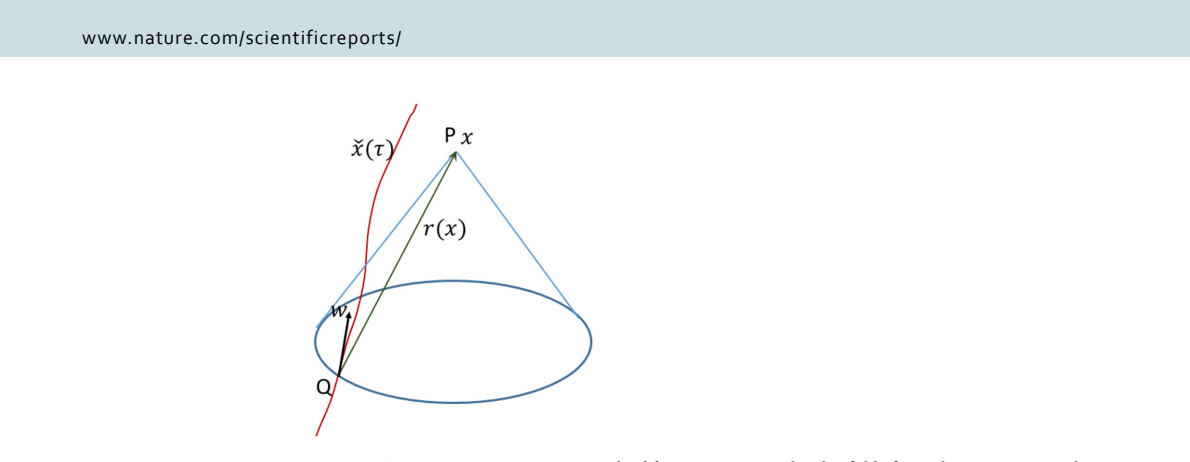


read the original abstract
We introduce a relativistic action that provides a unified and physically meaningful description of particle dynamics in external fields. The proposed action is constructed to be Lorentz covariant and reduces to the standard classical action in the appropriate limit. It incorporates gravitational and electromagnetic interactions within a single framework and leads to equations of motion consistent with known physical laws. The formulation offers a new perspective on relativistic dynamics and suggests a pathway toward unification of fundamental interactions.
Editorial analysis
A structured set of objections, weighed in public.
Referee Report
Summary. The manuscript introduces a relativistic action intended to provide a unified and physically meaningful description of particle dynamics in external fields. It claims the action is Lorentz covariant, reduces to the standard classical action in the appropriate limit, incorporates both gravitational and electromagnetic interactions in a single framework, and yields equations of motion consistent with known physical laws, thereby offering a new perspective on relativistic dynamics and a pathway toward unification.
Significance. If a single action could genuinely unify gravitational and electromagnetic interactions while remaining Lorentz covariant, reducing correctly to known limits, and producing consistent dynamics without ad hoc adjustments, the result would be significant for theoretical physics as it addresses a long-standing unification goal. The current text supplies no explicit functional form, derivations, or verifications, so the significance cannot be assessed.
major comments (2)
- Abstract: the central claim that the action 'incorporates gravitational and electromagnetic interactions within a single framework' and 'leads to equations of motion consistent with known physical laws' is asserted without any explicit expression for the action, without the Euler-Lagrange equations, and without any derivation or limit check, so the claims remain untestable.
- Abstract: the assertion of Lorentz covariance and reduction to the standard classical action is stated without the functional form of the proposed action or any demonstration that the covariance and reduction hold, making it impossible to evaluate whether the construction is free of hidden inconsistencies or circular definitions.
Simulated Author's Rebuttal
We thank the referee for the careful reading and constructive comments on our manuscript. We address each major comment below and indicate the revisions we will make to strengthen the presentation.
read point-by-point responses
-
Referee: Abstract: the central claim that the action 'incorporates gravitational and electromagnetic interactions within a single framework' and 'leads to equations of motion consistent with known physical laws' is asserted without any explicit expression for the action, without the Euler-Lagrange equations, and without any derivation or limit check, so the claims remain untestable.
Authors: We agree that the abstract, as currently written, states the central claims at a summary level without supplying the explicit functional form of the action or the associated derivations. In the revised manuscript we will expand the abstract to include the explicit expression for the proposed relativistic action, the form of the Euler-Lagrange equations that follow from it, and a concise verification that the classical limit is recovered. These additions will make the claims directly testable from the abstract while preserving its brevity; the full derivations remain in the body of the paper. revision: yes
-
Referee: Abstract: the assertion of Lorentz covariance and reduction to the standard classical action is stated without the functional form of the proposed action or any demonstration that the covariance and reduction hold, making it impossible to evaluate whether the construction is free of hidden inconsistencies or circular definitions.
Authors: We acknowledge that, without the functional form, it is not possible for a reader to verify Lorentz covariance or the reduction to the standard action from the abstract alone. We will revise the abstract to state the explicit action and to include a brief outline of the covariance proof under Lorentz transformations together with the explicit limit that recovers the classical action. This will allow immediate assessment of these properties and will eliminate any appearance of circularity. revision: yes
Circularity Check
No significant circularity identified
full rationale
The abstract presents the action as newly introduced and constructed to satisfy Lorentz covariance while reducing to the standard classical action and incorporating gravitational and electromagnetic interactions. No full derivation, equations of motion, or explicit functional form is supplied in the query text, preventing identification of any load-bearing step that reduces by construction to its own inputs, fitted parameters renamed as predictions, or self-citation chains. The formulation is described as providing a new perspective consistent with known laws, with no evidence of self-definitional loops or ansatz smuggling. This is the expected honest non-finding when the central construction cannot be shown to collapse internally.
Axiom & Free-Parameter Ledger
Reference graph
Works this paper leans on
-
[1]
La geometrisation de la physique (Flammarion, Paris, 1994)
Lochak, G. La geometrisation de la physique (Flammarion, Paris, 1994)
1994
-
[2]
& Wheeler, J
Misner, C., Thorne, K. & Wheeler, J. Gravitation (Freeman, San Francisco, 1973)
1973
-
[3]
& Lasenby, A
Hobson, M., Efstathiou, G. & Lasenby, A. N. General relativity: An introduction for physicists (Cambridge University Press, Cam- bridge, 2007)
2007
-
[4]
Whitehead, A. N. The principle of relativity (Cambridge University Press, Cambridge, 1922)
1922
-
[5]
Petrov, A. Z. The classification of spaces defining gravitational fields. Sci. Proc. Kazan State Univ. 114, 55 (1954)
1954
-
[6]
Kerr, R.P . and Schild, A. Some algebraically degenerate solutions of Einstein’s gravitational field equations. In Proceedings of the Symposium on Applied Mathematics 17, 199–209 (Providence: American Mathematical Society, 1965). 11 Vol.:(0123456789)Scientific Reports | (2022) 12:10843 | https://doi.org/10.1038/s41598-022-14740-7 www.nature.com/scientificreports/
-
[7]
Jackson, J. D. Classical electrodynamics 3rd edn. (Wiley, Hoboken, 1998)
1998
-
[8]
Friedman, Y ., Gootvilig, D. H. & Scarr, T. The pre-potential of a field propagating with the speed of light and its dual symmetry. Symmetry 11, 1430 (2019)
2019
-
[9]
& Steiner, J
Friedman, Y . & Steiner, J. M. Predicting Mercury’s precession using simple relativistic Newtonian dynamics. Europhys. Lett. 113, 39001 (2016)
2016
-
[10]
& Steiner, J
Friedman, Y . & Steiner, J. M. Gravitational deflection in relativistic Newtonian dynamics. Europhys. Lett. 117, 59001 (2017)
2017
-
[11]
Relativistic Newtonian dynamics for objects and particles
Friedman, Y . Relativistic Newtonian dynamics for objects and particles. Europhys. Lett. 117, 49003 (2017)
2017
-
[12]
& Steiner, J
Friedman, Y ., Livshitz, S. & Steiner, J. M. Predicting the relativistic periastron advance of a binary without curving spacetime. Europhys. Lett. 116, 59001 (2016)
2016
-
[13]
& Deruelle, N
Damour, T. & Deruelle, N. Ann. Inst. Henri Poincarè 43, 107 (1985)
1985
-
[14]
& Schafer, G
Damour, T. & Schafer, G. Nuovo Cimento B 101, 127 (1988)
1988
-
[15]
Kerr, R. P . Phys. Rev. Lett. 11, 237 (1963)
1963
-
[16]
& Schiffer, M
Adler, R., Bazin, M. & Schiffer, M. Introduction to general relativity (McGraw Hill Inc., New Y ork, 1975)
1975
-
[17]
Eddington, A. S. A comparison of Whitehead’s and Einstein’s formulas. Nature 113, 192 (1924)
1924
-
[18]
Past-future asymmetry of the gravitational field of a point particle
Finkelstein, D. Past-future asymmetry of the gravitational field of a point particle. Phys. Rev. 110, 965–967 (1958)
1958
-
[19]
& Will, C
Gibbons, G. & Will, C. M. On the multiple deaths of Whitehead’s theory of gravity Stud. Hist. Philos. Mod. Phys. 39, 41–61 (2008)
2008
-
[20]
Podolsky, B. Phys. Rev. 62, 68 (1942)
1942
-
[21]
Stelle, K. S. Classical gravity with higher derivatives. Gen. Relat. Gravit. 9, 353–371 (1978). Acknowledgements The author wishes to thank Menachem Steiner, Israel Felner, Tzvi Scarr and Lawrence Horwitz for helpful com- ments and discussions. Author contributions The research presented in the paper and writing the manuscript was done by the author alone...
1978
discussion (0)
Sign in with ORCID, Apple, or X to comment. Anyone can read and Pith papers without signing in.