Recognition: unknown
Effective Observer-Split Source Terms in Rotating Frames and Gravitomagnetic Backgrounds in Extended Aharonov-Bohm Electrodynamics
Pith reviewed 2026-05-08 08:35 UTC · model grok-4.3
The pith
Rotating observer frames introduce a split source term that can drive the scalar sector in extended Aharonov-Bohm electrodynamics at finite scales
A machine-rendered reading of the paper's core claim, the machinery that carries it, and where it could break.
Core claim
For standard generally covariant, locally U(1)-invariant matter the physical four-current remains covariantly conserved, so neither rotation nor stationary gravitomagnetism generates a genuine source for the scalar sector at the microscopic level. After a 3+1 decomposition with respect to a rotating observer congruence, the observer-measured transport current obeys a projected continuity equation containing the exact split source term I_split ≡ 1/N D_i(ρ β^i), which reduces in the weak-field regime to I_G = D_i(ρ β^i). This term is the bookkeeping term that appears when covariant conservation is rewritten in transport variables adapted to a rotating slicing, allowing a phenomenological AB-tt
What carries the argument
The split source term I_split ≡ 1/N D_i(ρ β^i) that appears in the projected continuity equation for the observer-measured transport current after 3+1 decomposition with respect to a rotating observer congruence
If this is right
- In the rigid-rotation weak-field limit the source reduces to I_G = (Ω × r) · ∇ρ
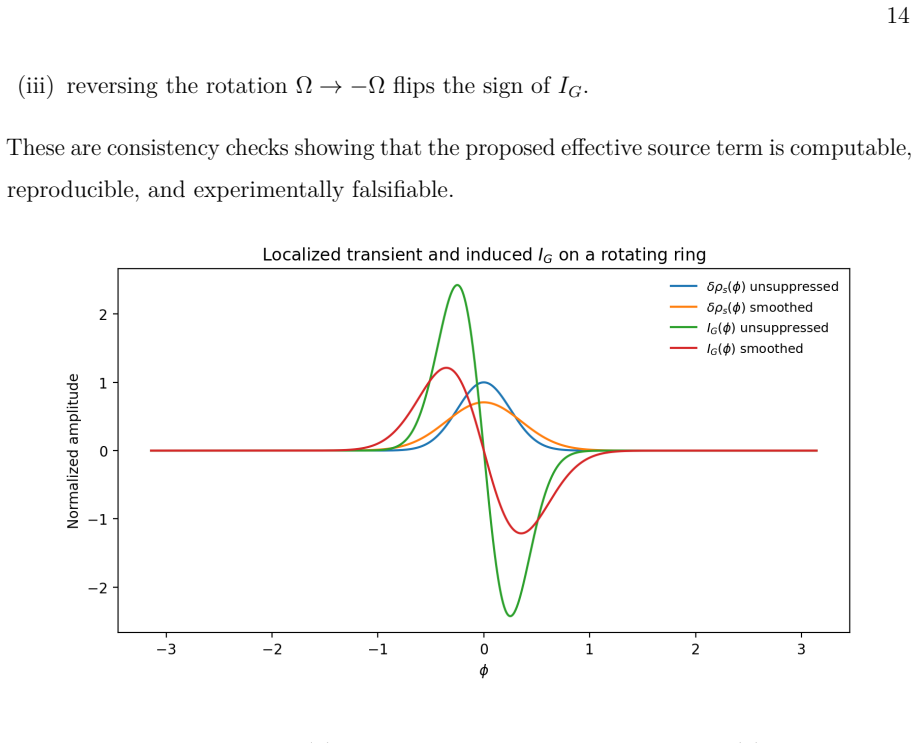
- For localized transients the source reduces to I_G = Ω ∂_φ (δρ_s)
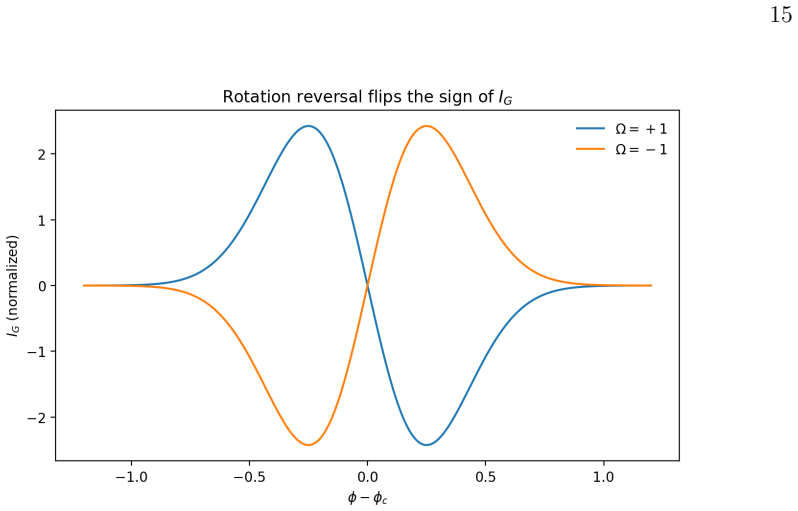
- The framework produces operational signatures including reversal under Ω → -Ω, suppression for nearly axisymmetric charge distributions, and sensitivity to transient non-axisymmetric charge structure
- The resulting framework is effective rather than fundamental, observer-tied rather than local-inertial, and experimentally meaningful only at mesoscopic or macroscopic scales
Where Pith is reading between the lines
- The same split-source bookkeeping could appear in other non-inertial frames and might be tested by comparing accelerated versus rotating charge configurations
- Experiments with mesoscopic rotating capacitors or fluid cells carrying azimuthal charge variations could isolate the predicted linear dependence on Ω
- Stronger gravitomagnetic fields beyond the weak-field regime might require a covariant extension of the closure rather than the projected form
Load-bearing premise
That the split source term can be inserted into a phenomenological AB-type closure to drive the scalar sector on finite-scale rotating systems while remaining consistent with microscopic covariant conservation and without requiring additional justification for the extended electrodynamics model.
What would settle it
A laboratory measurement of the scalar potential around a rigidly rotating charge distribution possessing clear azimuthal asymmetry that shows no dependence on the magnitude or sign of the angular velocity.
Figures
read the original abstract
We examine whether rotating frames and stationary gravitomagnetic backgrounds can provide a meaningful link to extended Aharonov-Bohm electrodynamics without invoking microscopic charge non-conservation. For standard generally covariant, locally $U(1)$-invariant matter, the answer at the microscopic level is negative: the physical four-current remains covariantly conserved, so neither rotation nor stationary gravitomagnetism by themselves generate a genuine source for the scalar sector. A weaker but still useful connection nevertheless emerges after a $3+1$ decomposition with respect to a rotating observer congruence. In that description, the observer-measured transport current on the spatial slice obeys a projected continuity equation containing an exact split source term $I_{\mathrm{split}} \equiv \frac{1}{N} D_i(\rho\,\beta^i)$, which reduces in the weak-field regime to $I_G = D_i(\rho\,\beta^i)$. This term is not a frame-independent microscopic anomaly; it is the bookkeeping term that appears when covariant conservation is rewritten in transport variables adapted to a rotating slicing. We then propose a phenomenological AB-type closure in which this split source drives the scalar sector on finite-scale rotating systems. In the rigid-rotation weak-field limit, the source reduces to $I_G = (\boldsymbol{\Omega} \times \mathbf{r})\cdot \nabla \rho$, and for localized transients to $ I_G = \Omega\partial_\phi (\delta\rho_s)$. The resulting framework is therefore effective rather than fundamental, observer-tied rather than local-inertial, and experimentally meaningful only at mesoscopic or macroscopic scales. It yields concrete operational signatures, including reversal under $\Omega \to -\Omega$, suppression for nearly axisymmetric charge distributions, and sensitivity to transient non-axisymmetric charge structure.
Editorial analysis
A structured set of objections, weighed in public.
Referee Report
Summary. The manuscript argues that standard generally covariant, locally U(1)-invariant matter exhibits exact covariant conservation ∇_μ J^μ = 0, so neither rotation nor stationary gravitomagnetism generates a microscopic source for the scalar sector of extended Aharonov-Bohm electrodynamics. After a 3+1 decomposition along a rotating observer congruence, however, the projected continuity equation contains an exact split source I_split ≡ (1/N) D_i(ρ β^i) that reduces to I_G = D_i(ρ β^i) in the weak-field limit. The authors propose inserting this term into a phenomenological AB-type closure to drive the scalar sector on finite-scale rotating systems, yielding concrete signatures such as reversal under Ω → −Ω and suppression for axisymmetric charge distributions.
Significance. The distinction between coordinate artifacts and physical sources is clearly drawn, and the explicit operational predictions (including the rigid-rotation form I_G = (Ω × r) · ∇ρ and the transient form I_G = Ω ∂_φ(δρ_s)) constitute a falsifiable, observer-tied effective framework. If the phenomenological closure is shown to preserve microscopic conservation upon reconstruction, the work would supply a useful mesoscopic modeling tool; the current absence of that consistency check limits its immediate impact.
major comments (2)
- [Abstract / phenomenological closure] Abstract and the section introducing the phenomenological AB-type closure: the insertion of the split source I_split into the extended electrodynamics model is not accompanied by a reconstruction of the four-current from the 3+1 variables or an explicit check that ∇_μ J^μ = 0 is recovered at the level of the field equations. This verification is load-bearing for the central claim that the proposal remains consistent with microscopic covariant conservation.
- [Weak-field and transient limits] The paragraph deriving the weak-field reductions (I_G = (Ω × r) · ∇ρ and I_G = Ω ∂_φ(δρ_s)): these expressions are obtained by specializing the exact I_split, yet no demonstration is given that the resulting source term, when fed into the scalar-sector equations of the extended AB model, preserves the original U(1) invariance or the projected continuity equation without additional ad-hoc adjustments.
minor comments (2)
- [Abstract] The distinction between the exact I_split and the weak-field I_G is introduced only in the abstract; an early dedicated paragraph or equation block would improve readability.
- [3+1 decomposition] Notation for the lapse N, shift β^i, and spatial derivative D_i is used without a brief reminder of the 3+1 conventions in the main text; a short footnote or inline reference to standard ADM notation would help.
Simulated Author's Rebuttal
We thank the referee for the constructive report and for highlighting the need for explicit consistency checks in the phenomenological framework. We address each major comment below and will incorporate the requested verifications in a revised manuscript.
read point-by-point responses
-
Referee: [Abstract / phenomenological closure] Abstract and the section introducing the phenomenological AB-type closure: the insertion of the split source I_split into the extended electrodynamics model is not accompanied by a reconstruction of the four-current from the 3+1 variables or an explicit check that ∇_μ J^μ = 0 is recovered at the level of the field equations. This verification is load-bearing for the central claim that the proposal remains consistent with microscopic covariant conservation.
Authors: We agree that an explicit reconstruction of the four-current and verification of covariant conservation would strengthen the central claim. The split source I_split is obtained directly from the 3+1 projection of the covariantly conserved four-current J^μ along the rotating observer congruence, so the underlying ∇_μ J^μ = 0 holds by construction at the microscopic level. In the revised manuscript we will add a dedicated subsection (or appendix) that (i) reconstructs J^μ from the 3+1 variables (ρ, β^i, N, etc.), (ii) substitutes the phenomenological closure into the scalar-sector equations, and (iii) confirms that the covariant divergence vanishes identically without introducing new microscopic sources. This addition will preserve the effective, observer-tied character of the model while addressing the consistency concern. revision: yes
-
Referee: [Weak-field and transient limits] The paragraph deriving the weak-field reductions (I_G = (Ω × r) · ∇ρ and I_G = Ω ∂_φ(δρ_s)): these expressions are obtained by specializing the exact I_split, yet no demonstration is given that the resulting source term, when fed into the scalar-sector equations of the extended AB model, preserves the original U(1) invariance or the projected continuity equation without additional ad-hoc adjustments.
Authors: The reduced expressions follow from the exact I_split by taking the weak-field or localized-transient limits; because I_split itself is derived without approximation from the projected continuity equation, the U(1) invariance and conservation properties are inherited. To make the preservation explicit, the revised manuscript will include a short derivation showing that substitution of the reduced sources into the scalar-sector equations recovers the projected continuity equation and does not require additional ad-hoc adjustments. The effective nature of the closure remains unchanged. revision: yes
Circularity Check
No circularity: split source derived from standard conservation and used phenomenologically
full rationale
The paper first recalls the exact covariant conservation ∇_μ J^μ = 0 for standard U(1)-invariant matter, performs a 3+1 decomposition along a rotating observer congruence to obtain the bookkeeping term I_split ≡ (1/N) D_i(ρ β^i), and then explicitly proposes a phenomenological closure that inserts this term into the scalar sector of the extended model. No equation or claim reduces the output to the input by construction, no fitted parameter is relabeled as a prediction, and no load-bearing uniqueness theorem or ansatz is imported solely via self-citation. The framework is presented as effective and observer-tied, with the derivation remaining independent of the target extended dynamics.
Axiom & Free-Parameter Ledger
axioms (2)
- domain assumption Standard generally covariant, locally U(1)-invariant matter
- standard math Validity of 3+1 decomposition with respect to a rotating observer congruence
invented entities (1)
-
phenomenological AB-type closure
no independent evidence
Reference graph
Works this paper leans on
-
[1]
Rotation reversal: SinceIG is odd underβ→−β, any observable response that depends linearly on the split source changes sign under reversal of the sense of rotation
-
[2]
The effect requires charge inhomogeneity
Gradient dependence: If the relevant charge density is spatially uniform,IG vanishes at leading order. The effect requires charge inhomogeneity
-
[3]
Angular-structure dependence: The observable response is controlled by non- axisymmetric charge gradients, especially transient ones. 9
-
[4]
Geometry dependence: The observable response scales with the overlap between the charge structure and the shift or gravitomagnetic flow
-
[5]
A minimal reproducible numerical implementation of the transient model and its immediate diagnostics is provided in Appendix D
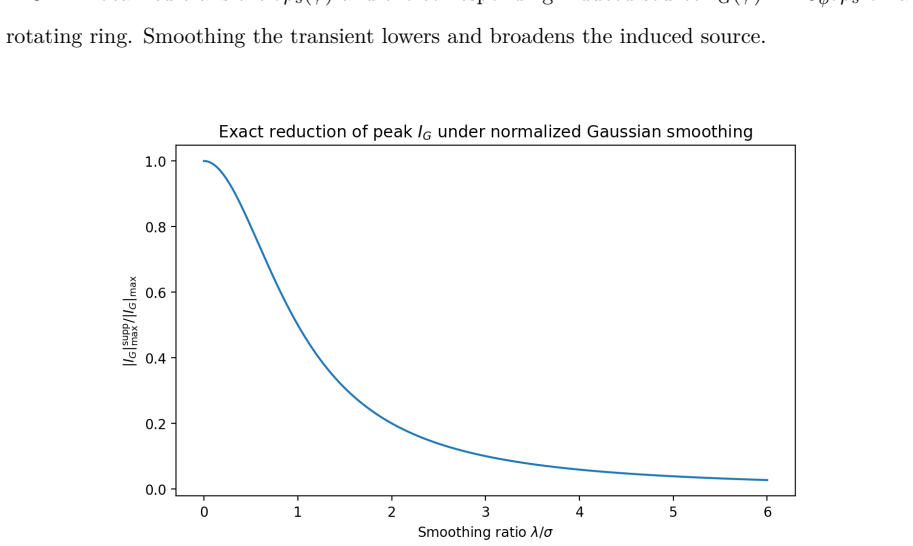
Transient sensitivity: Smoothing or suppressing localized transient perturbations should reduce the source term. A minimal reproducible numerical implementation of the transient model and its immediate diagnostics is provided in Appendix D. VIII. DISCUSSION AND LIMITATIONS The analysis developed in this paper leads to three main conclusions. First, standa...
-
[6]
Generalized Maxwell equations and charge conservation censorship,
G. Modanese, “Generalized Maxwell equations and charge conservation censorship,” Modern Physics Letters B311750052 (2017)
2017
-
[7]
Oscillating dipole with fractional quantum source in Aharonov-Bohm electrodynamics,
G. Modanese, “Oscillating dipole with fractional quantum source in Aharonov-Bohm electrodynamics,” Results in Physics7, 480-482 (2017)
2017
-
[8]
Quantum uncertainty and energy flux in extended electrody- namics,
F. Minotti and G. Modanese, “Quantum uncertainty and energy flux in extended electrody- namics,” Quantum Reports3, 703-723 (2021)
2021
-
[9]
Gauge waves generation and detection in Aharonov-Bohm electrodynamics,
F. Minotti and G. Modanese, “Gauge waves generation and detection in Aharonov-Bohm electrodynamics,” Eur. Phys. J. C83, 1086 (2023)
2023
-
[10]
A new theory of tensor-scalar gravity coupled to Aharonov- Bohm electrodynamics,
F. Minotti and G. Modanese, “A new theory of tensor-scalar gravity coupled to Aharonov- Bohm electrodynamics,” Modern Physics Letters A40, 2550023 (2025)
2025
-
[11]
F. Minotti and G. Modanese, “Scalar-tensor gravity and Aharonov-Bohm electrodynamics with bosons: applications to superconductors,” arXiv:2603.26986 (2026)
-
[12]
Gravitational Collapse: The Role of General Relativity,
R. Penrose, “Gravitational Collapse: The Role of General Relativity,” Gen. Relativ. Gravit. 34, 1141-1165 (2002), reprinted fromRivista del Nuovo Cimento, Numero Speciale I, 257 (1969)
2002
-
[13]
Rotation Effects and The Gravito-Magnetic Approach,
M. L. Ruggiero, “Rotation Effects and The Gravito-Magnetic Approach,” Nuovo Cimento B119, 893 (2004)
2004
-
[14]
The Sagnac Effect in curved space-times from an analogy with the Aharonov-Bohm Effect,
M. L. Ruggiero, “The Sagnac Effect in curved space-times from an analogy with the Aharonov-Bohm Effect,” General Relativity and Gravitation37, 1845 (2005)
2005
-
[15]
Gravito-electromagnetic Aharonov-Bohm effect: some rotation effects revised,
M. L. Ruggiero, “Gravito-electromagnetic Aharonov-Bohm effect: some rotation effects revised,” General Relativity and Gravitation43, 2909 (2011)
2011
-
[16]
Electromagnetism in Curved Space- times: Coupling of the Electromagnetic and Gravitational Fields,
C. R. D. Bunney, S. M. Grillo and R. T. Thompson, “Electromagnetism in Curved Space- times: Coupling of the Electromagnetic and Gravitational Fields,” Symmetry11, 678 (2019)
2019
-
[17]
Electrodynamics and spacetime geometry: foundations,
F. S. N. Lobo and S. Cabral, “Electrodynamics and spacetime geometry: foundations,” Foundations of Physics47, 208-228 (2017)
2017
discussion (0)
Sign in with ORCID, Apple, or X to comment. Anyone can read and Pith papers without signing in.