Recognition: unknown
A systematic literature Review for Transformer-based Software Vulnerability detection
Pith reviewed 2026-05-08 02:53 UTC · model grok-4.3
The pith
A review of 80 studies maps how transformer models detect software vulnerabilities and highlights recurring technical gaps.
A machine-rendered reading of the paper's core claim, the machinery that carries it, and where it could break.
Core claim
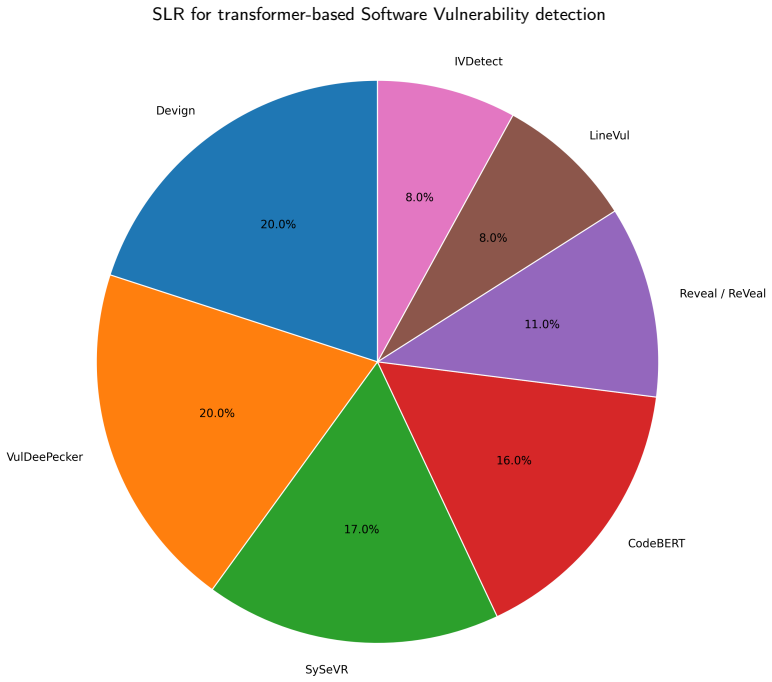
By following Kitchenham guidelines, the authors examined 80 studies and grouped transformer models into encoder-only, decoder-only, and combined encoder-decoder architectures. They catalogued the datasets and code types used, the most common pre-trained models and fine-tuning setups, the vulnerability categories targeted, and the metrics applied. The synthesis shows that most work relies on source code or smart-contract data, that encoder architectures dominate, and that four issues repeatedly surface: class imbalance in training data, lack of interpretability for the model's decisions, poor scaling to large codebases, and weak generalization when the model encounters a different programming
What carries the argument
The systematic classification of transformer architectures into encoder, decoder, and combined types, applied to source code, logs, and smart contracts, which structures the comparison of trends, benchmarks, and open challenges across the 80 studies.
If this is right
- Future studies can adopt the most frequently used benchmarks and reference models identified in the review to enable direct comparison.
- Researchers should prioritize techniques that mitigate data imbalance and improve cross-language generalization.
- New work should incorporate interpretability methods so that vulnerability predictions can be explained to developers.
- Scalability experiments on larger codebases are needed before deployment in production environments.
Where Pith is reading between the lines
- Security teams could use the consolidated list of common baselines to evaluate commercial tools more consistently.
- The emphasis on smart-contract data suggests the review's findings may transfer most readily to blockchain security research.
- A natural next step would be to test whether the identified challenges also appear in non-transformer deep-learning approaches to the same problem.
- Standardized reporting of dataset statistics and metric choices across papers would make future reviews more reliable.
Load-bearing premise
The 80 chosen papers fully represent all relevant work on the topic and the authors' groupings of architectures, datasets, and challenges contain no selection or interpretation bias.
What would settle it
An independent search that locates substantially more or fewer than 80 qualifying studies between 2021 and 2025, or a re-analysis that places the same papers into different architecture or challenge categories with different frequency counts.
Figures


read the original abstract
Context: Software vulnerabilities pose significant security threats to software systems, especially as software is increasingly used across many areas of daily life, including health, government, and finance. Recently, transformer-based models have demonstrated promising results in automatic software vulnerability identification due to their robust contextual modelling and representation learning capabilities. Objectives: While numerous systematic literature reviews (SLRs) have examined machine learning and deep learning methods for identifying vulnerabilities, a more transformer-centric analysis remains to be explored. This SLR critically analysed 80 studies published between 2021 and 2025 that utilised transformer models to identify software vulnerabilities. Methods: Using Kitchenhams SLR guidelines, we methodically evaluate current research from various perspectives, encompassing study trends, datasets and sources, programming languages, transformer frameworks, detection detail levels, assessment metrics, reference models, types of vulnerabilities, and experimental configurations. Results: We classify transformer models into encoder, decoder, and combined architectures and analyse both pre-trained and fine-tuned versions utilized on source code, logs, and smart contracts. The results emphasise prevailing research trends, frequently utilised benchmarks, and main baselines. It also uncovers crucial technical issues like data imbalance, interpretability, scalability, and generalization across programming languages. Conclusion: By integrating current evidence and recognising unaddressed research areas, this SLR provides a consolidated resource for researchers and professionals seeking to develop more reliable, precise, and interpretable transformer-based vulnerability identification systems.
Editorial analysis
A structured set of objections, weighed in public.
Referee Report
Summary. This paper presents a systematic literature review (SLR) of transformer-based models for software vulnerability detection. Following Kitchenham's guidelines, it analyzes 80 studies published 2021-2025 across dimensions including study trends, datasets, programming languages, transformer architectures (encoder/decoder/combined, pre-trained vs. fine-tuned), detection levels, metrics, baselines, vulnerability types, and experimental setups. It classifies models, highlights benchmarks, and identifies challenges such as data imbalance, interpretability, scalability, and cross-language generalization, concluding with research gaps.
Significance. If the underlying selection and classification process proves reproducible and unbiased, the review would offer a timely consolidation of recent transformer applications in vulnerability detection, useful for identifying prevalent benchmarks, baselines, and open technical issues. No machine-checked proofs or parameter-free derivations are present; the value rests entirely on the completeness and transparency of the literature synthesis.
major comments (1)
- [Methods] Methods section: The claim of following Kitchenham's SLR guidelines is not supported by the required reporting elements. No Boolean search strings, database list with execution dates, PRISMA flow diagram with exact counts at each stage, detailed inclusion/exclusion criteria, quality assessment protocol, or inter-rater reliability measures (e.g., Cohen's kappa) are provided. This directly undermines verification that the 80 studies form a complete, unbiased sample and that classifications of architectures, datasets, and challenges are free from selection or interpretation bias.
minor comments (2)
- [Abstract] Abstract: 'Kitchenhams SLR guidelines' should read 'Kitchenham's SLR guidelines'.
- [Abstract] Abstract: The range '2021 and 2025' includes a future year; clarify the actual search cutoff date.
Simulated Author's Rebuttal
We thank the referee for the constructive feedback on our systematic literature review. We address the major comment regarding the methods section below and will revise the manuscript to improve transparency and reproducibility.
read point-by-point responses
-
Referee: [Methods] Methods section: The claim of following Kitchenham's SLR guidelines is not supported by the required reporting elements. No Boolean search strings, database list with execution dates, PRISMA flow diagram with exact counts at each stage, detailed inclusion/exclusion criteria, quality assessment protocol, or inter-rater reliability measures (e.g., Cohen's kappa) are provided. This directly undermines verification that the 80 studies form a complete, unbiased sample and that classifications of architectures, datasets, and challenges are free from selection or interpretation bias.
Authors: We acknowledge that the current version of the manuscript does not provide the full set of reporting elements required to substantiate adherence to Kitchenham's SLR guidelines. While the methods overview states that Kitchenham's guidelines were followed and describes the overall process at a high level, specific details such as Boolean search strings, database execution dates, a PRISMA flow diagram, explicit inclusion/exclusion criteria, quality assessment protocol, and inter-rater reliability measures (e.g., Cohen's kappa) are indeed absent. This limits independent verification of completeness and bias. In the revised manuscript, we will expand the Methods section with a dedicated subsection that includes: (1) the complete Boolean search strings for each database, (2) the list of databases with exact search execution dates, (3) a PRISMA flow diagram showing exact counts at each screening stage, (4) detailed inclusion and exclusion criteria, (5) the quality assessment protocol and scoring, and (6) inter-rater reliability statistics. These additions will directly support the claim of following the guidelines and allow readers to assess the sample and classifications. We maintain that the 80 studies were selected systematically, but agree that greater detail is essential for full transparency. revision: yes
Circularity Check
No circularity in this systematic literature review
full rationale
This paper is a systematic literature review that synthesizes findings from 80 existing studies on transformer-based vulnerability detection using Kitchenham guidelines. It contains no derivations, equations, predictions, fitted parameters, or first-principles results. The central claims consist of classifications of architectures, datasets, trends, and challenges drawn from the reviewed literature, with no steps that reduce by construction to the paper's own inputs or self-citations. The work is self-contained as an external synthesis and exhibits no load-bearing circular patterns.
Axiom & Free-Parameter Ledger
axioms (1)
- domain assumption Kitchenham's guidelines provide an appropriate and unbiased framework for reviewing software engineering literature on AI methods.
Reference graph
Works this paper leans on
-
[1]
Future Internet 14, 118
Alaoui,R.L.,Nfaoui,E.H.,2022.Deeplearningforvulnerabilityand attackdetectiononwebapplications:Asystematicliteraturereview. Future Internet 14, 118
2022
-
[2]
Deep learning-based improved transformer modelonandroidmalwaredetectionandclassificationininternetof vehicles
Almakayeel, N., 2024. Deep learning-based improved transformer modelonandroidmalwaredetectionandclassificationininternetof vehicles. Scientific Reports 14, 25175
2024
-
[3]
Low level source code vulnerability detection using advanced bert language model., in: Canadian AI
Alqarni, M., Azim, A., 2022. Low level source code vulnerability detection using advanced bert language model., in: Canadian AI
2022
-
[4]
C3- vulmap: A dataset for privacy-aware vulnerability detection in healthcare systems
Ameh, J.E., Otebolaku, A., Shenfield, A., Ikpehai, A., 2025. C3- vulmap: A dataset for privacy-aware vulnerability detection in healthcare systems. Electronics 14, 2703
2025
-
[5]
Db- cbil: A distilbert-based transformer hybrid model using cnn and bilstm for software vulnerability detection
Bahaa, A., Kamal, A.E.R., Fahmy, H., Ghoneim, A.S., 2024. Db- cbil: A distilbert-based transformer hybrid model using cnn and bilstm for software vulnerability detection. IEEE Access
2024
-
[6]
A systematic literature review on softwarevulnerabilitypredictionmodels
Bassi, D., Singh, H., 2023. A systematic literature review on softwarevulnerabilitypredictionmodels. IEEEAccess11,110289– 110311
2023
-
[7]
Bui, V.C., Do, X.C., 2023. Detecting software vulnerabilities based on source code analysis using gcn transformer, in: 2023 RIVF International Conference on Computing and Communication Technologies (RIVF), IEEE. pp. 112–117
2023
-
[8]
Multi-source cross-domain vulnerability detection based on code pre-trained model
Cao, Y., Dong, Y., 2025. Multi-source cross-domain vulnerability detection based on code pre-trained model. Information and Soft- ware Technology , 107764
2025
-
[9]
Vulnerability detection based on transformer and high-quality number embedding
Cao, Y., Dong, Y., Peng, J., 2024. Vulnerability detection based on transformer and high-quality number embedding. Concurrency and Computation: Practice and Experience 36, e8292
2024
-
[10]
Chan,A.,Kharkar,A.,Moghaddam,R.Z.,Mohylevskyy,Y.,Helyar, A.,Kamal,E.,Elkamhawy,M.,Sundaresan,N.,2023. Transformer- based vulnerability detection in code at edittime: Zero-shot, few- shot, or fine-tuning? arXiv preprint arXiv:2306.01754 . Naseer et al.:Preprint submitted to ElsevierPage 24 of 27 SLR for transformer-based Software Vulnerability detection
-
[11]
Hlt: A hierarchical vulnerability detection model based on transformer, in: 2022 4th International Conference on Data Intelligence and Security (ICDIS), IEEE
Chen, Y., Liu, Z., 2022. Hlt: A hierarchical vulnerability detection model based on transformer, in: 2022 4th International Conference on Data Intelligence and Security (ICDIS), IEEE. pp. 50–54
2022
-
[12]
Machine learning methods for softwarevulnerabilitydetection,in:ProceedingsofthefourthACM internationalworkshoponsecurityandprivacyanalytics,pp.31–39
Chernis, B., Verma, R., 2018. Machine learning methods for softwarevulnerabilitydetection,in:ProceedingsofthefourthACM internationalworkshoponsecurityandprivacyanalytics,pp.31–39
2018
-
[13]
Data preparation for soft- ware vulnerability prediction: A systematic literature review
Croft, R., Xie, Y., Babar, M.A., 2022. Data preparation for soft- ware vulnerability prediction: A systematic literature review. IEEE Transactions on Software Engineering 49, 1044–1063
2022
-
[14]
Cui, H., Zhang, C., Cai, F., 2025. Vulgtda: A software vulnerability detection method via graph transformer and domain adaptation, in: 20255thInternationalConferenceonNeuralNetworks,Information and Communication Engineering (NNICE), IEEE. pp. 1053–1056
2025
-
[15]
Multivd: A transformer-based multitask approach for software vulnerability detection, in: Proceedings of the 21st International Conference on Security and Cryptography, pp
Curto, C., Giordano, D., Palazzo, S., Indelicato, D., 2024. Multivd: A transformer-based multitask approach for software vulnerability detection, in: Proceedings of the 21st International Conference on Security and Cryptography, pp. 416–423
2024
-
[16]
Cwevulnerabilities
CWE,. Cwevulnerabilities. https://cwe.mitre.org/. Accessed:2025- 11-18
2025
-
[17]
Devlin, J., Chang, M.W., Lee, K., Toutanova, K., 2019. Bert: Pre-training of deep bidirectional transformers for language un- derstanding, in: Proceedings of the 2019 conference of the North American chapter of the association for computational linguistics: humanlanguagetechnologies,volume1(longandshortpapers),pp. 4171–4186
2019
-
[18]
Automated Software Engineering 31, 40
Do,C.X.,Luu,N.T.,Nguyen,P.T.L.,2024.Optimizingsoftwarevul- nerabilitydetectionusingrobertaandmachinelearning. Automated Software Engineering 31, 40
2024
-
[19]
Anovelapproachfor software vulnerability detection based on ensemble learning model
DoXuan,C.,Quang,D.B.,Quang,V.D.,2026. Anovelapproachfor software vulnerability detection based on ensemble learning model. Computers and Electrical Engineering 130, 110848
2026
-
[20]
Asystematicliteraturereviewofsoftware vulnerability detection
Eberendu, A.C., Udegbe, V.I., Ezennorom, E.O., Ibegbulam, A.C., Chinebu,T.I.,etal.,2022. Asystematicliteraturereviewofsoftware vulnerability detection. European Journal of Computer Science and Information Technology 10, 23–37
2022
-
[21]
Python source code vulnerability detection with named entity recognition
Ehrenberg, M., Sarkani, S., Mazzuchi, T.A., 2024. Python source code vulnerability detection with named entity recognition. Com- puters & Security 140, 103802
2024
-
[22]
CodeBERT: A Pre-Trained Model for Programming and Natural Languages
Feng,Z.,2020. Codebert:Apre-trainedmodelforprogrammingand natural languages. arXiv preprint arXiv:2002.08155
work page internal anchor Pith review arXiv 2020
-
[23]
Securefalcon: Are we there yet in automated software vulnerability detection with llms? IEEE Transactions on Software Engineering
Ferrag, M.A., Battah, A., Tihanyi, N., Jain, R., Maimuţ, D., Al- wahedi, F., Lestable, T., Thandi, N.S., Mechri, A., Debbah, M., et al., 2025a. Securefalcon: Are we there yet in automated software vulnerability detection with llms? IEEE Transactions on Software Engineering
-
[24]
Ferrag, M.A., Battah, A., Tihanyi, N., Jain, R., Maimuţ, D., Al- wahedi, F., Lestable, T., Thandi, N.S., Mechri, A., Debbah, M., Cordeiro,L.C.,2025b. Securefalcon:Arewethereyetinautomated software vulnerability detection with llms? IEEE Transactions on Software Engineering 51, 1248–1265. doi:10.1109/TSE.2025. 3548168
-
[25]
Ferretti,S.,D’Angelo,G.,Ghini,V.,Tomasone,M.B.,2025. Detect- ing smart contract vulnerabilities using transformers and llms, in: 2025 IEEE International Conference on Pervasive Computing and Communications Workshops and other Affiliated Events (PerCom Workshops), IEEE. pp. 7–12
2025
-
[26]
Linevul: A transformer-based line-levelvulnerabilityprediction,in:Proceedingsofthe19thInter- nationalConferenceonMiningSoftwareRepositories,pp.608–620
Fu, M., Tantithamthavorn, C., 2022. Linevul: A transformer-based line-levelvulnerabilityprediction,in:Proceedingsofthe19thInter- nationalConferenceonMiningSoftwareRepositories,pp.608–620
2022
-
[27]
sguard+: Machine learning guided rule-based automated vulnerability repair onsmartcontracts
Gao, C., Yang, W., Ye, J., Xue, Y., Sun, J., 2024. sguard+: Machine learning guided rule-based automated vulnerability repair onsmartcontracts. ACMTransactionsonSoftwareEngineeringand Methodology 33, 1–55
2024
-
[28]
Software vulnerability analysis and discovery using machine-learning and data-mining techniques: A survey
Ghaffarian, S.M., Shahriari, H.R., 2017. Software vulnerability analysis and discovery using machine-learning and data-mining techniques: A survey. ACM computing surveys (CSUR) 50, 1–36
2017
-
[29]
Gong, P., Yang, W., Wang, L., Wei, F., HaiLaTi, K., Liao, Y.,
-
[30]
Computers, Materials & Continua 76
Gratdet:Smartcontractvulnerabilitydetectorbasedongraph representation and transformer. Computers, Materials & Continua 76
-
[31]
Detectbert:Codevulnerabilitydetection,in:2024 Global Conference on Communications and Information Technolo- gies (GCCIT), IEEE
Gujar,S.S.,2024. Detectbert:Codevulnerabilitydetection,in:2024 Global Conference on Communications and Information Technolo- gies (GCCIT), IEEE. pp. 1–21
2024
-
[32]
Transformer-based semanticembeddingsandhybridneuralnetworksforrobustsoftware vulnerabilitydetection,in:2025InnovationsinPowerandAdvanced Computing Technologies (i-PACT), IEEE
Gunda, B.S., Krishna, G.B., Rawat, S.S., 2025. Transformer-based semanticembeddingsandhybridneuralnetworksforrobustsoftware vulnerabilitydetection,in:2025InnovationsinPowerandAdvanced Computing Technologies (i-PACT), IEEE. pp. 1–9
2025
-
[33]
Gupta, A.R., Tomar, D.S., Shekhar, R., 2024. Dl-vulbert: A deep learning classifier for the identification of software vulnerabilities, in: 2024 15th International Conference on Computing Communica- tion and Networking Technologies (ICCCNT), IEEE. pp. 1–7
2024
-
[34]
Vulberta: Simplified source code pre-training for vulnerability detection, in: 2022 International joint conference on neural networks (IJCNN), IEEE
Hanif, H., Maffeis, S., 2022. Vulberta: Simplified source code pre-training for vulnerability detection, in: 2022 International joint conference on neural networks (IJCNN), IEEE. pp. 1–8
2022
-
[35]
A systematic literature review on automated software vulnerability detection using machine learning
Harzevili, N.s., Belle, A.b., Wang, J., Wang, S., Jiang, Z.m.j., Na- gappan, N., 2025. A systematic literature review on automated software vulnerability detection using machine learning. ACM COMPUTING SURVEYS 57
2025
-
[36]
Vultr: Software vulnerability detection model based on multi-layer key feature en- hancement
He, H., Wang, S., Wang, Y., Liu, K., Yu, L., 2025. Vultr: Software vulnerability detection model based on multi-layer key feature en- hancement. Computers & Security 148, 104139
2025
-
[37]
Linevd: Statement- level vulnerability detection using graph neural networks, in: Pro- ceedings of the 19th international conference on mining software repositories, pp
Hin, D., Kan, A., Chen, H., Babar, M.A., 2022. Linevd: Statement- level vulnerability detection using graph neural networks, in: Pro- ceedings of the 19th international conference on mining software repositories, pp. 596–607
2022
-
[38]
Avulnerability detection algorithm based on transformer model, in: International ConferenceonArtificialIntelligenceandSecurity,Springer.pp.43– 55
Hou,F.,Zhou,K.,Li,L.,Tian,Y.,Li,J.,Li,J.,2022. Avulnerability detection algorithm based on transformer model, in: International ConferenceonArtificialIntelligenceandSecurity,Springer.pp.43– 55
2022
-
[39]
Anunbiasedtransformersourcecodelearningwithseman- tic vulnerability graph, in: 2023 IEEE 8th European Symposium on Security and Privacy (EuroS&P), IEEE
Islam, N.T., Parra, G.D.L.T., Manuel, D., Bou-Harb, E., Najafirad, P.,2023. Anunbiasedtransformersourcecodelearningwithseman- tic vulnerability graph, in: 2023 IEEE 8th European Symposium on Security and Privacy (EuroS&P), IEEE. pp. 144–159
2023
-
[40]
Design and evalua- tion of highly accurate smart contract code vulnerability detection framework
Jeon, S., Lee, G., Kim, H., Woo, S.S., 2024. Design and evalua- tion of highly accurate smart contract code vulnerability detection framework. Data Mining and Knowledge Discovery 38, 888–912
2024
-
[41]
Haformer:Semanticfusionofhexmachinecodeandassemblycode for cross-architecture binary vulnerability detection
Jiang, X., Wang, S., Gong, Y., Yu, T., Liu, L., Yu, X., 2024. Haformer:Semanticfusionofhexmachinecodeandassemblycode for cross-architecture binary vulnerability detection. Computers & Security 145, 104029
2024
-
[42]
JianJie,Y.,Le,W.,2023.Codedefectdetectionmethodbasedonbert and ensemble, in: 2023 9th International Conference on Computer and Communications (ICCC), IEEE. pp. 2130–2138
2023
-
[43]
Kaanan,E.,Karim,T.,Shaon,M.S.H.,Sultan,M.F.,Cuzzocrea,A., Akter,M.S.,2024.Llm-basedapproachforbufferoverflowdetection insourcecode,in:202427thInternationalConferenceonComputer and Information Technology (ICCIT), IEEE. pp. 1898–1902
2024
-
[44]
Transfer learning for software vulnera- bility prediction using transformer models
Kalouptsoglou, I., Siavvas, M., Ampatzoglou, A., Kehagias, D., Chatzigeorgiou, A., 2025. Transfer learning for software vulnera- bility prediction using transformer models. Journal of Systems and Software 227, 112448
2025
-
[45]
Katz, K., Moshtari, S., Mujhid, I., Mirakhorli, M., Garcia, D.,
-
[46]
Siexvults: Sensitive information exposure vulnerability de- tection system using transformer models and static analysis, in: 2025 ACM/IEEE International Symposium on Empirical Software Engineering and Measurement (ESEM), IEEE. pp. 230–241
2025
-
[47]
Leveraging transformers to discover software vulnerabilities based on source code slices, in: Proceedings of the 2026 Australasian Information Security Confer- ence, pp
Khan, A.R., Xu, Y., Li, Y., 2026. Leveraging transformers to discover software vulnerabilities based on source code slices, in: Proceedings of the 2026 Australasian Information Security Confer- ence, pp. 1–9
2026
-
[48]
Robustvulnerabilitydetection in solidity-based ethereum smart contracts using fine-tuned trans- former encoder models
Kim,J.,Lee,S.,Kim,H.,etal.,2024. Robustvulnerabilitydetection in solidity-based ethereum smart contracts using fine-tuned trans- former encoder models. IEEE Access
2024
-
[49]
Kim,S.,Choi,J.,Ahmed,M.E.,Nepal,S.,Kim,H.,2022.Vuldebert: A vulnerability detection system using bert, in: 2022 IEEE Interna- tional Symposium on Software Reliability Engineering Workshops Naseer et al.:Preprint submitted to ElsevierPage 25 of 27 SLR for transformer-based Software Vulnerability detection (ISSREW), IEEE. pp. 69–74
2022
-
[50]
Guidelinesforperforming systematic literature reviews in software engineering
Kitchenham,B.,Charters,S.,etal.,2007. Guidelinesforperforming systematic literature reviews in software engineering. Technical Report. Technical report, ver. 2.3 ebse technical report. ebse
2007
-
[51]
Asurveyondata-drivensoft- ware vulnerability assessment and prioritization
Le,T.H.,Chen,H.,Babar,M.A.,2022. Asurveyondata-drivensoft- ware vulnerability assessment and prioritization. ACM Computing Surveys 55, 1–39
2022
-
[52]
Le, T.H.M., Babar, M.A., Thai, T.H., 2024. Software vulner- ability prediction in low-resource languages: An empirical study of codebert and chatgpt, in: Proceedings of the 28th International ConferenceonEvaluationandAssessmentinSoftwareEngineering, pp. 679–685
2024
-
[53]
Li, J., 2025. Macd: Source code vulnerability detection method integrating mamba and attention, in: 2025 7th International Con- ferenceonElectronicsandCommunication,NetworkandComputer Technology (ECNCT), IEEE. pp. 376–380
2025
-
[54]
Li, S., Chen, D., Zhang, J., Wang, H., Li, L., Qian, Y., Liu, H.,
-
[55]
Software vulnerability detection based on anomaly-attention, in: 2022 4th International Conference on Robotics and Computer Vision (ICRCV), IEEE. pp. 261–265
2022
-
[56]
Liang, C., Wei, Q., Jiang, Z., Wang, Y., Du, J., 2024. A source code vulnerability detection method based on adaptive graph neural networks, in: Proceedings of the 39th IEEE/ACM International Conference on Automated Software Engineering Workshops, pp. 187–196
2024
-
[57]
Software vulnerability detection using deep neural networks: a survey
Lin, G., Wen, S., Han, Q.L., Zhang, J., Xiang, Y., 2020. Software vulnerability detection using deep neural networks: a survey. Pro- ceedings of the IEEE 108, 1825–1848
2020
-
[58]
Makingvulnerabilitypre- diction more practical: Prediction, categorization, and localization
Liu,C.,Chen,X.,Li,X.,Xue,Y.,2024a. Makingvulnerabilitypre- diction more practical: Prediction, categorization, and localization. Information and Software Technology 171, 107458
-
[59]
Automatic software vulnerability detection in binary code, in: International Conference on Machine Learning for Cyber Security, Springer
Liu, S., Li, L., Ban, X., Chen, C., Zhang, J., Camtepe, S., Xiang, Y., 2024b. Automatic software vulnerability detection in binary code, in: International Conference on Machine Learning for Cyber Security, Springer. pp. 148–166
-
[60]
Software vulnerability detectionwithgptandin-contextlearning,in:20238thInternational Conference on Data Science in Cyberspace (DSC), IEEE
Liu, Z., Liao, Q., Gu, W., Gao, C., 2023. Software vulnerability detectionwithgptandin-contextlearning,in:20238thInternational Conference on Data Science in Cyberspace (DSC), IEEE. pp. 229– 236
2023
-
[61]
Pre-training bypredictingprogramdependenciesforvulnerabilityanalysistasks, in:ProceedingsoftheIEEE/ACM46thInternationalConferenceon Software Engineering, pp
Liu, Z., Tang, Z., Zhang, J., Xia, X., Yang, X., 2024c. Pre-training bypredictingprogramdependenciesforvulnerabilityanalysistasks, in:ProceedingsoftheIEEE/ACM46thInternationalConferenceon Software Engineering, pp. 1–13
-
[62]
Assessing the effectiveness of vulnerability detection via prompt tuning: An empirical study, in: 2023 30th Asia-Pacific Software Engineering Conference (APSEC), IEEE
Lu, G., Ju, X., Chen, X., Yang, S., Chen, L., Shen, H., 2023. Assessing the effectiveness of vulnerability detection via prompt tuning: An empirical study, in: 2023 30th Asia-Pacific Software Engineering Conference (APSEC), IEEE. pp. 415–424
2023
-
[63]
Harnessing the power of llms in source code vulnerability detection, in: MILCOM 2024-2024 IEEE Military Communications Conference (MILCOM), IEEE
Mahyari, A.A., 2024. Harnessing the power of llms in source code vulnerability detection, in: MILCOM 2024-2024 IEEE Military Communications Conference (MILCOM), IEEE. pp. 251–256
2024
-
[64]
A transformer- based ide plugin for vulnerability detection, in: Proceedings of the 37th IEEE/ACM International Conference on Automated Software Engineering, pp
Mamede, C., Pinconschi, E., Abreu, R., 2022. A transformer- based ide plugin for vulnerability detection, in: Proceedings of the 37th IEEE/ACM International Conference on Automated Software Engineering, pp. 1–4
2022
-
[65]
Healthcarefrauddetectionusingadaptivelearninganddeeplearning techniques
Matloob, I., Khan, S., Rukaiya, R., Alfraihi, H., Ali Khan, J., 2025. Healthcarefrauddetectionusingadaptivelearninganddeeplearning techniques. Evolving Systems 16, 72
2025
-
[66]
Secureqwen:Leverag- ingllmsforvulnerabilitydetectioninpythoncodebases
Mechri,A.,Ferrag,M.A.,Debbah,M.,2025. Secureqwen:Leverag- ingllmsforvulnerabilitydetectioninpythoncodebases. Computers & Security 148, 104151
2025
-
[67]
Ladle: a method for unsupervised anomaly detection across log types
Mylläri, J., Aalto, T., Nurminen, J.K., 2025. Ladle: a method for unsupervised anomaly detection across log types. Automated Software Engineering 32, 34
2025
-
[68]
Mando-hgt: Heterogeneous graph transformers for smart contract vulnerability detection, in: 2023 IEEE/ACM 20th International Conference on Mining Software Repositories (MSR), IEEE
Nguyen, H.H., Nguyen, N.M., Xie, C., Ahmadi, Z., Kudendo, D., Doan, T.N., Jiang, L., 2023. Mando-hgt: Heterogeneous graph transformers for smart contract vulnerability detection, in: 2023 IEEE/ACM 20th International Conference on Mining Software Repositories (MSR), IEEE. pp. 334–346
2023
-
[69]
Abundant modalities offermorenutrients:Multi-modal-basedfunction-levelvulnerability detection
Ni, C., Yin, X., Li, X., Xu, X., Yu, Z., 2025. Abundant modalities offermorenutrients:Multi-modal-basedfunction-levelvulnerability detection. ACMTransactionsonSoftwareEngineeringandMethod- ology
2025
-
[70]
Open science in software engineering: A study on deep learning- based vulnerability detection
Nong, Y., Sharma, R., Hamou-Lhadj, A., Luo, X., Cai, H., 2022. Open science in software engineering: A study on deep learning- based vulnerability detection. IEEE Transactions on Software Engineering 49, 1983–2005
2022
-
[71]
Oladokun, O., Rice, J., 2025. How effective are pretrained pro- gramminglanguage-basedlanguagemodels(pllms)inthedetection of android vulnerabilities?, in: 2025 IEEE Canadian Conference on ElectricalandComputerEngineering(CCECE),IEEE.pp.150–154
2025
-
[72]
Real-world examples of application security breaches
Pavicic, B., . Real-world examples of application security breaches. https://true-positives.com/appsec-blog/cybersecurity- breaches-real-world-examples-lessons-learned. Accessed:2025-11- 25
2025
-
[73]
Peng,T.,Chen,S.,Zhu,F.,Tang,J.,Liu,J.,Hu,X.,2023. Ptlvd:Pro- gramslicingandtransformer-basedline-levelvulnerabilitydetection system, in: 2023 IEEE 23rd International Working Conference on Source Code Analysis and Manipulation (SCAM), IEEE. pp. 162– 173
2023
-
[74]
Codebert-based embeddings for detecting vulnerable smartcontracts,in:2025IEEE50thConferenceonLocalComputer Networks (LCN), IEEE
Perera, A., Pillai, B., Tharani, J.S., Rao, A.S., Muthukkumarasamy, V., 2025. Codebert-based embeddings for detecting vulnerable smartcontracts,in:2025IEEE50thConferenceonLocalComputer Networks (LCN), IEEE. pp. 1–9
2025
-
[75]
Perl,H.,Dechand,S.,Smith,M.,Arp,D.,Yamaguchi,F.,Rieck,K., Fahl,S.,Acar,Y.,2015. Vccfinder:Findingpotentialvulnerabilities in open-source projects to assist code audits, in: Proceedings of the 22nd ACM SIGSAC conference on computer and communications security, pp. 426–437
2015
-
[76]
Software vulnerability detection using large language models, in: 2023 IEEE 34th International Symposium on Software Reliability Engineering Workshops (ISSREW), IEEE
Purba, M.D., Ghosh, A., Radford, B.J., Chu, B., 2023. Software vulnerability detection using large language models, in: 2023 IEEE 34th International Symposium on Software Reliability Engineering Workshops (ISSREW), IEEE. pp. 112–119
2023
-
[77]
Reza, S.I., Moon, I.T., Fahim, M.F.S., Alam, A., Sheikh, M.T.,
-
[78]
An empirical analysis of transformer-based models with lime explainability for javascript vulnerability detection, in: 2026 5th International Conference on Electrical, Computer & Telecom- munication Engineering (ICECTE), IEEE. pp. 1–6
2026
-
[79]
Rusinova, Z., Chernyshov, Y., Dolganov, A., 2024. Explaining of transformer-based models for vulnerable function detection, in: 2024 IEEE Ural-Siberian Conference on Biomedical Engineering, Radioelectronics and Information Technology (USBEREIT), IEEE. pp. 304–307
2024
-
[80]
Vulnerai: Gpt based web ap- plication vulnerability detection, in: 2024 International Conference onArtificialIntelligence,MetaverseandCybersecurity(ICAMAC), IEEE
Saimbhi, S.S., Akpinar, K.O., 2024. Vulnerai: Gpt based web ap- plication vulnerability detection, in: 2024 International Conference onArtificialIntelligence,MetaverseandCybersecurity(ICAMAC), IEEE. pp. 1–6
2024
discussion (0)
Sign in with ORCID, Apple, or X to comment. Anyone can read and Pith papers without signing in.