Recognition: unknown
The evolution of the baryonic content and mass profiles of satellite galaxies in the MTNG simulations
Pith reviewed 2026-05-08 02:23 UTC · model grok-4.3
The pith
In the MTNG simulation, satellite galaxies lose ~80% of their gas by the time their subhalos lose half their mass, while stellar mass and magnitudes evolve more slowly following v_max reduction, with inner mass loss occurring early.
A machine-rendered reading of the paper's core claim, the machinery that carries it, and where it could break.
Core claim
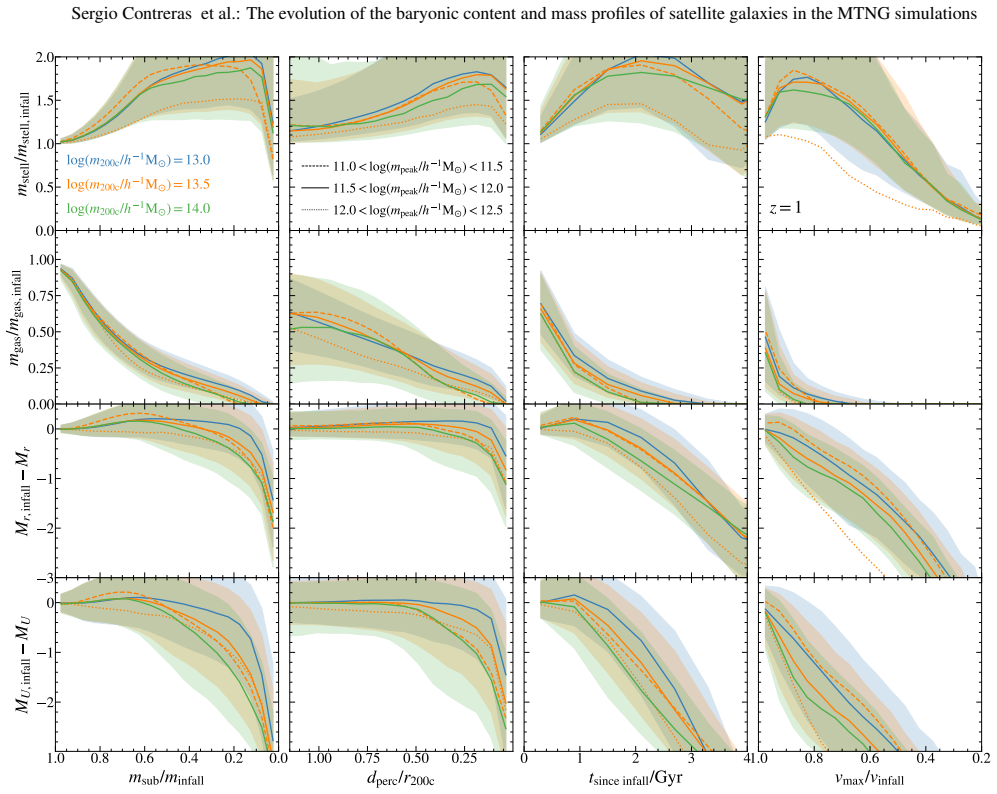
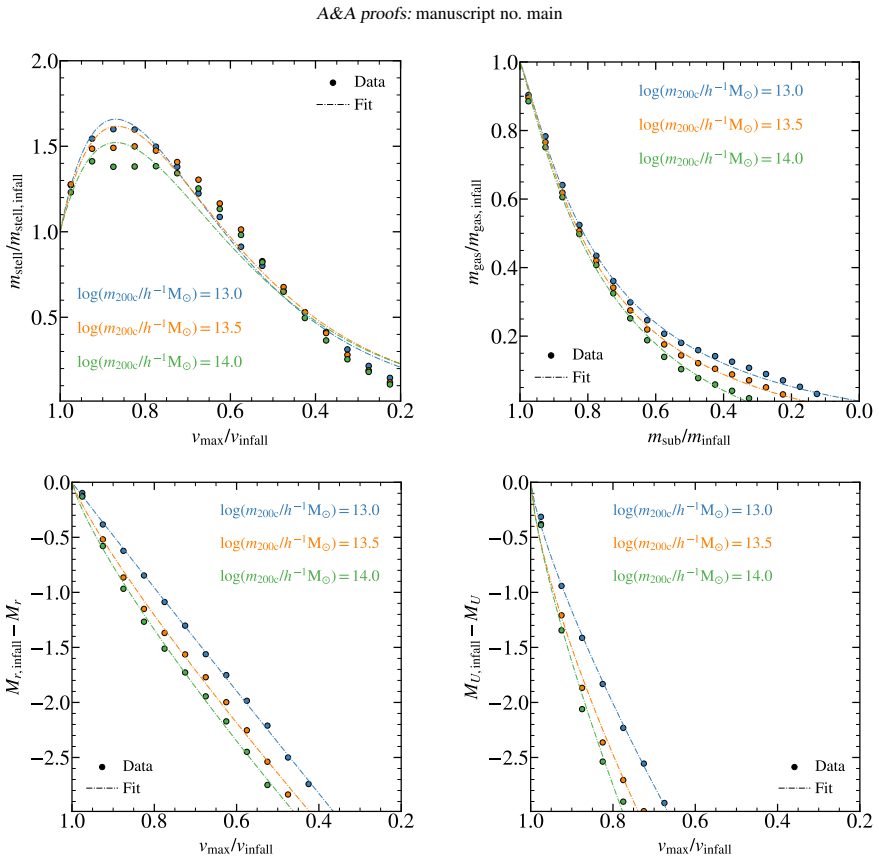
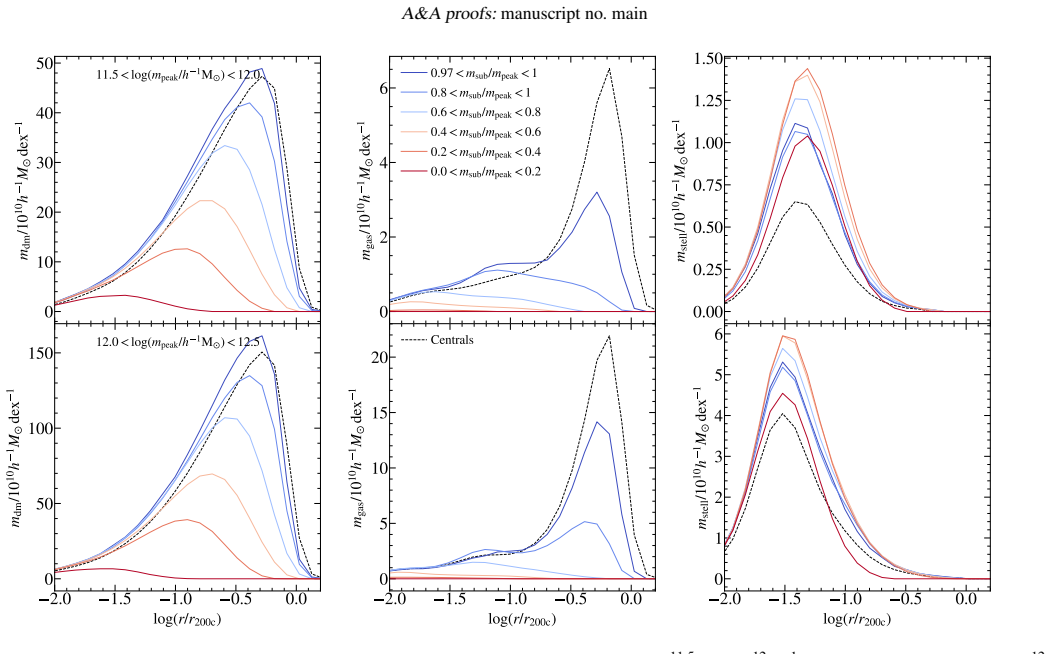
We find that the gas mass, which is well described by the remaining subhalo mass fraction, declines much more rapidly than the other components, with satellites losing ∼80% of their gas by the time the subhalo has lost half of its total mass. By contrast, the evolution of stellar mass and magnitudes is overall slower and is better described by the reduction of the host subhalo v_max. ... although stripping is strongest in the outer regions, the intermediate and inner parts of satellites experience mass loss at early times.
Load-bearing premise
That the baryonic physics and numerical resolution in the MTNG simulation produce trends that are robust and representative of real satellite galaxies, without significant dependence on the specific subgrid models or resolution limits affecting the reported gas loss and mass profile evolution.
Figures



read the original abstract
Empirical models often rely on key relations from the galaxy--halo connection to construct mock galaxy catalogues. These relations typically describe central galaxies more accurately than satellite galaxies, which are generally less massive and orbit within larger haloes. Satellite galaxies are affected by a variety of physical processes that pose significant challenges for modelling. In this work, we use \MTNG, a state-of-the-art cosmological hydrodynamic simulation, to study the evolution of the baryonic component of satellites. Using the merger trees from this simulation, we follow the evolution of all $z=0$ satellite galaxies, tracking their stellar mass, gas mass, and $r$- and $U$-band magnitudes. We characterise this evolution using proxies including the fraction of subhalo mass and maximum circular velocity remaining relative to infall, the pericentric distance, and the time since infall. All of these quantities are commonly available in gravity-only simulations and can therefore be used to model these trends in simpler galaxy population models. We find that the gas mass, which is well described by the remaining subhalo mass fraction, declines much more rapidly than the other components, with satellites losing $\sim 80\%$ of their gas by the time the subhalo has lost half of its total mass. By contrast, the evolution of stellar mass and magnitudes is overall slower and is better described by the reduction of the host subhalo $v_{\rm max}$. We then examine the evolution of satellite mass profiles. We find that, although stripping is strongest in the outer regions, the intermediate and inner parts of satellites experience mass loss at early times. The results of this work can be used by empirical models and galaxy formation models built on gravity-only simulations to improve their descriptions of satellite galaxies.
Editorial analysis
A structured set of objections, weighed in public.
Referee Report
Summary. The paper uses the MTNG cosmological hydrodynamic simulation and its merger trees to track the baryonic evolution (gas mass, stellar mass, r- and U-band magnitudes) of z=0 satellite galaxies. Evolution is characterized via proxies including remaining subhalo mass fraction, v_max, pericentric distance, and time since infall. Key results are that gas mass declines rapidly (∼80% loss by the time subhalo mass halves, well-described by mass fraction), while stellar mass and magnitudes evolve more slowly and track v_max reduction better; mass profiles show early stripping in inner and intermediate regions despite stronger outer losses. These relations are offered as inputs for empirical models built on gravity-only simulations.
Significance. If robust, the work supplies concrete, simulation-derived scalings that address a known weakness in the galaxy-halo connection for satellites, allowing gravity-only models to incorporate differential stripping without full hydrodynamics. Credit is due for the direct use of particle data and merger trees to derive component-specific proxies. The significance is reduced, however, by the absence of any demonstrated robustness to numerical resolution or subgrid variations, limiting portability of the quoted relations.
major comments (3)
- [Methods] Methods section: The quantitative claims (e.g., ∼80% gas loss at 50% subhalo mass remaining, inner mass loss at early times) are extracted from a single MTNG hydro run with no reported resolution-convergence tests at fixed cosmology or cross-comparisons to other codes (TNG, EAGLE) using identical tracking. This is load-bearing because gas stripping and inner-profile evolution are directly sensitive to the specific implementations of ram-pressure, stellar/AGN feedback, and force softening.
- [Results on baryonic content] Results on baryonic content: The statement that gas mass is 'well described by the remaining subhalo mass fraction' while stellar mass tracks v_max is presented without any goodness-of-fit metrics, scatter quantification, or alternative-proxy comparisons, making it impossible to judge how reliably these can be implemented as parameter-free proxies in gravity-only models.
- [Mass-profile evolution] Mass-profile evolution subsection: The claim that 'intermediate and inner parts of satellites experience mass loss at early times' lacks explicit radial bin definitions, enclosed-mass thresholds, or statistical significance tests against outer stripping; without these the result cannot be translated into a usable model ingredient.
minor comments (3)
- [Abstract] Abstract: The phrase 'all z=0 satellite galaxies' should specify the minimum subhalo mass or stellar-mass threshold and the host-halo mass range to allow reproducibility.
- [Notation] Notation: v_max is used throughout without an explicit definition relative to the infall-time value or the subhalo finder output; a short equation or reference would remove ambiguity.
- [Figures] Figure captions: Several panels lack reported sample sizes, bootstrap errors, or the exact definition of 'time since infall,' reducing clarity for readers who wish to adopt the relations.
Simulated Author's Rebuttal
We thank the referee for their detailed and constructive report. We address each of the major comments below and will make appropriate revisions to the manuscript to improve clarity and robustness where possible. We note that some aspects, such as cross-simulation comparisons, are beyond the scope of this study.
read point-by-point responses
-
Referee: [Methods] Methods section: The quantitative claims (e.g., ∼80% gas loss at 50% subhalo mass remaining, inner mass loss at early times) are extracted from a single MTNG hydro run with no reported resolution-convergence tests at fixed cosmology or cross-comparisons to other codes (TNG, EAGLE) using identical tracking. This is load-bearing because gas stripping and inner-profile evolution are directly sensitive to the specific implementations of ram-pressure, stellar/AGN feedback, and force softening.
Authors: We acknowledge the importance of demonstrating robustness to numerical resolution and subgrid physics variations. The MTNG simulation employs a specific set of subgrid models and resolution parameters, and while we have not performed dedicated convergence tests within this work, the trends we report are qualitatively consistent with expectations from the broader literature on environmental effects in hydrodynamical simulations. We will revise the Methods section to include a more detailed description of the MTNG resolution and subgrid physics, along with a discussion of potential sensitivities and caveats. However, performing full resolution convergence tests at fixed cosmology or direct cross-comparisons with TNG and EAGLE using identical tracking methods would require access to additional simulation data and significant additional analysis, which is not feasible in the current study. We will explicitly note this as a limitation. revision: partial
-
Referee: [Results on baryonic content] Results on baryonic content: The statement that gas mass is 'well described by the remaining subhalo mass fraction' while stellar mass tracks v_max is presented without any goodness-of-fit metrics, scatter quantification, or alternative-proxy comparisons, making it impossible to judge how reliably these can be implemented as parameter-free proxies in gravity-only models.
Authors: We agree that providing quantitative measures of fit quality and scatter will strengthen the presentation of these relations. In the revised manuscript, we will include goodness-of-fit statistics (such as the coefficient of determination and root-mean-square scatter) for the relations between gas mass and subhalo mass fraction, and between stellar mass/magnitudes and v_max. We will also compare these proxies to alternatives like time since infall and pericentric distance to demonstrate their relative performance. This will allow readers to better assess the reliability for use in empirical models. revision: yes
-
Referee: [Mass-profile evolution] Mass-profile evolution subsection: The claim that 'intermediate and inner parts of satellites experience mass loss at early times' lacks explicit radial bin definitions, enclosed-mass thresholds, or statistical significance tests against outer stripping; without these the result cannot be translated into a usable model ingredient.
Authors: We will clarify the mass-profile analysis in the revised version. Specifically, we will define the radial bins explicitly (e.g., inner: r < 0.1 r_infall, intermediate: 0.1 r_infall < r < 0.5 r_infall, outer: r > 0.5 r_infall, where r_infall is the virial radius at infall), specify the enclosed mass thresholds used, and include statistical tests (such as Kolmogorov-Smirnov tests or bootstrap resampling) to quantify the significance of the early mass loss in inner and intermediate regions compared to outer regions. This will make the result more readily usable in modeling contexts. revision: yes
- Cross-comparisons to other hydrodynamic codes such as TNG and EAGLE with identical tracking
Axiom & Free-Parameter Ledger
axioms (1)
- domain assumption Standard Lambda-CDM cosmology and the subgrid galaxy formation physics implemented in MTNG
Reference graph
Works this paper leans on
-
[1]
The tidal evolution of satellite galaxies in cosmological simulations: insights from COLIBRE
Aguirre-Santaella, A., Sánchez-Conde, M. A., Ogiya, G., Stücker, J., & Angulo, R. E. 2023, MNRAS, 518, 93 Angulo, R. E. & Pontzen, A. 2016, MNRAS, 462, L1 Angulo, R. E., Zennaro, M., Contreras, S., et al. 2021, MNRAS, 507, 5869 Aricò, G. & Angulo, R. E. 2024, Astronomy and Astrophysics, 690, 10 Aricò, G., Angulo, R. E., Hernández-Monteagudo, C., Contreras...
work page internal anchor Pith review Pith/arXiv arXiv 2023
-
[2]
We find that, by using the same pa- rameterisation as forv max/vinfall, we can recover the evolution of most properties almost perfectly
The remaining subhalo mass fraction is more commonly used to describe satellite evolution, as it tends to be more readily available thanv max/vinfall. We find that, by using the same pa- rameterisation as forv max/vinfall, we can recover the evolution of most properties almost perfectly. The only property that presents some difficulty in the modelling is ...
2022
discussion (0)
Sign in with ORCID, Apple, or X to comment. Anyone can read and Pith papers without signing in.