Recognition: unknown
Randomised measurements of a disorder-induced entanglement transition in a neutral atom quantum processor
Pith reviewed 2026-05-08 03:55 UTC · model grok-4.3
The pith
A new randomised measurement protocol extracts entanglement entropy on neutral-atom simulators and shows disorder inducing a chaotic-to-localised transition.
A machine-rendered reading of the paper's core claim, the machinery that carries it, and where it could break.
Core claim
We devise and demonstrate the measurement of entanglement entropy in a programmable analogue quantum simulator using a randomised measurement protocol that leverages local energy tuning together with a global field to bypass the need for local gate control. We implement this on a commercially available neutral-atom quantum simulator and use it to show how programmable disorder in the local Hamiltonian parameters leads to a transition from chaotic to localised entanglement dynamics.
What carries the argument
The randomised measurement protocol relying on local energy tuning and a global field to implement subsystem unitaries for entropy calculation.
If this is right
- This extends randomised measurement techniques to analogue systems without universal local control.
- Programmable disorder can induce controllable transitions in entanglement dynamics.
- Entanglement spreading differences are resolvable in small systems given current decoherence times.
- The approach opens randomised measurement toolboxes for other analogue quantum simulators.
Where Pith is reading between the lines
- Adapting this protocol to other platforms with global control but limited local addressing could enable similar studies of localisation.
- Larger system sizes might show sharper transitions if decoherence is further reduced.
- These measurements could help benchmark quantum simulators for many-body phenomena beyond current small-system limits.
Load-bearing premise
The combination of local energy tuning and global fields accurately mimics the randomised unitaries without significant errors from hardware imperfections, and the observed differences in entanglement dynamics arise specifically from the introduced disorder rather than from decoherence or other noise.
What would settle it
Repeating the experiment on the same hardware but with all disorder parameters set to zero and observing no change in the 'localised' dynamics, or obtaining mismatched entropy values when cross-checked against exact calculations for small known states.
Figures




read the original abstract
The development and spread of entanglement in complex quantum systems is central to exploring many-body phenomena out of equilibrium. Measuring entanglement dynamics can shed light on information scrambling and thermalisation, namely on transitions from many-body quantum chaos to localisation in disordered, interacting systems. In quantum computing systems, entanglement entropy and other nonlinear functions of the density matrix have been recently measured, in particular by using the randomised measurement toolbox. However, it is difficult to implement the required arbitrary unitary rotations on specific subsystems without universal local control. Here we devise and demonstrate the measurement of entanglement entropy in a programmable analogue quantum simulator using a randomised measurement protocol that leverages local energy tuning together with a global field to bypass the need for local gate control. We implement this on a commercially available neutral-atom quantum simulator, QuEra's Aquila, and use it to show how programmable disorder in the local Hamiltonian parameters leads to a transition from chaotic to localised entanglement dynamics. Given current decoherence times, we clearly resolve disorder-specific, time-dependent entanglement spreading in small systems. Our work extends the utility of programmable analogue quantum simulators, and opens further opportunities for wider randomised measurement toolboxes in a range of other analogue systems.
Editorial analysis
A structured set of objections, weighed in public.
Referee Report
Summary. The paper claims to devise and experimentally demonstrate a randomised measurement protocol for entanglement entropy in programmable analogue quantum simulators. The protocol uses local energy tuning combined with a global field to bypass the need for local gate control, and is implemented on QuEra's Aquila neutral-atom processor to observe a disorder-induced transition from chaotic to localised entanglement dynamics, resolving time-dependent spreading differences in small systems despite decoherence limits.
Significance. If the protocol's accuracy is confirmed and the observed dynamics are robustly attributable to the programmed disorder, the work is significant for extending randomised measurement techniques beyond systems with universal local control. This enables new studies of many-body localisation, information scrambling, and entanglement transitions on current analogue hardware platforms, with practical value from the commercial neutral-atom implementation.
major comments (2)
- [Methods] Methods section on the randomised measurement protocol: the central claim that local energy tuning plus global drive accurately extracts entanglement entropy requires explicit quantification of systematic bias (e.g., from finite pulse durations, calibration drift, or the approximation in the unitary ensemble), as this is load-bearing for interpreting the measured transition; without such bounds or validation simulations, the protocol's fidelity remains unverified.
- [Results] Results section on entanglement dynamics: the attribution of time-dependent spreading differences to the introduced programmable disorder (rather than residual decoherence or other uncontrolled effects) is central to the transition claim, yet the manuscript provides no quantitative control experiments, decoherence modeling, or error-bar analysis to rule out confounds, especially given the abstract's note on current decoherence times limiting resolution to small systems.
minor comments (2)
- [Abstract] Abstract: the phrase 'clearly resolve' could be tempered or supported by specifying the exact system sizes and disorder strengths used in the demonstration.
- [Figures] Figure presentation: ensure all data plots include error bars, legends for different disorder realizations, and clear labels distinguishing chaotic vs. localised regimes.
Simulated Author's Rebuttal
We thank the referee for their careful reading and constructive comments on our manuscript. We address each major comment below and have revised the manuscript to incorporate additional analysis and validation as requested.
read point-by-point responses
-
Referee: [Methods] Methods section on the randomised measurement protocol: the central claim that local energy tuning plus global drive accurately extracts entanglement entropy requires explicit quantification of systematic bias (e.g., from finite pulse durations, calibration drift, or the approximation in the unitary ensemble), as this is load-bearing for interpreting the measured transition; without such bounds or validation simulations, the protocol's fidelity remains unverified.
Authors: We agree that explicit bounds on systematic bias are necessary to support the protocol's accuracy. In the revised manuscript, we have expanded the Methods section with numerical simulations of the full protocol, incorporating realistic finite pulse durations, calibration drift levels consistent with Aquila specifications, and the unitary ensemble approximation. These simulations bound the systematic error in the extracted entanglement entropy to less than 5% across the parameter regime of the experiment. We have also added direct validation against exact diagonalization results for small system sizes (up to 4 qubits), confirming high fidelity of the local energy tuning plus global drive approach. These additions provide the requested quantification and strengthen the foundation for interpreting the observed transition. revision: yes
-
Referee: [Results] Results section on entanglement dynamics: the attribution of time-dependent spreading differences to the introduced programmable disorder (rather than residual decoherence or other uncontrolled effects) is central to the transition claim, yet the manuscript provides no quantitative control experiments, decoherence modeling, or error-bar analysis to rule out confounds, especially given the abstract's note on current decoherence times limiting resolution to small systems.
Authors: We acknowledge the importance of ruling out potential confounds to attribute the dynamics specifically to programmable disorder. In the revised Results section, we now include quantitative control experiments comparing entanglement spreading with and without the applied disorder, a decoherence model parameterized by independently measured T1 and T2 times on the Aquila device, and error bars on all data points derived from bootstrap resampling over the randomized measurement shots. These controls demonstrate that the time-dependent differences persist beyond what decoherence alone would produce, while remaining consistent with the abstract's statement on decoherence limits for small systems. This analysis directly supports the disorder-induced transition claim. revision: yes
Circularity Check
No significant circularity: experimental demonstration on hardware
full rationale
The paper is an experimental work implementing a randomized measurement protocol on QuEra's Aquila neutral-atom processor to extract entanglement entropy and observe disorder-induced transitions in entanglement dynamics. The abstract and described claims rest on hardware measurements and protocol implementation rather than any theoretical derivation chain. No equations, fitted parameters presented as predictions, self-definitional constructs, or load-bearing self-citations are present in the provided text. The central results are data-driven observations of time-dependent spreading differences attributable to programmed disorder, with no reduction to inputs by construction.
Axiom & Free-Parameter Ledger
Reference graph
Works this paper leans on
-
[1]
The Hamiltonian of the system is given by Eq
Experimental protocol In this experiment we employ a system ofN= 6 atoms arranged in a 1D lattice with interatomic separation of a= 10µm. The Hamiltonian of the system is given by Eq. (1). Fig. 3aoutlines the experimental protocol tailored to Aquila, which comprises four stages: preparation, evolu- tion, randomisation, and measurement. (i)Preparation: Ω a...
-
[2]
9 in Appendix D)
Ramps Since the hardware constraints require Ω and ∆ local to be 0 at the start and end of each sequence, we ap- ply linear ramps of Ω and ∆ local in the preparation and measurement steps (see Fig. 9 in Appendix D). We chose the shortest allowed ramp durations of 0.632µs for Ω and 0.05µs for ∆ local. We also find that ramping up Ω af- ter ∆local in thePre...
-
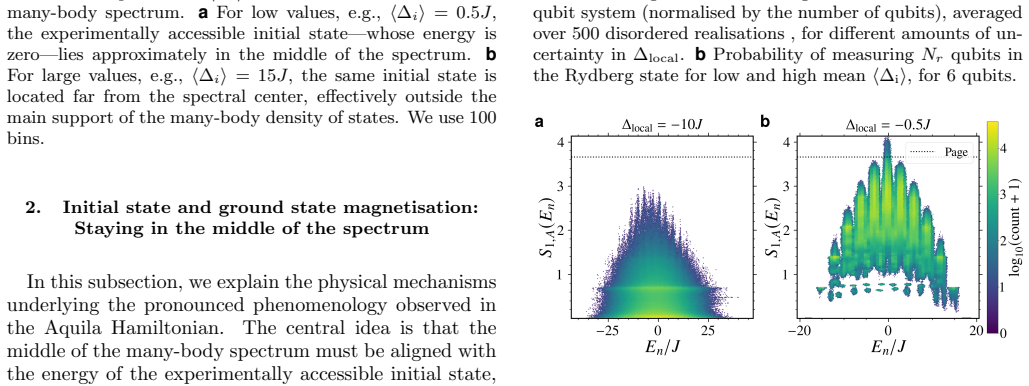
[3]
Readout error Due to experimental imperfections such as atom loss and imperfect optical pumping, there is a finite readout error in both ground and Rydberg states, parametrised byϵ g andϵ r, respectively. To account for the non- negligible readout error during measurement, we define a mapTfrom the pre-measurement probabilities (p g, pr) to actual measured...
-
[4]
In order to benchmark this, we perform a Rydberg-Ramsey measurement in the pres- ence of applied uniform local detunings on each site of a 5×4 square site array spaced by 21µm
Decoherence error Application of local detuning (∆ local) introduces sig- nificant decoherence. In order to benchmark this, we perform a Rydberg-Ramsey measurement in the pres- ence of applied uniform local detunings on each site of a 5×4 square site array spaced by 21µm. We ex- tractT ∗ 2 values by fitting a gaussian decay of the ram- sey fringes. To be ...
-
[5]
Amico, R
L. Amico, R. Fazio, A. Osterloh, and V. Vedral, Entan- glement in many-body systems, Rev. Mod. Phys.80, 517 (2008)
2008
-
[6]
Elben, S
A. Elben, S. T. Flammia, H.-Y. Huang, R. Kueng, J. Preskill, B. Vermersch, and P. Zoller, The randomized measurement toolbox, Nat. Rev. Phys.5, 9–24 (2022)
2022
-
[7]
Brydges, A
T. Brydges, A. Elben, P. Jurcevic, B. Vermersch, C. Maier, B. P. Lanyon, P. Zoller, R. Blatt, and C. F. Roos, Probing R´ enyi entanglement entropy via random- ized measurements, Science364, 260–263 (2019)
2019
-
[8]
D. Zhu, Z. P. Cian, C. Noel, A. Risinger, D. Biswas, L. Egan, Y. Zhu, A. M. Green, C. H. Alderete, N. H. Nguyen, Q. Wang, A. Maksymov, Y. Nam, M. Cetina, N. M. Linke, M. Hafezi, and C. Monroe, Cross-platform comparison of arbitrary quantum states, Nat. Commun. 13, 6620 (2022)
2022
- [9]
- [10]
-
[11]
D. N. Page, Average entropy of a subsystem, Phys. Rev. Lett.71, 1291 (1993)
1993
-
[12]
J. M. Deutsch, Quantum statistical mechanics in a closed system, Phys. Rev. A43, 2046 (1991)
2046
-
[13]
Srednicki, Chaos and quantum thermalization, Phys
M. Srednicki, Chaos and quantum thermalization, Phys. Rev. E50, 888 (1994)
1994
-
[14]
D’Alessio, Y
L. D’Alessio, Y. Kafri, A. Polkovnikov, and M. Rigol, From quantum chaos and eigenstate thermalization to statistical mechanics and thermodynamics, Adv. Phys. 65, 239 (2016)
2016
-
[15]
Haake,Quantum Signatures of Chaos(Springer, Hei- delberg, 1991)
F. Haake,Quantum Signatures of Chaos(Springer, Hei- delberg, 1991)
1991
-
[16]
Oganesyan and D
V. Oganesyan and D. A. Huse, Localization of interacting fermions at high temperature, Phys. Rev. B75, 155111 (2007)
2007
-
[17]
ˇZnidariˇ c, T
M. ˇZnidariˇ c, T. Prosen, and P. Prelovˇ sek, Many-body localization in the HeisenbergXXZmagnet in a random field, Phys. Rev. B77, 064426 (2008)
2008
-
[18]
Pal and D
A. Pal and D. A. Huse, Many-body localization phase transition, Phys. Rev. B82, 174411 (2010)
2010
-
[19]
J. H. Bardarson, F. Pollmann, and J. E. Moore, Un- bounded Growth of Entanglement in Models of Many- Body Localization, Phys. Rev. Lett.109, 017202 (2012)
2012
-
[20]
Serbyn, Z
M. Serbyn, Z. Papi´ c, and D. A. Abanin, Local Conserva- tion Laws and the Structure of the Many-Body Localized States, Phys. Rev. Lett.111, 127201 (2013)
2013
-
[21]
D. A. Huse, R. Nandkishore, and V. Oganesyan, Phe- nomenology of fully many-body-localized systems, Phys. Rev. B90, 174202 (2014)
2014
-
[22]
Nandkishore and D
R. Nandkishore and D. A. Huse, Many-body localiza- tion and thermalization in quantum statistical mechan- ics, Annu. Rev. Condens. Matter Phys.6, 15–38 (2015)
2015
-
[23]
D. A. Abanin, E. Altman, I. Bloch, and M. Serbyn, Col- loquium: Many-body localization, thermalization, and entanglement, Rev. Mod. Phys.91, 021001 (2019)
2019
-
[24]
Abanin, J
D. Abanin, J. Bardarson, G. De Tomasi, S. Gopalakr- ishnan, V. Khemani, S. Parameswaran, F. Pollmann, A. Potter, M. Serbyn, and R. Vasseur, Distinguishing lo- calization from chaos: Challenges in finite-size systems, Ann. Phys.427, 168415 (2021)
2021
-
[25]
ˇSuntajs, J
J. ˇSuntajs, J. Bonˇ ca, T. Prosen, and L. Vidmar, Quan- tum chaos challenges many-body localization, Phys. Rev. E102, 062144 (2020)
2020
-
[26]
Y. Y. Atas, E. Bogomolny, O. Giraud, and G. Roux, Dis- tribution of the Ratio of Consecutive Level Spacings in Random Matrix Ensembles, Phys. Rev. Lett.110, 084101 (2013)
2013
-
[27]
Leviandier, M
L. Leviandier, M. Lombardi, R. Jost, and J. P. Pique, Fourier Transform: A Tool to Measure Statistical Level Properties in Very Complex Spectra, Phys. Rev. Lett. 56, 2449 (1986)
1986
-
[28]
Br´ ezin and S
E. Br´ ezin and S. Hikami, Spectral form factor in a ran- dom matrix theory, Phys. Rev. E55, 4067 (1997)
1997
-
[29]
del Campo, J
A. del Campo, J. Molina-Vilaplana, and J. Sonner, Scrambling the spectral form factor: Unitarity con- straints and exact results, Phys. Rev. D95, 126008 (2017)
2017
-
[30]
J. S. Cotler, G. Gur-Ari, M. Hanada, J. Polchinski, P. Saad, S. H. Shenker, D. Stanford, A. Streicher, and M. Tezuka, Black holes and random matrices, J. High Energy Phys.2017, 118 (2017)
2017
-
[31]
Roushan, C
P. Roushan, C. Neill, J. Tangpanitanon, V. M. Bastidas, A. Megrant, R. Barends, Y. Chen, Z. Chen, B. Chiaro, A. Dunsworth, A. Fowler, B. Foxen, M. Giustina, E. Jef- frey, J. Kelly, E. Lucero, J. Mutus, M. Neeley, C. Quin- tana, D. Sank, A. Vainsencher, J. Wenner, T. White, H. Neven, D. G. Angelakis, and J. Martinis, Spectro- scopic signatures of localizat...
2017
-
[32]
Many-body interferometry with semiconductor spins
D. Jirovec, S. Reale, P. Cova-Fari˜ na, C. Ventura- Meinersen, M. T. P. Nguyen, X. Zhang, S. D. Oosterhout, G. Scappucci, M. Veldhorst, M. Rimbach-Russ, S. Bosco, and L. M. K. Vandersypen, Many-body interferometry with semiconductor spins, arXiv:2511.04310 (2025)
work page internal anchor Pith review Pith/arXiv arXiv 2025
-
[33]
L. K. Joshi, A. Elben, A. Vikram, B. Vermersch, V. Gal- itski, and P. Zoller, Probing Many-Body Quantum Chaos with Quantum Simulators, Phys. Rev. X12, 011018 10 (2022)
2022
-
[34]
A. K. Das, C. Cianci, D. G. A. Cabral, D. A. Zarate-Herrada, P. Pinney, S. Pilatowsky-Cameo, A. S. Matsoukas-Roubeas, V. S. Batista, A. del Campo, E. J. Torres-Herrera, and L. F. Santos, Proposal for many- body quantum chaos detection, Phys. Rev. Res.7, 013181 (2025)
2025
-
[35]
H. Dong, P. Zhang, C. B. Da˘ g, Y. Gao, N. Wang, J. Deng, X. Zhang, J. Chen, S. Xu, K. Wang, Y. Wu, C. Zhang, F. Jin, X. Zhu, A. Zhang, Y. Zou, Z. Tan, Z. Cui, Z. Zhu, F. Shen, T. Li, J. Zhong, Z. Bao, H. Li, Z. Wang, Q. Guo, C. Song, F. Liu, A. Chan, L. Ying, and H. Wang, Mea- suring the spectral form factor in many-body chaotic and localized phases of q...
2025
-
[36]
Gonz´ alez-Cuadra, M
D. Gonz´ alez-Cuadra, M. Hamdan, T. V. Zache, B. Braverman, M. Kornjaˇ ca, A. Lukin, S. H. Cant´ u, F. Liu, S.-T. Wang, A. Keesling, M. D. Lukin, P. Zoller, and A. Bylinskii, Observation of string breaking on a (2 + 1)D Rydberg quantum simulator, Nature642, 321 (2025)
2025
-
[37]
M. D. Lukin, M. Fleischhauer, R. Cote, L. M. Duan, D. Jaksch, J. I. Cirac, and P. Zoller, Dipole Blockade and Quantum Information Processing in Mesoscopic Atomic Ensembles, Phys. Rev. Lett.87, 037901 (2001)
2001
-
[38]
Urban, T
E. Urban, T. A. Johnson, T. Henage, L. Isenhower, D. D. Yavuz, T. G. Walker, and M. Saffman, Observation of Rydberg blockade between two atoms, Nat. Phys.5, 110 (2009)
2009
-
[39]
R. Fan, P. Zhang, H. Shen, and H. Zhai, Out-of-time- order correlation for many-body localization, Science Bulletin62, 707 (2017)
2017
-
[40]
S. J. van Enk and C. W. J. Beenakker, Measuring Trρn on Single Copies ofρUsing Random Measurements, Phys. Rev. Lett.108, 110503 (2012)
2012
-
[41]
Elben, B
A. Elben, B. Vermersch, C. F. Roos, and P. Zoller, Sta- tistical correlations between locally randomized measure- ments: A toolbox for probing entanglement in many- body quantum states, Phys. Rev. A99, 052323 (2019)
2019
-
[42]
Huang, R
H.-Y. Huang, R. Kueng, and J. Preskill, Predicting many properties of a quantum system from very few measure- ments, Nat. Phys.16, 1050 (2020)
2020
-
[43]
Elben, B
A. Elben, B. Vermersch, M. Dalmonte, J. I. Cirac, and P. Zoller, R´ enyi Entropies from Random Quenches in Atomic Hubbard and Spin Models, Phys. Rev. Lett.120, 050406 (2018)
2018
-
[44]
Vermersch, A
B. Vermersch, A. Elben, M. Dalmonte, J. I. Cirac, and P. Zoller, Unitaryn-designs via random quenches in atomic Hubbard and spin models: Application to the measurement of R´ enyi entropies, Phys. Rev. A97, 023604 (2018)
2018
-
[45]
Denzler, A
J. Denzler, A. A. Mele, E. Derbyshire, T. Guaita, and J. Eisert, Learning Fermionic Correlations by Evolving with Random Translationally Invariant Hamiltonians, Phys. Rev. Lett.133, 240604 (2024)
2024
-
[46]
McGinley and M
M. McGinley and M. Fava, Shadow Tomography from Emergent State Designs in Analog Quantum Simulators, Phys. Rev. Lett.131, 160601 (2023)
2023
-
[47]
M. C. Tran, D. K. Mark, W. W. Ho, and S. Choi, Mea- suring Arbitrary Physical Properties in Analog Quantum Simulation, Phys. Rev. X13, 011049 (2023)
2023
-
[48]
Lloyd, Almost Any Quantum Logic Gate is Universal, Phys
S. Lloyd, Almost Any Quantum Logic Gate is Universal, Phys. Rev. Lett.75, 346 (1995)
1995
-
[49]
Lloyd, Universal Quantum Simulators, Science273, 1073 (1996)
S. Lloyd, Universal Quantum Simulators, Science273, 1073 (1996)
1996
-
[50]
D. E. Deutsch, A. Barenco, and A. Ekert, Universality in quantum computation, Proc. R. Soc. Lond. A449, 669 (1997)
1997
-
[51]
C. M. Kropf, C. Gneiting, and A. Buchleitner, Effective Dynamics of Disordered Quantum Systems, Phys. Rev. X6, 031023 (2016)
2016
-
[52]
O. Scholin, A. Matsoukas-Roubeas, L. S´ a, A. De, M. Hamdan, A. Bylinskii, A. Daley, and D. Gangloff, Randomised measurements of a disorder-induced entan- glement transition in a neutral atom quantum processor (dataset), https://dx.doi.org/10.5287/ora-dow5oapxe
-
[53]
G. C. Toga, S. Darbha, E. Rrapaj, P. L. S. Lopes, and A. F. Kemper, Information Propagation in Rydberg Ar- rays via Analog OTOC Calculations, arXiv:2604.05038 (2026)
work page internal anchor Pith review Pith/arXiv arXiv 2026
-
[54]
Bohigas, M
O. Bohigas, M. J. Giannoni, and C. Schmit, Characteri- zation of Chaotic Quantum Spectra and Universality of Level Fluctuation Laws, Phys. Rev. Lett.52, 1 (1984)
1984
-
[55]
F. J. Dyson, Statistical Theory of the Energy Levels of Complex Systems. II, J. Math. Phys.3, 157–165 (1962)
1962
-
[56]
M. B. Hastings, An area law for one-dimensional quan- tum systems, J. Stat. Mech.2007, P08024 (2007)
2007
-
[57]
Notarnicola, A
S. Notarnicola, A. Elben, T. Lahaye, A. Browaeys, S. Montangero, and B. Vermersch, A randomized mea- surement toolbox for an interacting Rydberg-atom quan- tum simulator, New J. Phys.25, 103006 (2023)
2023
-
[58]
C. W. J. Beenakker, J. W. F. Venderbos, and M. P. van Exter, Two-Photon Speckle as a Probe of Multi- Dimensional Entanglement, Phys. Rev. Lett.102, 193601 (2009)
2009
-
[59]
W. H. Peeters, J. J. D. Moerman, and M. P. van Exter, Observation of Two-Photon Speckle Patterns, Phys. Rev. Lett.104, 173601 (2010)
2010
-
[60]
S. M. B. Collins and J. Novak, The Weingarten Calculus, Not. Am. Math. Soc.69, 734 (2022). 11 Appendix A: Transition from Quantum Chaos to Localisation Generic (that is, not fine-tuned) systems are usually found in a so-called quantum chaotic regime, which can be diagnosed through spectral statistics [11]. Accord- ing to the Bohigas-Giannoni-Schmit (BGS) ...
2022
-
[61]
Numerical signatures of quantum chaos and localisation Under these conditions, we first look at the eigen- value statistics of the Hamiltonian, as measured by the 12 Level spacings SFF Eigenstate EE Entanglement growth Quantum chaotic Wigner-Dyson correlation hole volume law linear growth, fast saturation MBL exponential no correlation hole area law logar...
-
[62]
Initial state and ground state magnetisation: Staying in the middle of the spectrum In this subsection, we explain the physical mechanisms underlying the pronounced phenomenology observed in the Aquila Hamiltonian. The central idea is that the middle of the many-body spectrum must be aligned with the energy of the experimentally accessible initial state, ...
-
[63]
A randomised measurement toolbox for an interacting Rydberg-atom quantum simulator
von Neumann Entropy of Eigenstates Fig. 7 shows the distribution of the bipartite von Neu- mann entropyS 1,A(En) of energy eigenstates for a 12- 14 qubit system over 1000 disorder realisations, plotted as a function of eigenenergyE n/J. For ∆ local =−10J, see Fig. 7a, most eigenstates are concentrated at rela- tively low entropy values, particularly near ...
2019
-
[64]
experimental
Bloqade Analog with Braket To perform all the experiments described in this work, we use QuEra’s Bloqade Analog Python package (ver- sion 0.16.3), which is open source:https://github. com/QuEraComputing/bloqade-analog. Bloqade Ana- log has documentation to guides new users and explain FIG. 9. Example task submitted to Aquila showing the time-dependent fun...
-
[65]
Calibration checks a. Rabi oscillations We use two primary calibration checks based on Rabi oscillations in order to (1) ensure the Rabi frequency matches what we expect and (2) we understand the read- out errors. We take a chain of 6 atoms spaced 10µm and sethi = 1 except for one valuei ′ for whichh ′ i = 0. We set ∆ local = −125µs−1. We sweepi ′ from in...
-
[66]
For a given Rabi oscillation, let the fit param- eters for the amplitude and the vertical offset beA, B
Determining the rate of false detection Using our Rabi experiments as explained in a sub- section above, we can fit to the functionf(t) = Asin(Ω efft+φ) +B, whereA, Ω eff,φ, andBare fit pa- rameters. For a given Rabi oscillation, let the fit param- eters for the amplitude and the vertical offset beA, B. We use ϵr = 1− A+B Ω2 Ω2+∆2 (D1) ϵg =A−B(D2) We use ...
discussion (0)
Sign in with ORCID, Apple, or X to comment. Anyone can read and Pith papers without signing in.