Recognition: no theorem link
Information Propagation in Rydberg Arrays via Analog OTOC Calculations
Pith reviewed 2026-05-10 19:33 UTC · model grok-4.3
The pith
A sequence of global randomized quenches computes out-of-time-order correlators on analog neutral-atom simulators without backward time evolution.
A machine-rendered reading of the paper's core claim, the machinery that carries it, and where it could break.
Core claim
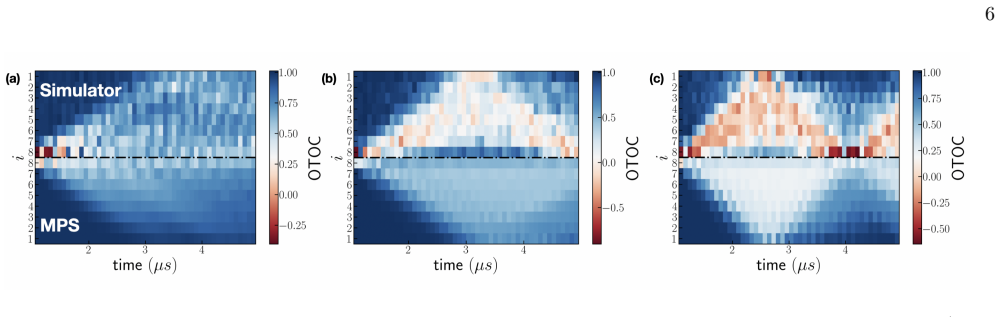
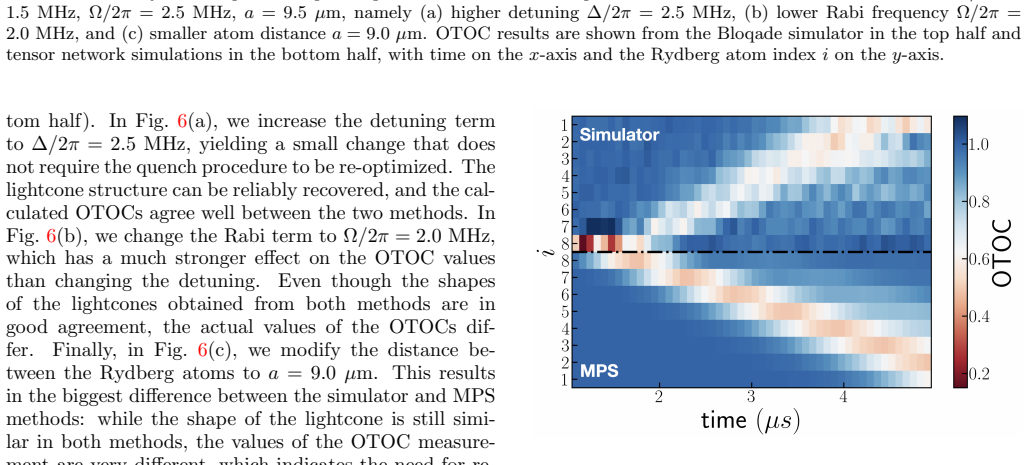
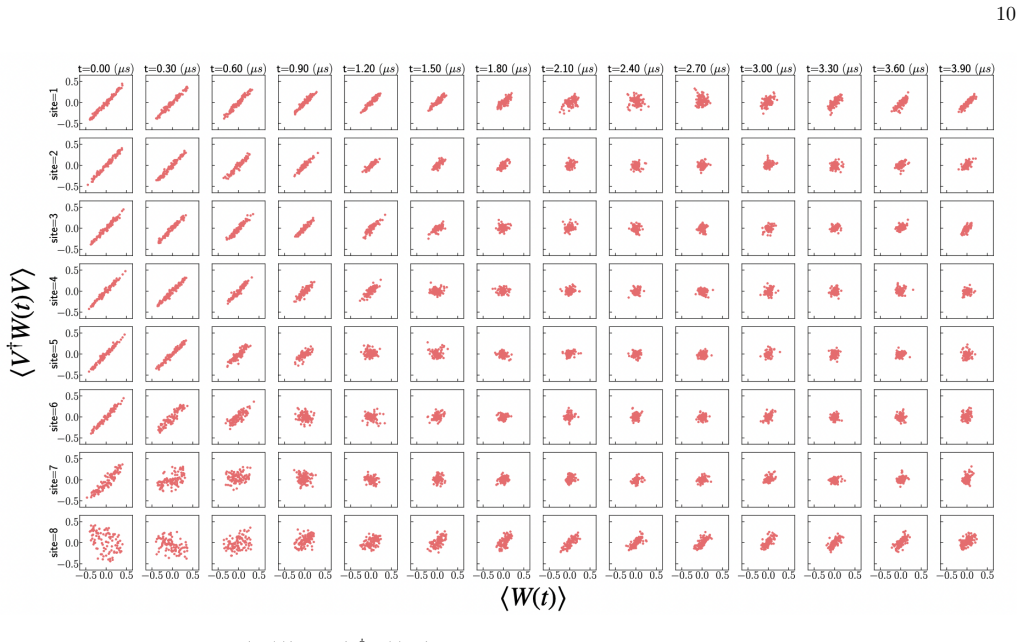
By applying a sequence of global randomized quenches that approximate unitary 2-design properties, infinite-temperature OTOCs can be extracted from statistical correlations of measurement outcomes on analog quantum simulators. This is demonstrated through the observation of the lightcone of information propagation in one-dimensional Rydberg atom arrays, with hardware results agreeing with state-vector and matrix product state simulations.
What carries the argument
The randomized quench protocol that generates statistical correlations approximating unitary 2-designs for OTOC extraction without backward evolution.
If this is right
- The lightcone of information propagation becomes directly observable in hardware experiments on Rydberg arrays.
- Hardware results agree with both state-vector simulations and matrix-product-state calculations for the tested chain lengths.
- The protocol supplies a scalable method for probing quantum chaos in complex many-body systems on current analog devices.
- It constitutes the first fully analog demonstration of randomized OTOC measurements in neutral-atom simulators.
Where Pith is reading between the lines
- The same quench sequence could be applied to two-dimensional or larger arrays to track how scrambling depends on geometry and interaction range.
- Optimization of quench number and distribution might reduce the number of experimental shots needed while maintaining accuracy.
- Direct comparisons between this analog method and digital-circuit implementations of OTOCs could reveal platform-specific advantages for scrambling studies.
Load-bearing premise
The sequence of global randomized quenches sufficiently approximates the unitary 2-design properties required to extract accurate infinite-temperature OTOCs from statistical correlations.
What would settle it
In a small Rydberg chain where exact OTOCs can be computed classically with explicit time reversal, the values obtained from the randomized-quench protocol would deviate significantly from the exact results if the 2-design approximation fails.
Figures



read the original abstract
Out-of-time-order correlators (OTOCs) are the main tool for probing quantum chaos and scrambling, and have become crucial probes in many areas of quantum computing. However, the measurement of OTOCs is difficult to implement on analog quantum computers due to the requirement of backward time evolution. In this paper, we develop and implement a randomized measurement protocol to compute OTOCs on Aquila by QuEra Computing. Unlike traditional methods that require backward time evolution, our approach utilizes a sequence of global randomized quenches that approximates the unitary 2-design properties necessary for extracting infinite-temperature OTOCs from statistical correlations. We demonstrate the protocol's success by explicitly observing the lightcone of information propagation in 1D Rydberg chains, and compare hardware results to both state-vector simulations and matrix product state (MPS) tensor network calculations. This work establishes the first demonstration of fully analog randomized OTOC measurements in neutral-atom simulators, providing a scalable pathway to probe quantum chaos in complex many-body systems.
Editorial analysis
A structured set of objections, weighed in public.
Referee Report
Summary. The manuscript develops a randomized measurement protocol for infinite-temperature out-of-time-order correlators (OTOCs) on analog neutral-atom hardware. It replaces backward time evolution with a sequence of global randomized quenches on the Rydberg array that are asserted to approximate the unitary 2-design properties needed to extract the correlator from statistical averages. The protocol is implemented on Aquila, the lightcone of information propagation is observed in 1D chains, and hardware data are compared to state-vector and MPS simulations.
Significance. If the quench ensemble is shown to be sufficiently close to a 2-design, the work would provide a practical route to OTOC measurements on analog platforms that cannot easily implement time reversal, thereby enabling scalable studies of scrambling in Rydberg arrays. The explicit hardware-to-numerics comparison for small chains is a concrete strength that grounds the experimental claim.
major comments (3)
- [Abstract / Protocol description] Abstract and protocol section: the assertion that the global randomized quenches 'approximate the unitary 2-design properties necessary' for unbiased infinite-temperature OTOC extraction is not accompanied by any quantitative bound (frame potential, 2-design distance, or mixing time). Agreement with exact simulations on small instances therefore only validates the protocol for those specific cases and does not establish convergence or absence of bias for the claimed lightcone observation.
- [Experimental results / Lightcone observation] Results section on lightcone: no error bars, bootstrap uncertainties, or statistical significance measures are reported for the hardware OTOC values or for the agreement with state-vector/MPS data. Without these, it is impossible to judge whether the observed lightcone is robust or could be affected by the finite quench ensemble or hardware noise.
- [Numerical benchmarks] Comparison with numerics: the manuscript shows agreement for small 1D chains but does not analyze how the design error or extraction bias scales with system size, quench depth, or chain length. This scaling information is load-bearing for the claim of a 'scalable pathway'.
minor comments (2)
- [Methods] The abstract and methods would benefit from an explicit statement of the number of quenches, the precise pulse-shape parameters, and the exact formula used to convert the measured correlations into the OTOC.
- [Figures] Figure captions should include the system sizes, number of shots, and any post-processing steps applied to the hardware data.
Simulated Author's Rebuttal
We thank the referee for the constructive and detailed report. The comments highlight important aspects of rigor in presenting the protocol and results. We address each major comment point-by-point below, indicating where revisions will be made to strengthen the manuscript.
read point-by-point responses
-
Referee: [Abstract / Protocol description] Abstract and protocol section: the assertion that the global randomized quenches 'approximate the unitary 2-design properties necessary' for unbiased infinite-temperature OTOC extraction is not accompanied by any quantitative bound (frame potential, 2-design distance, or mixing time). Agreement with exact simulations on small instances therefore only validates the protocol for those specific cases and does not establish convergence or absence of bias for the claimed lightcone observation.
Authors: We agree that the manuscript would benefit from a more quantitative characterization of how closely the randomized quench ensemble approximates a unitary 2-design. The protocol is constructed from global random unitaries drawn from a distribution intended to satisfy the requisite averaging properties, and its practical performance is validated by the agreement with exact state-vector simulations on the small chains studied. However, explicit bounds (e.g., frame potential or 2-design distance) are not computed in the current version. In the revised manuscript we will add a dedicated paragraph in the protocol section discussing the theoretical convergence rate of the quench ensemble to a 2-design and, for the ensemble sizes used, report numerical estimates of the relevant distance measures on small systems where they can be computed exactly. revision: yes
-
Referee: [Experimental results / Lightcone observation] Results section on lightcone: no error bars, bootstrap uncertainties, or statistical significance measures are reported for the hardware OTOC values or for the agreement with state-vector/MPS data. Without these, it is impossible to judge whether the observed lightcone is robust or could be affected by the finite quench ensemble or hardware noise.
Authors: We acknowledge that the absence of uncertainty quantification makes it difficult to assess the statistical robustness of the hardware data. The OTOC values are obtained from finite-shot averages over both the randomized quench realizations and the measurement outcomes on Aquila; the observed lightcone structure is qualitatively consistent across independent runs and with the numerics, but no error bars or significance tests were included in the figures. In the revised version we will add bootstrap or jackknife error estimates to the hardware OTOC curves, report the number of shots and quench realizations used, and include a brief discussion of how the finite ensemble size and hardware noise affect the visibility of the lightcone. revision: yes
-
Referee: [Numerical benchmarks] Comparison with numerics: the manuscript shows agreement for small 1D chains but does not analyze how the design error or extraction bias scales with system size, quench depth, or chain length. This scaling information is load-bearing for the claim of a 'scalable pathway'.
Authors: The present work is an initial demonstration on small 1D chains (where exact state-vector and MPS comparisons are feasible) and therefore does not contain a systematic scaling study of the residual bias with system size or quench depth. Such an analysis would require substantially larger numerical resources and is left for future work. Nevertheless, the protocol’s design is based on established approximate 2-design constructions whose error is known to decay with the number of random layers; we will add a short theoretical discussion of this expected scaling in the revised manuscript and clarify that the ‘scalable pathway’ claim refers primarily to the analog hardware implementation rather than to an exhaustive numerical characterization of bias for arbitrarily large systems. revision: partial
Circularity Check
No circularity: experimental protocol validated against independent numerics
full rationale
The paper implements a randomized quench protocol on hardware and extracts OTOCs via statistical correlations, then benchmarks the hardware output directly against state-vector and MPS simulations on the same small instances. No equation defines the target OTOC in terms of the measured correlator, no parameter is fitted to the data and then relabeled as a prediction, and no load-bearing step reduces to a self-citation or ansatz imported from prior work by the same authors. The central claim is an empirical demonstration whose correctness is tested externally rather than by construction.
Axiom & Free-Parameter Ledger
Forward citations
Cited by 2 Pith papers
-
Randomised measurements of a disorder-induced entanglement transition in a neutral atom quantum processor
A randomised measurement protocol enables observation of a disorder-induced entanglement transition from chaotic to localised dynamics in a neutral atom quantum processor.
-
Graph-State Circuit Blocks control Entanglement and Scrambling Velocities
LC-inequivalent graph-state blocks in random Clifford circuits yield distinct entanglement velocities v_E and butterfly velocities v_B, correlated with internal entanglement distribution and graph connectivity.
Reference graph
Works this paper leans on
-
[1]
Y. Sekino and L. Susskind, Journal of High En- ergy Physics2008, 065 (2008), ISSN 1029-8479, arXiv:0808.2096 [hep-th, physics:quant-ph], URLhttp: //arxiv.org/abs/0808.2096
work page Pith review arXiv 2008
-
[2]
J. Maldacena, S. H. Shenker, and D. Stanford, JHEP08, 106 (2016), 1503.01409
work page Pith review arXiv 2016
-
[3]
Swingle, G
B. Swingle, G. Bentsen, M. Schleier-Smith, and P. Hay- den, Physical Review A94, 040302 (2016)
2016
-
[4]
Xu and B
S. Xu and B. Swingle, Nature Physics16, 199 (2020), ISSN 1745-2473, 1745-2481, URLhttp://www.nature. com/articles/s41567-019-0712-4
2020
-
[5]
Swingle, Nature Physics14, 988 (2018)
B. Swingle, Nature Physics14, 988 (2018)
2018
-
[6]
Xu and B
S. Xu and B. Swingle, PRX quantum5, 010201 (2024)
2024
- [7]
-
[8]
Dowling, P
N. Dowling, P. Kos, and K. Modi, Physical Review Let- ters131, 180403 (2023)
2023
-
[9]
T. Xu, T. Scaffidi, and X. Cao, Physical review letters 124, 140602 (2020)
2020
-
[10]
Hashimoto, K.-B
K. Hashimoto, K.-B. Huh, K.-Y. Kim, and R. Watanabe, Journal of High Energy Physics2020, 1 (2020)
2020
-
[11]
Pappalardi, A
S. Pappalardi, A. Russomanno, B. ˇZunkoviˇ c, F. Iemini, A. Silva, and R. Fazio, Physical Review B98, 134303 (2018)
2018
-
[12]
S. H. Shenker and D. Stanford, JHEP03, 067 (2014), 1306.0622
work page Pith review arXiv 2014
-
[13]
A. I. Larkin and Y. N. Ovchinnikov, Sov Phys JETP28, 1200 (1969)
1969
- [14]
-
[15]
G¨ arttner, J
M. G¨ arttner, J. G. Bohnet, A. Safavi-Naini, M. L. Wall, J. J. Bollinger, and A. M. Rey, Nature Physics13, 781 (2017)
2017
-
[16]
M. K. Joshi, A. Elben, B. Vermersch, T. Brydges, C. Maier, P. Zoller, R. Blatt, and C. F. Roos, Physical Review Letters124, 240505 (2020)
2020
-
[17]
X. Mi, P. Roushan, C. Quintana, S. Mandra, J. Marshall, C. Neill, F. Arute, K. Arya, J. Atalaya, R. Babbush, et al., Science374, 1479 (2021)
2021
-
[18]
K. A. Landsman, C. Figgatt, T. Schuster, N. M. Linke, B. Yoshida, N. Y. Yao, and C. Monroe, Nature567, 61 (2019)
2019
- [19]
-
[20]
J. Zhang, F. M. Cucchietti, C. M. Chandrashekar, M. Laforest, C. A. Ryan, M. Ditty, A. Hubbard, J. K. Gamble, and R. Laflamme, Physical Review A79, 012305 (2009), ISSN 1050-2947, 1094-1622, URLhttps: //link.aps.org/doi/10.1103/PhysRevA.79.012305
-
[21]
C. Zhang, S. Kundu, N. Makri, M. Gruebele, and P. G. Wolynes, Proceedings of the National Academy of Sciences121, e2321668121 (2024), https://www.pnas.org/doi/pdf/10.1073/pnas.2321668121, URLhttps://www.pnas.org/doi/abs/10.1073/pnas. 2321668121. 8
-
[22]
Chamon, E
C. Chamon, E. R. Mucciolo, A. E. Ruckenstein, and Z.- C. Yang, npj Quantum Information10, 37 (2024)
2024
-
[23]
Schuster, B
T. Schuster, B. Kobrin, P. Gao, I. Cong, E. T. Khabi- boulline, N. M. Linke, M. D. Lukin, C. Monroe, B. Yoshida, and N. Y. Yao, Physical Review X12, 031013 (2022)
2022
-
[24]
M. S. Blok, V. V. Ramasesh, T. Schuster, K. O’Brien, J.-M. Kreikebaum, D. Dahlen, A. Morvan, B. Yoshida, N. Y. Yao, and I. Siddiqi, Physical Review X11, 021010 (2021)
2021
- [25]
-
[26]
C. Zhang, R. Corti˜ nas, A. Karamlou, N. Noll, J. Provazza, J. Bausch, S. Shirobokov, A. White, M. Claassen, S. Kang, et al., arXiv preprint arXiv:2510.19550 (2025)
- [27]
-
[28]
B. Vermersch, A. Elben, L. M. Sieberer, N. Y. Yao, and P. Zoller, Physical Review X9, 021061 (2019), ISSN 2160-3308, arXiv:1807.09087 [cond-mat, physics:hep-th, physics:physics, physics:quant-ph], URLhttp://arxiv. org/abs/1807.09087
-
[29]
M. Asaduzzaman, R. G. Jha, and B. Sambasivam, Physi- cal Review D109, 105002 (2024), ISSN 2470-0010, 2470- 0029, arXiv:2311.17991 [quant-ph], URLhttp://arxiv. org/abs/2311.17991
-
[30]
Asaduzzaman, S
M. Asaduzzaman, S. Catterall, Y. Meurice, and G. C. Toga, Physical Review D109, 054513 (2024)
2024
-
[31]
L. K. Joshi, A. Elben, A. Vikram, B. Vermersch, V. Gal- itski, and P. Zoller, Physical Review X12, 011018 (2022), ISSN 2160-3308, URLhttps://link.aps.org/doi/10. 1103/PhysRevX.12.011018
2022
- [32]
-
[33]
A. Elben, B. Vermersch, M. Dalmonte, J. Cirac, and P. Zoller, Physical Review Letters120, 050406 (2018), ISSN 0031-9007, 1079-7114, URLhttps://link.aps. org/doi/10.1103/PhysRevLett.120.050406
-
[34]
B. Vermersch, A. Elben, M. Dalmonte, J. I. Cirac, and P. Zoller, Physical Review A97, 023604 (2018), ISSN 2469-9926, 2469-9934, URLhttps://link.aps. org/doi/10.1103/PhysRevA.97.023604
- [35]
-
[36]
Elben, B
A. Elben, B. Vermersch, C. F. Roos, and P. Zoller, Physical Review A99, 052323 (2019), ISSN 2469-9926, 2469-9934, URLhttps://link.aps.org/doi/10.1103/ PhysRevA.99.052323
2019
- [37]
-
[38]
Browaeys and T
A. Browaeys and T. Lahaye, Nature Physics16, 132 (2020)
2020
-
[39]
Keesling et al., Nature568, 207 (2019), 1809.05540
A. Keesling et al., Nature568, 207 (2019), 1809.05540
-
[40]
Darbha, M
S. Darbha, M. Kornjaˇ ca, F. Liu, J. Balewski, M. R. Hirsbrunner, P. L. Lopes, S.-T. Wang, R. Van Beeu- men, K. Klymko, and D. Camps, Physical Review B110, 155114 (2024)
2024
-
[41]
Darbha, M
S. Darbha, M. Kornjaˇ ca, F. Liu, J. Balewski, M. R. Hirsbrunner, P. L. Lopes, S.-T. Wang, R. Van Beeu- men, D. Camps, and K. Klymko, Physical Review B110, 155103 (2024)
2024
-
[42]
Bernien, S
H. Bernien, S. Schwartz, A. Keesling, H. Levine, A. Om- ran, H. Pichler, S. Choi, A. S. Zibrov, M. Endres, M. Greiner, et al., Nature551, 579 (2017)
2017
-
[43]
C. J. Turner, A. A. Michailidis, D. A. Abanin, M. Serbyn, and Z. Papi´ c, Nature Physics14, 745 (2018)
2018
-
[44]
Bluvstein, A
D. Bluvstein, A. Omran, H. Levine, A. Keesling, G. Se- meghini, S. Ebadi, T. T. Wang, A. A. Michailidis, N. Maskara, W. W. Ho, et al., Science371, 1355 (2021)
2021
-
[45]
Ebadi, T
S. Ebadi, T. T. Wang, H. Levine, A. Keesling, G. Se- meghini, A. Omran, D. Bluvstein, R. Samajdar, H. Pich- ler, W. W. Ho, et al., Nature595, 227 (2021)
2021
-
[46]
Gross, K
D. Gross, K. Audenaert, and J. Eisert, Journal of math- ematical physics48(2007)
2007
-
[47]
Roy and A
A. Roy and A. J. Scott, Designs, codes and cryptography 53, 13 (2009)
2009
-
[48]
Lambert, E
N. Lambert, E. Gigu‘ere, P. Menczel, B. Li, P. Hopf, G. Su’arez, M. Gali, J. Lishman, R. Gadhvi, R. Agar- wal, et al., Physics Reports1153, 1 (2026), ISSN 0370- 1573, URLhttps://www.sciencedirect.com/science/ article/pii/S0370157325002704
2026
- [49]
-
[50]
U. Schollw¨ ock, Rev. Mod. Phys.77, 259 (2005), URL https://link.aps.org/doi/10.1103/RevModPhys.77. 259
-
[51]
Xu and B
S. Xu and B. Swingle, Nature Physics16, 199 (2020)
2020
-
[52]
E. H. Lieb and D. W. Robinson,The finite group velocity of quantum spin systems(Springer, 2004)
2004
-
[53]
Yuan, S.-Y
D. Yuan, S.-Y. Zhang, Y. Wang, L.-M. Duan, and D.-L. Deng, Physical Review Research4, 023095 (2022), ISSN 2643-1564, URLhttps://link.aps.org/doi/10.1103/ PhysRevResearch.4.023095
2022
-
[54]
Chen and T
X. Chen and T. Zhou, Physical Review B100, 064305 (2019)
2019
-
[55]
D.-L. Deng, X. Li, J. Pixley, Y.-L. Wu, and S. Das Sarma, Physical Review B95, 024202 (2017)
2017
- [56]
-
[57]
Bukov, A
M. Bukov, A. G. Day, D. Sels, P. Weinberg, A. Polkovnikov, and P. Mehta, Physical Review X8, 031086 (2018)
2018
-
[58]
M. Y. Niu, S. Boixo, V. N. Smelyanskiy, and H. Neven, npj Quantum Information5, 33 (2019)
2019
-
[59]
Esslinger, Annu
T. Esslinger, Annu. Rev. Condens. Matter Phys.1, 129 (2010)
2010
-
[60]
Dutta, M
O. Dutta, M. Gajda, P. Hauke, M. Lewenstein, D.- S. L¨ uhmann, B. A. Malomed, T. Sowi´ nski, and J. Za- krzewski, Reports on Progress in Physics78, 066001 (2015)
2015
-
[61]
Sch¨ afer, T
F. Sch¨ afer, T. Fukuhara, S. Sugawa, Y. Takasu, and Y. Takahashi, Nature Reviews Physics2, 411 (2020)
2020
-
[62]
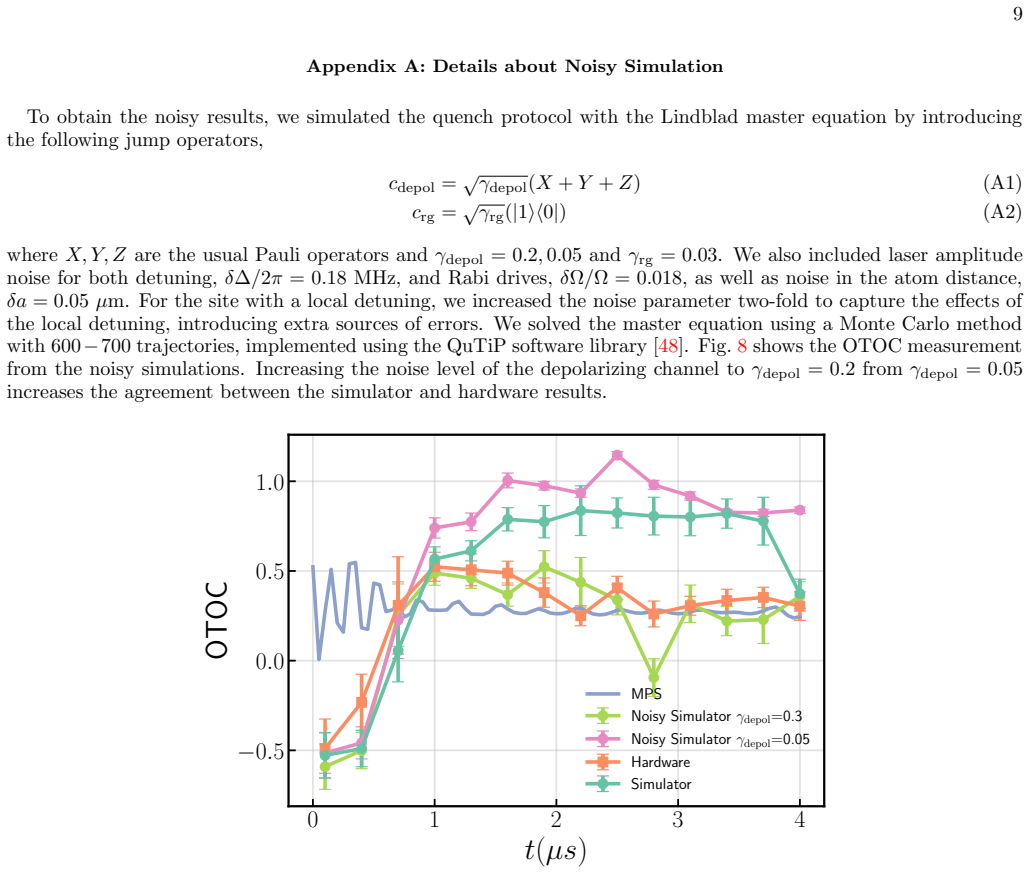
M. Xu, L. H. Kendrick, A. Kale, Y. Gang, C. Feng, S. Zhang, A. W. Young, M. Lebrat, and M. Greiner, Na- ture642, 909 (2025). 9 Appendix A: Details about Noisy Simulation To obtain the noisy results, we simulated the quench protocol with the Lindblad master equation by introducing the following jump operators, cdepol = √γdepol(X+Y+Z) (A1) crg = √γrg(|1⟩⟨0|...
2025
discussion (0)
Sign in with ORCID, Apple, or X to comment. Anyone can read and Pith papers without signing in.