Recognition: unknown
Seismic background mitigation with the Lunar Gravitational-wave Antenna
Pith reviewed 2026-05-07 17:21 UTC · model grok-4.3
The pith
Optimal spacing of two seismic stations on the Moon can reduce equivalent seismic noise by a factor of 2.3 at 0.3 Hz for gravitational-wave measurements.
A machine-rendered reading of the paper's core claim, the machinery that carries it, and where it could break.
Core claim
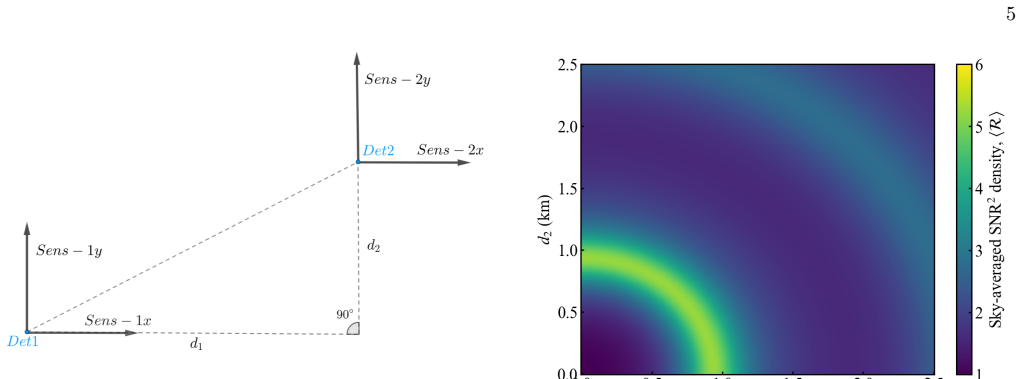
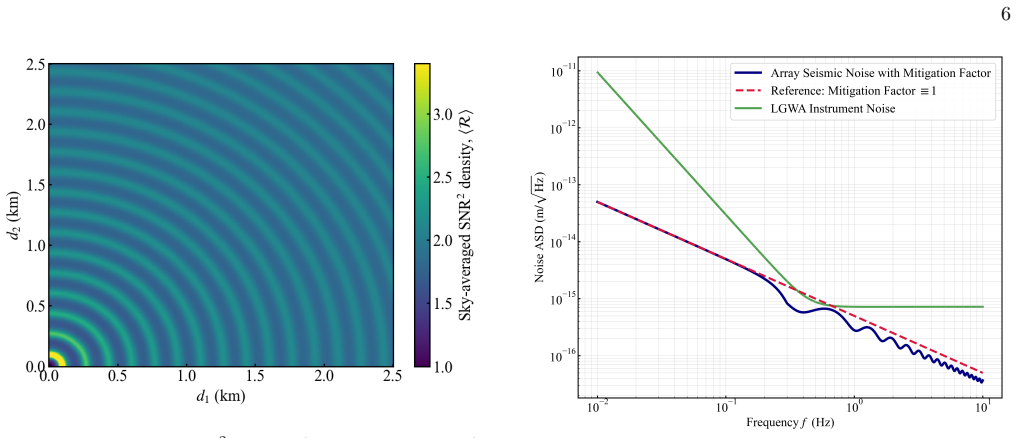
We derive the analytical expressions for the optimal squared signal-to-noise ratio considering two seismic stations in an isotropic, random, Gaussian seismic field. Our numerical analysis reveals that the capacity to mitigate the seismic noise critically depends on the distance between the two stations relative to the seismic-correlation length. We demonstrate that optimal placement of the two stations can yield significant improvements in the equivalent seismic noise amplitude spectrum density (ASD), approximately a factor of 2.3 at 0.3 Hz, compared to the measurement with a single station. The equivalent ASD of the seismic noise also exhibits distinct oscillatory and mitigation features.
What carries the argument
The Bessel-function form of the spatial correlation in an isotropic random Gaussian seismic field, which determines how signals from two stations are optimally combined to maximize the signal-to-noise ratio.
If this is right
- Optimal station separation relative to the seismic correlation length produces the largest noise reduction.
- The equivalent seismic noise ASD improves by a factor of approximately 2.3 at 0.3 Hz under optimal placement.
- The noise spectrum after combination displays oscillatory features set by the Bessel correlation structure.
- Array processing with two stations distinguishes gravitational-wave signals from the seismic background more effectively than a single station.
Where Pith is reading between the lines
- Extending the same correlation model to three or more stations could yield further noise suppression beyond the two-station case.
- Direct measurements of actual lunar seismic correlations would allow the analytical expressions to be recalibrated for site-specific conditions.
- The same optimal-combination approach may apply to other array-based gravitational-wave concepts on the Moon or on Earth where correlated noise dominates.
Load-bearing premise
The lunar seismic background is an isotropic random Gaussian field whose correlations are completely described by a Bessel-function form.
What would settle it
Seismic data recorded on the Moon showing correlation lengths or directional dependence that deviate strongly from the assumed Bessel form at frequencies near 0.3 Hz would eliminate the predicted factor-of-2.3 improvement.
Figures
read the original abstract
Lunar gravitational-wave (GW) detectors relying on the measurement of the response of the Moon to GWs are susceptible to a seismic background, which might pose a fundamental sensitivity limitation. The Lunar Gravitational-wave Antenna (LGWA) was conceived as an array of accelerometers with the idea that data can be processed to distinguish between a GW signal and the seismic background. As a result, the seismic noise of the GW measurement would be mitigated. However, so far, no quantitative assessment of the mitigation of the seismic background has been provided. In this article, we derive the analytical expressions for the optimal squared signal-to-noise ratio considering two seismic stations in an isotropic, random, Gaussian seismic field. Our numerical analysis reveals that the capacity to mitigate the seismic noise critically depends on the distance between the two stations relative to the seismic-correlation length. We demonstrate that optimal placement of the two stations can yield significant improvements in the equivalent seismic noise amplitude spectrum density (ASD), approximately a factor of 2.3 at 0.3 Hz, compared to the measurement with a single station. The equivalent ASD of the seismic noise also exhibits distinct oscillatory and mitigation features arising from the Bessel-function structure of the noise correlation.
Editorial analysis
A structured set of objections, weighed in public.
Referee Report
Summary. The manuscript derives analytical expressions for the optimal squared signal-to-noise ratio using two seismic stations in an isotropic, random, Gaussian seismic field whose spatial correlation is given by a Bessel function. Numerical results show that seismic-noise mitigation for the Lunar Gravitational-wave Antenna depends on station separation relative to the correlation length, with optimal placement yielding an approximately factor-of-2.3 reduction in equivalent seismic noise ASD at 0.3 Hz together with distance-dependent oscillatory features.
Significance. If the stated statistical model of the seismic field is applicable, the work supplies a clean, closed-form framework for quantifying array-based seismic mitigation in lunar GW detectors and identifies concrete guidance for station placement. The analytical SNR derivation and the explicit link between mitigation performance and the Bessel correlation structure constitute clear strengths.
major comments (2)
- [Numerical analysis and optimal-combination derivation] The factor-of-2.3 ASD improvement at 0.3 Hz and the reported oscillatory mitigation features are obtained by inverting the 2×2 noise covariance matrix whose off-diagonal elements are J0(d/λ). This result is load-bearing for the central claim; the manuscript should therefore include at least a brief sensitivity analysis or explicit statement of the range of validity when the actual lunar seismic field deviates from perfect isotropy, Gaussianity, or the exact Bessel functional form (e.g., due to scattering or layering).
- [Optimal SNR derivation] The optimal linear combination is derived under the assumption that the GW-induced signal vector is known and deterministic. Because real GW signals have unknown direction and polarization, the practical SNR gain may be lower; the paper should quantify or bound the degradation under a stochastic or unknown-signal model.
minor comments (2)
- [Abstract] The abstract states “approximately a factor of 2.3 at 0.3 Hz” without specifying the exact station separation or correlation length used; adding these parameters would improve reproducibility.
- [Figures] Figure captions should explicitly state the correlation length λ and the frequency at which each curve is evaluated so that the distance-dependent oscillations can be interpreted without reference to the main text.
Simulated Author's Rebuttal
We thank the referee for the careful reading and the recommendation of minor revision. We address each major comment below and have updated the manuscript accordingly.
read point-by-point responses
-
Referee: [Numerical analysis and optimal-combination derivation] The factor-of-2.3 ASD improvement at 0.3 Hz and the reported oscillatory mitigation features are obtained by inverting the 2×2 noise covariance matrix whose off-diagonal elements are J0(d/λ). This result is load-bearing for the central claim; the manuscript should therefore include at least a brief sensitivity analysis or explicit statement of the range of validity when the actual lunar seismic field deviates from perfect isotropy, Gaussianity, or the exact Bessel functional form (e.g., due to scattering or layering).
Authors: We agree that the assumptions of the seismic-field model are central to the quantitative claims. The revised manuscript now contains an explicit statement in the Discussion section that the derived improvement factor and oscillatory features are obtained under the assumptions of statistical isotropy, Gaussianity, and the exact Bessel correlation function. We further note that deviations arising from scattering or layering would alter the off-diagonal covariance terms and therefore the achievable mitigation. A full numerical sensitivity study is not possible with currently available lunar seismic data; the closed-form expressions we provide, however, constitute a transparent baseline that future work can extend once more detailed correlation measurements exist. revision: yes
-
Referee: [Optimal SNR derivation] The optimal linear combination is derived under the assumption that the GW-induced signal vector is known and deterministic. Because real GW signals have unknown direction and polarization, the practical SNR gain may be lower; the paper should quantify or bound the degradation under a stochastic or unknown-signal model.
Authors: The derivation yields the maximum attainable SNR for a perfectly known deterministic signal vector (i.e., fixed direction and polarization). This quantity therefore represents the theoretical upper bound on noise mitigation with the two-station configuration. For signals whose parameters are unknown a priori, the effective gain depends on the detection statistic (e.g., marginalization over sky location and polarization). We have added a concise paragraph in the Conclusions acknowledging this distinction and stating that the reported factor of ~2.3 is the ideal-case improvement. A quantitative bound on the degradation would require a specific GW population model and search pipeline, which lies outside the scope of the present work whose focus is the characterization of the seismic-noise covariance. revision: partial
Circularity Check
Derivation is self-contained from model assumptions to quantitative predictions
full rationale
The paper begins with the explicit modeling assumption of an isotropic, random, Gaussian seismic field whose spatial correlation is given by the Bessel function J0(d/λ). It then derives the optimal linear combination of two stations by inverting the 2x2 noise covariance matrix (whose off-diagonals are exactly that J0 term) to maximize the squared SNR for a deterministic GW signal. The reported factor-of-2.3 ASD improvement at 0.3 Hz and the oscillatory features are obtained by direct numerical evaluation of the resulting closed-form SNR expression as a function of station separation. No parameter is fitted to data, no result is defined in terms of itself, and no load-bearing step reduces to a self-citation or prior ansatz by the same authors. The entire chain is a standard forward derivation whose outputs are conditional on the stated statistical model but not equivalent to the inputs by construction.
Axiom & Free-Parameter Ledger
axioms (1)
- domain assumption The seismic background is an isotropic, random, Gaussian field
Reference graph
Works this paper leans on
-
[1]
A special situation occurs when ν2Sr n(kRd)2 ≪P inst ≪ν 2Sr n: RPar env-inst ≃ 1 2 |s+|2 ν2Srn + |δs|2 Pinst .(22) We notice that, in the parallel caseδs/s∼ O(d/R M), as seen in Eq
Parallel detectors (τ 1 =τ 2) When the sensitive axes of two detectors are perfectly parallel, the normalized correlation function can be ap- proximated as ΓPar ≃1− (kRd)2 8 (2 + cos 2τ),(19) and the SNR 2 density are RPar ≃1 2 |s+|2 Pinst +ν 2Srn + |δs|2 Pinst +ν 2Srn(kRd)2(2 + cos 2τ)/16 (20) RPar env ≃ 1 ν2Srn |s+|2 2 + 8|δs|2 (kRd)2(2 + cos 2τ) .(21) ...
2000
-
[2]
Non-parallel detectors (τ 1 ̸=τ 2) The SNR2 density for two non-parallel detectors is RNP env ≃ 1 ν2Srn |s+|2 1 + cos(τ1 −τ 2) + |δs|2 1−cos(τ 1 −τ 2) = 2 ν2Srn δs2 + 2s1s2[1−cos(τ 1 −τ 2)] sin2(τ1 −τ 2) .(24) E. Strain Noise Estimation and Equivalent Noise Spectrum Based on the calculations of SNR 2 density, we can di- rectly calculate the (dimensionless...
-
[3]
Furthermore, because the ratio of the array baseline to the seismic wavelength varies across the observation band, an effect further compounded by the dispersive na- ture ofc R(f) in the lunar regolith, a fixed array geometry cannot provide optimal mitigation across all frequencies. While prior sensitivity studies (like [17]) typically esti- mated the noi...
2025
-
[4]
B. P. Abbott, R. Abbott, T. D. Abbott, F. Acernese, K. Ackley, C. Adams, T. Adams, P. Addesso, R. X. Ad- hikari, V. B. Adya, et al., The Astrophysical Journal Let- ters848, L12 (2017), URLhttps://doi.org/10.3847/ 2041-8213/aa91c9
2017
-
[5]
B. P. Abbott, R. Abbott, T. D. Abbott, F. Acernese, K. Ackley, C. Adams, T. Adams, P. Addesso, R. X. Ad- hikari, V. B. Adya, et al. (LIGO Scientific Collaboration and Virgo Collaboration), Phys. Rev. Lett.123, 011102 (2019), URLhttps://doi.org/10.1103/PhysRevLett. 123.011102
-
[6]
R. Abbott, T. D. Abbott, F. Acernese, K. Ackley, C. Adams, N. Adhikari, R. X. Adhikari, V. B. Adya, C. Affeldt, D. Agarwal, et al. (LIGO Scientific Collab- oration, Virgo Collaboration, and KAGRA Collabora- tion), Phys. Rev. X13, 041039 (2023), URLhttps: //doi.org/10.1103/PhysRevX.13.041039
-
[7]
P. R. Saulson, Phys. Rev. D30, 732 (1984)
1984
-
[8]
Harms, Living Reviews in Relativity22, 6 (2019)
J. Harms, Living Reviews in Relativity22, 6 (2019)
2019
-
[9]
J. Harms, B. J. J. Slagmolen, R. X. Adhikari, M. C. Miller, M. Evans, Y. Chen, H. M¨ uller, and M. Ando, Phys. Rev. D88, 122003 (2013), URLhttps://doi.org/ 10.1103/PhysRevD.88.122003
-
[10]
M. Colpi, K. Danzmann, et al., arXiv e-prints arXiv:2402.07571 (2024), 2402.07571
work page internal anchor Pith review arXiv 2024
-
[11]
TianQin: a space-borne gravitational wave detector
J. Luo, L.-S. Chen, H.-Z. Duan, et al., Classical and Quantum Gravity33, 035010 (2016), 1512.02076
work page Pith review arXiv 2016
-
[12]
Z. Luo, Y. Wang, Y. Wu, W. Hu, and G. Jin, Progress of Theoretical and Experimental Physics2021, 05A108 (2021). 10
2021
-
[13]
The promise of multi-band gravitational wave astronomy
A. Sesana, Phys. Rev. Lett.116, 231102 (2016), 1602.06951
work page Pith review arXiv 2016
-
[14]
M. Arca Sedda, C. P. L. Berry, K. Jani, et al., Classical and Quantum Gravity37, 215011 (2020), 1908.11375
- [15]
-
[16]
Lognonn´ e, M
P. Lognonn´ e, M. Le Feuvre, C. L. Johnson, and R. C. Weber, Journal of Geophysical Research (Planets)114, E12003 (2009)
2009
-
[17]
A. R. Vasavada, D. A. Paige, and S. E. Wood, Icarus 141, 179 (1999)
1999
-
[18]
C. Nunn, R. F. Garcia, Y. Nakamura, A. G. Marusiak, T. Kawamura, D. Sun, L. Margerin, R. Weber, M. Dril- leau, M. A. Wieczorek, et al., Space Science Reviews216, 89 (2020)
2020
-
[19]
Branchesi, M
M. Branchesi, M. Falanga, J. Harms, et al., Space Science Reviews219, 67 (2023)
2023
-
[20]
A. Cozzumbo, B. Mestichelli, M. Mirabile, L. Paiella, J. Tissino, and J. Harms, Philosophical Transactions of the Royal Society of London Series A382, 20230066 (2024), 2309.15160
-
[21]
M. Coughlin and J. Harms, Phys. Rev. D90, 102001 (2014), 1409.4680
- [22]
-
[23]
P. Amaro-Seoane, L. Bischof, J. J. Carter, M.-S. Har- tig, and D. Wilken, Classical and Quantum Gravity38, 125008 (2021), 2012.10443
- [24]
-
[25]
Weber, Physical Review117, 306 (1960)
J. Weber, Physical Review117, 306 (1960)
1960
-
[26]
Weber, Physics Today21, 34 (1968)
J. Weber, Physics Today21, 34 (1968)
1968
-
[27]
H. J. Paik and K. Y. Venkateswara, Advances in Space Research43, 167 (2009)
2009
-
[28]
J. Harms, Phys. Rev. Lett.129, 071102 (2022), URL https://doi.org/10.1103/PhysRevLett.129.071102
- [29]
-
[30]
M. Coughlin, N. Mukund, J. Harms, J. Driggers, R. Ad- hikari, and S. Mitra, Classical and Quantum Gravity33, 244001 (2016), 1606.01716
-
[31]
S. Koley, J. Harms, A. Allocca, F. Badaracco, A. Bertolini, T. Bulik, E. Calloni, M. Cieslar, R. De Rosa, L. Errico, et al., The European Physical Journal Plus 139, 48 (2024), ISSN 2190-5444, URLhttps://doi.org/ 10.1140/epjp/s13360-023-04834-0
- [32]
- [33]
-
[34]
M. Campillo and A. Paul, Science299, 547 (2003), https://www.science.org/doi/pdf/10.1126/science.1078551, URLhttps://www.science.org/doi/abs/10.1126/ science.1078551
-
[35]
E. Larose, A. Khan, Y. Nakamura, and M. Campillo, Geophysical Research Letters32(2005), URL https://agupubs.onlinelibrary.wiley.com/doi/ abs/10.1029/2005GL023518
-
[36]
T. V. Gudkova, P. Lognonn´ e, and J. Gagnepain-Beyneix, Icarus211, 1049 (2011)
2011
-
[37]
Kawamura, P
T. Kawamura, P. Lognonn´ e, Y. Nishikawa, and S. Tanaka, Journal of Geophysical Research (Planets) 122, 1487 (2017)
2017
-
[38]
Nakamura, Journal of Geophysical Research (Planets) 110, E01001 (2005)
Y. Nakamura, Journal of Geophysical Research (Planets) 110, E01001 (2005)
2005
-
[39]
Duennebier and G
F. Duennebier and G. H. Sutton, Journal of Geophysical Research79, 4351 (1974)
1974
-
[40]
Nakamura, G
Y. Nakamura, G. V. Latham, H. J. Dorman, A.-B. K. Ibrahim, J. Koyama, and P. Horvath, Lunar and Plane- tary Science Conference Proceedings3, 2299 (1979)
1979
-
[41]
Oberst, A
J. Oberst, A. Christou, R. Suggs, D. Moser, I. J. Daubar, A. S. McEwen, M. Burchell, T. Kawamura, H. Hiesinger, K. W¨ unnemann, et al., Planetary and Space Science74, 179 (2012)
2012
-
[42]
Gillet, L
K. Gillet, L. Margerin, M. Calvet, and M. Monnereau, Physics of the Earth and Planetary Interiors262, 28 (2017)
2017
-
[43]
Aki, Bulletin of the Earthquake Research Institute 35, 415 (1957)
K. Aki, Bulletin of the Earthquake Research Institute 35, 415 (1957)
1957
-
[44]
Cox, Acoustical Society of America Journal54, 1289 (1973)
H. Cox, Acoustical Society of America Journal54, 1289 (1973)
1973
-
[45]
M. M. Haney, T. D. Mikesell, K. van Wijk, and H. Naka- hara, Geophysical Journal International191, 189 (2012)
2012
-
[46]
Ben-Menahem, Nuovo Cimento C Geophysics Space Physics C6, 49 (1983)
A. Ben-Menahem, Nuovo Cimento C Geophysics Space Physics C6, 49 (1983)
1983
-
[47]
Majstorovi´ c, S
J. Majstorovi´ c, S. Rosat, and Y. Rogister, Phys. Rev. D 100, 044048 (2019)
2019
-
[48]
H. Yan, X. Chen, J. Zhang, F. Zhang, M. Wang, and L. Shao, Phys. Rev. D109, 064092 (2024), URLhttps: //doi.org/10.1103/PhysRevD.109.064092
- [49]
- [50]
-
[51]
R. C. Weber, P.-Y. Lin, E. J. Garnero, Q. Williams, and P. Lognonn´ e, Science331, 309 (2011)
2011
-
[52]
Sens-Sch¨ onfelder and E
C. Sens-Sch¨ onfelder and E. Larose, Earthquake Science 23, 519 (2010)
2010
-
[53]
J. F. Blanchette-Guertin, C. L. Johnson, and J. F. Lawrence, Journal of Geophysical Research (Planets) 117, E06003 (2012)
2012
-
[54]
K. Onodera, T. Kawamura, S. Tanaka, Y. Ishi- hara, and T. Maeda, Journal of Geophysical Research: Planets126, e2020JE006406 (2021), e2020JE006406 2020JE006406, URLhttps://agupubs.onlinelibrary. wiley.com/doi/abs/10.1029/2020JE006406
discussion (0)
Sign in with ORCID, Apple, or X to comment. Anyone can read and Pith papers without signing in.