Recognition: unknown
Joint Multiband Photometry with crowdsource
Pith reviewed 2026-05-07 17:11 UTC · model grok-4.3
The pith
Joint multiband fitting in crowdsource shares source positions across bands to improve flux consistency and cut positional scatter.
A machine-rendered reading of the paper's core claim, the machinery that carries it, and where it could break.
Core claim
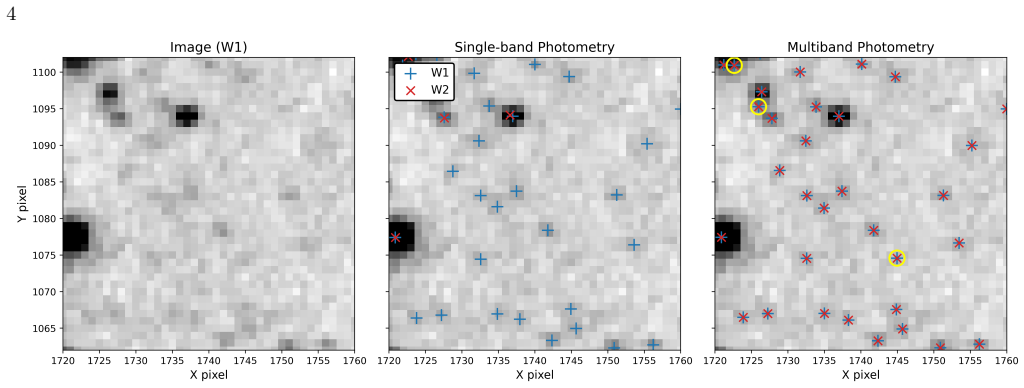
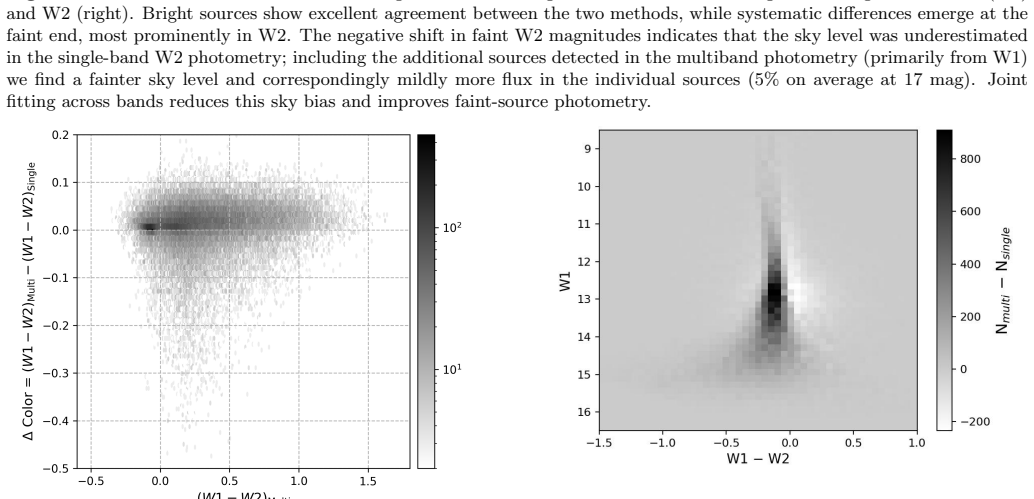
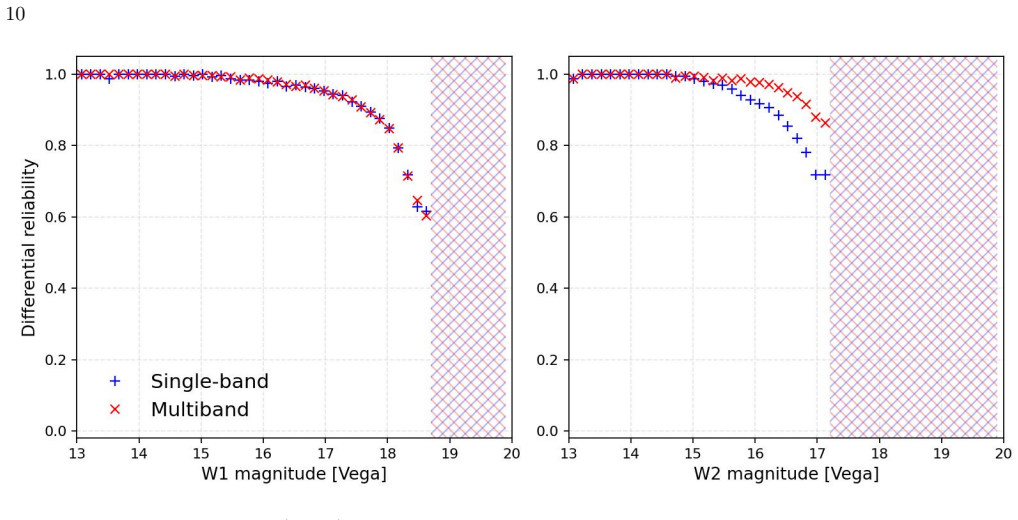
The multiband extension performs simultaneous fitting across bands by constraining sources to identical sky positions while allowing fluxes to vary freely; all available images contribute to source detection with configurable weighting. When applied to unWISE coadded tiles in both sparse and crowded regions, the joint fit produces more consistent fluxes and smaller band-to-band positional differences than independent single-band processing. The framework supplies a general foundation for constructing multiband crowded-field catalogs.
What carries the argument
The mathematical formulation of the multiband fit that enforces shared source locations across bands while permitting independent fluxes.
If this is right
- Photometric catalogs from crowded fields gain higher internal consistency between bands.
- Band-to-band positional scatter decreases relative to separate fits.
- Faint-source detection improves by combining information from all bands with spectral weighting.
- The same shared-position constraint supplies a reusable basis for other multiband crowded-field pipelines.
Where Pith is reading between the lines
- The fixed-position assumption could support more stable color measurements for source classification across bands.
- Surveys with many simultaneous bands would likely see larger reductions in catalog scatter in dense fields.
- The joint framework could be extended to time-series data to separate positional stability from flux variability.
Load-bearing premise
Sources occupy exactly the same positions in every band, differing only in their measured fluxes.
What would settle it
Running the joint versus independent fits on the same set of unWISE W1-W2 tiles and finding no reduction in either flux scatter or band-to-band positional differences would falsify the performance improvement.
Figures



read the original abstract
We present a new multiband extension to the crowdsource photometric pipeline, enabling simultaneous fitting across multiple imaging bands in crowded fields. The core idea is that multiple images of the same part of the sky should have the same sources at the same locations; only the fluxes in the different images should be allowed to vary in fitting. The framework also allows us to use all images of a given region to detect faint sources, with configurable weighting among the different bandpasses as appropriate for different source spectra. Similar concepts are already present in other crowded field packages like DAOPHOT and DOLPHOT; we now include it in the crowdsource fitting approach. We describe the mathematical formulation of the multiband fit and demonstrate its performance using the Wide-field Infrared Survey Explorer (WISE) W1 and W2 imaging as a concrete application. The multiband algorithm improves flux consistency and reduces band-to-band positional scatter relative to independent-band fitting. We test the method on unWISE coadded tiles spanning both sparse and crowded regions and quantify improvements in photometric agreement and astrometric stability. This framework provides a general foundation for future multiband crowded-field catalogs.
Editorial analysis
A structured set of objections, weighed in public.
Referee Report
Summary. The manuscript introduces a multiband extension to the crowdsource photometric pipeline for simultaneous fitting across imaging bands in crowded fields. The core model enforces identical source positions across bands while permitting band-specific fluxes to vary, and it incorporates multi-band data for source detection with configurable weighting. The approach is demonstrated on WISE W1 and W2 coadded tiles in both sparse and crowded regions, with the central claim being improved flux consistency and reduced band-to-band positional scatter relative to independent per-band fits.
Significance. If the flux-consistency results hold under the shared-position assumption, the method offers a practical addition to the crowdsource framework for producing more consistent multi-band catalogs in crowded fields. It extends established ideas from packages such as DAOPHOT and DOLPHOT with a configurable detection weighting scheme. The non-tautological component (flux agreement) could benefit analyses requiring cross-band photometry, provided the assumption of fixed positions is valid for the target population.
major comments (2)
- [Abstract] Abstract: the claim that the multiband algorithm 'reduces band-to-band positional scatter relative to independent-band fitting' is a direct consequence of the shared-position constraint (core idea paragraph). Inter-band position differences are identically zero by model construction in the joint fit but can be nonzero in independent fits; this therefore supplies no independent evidence of improved astrometric performance.
- [Demonstration on WISE data] Demonstration on WISE data: the abstract states that improvements in photometric agreement and astrometric stability are quantified, yet no specific numerical results (e.g., RMS flux differences, median positional offsets with uncertainties, or statistical tests) are supplied. Without these concrete metrics and baseline comparisons in the results section, the central performance claims cannot be evaluated.
minor comments (2)
- The abstract references DAOPHOT and DOLPHOT but supplies no citations; adding the standard references would place the work in context.
- [Mathematical formulation] Mathematical formulation section: the configurable weighting for multi-band detection is described but would benefit from an explicit equation or numerical example showing how weights are chosen for different source spectra.
Simulated Author's Rebuttal
We thank the referee for their careful and constructive review. We address each major comment below and have revised the manuscript to incorporate the suggested clarifications and additions.
read point-by-point responses
-
Referee: [Abstract] Abstract: the claim that the multiband algorithm 'reduces band-to-band positional scatter relative to independent-band fitting' is a direct consequence of the shared-position constraint (core idea paragraph). Inter-band position differences are identically zero by model construction in the joint fit but can be nonzero in independent fits; this therefore supplies no independent evidence of improved astrometric performance.
Authors: We agree that the elimination of inter-band positional differences is a direct and intended consequence of the shared-position model rather than an independent demonstration of improved astrometric precision. The joint fit enforces consistency by construction, which we view as a practical advantage for producing unified multi-band catalogs. We will revise the abstract and the relevant discussion to remove any implication that this constitutes evidence of superior astrometry and instead emphasize it as a model feature that improves catalog consistency. revision: yes
-
Referee: [Demonstration on WISE data] Demonstration on WISE data: the abstract states that improvements in photometric agreement and astrometric stability are quantified, yet no specific numerical results (e.g., RMS flux differences, median positional offsets with uncertainties, or statistical tests) are supplied. Without these concrete metrics and baseline comparisons in the results section, the central performance claims cannot be evaluated.
Authors: We acknowledge that while the manuscript states that improvements are quantified, the results section does not present the specific numerical metrics and statistical comparisons with sufficient detail. In the revised manuscript we will add explicit values for RMS flux differences between bands, median and RMS positional offsets (with uncertainties), and direct comparisons to independent-band fits, including any relevant statistical tests, supported by additional tables or figures. revision: yes
Circularity Check
Band-to-band positional scatter reduction is by construction under the shared-position model
specific steps
-
self definitional
[Abstract]
"The multiband algorithm improves flux consistency and reduces band-to-band positional scatter relative to independent-band fitting."
The framework defines that 'multiple images of the same part of the sky should have the same sources at the same locations; only the fluxes in the different images should be allowed to vary in fitting.' Band-to-band positional differences are therefore identically zero by model construction in the joint fit, while nonzero in independent-band fits. The asserted reduction is a direct consequence of the shared-position assumption rather than an independent result.
full rationale
The paper's core model enforces identical source positions across bands by definition, with only fluxes varying. The claimed reduction in band-to-band positional scatter therefore follows tautologically from this constraint when compared to independent fits (where positions may differ). Flux consistency improvements are not similarly forced, but the strongest claim bundles both, making the overall result partially circular. No other derivation steps reduce to inputs by construction.
Axiom & Free-Parameter Ledger
axioms (1)
- domain assumption Sources share identical positions across all bands
Reference graph
Works this paper leans on
-
[1]
Astropy Collaboration, Robitaille, T. P., Tollerud, E. J., et al. 2013, A&A, 558, A33, doi: 10.1051/0004-6361/201322068
-
[2]
2016, DOLPHOT: Stellar photometry,, Astrophysics Source Code Library, record ascl:1608.013 http://ascl.net/1608.013
Dolphin, A. 2016, DOLPHOT: Stellar photometry,, Astrophysics Source Code Library, record ascl:1608.013 http://ascl.net/1608.013
2016
-
[3]
Dolphin, A. E. 2000, PASP, 112, 1383, doi: 10.1086/316630
-
[4]
Farren, G. S., Krolewski, A., Qu, F. J., et al. 2025, PhRvD, 111, 083516, doi: 10.1103/PhysRevD.111.083516
-
[5]
Krolewski, A., Ferraro, S., Schlafly, E. F., & White, M. 2020, JCAP, 2020, 047, doi: 10.1088/1475-7516/2020/05/047
-
[6]
Cosmological constraints from unWISE and Planck CMB lensing tomography
Krolewski, A., Ferraro, S., & White, M. 2021, JCAP, 2021, 028, doi: 10.1088/1475-7516/2021/12/028
-
[7]
2014, AJ, 147, 108, doi: 10.1088/0004-6256/147/5/108
Lang, D. 2014, AJ, 147, 108, doi: 10.1088/0004-6256/147/5/108
-
[8]
Lang, D., Hogg, D. W., & Schlegel, D. J. 2016, AJ, 151, 36, doi: 10.3847/0004-6256/151/2/36
-
[9]
Meisner, A. M., Lang, D., Schlafly, E. F., & Schlegel, D. J. 2019, PASP, 131, 124504, doi: 10.1088/1538-3873/ab3df4
-
[10]
Meisner, A. M., Lang, D., & Schlegel, D. J. 2017, AJ, 154, 161, doi: 10.3847/1538-3881/aa894e
-
[11]
C., & Saunders, M
Paige, C. C., & Saunders, M. A. 1982, ACM Trans. Math. Software, 8, 43 14
1982
-
[12]
Portillo, S. K. N., Speagle, J. S., & Finkbeiner, D. P. 2020, AJ, 159, 165, doi: 10.3847/1538-3881/ab76ba
-
[13]
Sanders, D. B., Salvato, M., Aussel, H., et al. 2007, ApJS, 172, 86, doi: 10.1086/517885
-
[14]
The Astrophysical Journal Supplement Series , author =
Schlafly, E. F., Meisner, A. M., & Green, G. M. 2019, ApJS, 240, 30, doi: 10.3847/1538-4365/aafbea
-
[15]
Schlafly, E. F., Green, G. M., Lang, D., et al. 2018, ApJS, 234, 39, doi: 10.3847/1538-4365/aaa3e2
-
[16]
2007, ApJS, 172, 1, doi: 10.1086/516585
Scoville, N., Aussel, H., Brusa, M., et al. 2007, ApJS, 172, 1, doi: 10.1086/516585
-
[17]
Stetson, P. B. 1987, PASP, 99, 191, doi: 10.1086/131977
-
[18]
Szalay, A. S., Connolly, A. J., & Szokoly, G. P. 1999, AJ, 117, 68, doi: 10.1086/300689
-
[19]
Wright, E. L., Eisenhardt, P. R. M., Mainzer, A. K., et al. 2010, AJ, 140, 1868, doi: 10.1088/0004-6256/140/6/1868
discussion (0)
Sign in with ORCID, Apple, or X to comment. Anyone can read and Pith papers without signing in.