Recognition: unknown
Symmetry-Protected Topological Phases in the Triangular Majorana-Hubbard Ladder
Pith reviewed 2026-05-08 01:39 UTC · model grok-4.3
The pith
The triangular Majorana-Hubbard model on a four-leg ladder hosts multiple symmetry-protected topological phases.
A machine-rendered reading of the paper's core claim, the machinery that carries it, and where it could break.
Core claim
The triangular-lattice Majorana-Hubbard model on a four-leg ladder exhibits a richer variety of phases than previously known. Analysis of entanglement-spectrum degeneracies and adiabatic connections identifies multiple symmetry-protected topological phases. These phases could be realized in arrays of vortex-bound Majorana modes on the surface of a topological superconductor.
What carries the argument
Entanglement-spectrum degeneracies of the ground-state wavefunction, used to diagnose the presence and type of symmetry-protected topological order in the Majorana-Hubbard ladder.
If this is right
- The phase diagram contains more distinct phases than reported in prior studies of the same model.
- Multiple symmetry-protected topological phases are separated by phase boundaries that can be crossed adiabatically.
- The identified phases remain stable under the symmetries of the triangular-lattice Majorana-Hubbard interaction.
- Arrays of vortex-bound Majorana modes provide a concrete physical setting in which the predicted phases could appear.
Where Pith is reading between the lines
- Ladder geometries may serve as useful minimal models for capturing essential features of two-dimensional Majorana lattices.
- The results suggest that similar numerical diagnostics could be applied to other interaction strengths or lattice geometries to locate additional protected phases.
- Confirmation of these phases would supply concrete targets for experiments that engineer Majorana modes on superconducting surfaces.
Load-bearing premise
Numerical results from DMRG and variational uniform matrix product states on the finite-width ladder faithfully represent the true ground states of the infinite system, with entanglement degeneracies remaining free of significant truncation or finite-size artifacts.
What would settle it
A larger-scale simulation or direct experimental probe that finds a non-degenerate entanglement spectrum in a parameter regime the paper identifies as symmetry-protected topological.
Figures






read the original abstract
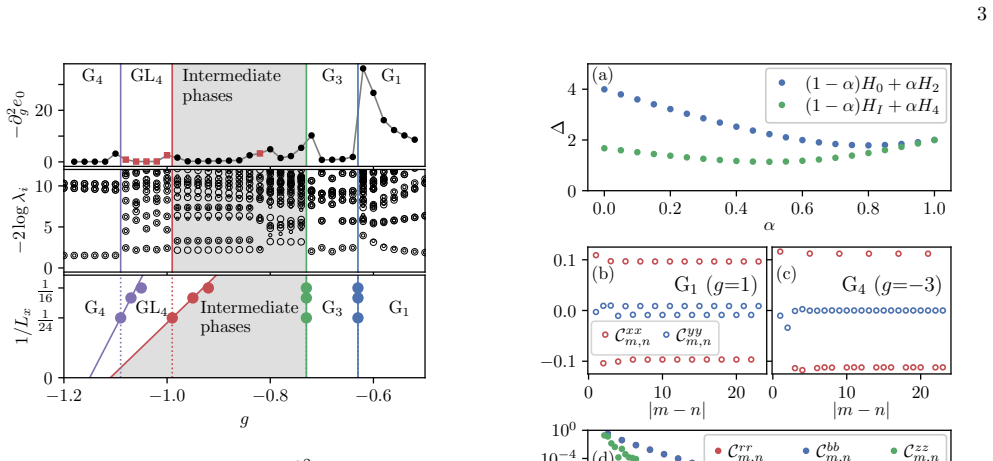
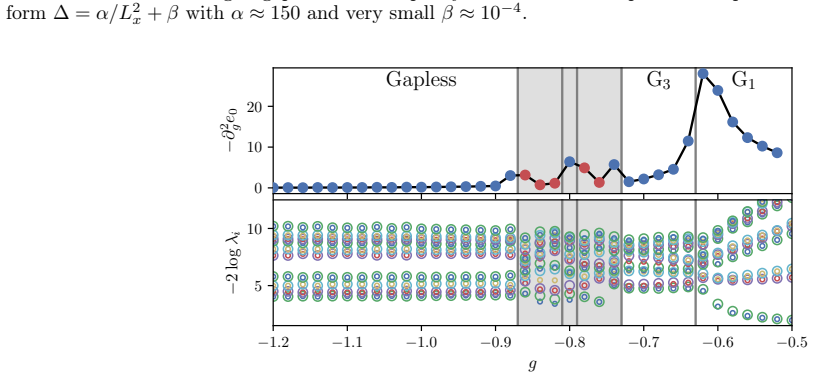
We map the phase diagram of the triangular-lattice Majorana-Hubbard model on a four-leg ladder using DMRG and variational uniform matrix product states, revealing a richer variety of phases than previously known. Analysis of entanglement-spectrum degeneracies and adiabatic connections identifies multiple symmetry-protected topological (SPT) phases. These phases could be realized in arrays of vortex-bound Majorana modes on the surface of a topological superconductor.
Editorial analysis
A structured set of objections, weighed in public.
Referee Report
Summary. The manuscript maps the phase diagram of the triangular-lattice Majorana-Hubbard model on a four-leg ladder using DMRG and variational uniform matrix product states. It identifies multiple symmetry-protected topological (SPT) phases via entanglement-spectrum degeneracies and adiabatic connections, suggesting possible realization in vortex-bound Majorana mode arrays on topological superconductor surfaces.
Significance. If the numerical identifications hold, the work would advance understanding of interacting Majorana systems by revealing a richer set of SPT phases than previously reported. The tensor-network approach combined with symmetry diagnostics is a methodological strength, and the proposed experimental link to topological superconductors adds relevance.
major comments (2)
- [§3 (Numerical Methods)] §3 (Numerical Methods): The DMRG and VUMPS sections report entanglement spectrum degeneracies used to diagnose SPT order but omit explicit bond-dimension convergence data, truncation-error estimates, or finite-size scaling. In interacting Majorana models, finite bond dimension can split or fabricate low-lying entanglement levels, so these checks are load-bearing for the central SPT claims.
- [§4 (Phase identifications)] §4 (Phase identifications): The adiabatic connection arguments and four-leg ladder results do not address how quasi-1D wrapping or boundary effects might alter effective symmetries or whether the reported SPT degeneracies persist for wider ladders; this is required to confirm the phases are not geometry artifacts.
minor comments (2)
- [Abstract] Abstract: The claim of 'a richer variety of phases than previously known' would be clearer if the newly identified phases were named or briefly characterized.
- [Throughout] Notation: Define all symmetry labels (e.g., for the SPT phases) at first use to aid readers unfamiliar with the specific Majorana-Hubbard symmetries.
Simulated Author's Rebuttal
We thank the referee for their careful reading of our manuscript and for the constructive comments. We address each major point below and will revise the manuscript accordingly to strengthen the numerical evidence and clarify the geometric considerations.
read point-by-point responses
-
Referee: §3 (Numerical Methods): The DMRG and VUMPS sections report entanglement spectrum degeneracies used to diagnose SPT order but omit explicit bond-dimension convergence data, truncation-error estimates, or finite-size scaling. In interacting Majorana models, finite bond dimension can split or fabricate low-lying entanglement levels, so these checks are load-bearing for the central SPT claims.
Authors: We agree that explicit convergence checks are essential for validating the entanglement spectrum degeneracies. In the revised manuscript, we will add bond-dimension convergence data, truncation-error estimates, and finite-size scaling analysis for representative points in each phase to demonstrate that the reported degeneracies are robust against finite bond dimension. revision: yes
-
Referee: §4 (Phase identifications): The adiabatic connection arguments and four-leg ladder results do not address how quasi-1D wrapping or boundary effects might alter effective symmetries or whether the reported SPT degeneracies persist for wider ladders; this is required to confirm the phases are not geometry artifacts.
Authors: We acknowledge the concern about ladder geometry. Our calculations use both open and periodic boundary conditions, with SPT degeneracies appearing consistently. Adiabatic connections are performed within the four-leg geometry to maintain symmetries. In the revision, we will add discussion explaining why the four-leg results are representative based on symmetry analysis. However, simulations on wider ladders are computationally prohibitive at present and are noted as future work; we cannot fully rule out geometry-specific effects without them. revision: partial
Circularity Check
Numerical phase mapping via DMRG/VUMPS is self-contained with no circular reductions
full rationale
The paper maps the phase diagram of the triangular Majorana-Hubbard model on a four-leg ladder using direct DMRG and variational uniform matrix product state simulations. Phases are identified by computing entanglement-spectrum degeneracies and checking adiabatic connections between states. No analytical derivation chain exists that reduces predictions or first-principles results to fitted parameters, self-definitions, or load-bearing self-citations by construction. The methodology consists of numerical outputs interpreted through standard entanglement diagnostics, making the work self-contained against external benchmarks without any of the enumerated circularity patterns.
Axiom & Free-Parameter Ledger
axioms (1)
- domain assumption DMRG and variational uniform matrix product states provide accurate approximations to the ground states of the quantum lattice model
Reference graph
Works this paper leans on
-
[1]
A.Yu. Kitaev. Fault-tolerant quantum computa- tion by anyons.Annals of Physics, 303(1):2– 30, 2003. URL:https://www.sciencedirect. com/science/article/pii/S0003491602000180, doi:10.1016/S0003-4916(02)00018-0
work page Pith review doi:10.1016/s0003-4916(02)00018-0 2003
-
[2]
D. A. Ivanov. Non-abelian statistics of half-quantum vortices inp-wave superconductors.Phys. Rev. Lett., 86:268–271, Jan 2001. URL:https://link.aps. org/doi/10.1103/PhysRevLett.86.268,doi:10.1103/ PhysRevLett.86.268
-
[3]
Rudro R. Biswas. Majorana fermions in vor- tex lattices.Phys. Rev. Lett., 111:136401, Sep
-
[5]
Ryan V. Mishmash, A. Yazdani, and Michael P. Zale- tel. Majorana lattices from the quantized hall limit of a proximitized spin-orbit coupled electron gas.Phys. Rev. B, 99:115427, Mar 2019. URL:https://link.aps. org/doi/10.1103/PhysRevB.99.115427,doi:10.1103/ PhysRevB.99.115427
-
[6]
Evidence for majorana bound states in an iron-based superconductor.Science, 362(6412):333–335, 2018
Dongfei Wang, Lingyuan Kong, Peng Fan, Hui Chen, Shiyu Zhu, Wenyao Liu, Lu Cao, Yujie Sun, Shixuan 6 Du, John Schneeloch, et al. Evidence for majorana bound states in an iron-based superconductor.Science, 362(6412):333–335, 2018
2018
-
[7]
Half-integer level shift of vortex bound states in an iron-based superconductor.Nature Physics, 15(11):1181–1187, 2019
Lingyuan Kong, Shiyu Zhu, Michal Papaj, Hui Chen, Lu Cao, Hiroki Isobe, Yuqing Xing, Wenyao Liu, Dongfei Wang, Peng Fan, et al. Half-integer level shift of vortex bound states in an iron-based superconductor.Nature Physics, 15(11):1181–1187, 2019
2019
-
[8]
Ching-Kai Chiu, T. Machida, Yingyi Huang, T. Hanaguri, and Fu-Chun Zhang. Scalable majo- rana vortex modes in iron-based superconductors. Science Advances, 6(9):eaay0443, 2020. URL:https:// www.science.org/doi/abs/10.1126/sciadv.aay0443, arXiv:https://www.science.org/doi/pdf/10.1126/ sciadv.aay0443,doi:10.1126/sciadv.aay0443
-
[10]
Ching-Kai Chiu, D. I. Pikulin, and M. Franz. Strongly interacting majorana fermions.Phys. Rev. B, 91:165402, Apr 2015. URL:https://link.aps.org/doi/10. 1103/PhysRevB.91.165402,doi:10.1103/PhysRevB.91. 165402
-
[13]
Jin-Peng Xu, Mei-Xiao Wang, Zhi Long Liu, Jian-Feng Ge, Xiaojun Yang, Canhua Liu, Zhu An Xu, Dandan Guan, Chun Lei Gao, Dong Qian, et al. Experimental detection of a majorana mode in the core of a magnetic vortex inside a topological insulator-superconductor bi 2 te 3/nbse 2 heterostructure.Physical review letters, 114(1):017001, 2015
2015
-
[14]
Signatures of hybridiza- tion of multiple majorana zero modes in a vortex.Nature, 633(8028):71–76, 2024
Tengteng Liu, Chun Yu Wan, Hao Yang, Yujun Zhao, Bangjin Xie, Weiyan Zheng, Zhaoxia Yi, Dandan Guan, Shiyong Wang, Hao Zheng, et al. Signatures of hybridiza- tion of multiple majorana zero modes in a vortex.Nature, 633(8028):71–76, 2024
2024
-
[15]
Spon- taneous vortex-antivortex lattice and majorana fermions in rhombohedral graphene.Phys
Filippo Gaggioli, Daniele Guerci, and Liang Fu. Spon- taneous vortex-antivortex lattice and majorana fermions in rhombohedral graphene.Phys. Rev. Lett., 135:116001, Sep 2025. URL:https://link.aps.org/doi/10.1103/ k8sb-rqxf,doi:10.1103/k8sb-rqxf
-
[16]
Armin Rahmani and Marcel Franz. Interacting Ma- jorana fermions.Reports on Progress in Physics, 82(8):084501, August 2019.arXiv:1811.02593,doi: 10.1088/1361-6633/ab28ef
-
[17]
Majorana-hubbard model on the square lattice.Phys
Ian Affleck, Armin Rahmani, and Dmitry Pikulin. Majorana-hubbard model on the square lattice.Phys. Rev. B, 96:125121, Sep 2017. URL:https://link.aps. org/doi/10.1103/PhysRevB.96.125121,doi:10.1103/ PhysRevB.96.125121
-
[18]
Phase diagrams of majorana-hubbard ladders.Phys
Armin Rahmani, Dmitry Pikulin, and Ian Affleck. Phase diagrams of majorana-hubbard ladders.Phys. Rev. B, 99:085110, Feb 2019. URL:https://link.aps.org/doi/ 10.1103/PhysRevB.99.085110,doi:10.1103/PhysRevB. 99.085110
-
[19]
Majorana-hubbard model on the honeycomb lattice.Phys
Chengshu Li and Marcel Franz. Majorana-hubbard model on the honeycomb lattice.Phys. Rev. B, 98:115123, Sep 2018. URL:https://link.aps.org/doi/ 10.1103/PhysRevB.98.115123,doi:10.1103/PhysRevB. 98.115123
-
[20]
Majorana fermions on a disordered triangular lattice.New Journal of Physics, 13(10):105006, oct 2011
Yaacov E Kraus and Ady Stern. Majorana fermions on a disordered triangular lattice.New Journal of Physics, 13(10):105006, oct 2011. URL:https: //dx.doi.org/10.1088/1367-2630/13/10/105006,doi: 10.1088/1367-2630/13/10/105006
-
[22]
Topological order and conformal quantum crit- ical points.Annals of Physics, 310(2):493–551,
Eddy Ardonne, Paul Fendley, and Eduardo Frad- kin. Topological order and conformal quantum crit- ical points.Annals of Physics, 310(2):493–551,
-
[23]
URL:https://www.sciencedirect.com/science/ article/pii/S0003491604000247,doi:10.1016/j.aop. 2004.01.004
-
[25]
F. D. M. Haldane. Nonlinear field theory of large-spin heisenberg antiferromagnets: Semiclassi- cally quantized solitons of the one-dimensional easy- axis néel state.Phys. Rev. Lett., 50:1153–1156, Apr 1983. URL:https://link.aps.org/doi/10.1103/ PhysRevLett.50.1153,doi:10.1103/PhysRevLett.50. 1153
-
[27]
Hidden symmetry break- ing and the Haldane phase in S=1 quantum spin chains
Tom Kennedy and Hal Tasaki. Hidden symmetry break- ing and the Haldane phase in S=1 quantum spin chains. Communications in Mathematical Physics, 147(3):431– 484, July 1992.doi:10.1007/BF02097239
-
[28]
Dominic V. Else, Stephen D. Bartlett, and An- drew C. Doherty. Hidden symmetry-breaking picture of symmetry-protected topological order.Phys. Rev. B, 88:085114, Aug 2013. URL:https://link.aps. org/doi/10.1103/PhysRevB.88.085114,doi:10.1103/ PhysRevB.88.085114
-
[29]
Preroughening transitions in crystal surfaces and valence-bond phases in quantum spin chains.Phys
Marcel den Nijs and Koos Rommelse. Preroughening transitions in crystal surfaces and valence-bond phases in quantum spin chains.Phys. Rev. B, 40:4709–4734, Sep 1989. URL:https://link.aps.org/doi/10.1103/ PhysRevB.40.4709,doi:10.1103/PhysRevB.40.4709
-
[30]
Frank Pollmann and Ari M. Turner. Detection of symmetry-protected topological phases in one dimension. Phys. Rev. B, 86:125441, Sep 2012. URL:https:// link.aps.org/doi/10.1103/PhysRevB.86.125441,doi: 10.1103/PhysRevB.86.125441
- [31]
-
[32]
Unpaired majorana fermions in quantum wires.Physics-Uspekhi, 44(10S):131, oct 2001.doi:10
A Yu Kitaev. Unpaired majorana fermions in quantum wires.Physics-Uspekhi, 44(10S):131, oct 2001.doi:10. 1070/1063-7869/44/10S/S29
2001
-
[33]
Com- plete classification of one-dimensional gapped quantum phases in interacting spin systems.Phys
Xie Chen, Zheng-Cheng Gu, and Xiao-Gang Wen. Com- plete classification of one-dimensional gapped quantum phases in interacting spin systems.Phys. Rev. B, 84:235128, Dec2011. URL:https://link.aps.org/doi/ 10.1103/PhysRevB.84.235128,doi:10.1103/PhysRevB. 84.235128
-
[34]
Classifying quantum phases using matrix product states and projected entangled pair states.Phys
Norbert Schuch, David Pérez-García, and Ignacio Cirac. Classifying quantum phases using matrix product states and projected entangled pair states.Phys. Rev. B, 84:165139, Oct2011. URL:https://link.aps.org/doi/ 10.1103/PhysRevB.84.165139,doi:10.1103/PhysRevB. 84.165139
-
[35]
One-dimensional symmetry protected topo- logical phases and their transitions.Phys
Ruben Verresen, Roderich Moessner, and Frank Poll- mann. One-dimensional symmetry protected topo- logical phases and their transitions.Phys. Rev. B, 96:165124, Oct2017. URL:https://link.aps.org/doi/ 10.1103/PhysRevB.96.165124,doi:10.1103/PhysRevB. 96.165124
-
[38]
Supplemental Material for this letter, including fur- ther details on the triangular-lattice Majorana-Hubbard model, and additional results on the gapless mode
-
[39]
Aaron Szasz, Johannes Motruk, Michael P. Zaletel, and Joel E. Moore. Chiral spin liquid phase of the triangular lattice Hubbard model: a density matrix renormaliza- tion group study.arXiv e-prints, page arXiv:1808.00463, August 2018.arXiv:1808.00463,doi:10.48550/arXiv. 1808.00463
work page internal anchor Pith review doi:10.48550/arxiv 2018
-
[40]
Matthew Fishman, Steven R. White, and E. Miles Stoudenmire. The ITensor Software Library for Tensor Network Calculations.Sci- Post Phys. Codebases, page 4, 2022. URL: https://scipost.org/10.21468/SciPostPhysCodeb.4, doi:10.21468/SciPostPhysCodeb.4
-
[41]
Matthew Fishman, Steven R. White, and E. Miles Stoudenmire. Codebase release 0.3 for ITensor.SciPost Phys. Codebases, pages 4–r0.3, 2022. URL:https: //scipost.org/10.21468/SciPostPhysCodeb.4-r0.3, doi:10.21468/SciPostPhysCodeb.4-r0.3
-
[42]
Tangent-space methods for uniform matrix product states.SciPost Phys
Laurens Vanderstraeten, Jutho Haegeman, and Frank Verstraete. Tangent-space methods for uniform matrix product states.SciPost Phys. Lect. Notes, page 7, 2019. URL:https: //scipost.org/10.21468/SciPostPhysLectNotes.7, doi:10.21468/SciPostPhysLectNotes.7
-
[43]
This is not the case forσz, which is why we subtract the unconnected part of the correlation
Note that correlations in parity-violating operators such asγ r,b andσ x,y consist only of the connected part since the expecation value of these operators is zero by parity symmetry. This is not the case forσz, which is why we subtract the unconnected part of the correlation
-
[44]
H.W.J. Blöte, A. Compagner, P.A.M. Cornelis- sen, A. Hoogland, F. Mallezie, and C. Van- derzande. Critical behaviour of two ising models with multispin interactions.Physica A: Statisti- cal Mechanics and its Applications, 139(2):395– 411, 1986. URL:https://www.sciencedirect. com/science/article/pii/0378437186901287, doi:10.1016/0378-4371(86)90128-7
-
[46]
O. F. de Alcantara Bonfim and J. Florencio. Quan- tum phase transitions in the transverse one-dimensional ising model with four-spin interactions.Phys. Rev. B, 74:134413, Oct2006. URL:https://link.aps.org/doi/ 10.1103/PhysRevB.74.134413,doi:10.1103/PhysRevB. 74.134413
-
[47]
Loïc Turban. One-dimensional ising model with mul- tispin interactions.Journal of Physics A: Mathemat- ical and Theoretical, 49(35):355002, aug 2016.doi: 10.1088/1751-8113/49/35/355002
-
[48]
D. Pérez-García, M. M. Wolf, M. Sanz, F. Verstraete, and J. I. Cirac. String order and symmetries in quantum spin lattices.Phys. Rev. Lett., 100:167202, Apr 2008. URL:https://link.aps.org/doi/10.1103/ PhysRevLett.100.167202,doi:10.1103/PhysRevLett. 100.167202
-
[49]
Jill C. Bonner and Gerhard Müller. Breakdown of scaling in the 1d spin-1/2 heisenberg ferromagnet. Journal of Applied Physics, 61(8):4429–4431, 04 1987. arXiv:https://pubs.aip.org/aip/jap/article-pdf/ 61/8/4429/18610509/4429_1_online.pdf,doi: 10.1063/1.338399
-
[50]
Critical spin dy- namics of Heisenberg ferromagnets revisited.Phys
Dmytro Tarasevych and Peter Kopietz. Critical spin dy- namics of Heisenberg ferromagnets revisited.Phys. Rev. B, 105(2):024403, January 2022.arXiv:2111.07621, doi:10.1103/PhysRevB.105.024403
-
[51]
G. E. Volovik. Topological Lifshitz transitions.Low Temperature Physics, 43(1):47–55, January 2017.arXiv: 1606.08318,doi:10.1063/1.4974185
-
[52]
Linhao Li, Masaki Oshikawa, and Yunqin Zheng. Intrin- sically/purely gapless-SPT from non-invertible duality transformations.SciPost Phys., 18:153, 2025. URL: https://scipost.org/10.21468/SciPostPhys.18.5. 153,doi:10.21468/SciPostPhys.18.5.153
-
[53]
Rintaro Masaoka, Tomohiro Soejima, and Haruki Watan- abe. Quadraticdispersionrelationsingaplessfrustration- free systems.Phys. Rev. B, 110:195140, Nov 2024. URL:https://link.aps.org/doi/10.1103/PhysRevB. 110.195140,doi:10.1103/PhysRevB.110.195140
-
[54]
Wei-Lin Li, Dan-Dan Liang, Zhi Li, and Xue-Jia Yu. Emergent gapless spiral phases and conformal Lifshitz criticality in the cluster Ising model with off-diagonal in- teractions.arXiv e-prints, page arXiv:2506.07151, June 2025.arXiv:2506.07151,doi:10.48550/arXiv.2506. 07151
-
[55]
Gapless and ordered phases in spin-1/2 kitaev–xx–gamma chain.Chinese Physics B, 35(3):037503, mar 2026.doi:10.1088/ 1674-1056/ae3067
Zebin Zhuang and Wang Yang. Gapless and ordered phases in spin-1/2 kitaev–xx–gamma chain.Chinese Physics B, 35(3):037503, mar 2026.doi:10.1088/ 1674-1056/ae3067. 8
2026
-
[56]
Dmitry Green and Claudio Chamon. Adsorption on carbon nanotubes: Quantum spin tubes, magnetization plateaus, and conformal symmetry.Phys. Rev. Lett., 85:4128–4131, Nov 2000. URL:https://link.aps. org/doi/10.1103/PhysRevLett.85.4128,doi:10.1103/ PhysRevLett.85.4128
-
[57]
Dmitry Green and Claudio Chamon. Geometric frus- tration and magnetization plateaus in quantum spin and bose-hubbard models on tubes.Phys. Rev. B, 65:104431, Mar 2002. URL:https://link.aps. org/doi/10.1103/PhysRevB.65.104431,doi:10.1103/ PhysRevB.65.104431
-
[58]
Timco, and Richard E.P
Olivier Cador, Dante Gatteschi, Roberta Sessoli, Anne- Laure Barra, Grigore A. Timco, and Richard E.P. Win- penny. Spin frustration effects in an odd-member antifer- romagnetic ring and the magnetic möbius strip.Journal of Magnetism and Magnetic Materials, 290-291:55–60,
-
[59]
Proceedings of the Joint European Magnetic Sym- posia (JEMS’ 04). URL:https://www.sciencedirect. com/science/article/pii/S030488530401399X, doi:10.1016/j.jmmm.2004.11.159
-
[60]
Quantum transitions driven by one-bond de- fects in quantum ising rings, Apr 2015
Massimo Campostrini, Andrea Pelissetto, and Ettore Vicari. Quantum transitions driven by one-bond de- fects in quantum ising rings, Apr 2015. URL:https:// link.aps.org/doi/10.1103/PhysRevE.91.042123,doi: 10.1103/PhysRevE.91.042123
-
[61]
Jian-Jun Dong, Peng Li, and Qi-Hui Chen. The a-cycle problem for transverse ising ring.Jour- nal of Statistical Mechanics: Theory and Experi- ment, 2016(11):113102, nov 2016. URL:https://dx. doi.org/10.1088/1742-5468/2016/11/113102,doi:10. 1088/1742-5468/2016/11/113102
-
[62]
Wojciech Florek, Michal Antkowiak, and Grzegorz Kamieniarz. Sequences of ground states and classifica- tion of frustration in odd-numbered antiferromagnetic rings.Phys. Rev. B,94:224421, Dec2016. URL:https:// link.aps.org/doi/10.1103/PhysRevB.94.224421,doi: 10.1103/PhysRevB.94.224421
-
[63]
Salvatore Marco Giampaolo, Flavia Brága Ramos, and Fabio Franchini. The frustration of being odd: uni- versal area law violation in local systems.Journal of Physics Communications, 3(8):081001, August 2019. arXiv:1807.07055,doi:10.1088/2399-6528/ab3ab3
-
[64]
Vanja Marić, Salvatore Marco Giampaolo, Domagoj Kuić, and Fabio Franchini. The frustration of being odd: how boundary conditions can destroy local or- der.New Journal of Physics, 22(8):083024, August 2020. arXiv:1908.10876,doi:10.1088/1367-2630/aba064
-
[65]
Pasquale Calabrese and John Cardy. Entanglement en- tropy and conformal field theory.Journal of Physics A Mathematical General, 42(50):504005, December 2009.arXiv:0905.4013,doi:10.1088/1751-8113/42/ 50/504005
-
[66]
Dec- orated defect construction of gapless-SPT states.Sci- Post Phys., 17:013, 2024
Linhao Li, Masaki Oshikawa, and Yunqin Zheng. Dec- orated defect construction of gapless-SPT states.Sci- Post Phys., 17:013, 2024. URL:https://scipost. org/10.21468/SciPostPhys.17.1.013,doi:10.21468/ SciPostPhys.17.1.013. Symmetry-Protected Topological Phases in the Triangular Majorana–Hubbard Ladder Supplemental material Will Holdhusen,1 Alberto Nocera,2...
-
[67]
Applying this to the noninteracting HamiltonianH 0 defined in Eq
Time-reversal symmetries The triangular-lattice Majorana-Hubbard (TLMH) model is not symmetric under the Majorana time-reversal (MTR) symmetry represented by the operator T0 =K(7) whereKis the complex conjugation operator takingi→ −iandγ→γ[1, 2]. Applying this to the noninteracting HamiltonianH 0 defined in Eq. (1), we seeT1H0T † 1 =−H 0. At the same time...
-
[68]
γn) commute so long as they share an even number of Majorana operators
Parity and fermion-string symmetries Since every term in the TLMH is the product of an even number of Majorana fermions, it conserves total fermion parity P= Y i,j c† i,jci,j −2 = (i)NY i,j γr i,jγb i,j.(10) This is a consequence of a general principle: it is simple to show any two strings of Majorana operators (that is to say, operators of the formγ1γ2 ....
-
[69]
As such, we should expect the generalized mean-field to have an energy density bounded from above by the simplified version
when we restrictτa =τ a =τ b =τ b ≡τ 1 andτ α =τ α =τ β =· · · ≡τ 2. As such, we should expect the generalized mean-field to have an energy density bounded from above by the simplified version. A. Self-consistency loop To obtain self-consistent values of the mean-field parametersτj, we utilize the following algorithm:
-
[70]
Choose a starting set of values forτj
-
[71]
Use derivatives of (23) to obtain corresponding values of∆j from Eq. (20)
-
[72]
Use (22) to obtain new values ofτj
-
[73]
This procedure can be adapted to infinite systems by replacing sums overkwith integration
Repeat steps 2 and 3 until quantities converge within a desired precision. This procedure can be adapted to infinite systems by replacing sums overkwith integration. We restrict ourselves to the same 4-leg ladder used in our DMRG simulations, which is theLy = 2,1 y-PBC case of a generalL x ×L y parallelogram on the rectangular lattice with a Brillouin zon...
-
[74]
Vertical lines indicate phase transitions. finite-size effect of some sort, difficulties in DMRG simulations (resulting from both the required periodic boundaries, the highly-entanglement nature of the eigenstates, and the twofold degeneracy of the ground state) prevent us from obtaining the excited states required to compute these gaps forLx >33. Further...
-
[75]
Tianyu Liu and M. Franz. Electronic structure of topological superconductors in the presence of a vortex lattice.Phys. Rev. B, 92:134519, Oct 2015. URL:https://link.aps.org/doi/10.1103/PhysRevB.92.134519,doi:10.1103/PhysRevB. 92.134519
-
[76]
Triangular lattice majorana-hubbard model: Mean-field theory and dmrg onawidth-4torus.Phys
Tarun Tummuru, Alberto Nocera, and Ian Affleck. Triangular lattice majorana-hubbard model: Mean-field theory and dmrg onawidth-4torus.Phys. Rev. B,103:115128, Mar2021. URL:https://link.aps.org/doi/10.1103/PhysRevB.103.115128, doi:10.1103/PhysRevB.103.115128
-
[77]
Journal of Physics C: Solid State Physics6(7), 1181–1203 (1973)
J M Kosterlitz and D J Thouless. Ordering, metastability and phase transitions in two-dimensional systems.Journal of Physics C: Solid State Physics, 6(7):1181, apr 1973.doi:10.1088/0022-3719/6/7/010
-
[78]
Wolf, Gerardo Ortiz, Frank Verstraete, and J
Michael M. Wolf, Gerardo Ortiz, Frank Verstraete, and J. Ignacio Cirac. Quantum phase transitions in matrix product 11 0.5 1.0 1 3 log [N π sin (x′π L )] 1 2 3S(x′) Lx = 33, c ≈ 1.053 0.5 1.0 1.5 1 3 log [N π sin (x′π L )] 1 2 3S(x′) Lx = 45, c ≈ 1.062 0.5 1.0 1.5 1 3 log [N π sin (x′π L )] 1 2 3S(x′) Lx = 55, c ≈ 1.076 0.5 1.0 1.5 1 3 log [N π sin (x′π L...
-
[79]
Erik S. Sørensen and Hae-Young Kee. Twice hidden string order and competing phases in the spin-1/2 Kitaev-Gamma ladder.npj Quantum Materials, 9(1):10, December 2024.arXiv:2307.08731,doi:10.1038/s41535-024-00621-x
-
[80]
Entanglement entropy and conformal field theory.J
Pasquale Calabrese and John Cardy. Entanglement entropy and conformal field theory.Journal of Physics A Mathematical General, 42(50):504005, December 2009.arXiv:0905.4013,doi:10.1088/1751-8113/42/50/504005
discussion (0)
Sign in with ORCID, Apple, or X to comment. Anyone can read and Pith papers without signing in.