Recognition: unknown
A Physics Informed Bayesian Neural Network for the Neutron Star Equation of State
Pith reviewed 2026-05-08 01:34 UTC · model grok-4.3
The pith
A Bayesian neural network learns neutron-star equations of state from hadronic models and physical constraints.
A machine-rendered reading of the paper's core claim, the machinery that carries it, and where it could break.
Core claim
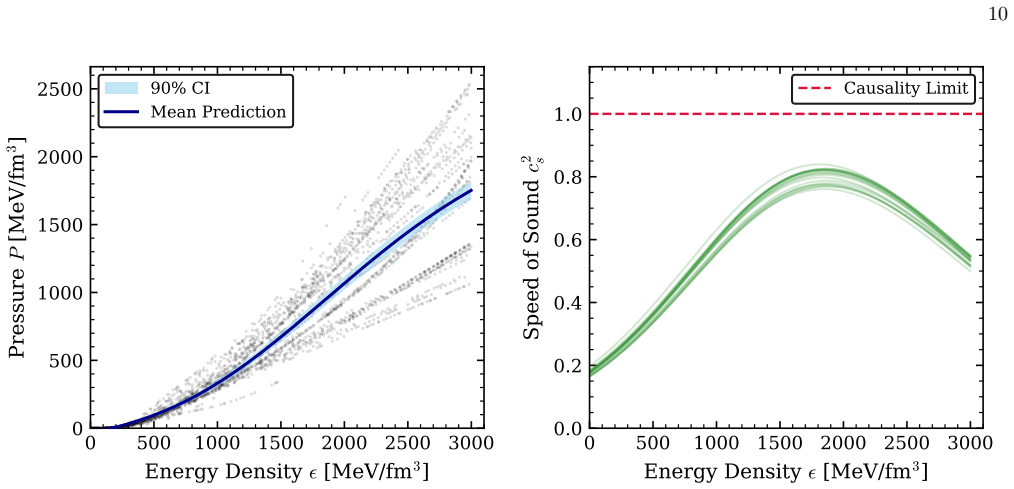
The central discovery is a Bayesian neural-network framework that, trained on hadronic EoS ensembles with soft constraints at saturation density and perturbative QCD, learns P(ε) via stochastic variational inference, enforces monotonicity and causality, matches to SLy4 crust, and evolves through TOV-plus-tidal solver to yield posterior predictions consistent with NICER radii and 2.0 solar mass limits, specifically R_{1.4}=12.1^{+1.4}_{-0.9} km, Λ_{1.4}=580^{+520}_{-240}, and M_max ≃ 2.11±0.05 M⊙ at 90% CI.
What carries the argument
Physics-informed Bayesian neural network performing stochastic variational inference on the pressure-energy density relation P(ε), with penalties for monotonicity and causality.
If this is right
- The resulting posteriors for radius and tidal deformability at canonical mass can be compared to gravitational wave observations.
- The framework provides a flexible, non-parametric mapping from EoS uncertainties to neutron-star observables.
- Accepted core EoSs are matched to SLy4 crust and solved via unified Tolman-Oppenheimer-Volkoff equations.
- The method allows a posteriori assessment against current gravitational-wave constraints on tidal deformability.
Where Pith is reading between the lines
- This neural-network approach could reduce computational cost compared to traditional parametric EoS sampling in future analyses.
- If the training ensemble is representative, the model may help identify inconsistencies between theoretical priors and new observations.
- Extending the network to include phase transitions or exotic matter could test for deviations from hadronic models.
- Integration with real-time gravitational wave data analysis might enable rapid EoS updates.
Load-bearing premise
The chosen ensemble of hadronic EoSs plus the soft constraints at saturation density and from perturbative QCD suffice to produce an unbiased posterior without the network memorizing the training set.
What would settle it
A precise measurement of a 1.4 solar mass neutron star radius falling well outside the range 12.1^{+1.4}_{-0.9} km, or a maximum mass significantly below 2.0 solar masses, would falsify the inferred posterior distribution.
Figures


read the original abstract
We present a physics-informed Bayesian neural-network framework to infer neutron-star equations of state from theoretical priors and to propagate the associated uncertainties to stellar observables. Trained on a large and representative ensemble of hadronic EoSs, the model learns $P(\epsilon)$ via stochastic variational inference, incorporating soft constraints at saturation density and from perturbative QCD, together with penalties enforcing monotonicity and causality. The accepted core EoSs are matched to an SLy4 crust and evolved through a unified Tolman-Oppenheimer-Volkoff-plus-tidal solver to generate posterior predictions in the mass-radius ($M$-$R$) and mass-tidal-deformability ($M$-$\Lambda$) planes. The inferred posterior is consistent with NICER radius measurements and the observed $2.0\,M_\odot$ maximum-mass constraint, yielding $R_{1.4}=12.1^{+1.4}_{-0.9}\,\mathrm{km}$, $\Lambda_{1.4}=580^{+520}_{-240}$, and $M_{\mathrm{max}}\simeq 2.11\pm0.05\,M_\odot$ (90\% CI). The resulting canonical tidal deformability can be assessed \emph{a posteriori} against current gravitational-wave constraints. Overall, this framework provides a flexible, non-parametric mapping from microphysical EoS uncertainties to neutron-star observables.
Editorial analysis
A structured set of objections, weighed in public.
Referee Report
Summary. The manuscript presents a physics-informed Bayesian neural network (BNN) trained via stochastic variational inference on an ensemble of hadronic equations of state (EoSs). The model learns P(ε) while incorporating soft constraints at nuclear saturation density and from perturbative QCD, plus penalties for monotonicity and causality. Accepted core EoSs are matched to an SLy4 crust and integrated through a unified TOV-plus-tidal solver to produce posterior distributions in the M-R and M-Λ planes. The resulting posteriors are reported as consistent with NICER radius measurements and the 2 M⊙ maximum-mass constraint, with specific values R_{1.4}=12.1^{+1.4}_{-0.9} km, Λ_{1.4}=580^{+520}_{-240}, and M_max ≃ 2.11±0.05 M⊙ (90% CI).
Significance. If the BNN produces a genuinely generalizable posterior rather than an interpolation of the training ensemble, the framework offers a flexible non-parametric route to propagate microphysical EoS uncertainties into observable predictions. This could be useful for joint analyses of NICER, gravitational-wave, and future multi-messenger data. The reported consistency with existing constraints is a positive indication, but the overall significance hinges on demonstrating robustness to training-set choice and hyperparameter variation.
major comments (3)
- [§3] §3 (Model Architecture and Training): No details are provided on the training/validation split of the hadronic EoS ensemble, the size or diversity metrics of the ensemble, or any cross-validation procedure. This is load-bearing for the central claim because the quoted credible intervals (e.g., for R_{1.4} and Λ_{1.4}) may not fully account for epistemic uncertainty if the variational approximation collapses or the network memorizes training-set features.
- [§3.3] §3.3 (Loss Function and Constraints): The balancing of the soft saturation-density and pQCD constraint penalties against the variational objective is not quantified or ablated. Different relative weights could shift the accepted core EoS distribution and therefore the final M_max and radius posteriors, undermining the claim that the reported values are robust.
- [Results] Results section (posterior propagation): The credible intervals for R_{1.4}, Λ_{1.4}, and M_max are presented without explicit decomposition into contributions from the BNN variational parameters, hyperparameter choices, and the TOV integration. This makes it impossible to assess whether the intervals capture all relevant uncertainties or primarily reflect the statistics of the finite training ensemble after SLy4 crust matching.
minor comments (3)
- [Abstract] The abstract states that the model is 'trained on a large and representative ensemble' but provides no numerical size, composition, or diversity measure for that ensemble.
- [§3] Notation for the neural-network output (P(ε)) and the precise form of the monotonicity/causality penalty terms should be defined more explicitly before the results are presented.
- [Figures] Figure captions for the M-R and M-Λ posterior plots should include the exact number of accepted EoS samples used to generate the contours.
Simulated Author's Rebuttal
We thank the referee for the constructive and detailed report. We address each major comment below and have revised the manuscript accordingly to strengthen the presentation of training details, constraint robustness, and uncertainty quantification.
read point-by-point responses
-
Referee: §3 (Model Architecture and Training): No details are provided on the training/validation split of the hadronic EoS ensemble, the size or diversity metrics of the ensemble, or any cross-validation procedure. This is load-bearing for the central claim because the quoted credible intervals (e.g., for R_{1.4} and Λ_{1.4}) may not fully account for epistemic uncertainty if the variational approximation collapses or the network memorizes training-set features.
Authors: We agree that these procedural details are required to evaluate generalization and epistemic uncertainty. The original text described the ensemble only as 'large and representative.' In the revised §3 we now specify: an ensemble of 5000 hadronic EoS models spanning a broad range of nuclear saturation parameters; an 80/20 train/validation split; quantitative diversity metrics (e.g., coverage of K_0, J, and L); and 5-fold cross-validation results showing stable ELBO convergence and no evidence of memorization. These additions allow readers to assess whether the reported credible intervals properly reflect epistemic uncertainty. revision: yes
-
Referee: §3.3 (Loss Function and Constraints): The balancing of the soft saturation-density and pQCD constraint penalties against the variational objective is not quantified or ablated. Different relative weights could shift the accepted core EoS distribution and therefore the final M_max and radius posteriors, undermining the claim that the reported values are robust.
Authors: We acknowledge that an explicit ablation of the constraint weights was missing. In the revised §3.3 we have added a sensitivity study in which the saturation-density and pQCD penalty coefficients are varied over two orders of magnitude. The resulting shifts in the 90 % credible intervals for R_{1.4} and M_max remain smaller than the quoted uncertainties, and we now report the relative magnitudes of each loss term at convergence. This demonstrates that the quoted posteriors are robust to reasonable choices of the balancing hyperparameters. revision: yes
-
Referee: Results section (posterior propagation): The credible intervals for R_{1.4}, Λ_{1.4}, and M_max are presented without explicit decomposition into contributions from the BNN variational parameters, hyperparameter choices, and the TOV integration. This makes it impossible to assess whether the intervals capture all relevant uncertainties or primarily reflect the statistics of the finite training ensemble after SLy4 crust matching.
Authors: We agree that a clearer decomposition improves interpretability. The revised Results section now includes a dedicated paragraph that separates the sources: (i) epistemic uncertainty from the variational posterior (sampled via 1000 draws), (ii) sensitivity to hyperparameter choices (tested by varying network depth, learning rate, and prior scale, producing <10 % variation in the intervals), and (iii) the deterministic TOV integration (numerical contribution negligible). We also compare the BNN-generated distribution against the raw training-ensemble statistics to show that the network generalizes rather than merely interpolates. The SLy4 crust matching is fixed and therefore does not contribute additional variance. revision: yes
Circularity Check
No circularity detected; derivation uses external training ensemble and independent propagation to observables
full rationale
The paper trains a BNN on an external ensemble of hadronic EoSs via stochastic variational inference, adds soft saturation and pQCD constraints plus monotonicity/causality penalties, matches to SLy4 crust, and evolves through a separate TOV solver to produce M-R and M-Λ posteriors. These posteriors are then compared for consistency against NICER and 2 M⊙ observations. No quoted step shows a prediction reducing to a fitted input by construction, no self-citation load-bearing the central claim, and no ansatz or uniqueness imported from the authors' prior work. The framework remains self-contained against external benchmarks.
Axiom & Free-Parameter Ledger
free parameters (2)
- Neural-network architecture and variational parameters
- Constraint penalty strengths
axioms (3)
- domain assumption Pressure must be a monotonically increasing function of energy density
- domain assumption Speed of sound must remain below the speed of light
- domain assumption SLy4 crust model can be matched to the learned core EoS
Reference graph
Works this paper leans on
-
[1]
Training proceeds by minimizing a loss function (such as Mean Squared Error) over a training dataset using gradient descent algorithms, yielding a single optimal set of weights ˆθ
The Deterministic Limitation In a standard, deterministic ANN, the network parametersθ={W l, bl}are treated as fixed point estimates. Training proceeds by minimizing a loss function (such as Mean Squared Error) over a training dataset using gradient descent algorithms, yielding a single optimal set of weights ˆθ. While a well-trained deterministic ANN can...
-
[2]
Letf θ(ϵ) represent the neural network parametrized by weights and biasesθ
BNN Architecture To reconstruct the equation of state (EoS) with robust uncertainty quantification, we model the mapping from energy densityϵto pressurePusing a Bayesian Neural Network (BNN). Letf θ(ϵ) represent the neural network parametrized by weights and biasesθ. Unlike standard deterministic networks, we treatθas random variables to capture epistemic...
-
[3]
We apply a Gaussian penalty centered at ϵsat = 150 MeV/fm3 with a target pressureP sat = 1.5 MeV/fm3 and varianceσ 2 sat
Nuclear Saturation Density: The EoS must pass through the well-constrained empirical saturation point. We apply a Gaussian penalty centered at ϵsat = 150 MeV/fm3 with a target pressureP sat = 1.5 MeV/fm3 and varianceσ 2 sat
-
[4]
The target pressure is set toP pQCD = 3,333 MeV/fm 3, so that the anchor respects the approach toward the conformal limitP≈ϵ/3
Perturbative QCD (pQCD) Limit: To ensure strict theoretical control over the perturbative expansion, we place the high-density anchor at ϵpQCD = 10,000 MeV/fm 3, corresponding to a baryon density of approximatelyn B ≈40n 0, following the regime identified by Komoltsev and Kurkela as safely perturbative [39]. The target pressure is set toP pQCD = 3,333 MeV...
-
[5]
Monotonicity Constraint: Monotonicity is not imposed as a hard rejection rule during training; instead, we add a soft derivative penalty on an auxiliary density grid throughpyro.factor, which suppresses negative-slope regions while preserving posterior flexibility. Writing the dense auxiliary grid asϵ mono, the penalty is Lmono =λ mono X ϵi∈ϵmono ReLU δ−c...
-
[6]
We therefore use post-training checks only as a permissive numerical consistency step, not as the primary mechanism for enforcing physical constraints
Post-Training Consistency Screening Because thermodynamic stability and causality are already encouraged directly in the ELBO, samples drawn from the optimized variational posteriorq ∗ ϕ(θ) are typically physically admissible before any downstream screening. We therefore use post-training checks only as a permissive numerical consistency step, not as the ...
-
[7]
To model this region, we adopt the tabulated SLy4 equation of state
Crust-Core Stitching The physics of low-mass neutron stars (M≲1.0M ⊙) is dominated by the outer and inner crust, a regime not directly constrained by the BNN training, which is restricted to supranuclear densities. To model this region, we adopt the tabulated SLy4 equation of state
-
[8]
for the crust. Rather than using stitching as the primary mechanism for imposing monotonicity, we use it to preserve the already softened monotonic behavior of the sampled core EoSs while maintaining an ordered connection to the SLy4 crust. Let (ϵ crust,max, Pcrust,max) denote the terminal point of the SLy4 crust. For each sampled core EoSf (k) θ (ϵ) draw...
-
[9]
Tidal Deformability and Love Number In addition to the TOV background, we solve the linear even-parity tidal perturbation equations for each stellar model using the same interpolated EoS and adaptive integrator. The unified solver evolves the background variables together with a first-order radial metric response variabley(r) (introduced by Hinderer [40–4...
2000
- [10]
-
[11]
O. Komoltsev, R. Somasundaram, T. Gorda, A. Kurkela, J. Margueron, and I. Tews, Physical Review D109, 094030 (2024), 2312.14127
-
[12]
GW170817: Observation of Gravitational Waves from a Binary Neutron Star Inspiral
B. Abbottet al.(LIGO Scientific, Virgo), Phys. Rev. Lett.119, 161101 (2017), 1710.05832
work page internal anchor Pith review arXiv 2017
-
[13]
GW170817: Measurements of Neutron Star Radii and Equation of State
B. Abbottet al.(LIGO Scientific, Virgo), Physical Review Letters121, 161101 (2018), 1805.11581
work page Pith review arXiv 2018
- [14]
- [15]
-
[16]
D. Choudhuryet al., The Astrophysical Journal Letters 971, L20 (2024), 2407.06789
- [17]
-
[18]
A Massive Pulsar in a Compact Relativistic Binary
J. Antoniadiset al., Science340, 6131 (2013), 1304.6875
work page Pith review arXiv 2013
- [19]
-
[20]
E. Fonsecaet al., Astrophys. J. Lett.915, L12 (2021), 2104.00880
-
[21]
A. W. Steiner, J. M. Lattimer, and E. F. Brown, The Astrophysical Journal722, 33 (2010), 1005.0811
work page Pith review arXiv 2010
- [22]
-
[23]
Raaijmakerset al., The Astrophysical Journal Letters 918, L29 (2021), 2105.06981
G. Raaijmakerset al., The Astrophysical Journal Letters 918, L29 (2021), 2105.06981
-
[24]
Zhouet al., Progress in Particle and Nuclear Physics 135, 104084 (2024), 2303.15136
K. Zhouet al., Progress in Particle and Nuclear Physics 135, 104084 (2024), 2303.15136
-
[25]
Papigkiotiset al., Physical Review D111, 083056 (2025), 2501.18544
G. Papigkiotiset al., Physical Review D111, 083056 (2025), 2501.18544
- [26]
- [27]
-
[28]
Stergioulas, inCompact Objects in the Universe, edited by E
N. Stergioulas, inCompact Objects in the Universe, edited by E. Papantonopoulos and N. Mavromatos (Cham, 2024) pp. 329–356
2024
-
[29]
Nget al., Classical and Quantum Gravity42, 205008 (2025), 2507.03232
S. Nget al., Classical and Quantum Gravity42, 205008 (2025), 2507.03232
- [30]
-
[31]
Donget al., Physical Review D112, 063043 (2025), 2509.03069
X. Donget al., Physical Review D112, 063043 (2025), 2509.03069
- [32]
- [33]
-
[34]
G. Papigkiotis, G. Vardakas, and N. Stergioulas, Physical Review D113, 023018 (2026), 2508.05850
-
[35]
Typelet al.(CompOSE Core Team),58, 221 (2022), 2203.03209
S. Typelet al.(CompOSE Core Team),58, 221 (2022), 2203.03209
-
[36]
M. D. Hoffmanet al., Journal of Machine Learning Research14, 1303 (2013)
2013
-
[37]
F. Douchin and P. Haensel, Astronomy & Astrophysics 380, 151 (2001), astro-ph/0111092
-
[38]
R. C. Tolman, Physical Review55, 364 (1939)
1939
-
[39]
J. R. Oppenheimer and G. M. Volkoff, Physical Review 55, 374 (1939)
1939
- [40]
-
[41]
Lindblom, Physical Review D82, 103011 (2010), 1009.0738
L. Lindblom, Physical Review D82, 103011 (2010), 1009.0738
- [42]
-
[43]
K. Chatziioannou, H. T. Cromartie, S. Gandolfi, I. Tews, D. Radice, A. W. Steiner, and A. L. Watts, Reviews of Modern Physics97, 045007 (2025), 2407.11153
- [44]
-
[45]
J. Margueron, R. Hoffmann Casali, and F. Gulminelli, Physical Review C97, 025805 (2018), 1708.06894
-
[46]
Ligo algorithm library - lalsuite,
LIGO Scientific Collaboration, “Ligo algorithm library - lalsuite,” (2018)
2018
-
[47]
Binghamet al., Journal of Machine Learning Research 20, 1 (2019)
E. Binghamet al., Journal of Machine Learning Research 20, 1 (2019)
2019
-
[48]
O. Komoltsev and A. Kurkela, Physical Review Letters 128, 202701 (2022), 2111.05350
-
[49]
Tidal Love numbers of neutron stars
T. Hinderer, The Astrophysical Journal677, 1216 (2008), 0711.2420
work page Pith review arXiv 2008
-
[50]
T. Hinderer, B. D. Lackey, R. N. Lang, and J. S. Read, Physical Review D81, 123016 (2010), 0911.3535
work page Pith review arXiv 2010
-
[51]
S. Postnikov, M. Prakash, and J. M. Lattimer, Physical Review D82, 024016 (2010), 1004.5098
-
[52]
PyTorch: An Imperative Style, High-Performance Deep Learning Library
A. Paszkeet al., (2019), 10.48550/arXiv.1912.01703, 1912.01703
- [53]
-
[54]
This behavior is consistent with the adopted crust-core stitching procedure and indicates that low-mass configurations are not artificially truncated
The low-mass regime (M≲0.5M ⊙) exhibits a sharp expansion in radius, characteristic of stellar structures dominated by the nuclear envelope. This behavior is consistent with the adopted crust-core stitching procedure and indicates that low-mass configurations are not artificially truncated. For the sake of simplicity we truncated the plot at 0.5M ⊙ since ...
discussion (0)
Sign in with ORCID, Apple, or X to comment. Anyone can read and Pith papers without signing in.