Recognition: unknown
Estimating the cascading global impacts of gas disruptions in Qatar
Pith reviewed 2026-05-07 17:32 UTC · model grok-4.3
The pith
A disruption in Qatar's gas sector leads to substantial supply losses in Asia and Europe, most severely affecting India, China, and South Korea.
A machine-rendered reading of the paper's core claim, the machinery that carries it, and where it could break.
Core claim
Using a multi-regional input-output framework and scenario analysis, the study shows that a disruption in Qatar's gas sector produces significant gas supply losses in Asia and Europe, with the largest aggregate impacts observed in India, China, and South Korea. Allowing for trade reallocation partially mitigates these losses. Further expansion of production capacity among major gas-producing countries improves supply conditions and leads to broader output gains; however, these benefits remain concentrated in a few large economies. Even significant increases in production among top producers offer limited relief to economies such as India and Pakistan. The results highlight the uneven分布 of cả
What carries the argument
The multi-regional input-output (MRIO) model, which traces inter-country industry flows to quantify direct gas supply shortfalls and their indirect cascading effects on output.
Where Pith is reading between the lines
- Disruptions in other major gas exporters could follow similar patterns of concentrated losses and uneven recovery.
- Countries facing limited relief might reduce risk by accelerating domestic production or long-term import diversification.
- Policy assessments of energy security should incorporate network-based modeling to identify hidden propagation paths.
- Adding price signals and substitution elasticities to the framework would test how much real-market flexibility alters the results.
Load-bearing premise
The model assumes fixed technical coefficients and only limited short-term substitution in energy trade after the shock occurs.
What would settle it
Direct measurement of actual gas supply volumes and downstream output changes in India, China, and South Korea immediately following a real-world reduction in Qatar's gas exports, compared against the model's predicted losses.
Figures






read the original abstract
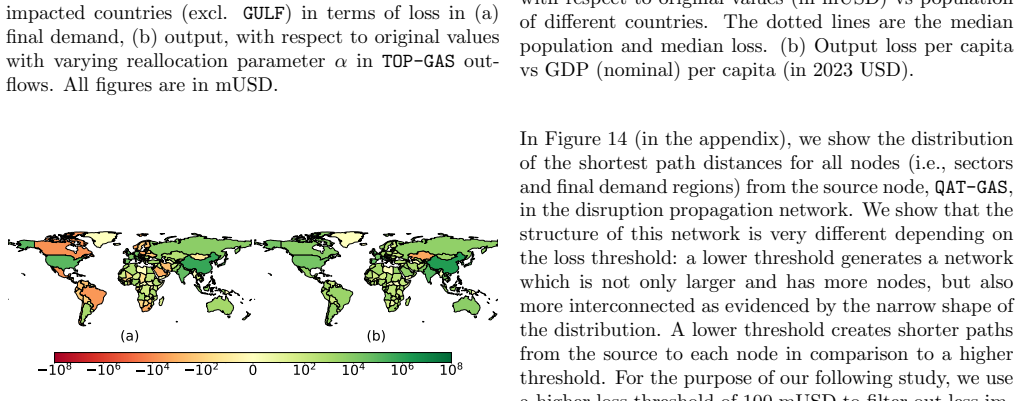
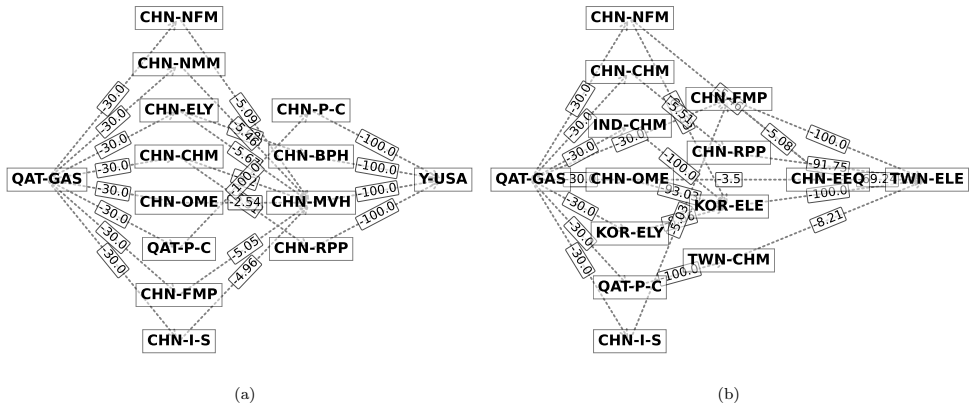
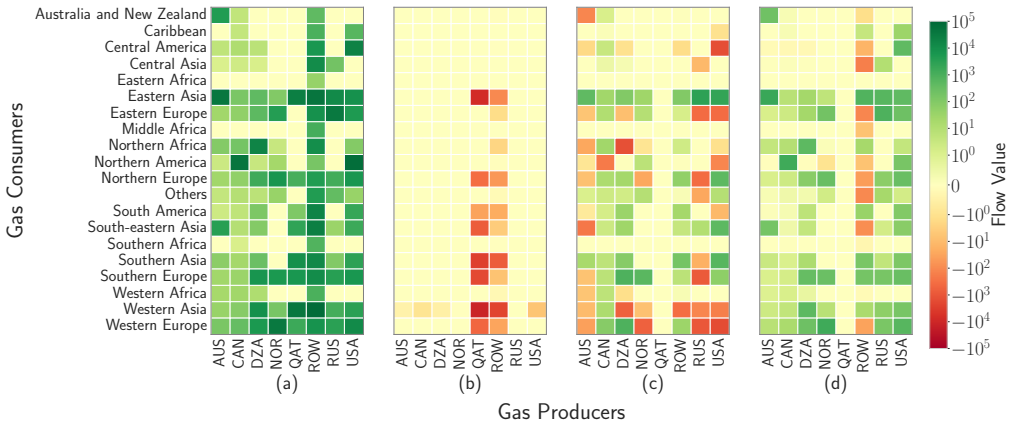
This study examines the global impacts of a localized disruption in Qatar's gas sector using a multi-regional input-output framework and scenario-based analysis. While the direct impacts of this disruption on importing countries are clear, indirect and cascading impacts are not well understood. We use a Multiregional input-output (MRIO) model to assess the impact of this disruption and to determine whether trade reallocations and increased production can mitigate its effects. Our analysis shows that this disruption leads to significant gas supply losses in Asia and Europe, with the largest aggregate impacts observed in India, China, and South Korea. Allowing for trade reallocation partially mitigates these losses. Further expansion of production capacity among major gas-producing countries improves supply conditions and leads to broader output gains; however, these benefits remain concentrated in a few large economies. Even significant increases in production among top producers offer limited relief to economies such as India and Pakistan. Overall, the results highlight the uneven distribution of both vulnerabilities and recovery potential within global supply chains. While adaptive mechanisms such as trade reallocation and production expansion can alleviate the effects of supply shocks, their effectiveness is limited and heterogeneous. The findings underscore the importance of network structure in shaping shock propagation and resilience, offering insights for managing systemic risks in an interconnected global economy.
Editorial analysis
A structured set of objections, weighed in public.
Referee Report
Summary. This paper applies a multi-regional input-output (MRIO) model to analyze the global cascading effects of a hypothetical disruption in Qatar's gas sector. The key findings are that the disruption causes significant gas supply losses in Asia and Europe, with the largest aggregate impacts in India, China, and South Korea. Trade reallocation partially mitigates these losses, while further expansion of production capacity in major gas-producing countries improves supply but with benefits concentrated in a few large economies and limited relief for others like India and Pakistan.
Significance. The analysis underscores the importance of global supply chain networks in propagating energy shocks and the heterogeneous nature of vulnerabilities and recovery potentials. By quantifying the limited effectiveness of trade reallocation and production expansion, it provides useful insights for policymakers concerned with energy security and systemic risk management in the gas sector.
major comments (2)
- [Methods] The MRIO model employs fixed technical coefficients, implying no short-term substitution or behavioral adjustments in response to the supply shock. This modeling choice is central to the reported impacts and mitigation effects, yet the manuscript does not discuss its appropriateness for LNG markets where rerouting and dual-fuel switching can occur rapidly. A sensitivity analysis or comparison with a model allowing substitution would be necessary to support the headline results on losses in India, China, and South Korea.
- [Results] The abstract and results lack any information on the specific data sources (e.g., the MRIO database used), the calibration of the model, the exact size of the Qatar disruption scenario, or validation against past events. These omissions are load-bearing because the quantitative claims about supply losses and mitigation cannot be evaluated for robustness without them.
minor comments (1)
- [Abstract] The abstract refers to 'significant gas supply losses' and 'broader output gains' without providing any numerical values or magnitudes; including key quantitative results would improve the summary's informativeness.
Simulated Author's Rebuttal
We thank the referee for the constructive and detailed comments on our manuscript. We have carefully reviewed the points raised and provide point-by-point responses below. We believe these suggestions will improve the clarity and robustness of the paper.
read point-by-point responses
-
Referee: [Methods] The MRIO model employs fixed technical coefficients, implying no short-term substitution or behavioral adjustments in response to the supply shock. This modeling choice is central to the reported impacts and mitigation effects, yet the manuscript does not discuss its appropriateness for LNG markets where rerouting and dual-fuel switching can occur rapidly. A sensitivity analysis or comparison with a model allowing substitution would be necessary to support the headline results on losses in India, China, and South Korea.
Authors: We agree that the fixed technical coefficients assumption is a core feature of the MRIO approach and merits explicit discussion. This modeling choice is standard for tracing immediate cascading effects in supply-chain networks following an abrupt shock, as it avoids conflating short-term propagation with longer-term adjustments that may not be feasible in the immediate aftermath of a disruption. LNG markets do allow some flexibility via rerouting and fuel switching, but infrastructure and contractual rigidities often limit rapid substitution in the short term. In the revised manuscript, we will add a new paragraph in the Methods section explicitly addressing the appropriateness of fixed coefficients for this LNG disruption scenario, its potential limitations, and implications for the reported impacts in Asia and Europe. While a full sensitivity analysis using a substitution-enabled model (e.g., CGE) lies outside the scope of the current input-output framework and would require substantial additional data and modeling, we will include a qualitative discussion of how substitution could moderate the headline results, supported by references to LNG market flexibility studies. revision: partial
-
Referee: [Results] The abstract and results lack any information on the specific data sources (e.g., the MRIO database used), the calibration of the model, the exact size of the Qatar disruption scenario, or validation against past events. These omissions are load-bearing because the quantitative claims about supply losses and mitigation cannot be evaluated for robustness without them.
Authors: We appreciate this observation on transparency. While the Methods section of the full manuscript describes the MRIO framework and scenario construction, we acknowledge that the abstract and Results section do not sufficiently foreground the data sources, calibration details, exact scenario parameters, or contextual validation. In the revised manuscript, we will update the abstract to briefly specify the MRIO database used and the scale of the Qatar disruption. We will also add a short subsection or expanded paragraphs in the Results (or a new Data and Scenario subsection) detailing the specific data sources, model calibration procedure, the precise magnitude of the assumed gas output reduction in Qatar, and a discussion relating the hypothetical scenario to historical supply disruptions for context and to support robustness. These additions will make the quantitative findings more readily evaluable. revision: yes
Circularity Check
No significant circularity; standard MRIO propagation of external shock
full rationale
The paper applies a conventional multi-regional input-output model to an exogenous supply shock in Qatar's gas sector. Impacts are obtained by scaling the Leontief inverse against observed trade coefficients and scenario-defined reductions in gas availability; no parameter is fitted to the target outcomes, no result is renamed as a prediction, and no load-bearing step reduces to a self-citation or internal definition. The reported country rankings and mitigation effects therefore follow directly from the external MRIO tables and the chosen shock magnitudes rather than from any tautological construction within the paper itself.
Axiom & Free-Parameter Ledger
axioms (1)
- domain assumption Leontief production functions with fixed technical coefficients and no immediate substitution
Reference graph
Works this paper leans on
-
[1]
The Global Trade Analysis Project (GTAP) Data Base: Version 12.Journal of Global Economic Analysis, 10(2):1–45, 2025
Angel Aguiar, Uris Baldos, Maksym Chepeliev, Er- win Corong, and Thiago Simonato. The Global Trade Analysis Project (GTAP) Data Base: Version 12.Journal of Global Economic Analysis, 10(2):1–45, 2025
2025
-
[2]
Ras Laffan to your kitchen: Why India’s gas risk may run deeper than it appears
Saurav Anand. Ras Laffan to your kitchen: Why India’s gas risk may run deeper than it appears. Fi- nancial Express,https://www.financialexpress .com/business/news/ras-laffan-to-your-kit chen-why-indias-gas-risk-may-run-deeper-t han-it-appears/4197235/, April 2026. Accessed: 2026-04-06
-
[3]
Damage to Qatar LNG trains ‘will cut helium output by 14%’ for many years
Christian Annesley. Damage to Qatar LNG trains ‘will cut helium output by 14%’ for many years. gas- world,https://www.gasworld.com/story/damag e-to-qatar-lng-trains-will-cut-helium-out put-by-14-for-many-years/2174708.article/, March 2026. Accessed: 2026-03-19
-
[4]
Iran attacks wipe out 17% of Qatar’s LNG capacity for up to five years, QatarEn- ergy CEO says
Channel News Asia. Iran attacks wipe out 17% of Qatar’s LNG capacity for up to five years, QatarEn- ergy CEO says. Channel News Asia (CNA),https: //www.channelnewsasia.com/world/iran-attac ks-wipe-out-17-qatars-lng-capacity-up-fiv e-years-qatarenergy-ceo-says-6006401, March
-
[5]
Accessed: 2026-03-20
2026
-
[6]
Will the Iran Conflict Deepen China-Russia Energy Relations? Center on Global Energy Policy, Columbia Univer- sity SIPA,https://www.energypolicy.columbia
Erica Downs and Tatiana Mitrova. Will the Iran Conflict Deepen China-Russia Energy Relations? Center on Global Energy Policy, Columbia Univer- sity SIPA,https://www.energypolicy.columbia. edu/will-the-iran-conflict-deepen-china-r ussia-energy-relations/, March 2026. Accessed: 2026-04-20
2026
-
[7]
Galbusera and G
L. Galbusera and G. Giannopoulos. On input- output economic models in disaster impact assess- ment.International Journal of Disaster Risk Reduc- tion, 30:186–198, 2018
2018
-
[8]
No helium, no chips: why Australia needs to make the gas again
Arup George. No helium, no chips: why Australia needs to make the gas again. The Strategist,https: //www.aspistrategist.org.au/no-helium-no-c hips-why-australia-needs-to-make-the-gas-a gain/, April 2026. Accessed: 2026-04-22
2026
-
[9]
Gas supply and demand outlook for 2026 quarter
Australian Government. Gas supply and demand outlook for 2026 quarter. Australian Government Department of Industry Science and Resources,ht tps://www.industry.gov.au/news/gas-supply-a nd-demand-outlook-2026-quarter-3, April 2026. Accessed: 2026-04-22
2026
-
[10]
Dabo Guan, Daoping Wang, Stephane Hallegatte, Steven J. Davis, Jingwen Huo, Shuping Li, Yangchun Bai, Tianyang Lei, Qianyu Xue, D’Maris Coffman, Danyang Cheng, Peipei Chen, Xi Liang, Bing Xu, Xiaosheng Lu, Shouyang Wang, Klaus Hubacek, and Peng Gong. Global supply-chain effects of COVID- 19 control measures.Nature Human Behaviour, 4(6):577–587, June 2020
2020
-
[11]
P. He, T. S. Ng, and B. Su. Energy-economic re- silience with multi-region input–output linear pro- gramming models.Energy Economics, 84, 2019
2019
-
[12]
A review of helium resources and development.Natural Gas Industry B, 12(3):356–367, 2025
Zhongjun Hu and Jingyu Li. A review of helium resources and development.Natural Gas Industry B, 12(3):356–367, 2025
2025
-
[13]
Inoue and Y
H. Inoue and Y. Todo. Firm-level propagation of shocks through supply-chain networks.Nature Sus- tainability, 2(9):841–847, 2019
2019
-
[14]
World Energy Out- look 2024
International Energy Agency. World Energy Out- look 2024. Technical report, International Energy Agency, Paris, 2024. License: CC BY 4.0
2024
-
[15]
Global LNG Capacity Tracker
International Energy Agency. Global LNG Capacity Tracker. International Energy Agency,https:// www.iea.org/data-and-statistics/data-too ls/global-lng-capacity-tracker, March 2026. Accessed: 2026-03-17. 11
2026
-
[16]
E. E. Koks and M. Thissen. A Multiregional Impact Assessment Model for disaster analysis.Economic Systems Research, 28(4):429–449, 2016
2016
-
[17]
Cambridge Uni- versity Press, 2 edition, 2009
Ronald Miller and Peter Blair.Input-Output Anal- ysis: Foundations and Extensions. Cambridge Uni- versity Press, 2 edition, 2009
2009
-
[18]
Simultaneous supply and demand constraints in input–output net- works: the case of Covid-19 in Germany, Italy, and Spain.Economic Systems Research, 34(3):273–293, 2022
Anton Pichler and J Doyne Farmer. Simultaneous supply and demand constraints in input–output net- works: the case of Covid-19 in Germany, Italy, and Spain.Economic Systems Research, 34(3):273–293, 2022
2022
-
[19]
India’s Fac- tory Workers Were Getting By
Krishna Pokharel and Tripti Lahiri. India’s Fac- tory Workers Were Getting By. Then the Strait of Hormuz Closed. The Wall Street Journal,https: //www.wsj.com/world/india/indias-factory-w orkers-were-getting-by-then-the-strait-o f-hormuz-closed-76003964, April 2026. Accessed: 2026-04-22
2026
-
[20]
Asia Boosts U.S
Reuters. Asia Boosts U.S. LPG Imports to Replace Middle East Supply. Reuters,https://www.reut ers.com/business/energy/asia-boosts-us-lpg -imports-replace-middle-east-supply-2026-0 4-10/, April 2026. Accessed: 2026-04-20
2026
-
[21]
LNG Supply Shock From Qatar Disruption Ripples Across Asia
The New York Times. LNG Supply Shock From Qatar Disruption Ripples Across Asia. The New York Times,https://www.nytimes.com/2026/0 3/30/business/lng-supply-asia-qatar-iran. html, March 2026. Accessed: 2026-04-15
2026
-
[22]
Japan, South Korea petrochemical industry slows output on Iran war
Qatar Tribune. Japan, South Korea petrochemical industry slows output on Iran war. Qatar Tribune, https://www.qatar-tribune.com/article/225 197/business/japan-south-korea-petrochemic al-industry-slows-output-on-iran-war, March
-
[23]
Accessed: 2026-03-22
2026
-
[24]
U.S., Australia can do little to replace lost Qatari LNG cargoes
Curtis Williams, Scott Disavino, and Helen Clark. U.S., Australia can do little to replace lost Qatari LNG cargoes. Reuters,https://www.reuters.com/ business/energy/there-is-little-us-lng-pro ducers-can-do-immediately-replace-lost-qat ari-cargoes-2026-03-04/, March 2026. Accessed: 2026-03-04
2026
-
[25]
Zhang, H
Y. Zhang, H. Li, X. Sun, Q. Tang, B. Ren, and J. Shi. Network spillover effects and path analysis of shocks - An empirical study in China.Structural Change and Economic Dynamics, 72:275–285, 2025. 12 Technical Appendix Additional resultsFigure 10 shows the gas flow from producer firms to more fine-grained consumer regions. For clarity, we combined some of...
2025
discussion (0)
Sign in with ORCID, Apple, or X to comment. Anyone can read and Pith papers without signing in.