Recognition: 3 theorem links
· Lean TheoremA New Kind of Network? Review and Reference Implementation of Neural Cellular Automata
Pith reviewed 2026-05-13 06:38 UTC · model grok-4.3
The pith
A unified modular framework and notation organizes existing Neural Cellular Automata methods together with open reference code.
A machine-rendered reading of the paper's core claim, the machinery that carries it, and where it could break.
Core claim
Existing Neural Cellular Automata methods share enough structural elements that they can be expressed through a single modular framework and unified notation. The paper presents this framework explicitly and releases a reference implementation in NCAtorch to serve as a common starting point for further development and comparison of such models.
What carries the argument
The modular framework for Neural Cellular Automata, which breaks models into reusable components for state, update rules, and neural integration under a shared notation.
If this is right
- Different NCA papers can be rewritten in the common notation, allowing direct side-by-side comparison of their update mechanisms.
- New models can be assembled by selecting and recombining existing modules rather than starting from scratch.
- The reference NCAtorch code lowers the entry cost for running and modifying NCA experiments.
- Standardized notation may reduce ambiguity when authors describe new variants or extensions.
Where Pith is reading between the lines
- The framework might expose hidden similarities between NCA and other neural architectures that operate on grid or graph structures.
- It could be tested whether the same modular breakdown applies directly to continuous or higher-dimensional automata variants.
- Widespread use of the shared library might encourage creation of common benchmark tasks for generative NCA performance.
Load-bearing premise
The variety of published Neural Cellular Automata methods shares enough common structure to be captured by one modular framework without material loss of their distinctive details.
What would settle it
An existing NCA model from the literature that cannot be represented accurately by the proposed modules without substantial redefinition or loss of its original behavior.
Figures



read the original abstract
Stephen Wolfram proclaimed in his 2003 seminal work "A New Kind Of Science" that simple recursive programs in the form of Cellular Automata (CA) are a promising approach to replace currently used mathematical formalizations, e.g. differential equations, to improve the modeling of complex systems. Over two decades later, while Cellular Automata have still been waiting for a substantial breakthrough in scientific applications, recent research showed new and promising approaches which combine Wolfram's ideas with learnable Artificial Neural Networks: So-called Neural Cellular Automata (NCA) are able to learn the complex update rules of CA from data samples, allowing them to model complex, self-organizing generative systems. The aim of this paper is to review the existing work on NCA and provide a unified modular framework and notation, as well as a reference implementation in the open-source library NCAtorch. Supplementary materials, videos, and code are available at the project website: https://www.neural-cellular-automata.org/
Editorial analysis
A structured set of objections, weighed in public.
Referee Report
Summary. The manuscript reviews existing research on Neural Cellular Automata (NCA), which integrate neural networks with cellular automata to learn complex update rules from data for modeling self-organizing generative systems. Building on Wolfram's cellular automata ideas, it proposes a unified modular framework and notation to standardize descriptions of diverse NCA methods and supplies a reference implementation in the open-source NCAtorch library, with supplementary videos and code available online.
Significance. If the modular framework captures the common structure across prior NCA variants without material loss of detail, the paper would provide a valuable standardization resource that consolidates the literature and lowers barriers to entry via the reproducible NCAtorch implementation. The explicit code release and project website constitute concrete strengths that support reproducibility and extension of the reviewed methods.
minor comments (3)
- [Abstract] The abstract states the goal of providing a 'unified modular framework' but does not preview the specific modules (e.g., perception, update, or state representation) that constitute the framework; adding a one-sentence enumeration would improve immediate clarity.
- [Section 3] Section 3 (presumed framework definition) introduces new notation without an explicit mapping table to the original notations in the cited NCA papers; including such a table would strengthen the claim of unification.
- [Implementation section] The reference implementation description would benefit from a brief statement on which specific prior NCA variants (e.g., from Mordvintsev et al. or others) were used as test cases for validation.
Simulated Author's Rebuttal
We thank the referee for their positive review of our manuscript on Neural Cellular Automata, including the unified modular framework, notation, and NCAtorch reference implementation. We appreciate the recognition of its value for standardizing the literature and supporting reproducibility.
Circularity Check
Review and reference implementation shows no circularity
full rationale
The paper is a review of prior Neural Cellular Automata literature together with a proposed modular notation and open reference implementation (NCAtorch). No derivations, predictions, fitted parameters, or uniqueness theorems are present that could reduce to inputs by construction. The central claim is the standardization value of the framework and code release; these are independent of any internal self-referential steps and rest on external prior work plus the released implementation itself.
Axiom & Free-Parameter Ledger
Lean theorems connected to this paper
-
IndisputableMonolith/Cost/FunctionalEquation.leanwashburn_uniqueness_aczel echoes?
echoesECHOES: this paper passage has the same mathematical shape or conceptual pattern as the Recognition theorem, but is not a direct formal dependency.
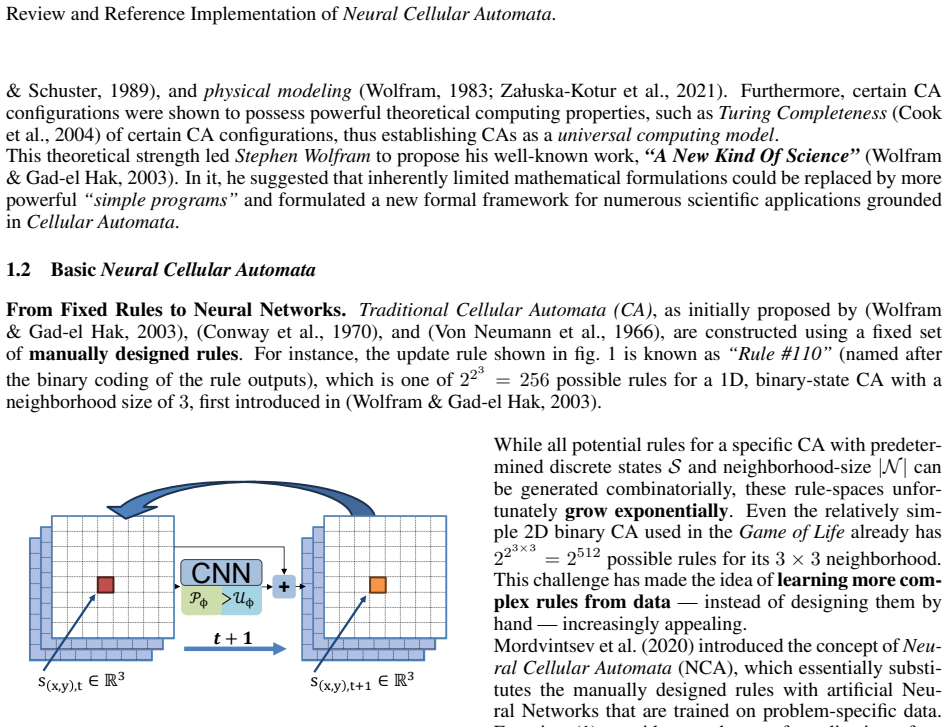
si,t+1 := s i,t + f ϕ[N(s i,t)] ... st+1 := s t + U ϕ[P N,ϕ ∗ s t] (Eq. 1-2); modular perception (Sobel/Conv/Attention/Deformable) and update modules
-
IndisputableMonolith/Foundation/RealityFromDistinction.leanreality_from_one_distinction echoes?
echoesECHOES: this paper passage has the same mathematical shape or conceptual pattern as the Recognition theorem, but is not a direct formal dependency.
living mask M = M_pre ∧ M_post ... sample pool with perturbations
-
IndisputableMonolith/Foundation/AlexanderDuality.leanalexander_duality_circle_linking unclear?
unclearRelation between the paper passage and the cited Recognition theorem.
8-tick period, D=3, φ-ladder spacings, J-cost forcing, parameter-free constants
What do these tags mean?
- matches
- The paper's claim is directly supported by a theorem in the formal canon.
- supports
- The theorem supports part of the paper's argument, but the paper may add assumptions or extra steps.
- extends
- The paper goes beyond the formal theorem; the theorem is a base layer rather than the whole result.
- uses
- The paper appears to rely on the theorem as machinery.
- contradicts
- The paper's claim conflicts with a theorem or certificate in the canon.
- unclear
- Pith found a possible connection, but the passage is too broad, indirect, or ambiguous to say the theorem truly supports the claim.
Reference graph
Works this paper leans on
-
[1]
Growing Neural Cellular Automata,
URLhttps://arxiv.org/abs/1202.2745. John Conway et al. The game of life.Scientific American, 223(4):4, 1970. Matthew Cook et al. Universality in elementary cellular automata.Complex systems, 15(1):1–40, 2004. Stephen Coombes. The geometry and pigmentation of seashells.Nottingham: Department of Mathematical Sciences, University of Nottingham, 2009. Jifeng ...
-
[2]
https://distill.pub/selforg/2021/textures
doi: 10.23915/distill.00027.003. https://distill.pub/selforg/2021/textures. Maximilian Otte, Quentin Delfosse, Johannes Czech, and Kristian Kersting. Generative adversarial neural cellular automata.arXiv preprint arXiv:2108.04328, 2021a. Maximilian Otte, Quentin Delfosse, Johannes Czech, and Kristian Kersting. Generative adversarial neural cellular automa...
-
[3]
ISSN 0045-7825. doi: 10.1016/j.cma.2023.116197. URLhttp://dx.doi.org/10.1016/j.cma.2023. 116197. Mattie Tesfaldet, Derek Nowrouzezahrai, and Chris Pal. Attention-based neural cellular automata.Advances in Neural Information Processing Systems, 35:8174–8186, 2022a. Mattie Tesfaldet, Derek Nowrouzezahrai, and Christopher Pal. Attention-based neural cellular...
discussion (0)
Sign in with ORCID, Apple, or X to comment. Anyone can read and Pith papers without signing in.