Recognition: unknown
Power Foam: Unifying Real-Time Differentiable Ray Tracing and Rasterization
Pith reviewed 2026-05-07 17:00 UTC · model grok-4.3
The pith
Power Foam generalizes Voronoi foams to bounded power diagrams so a single differentiable 3D representation supports both constant-time ray tracing and rasterization competitive with 3DGS.
A machine-rendered reading of the paper's core claim, the machinery that carries it, and where it could break.
Core claim
By generalizing Voronoi foams to bounded power diagrams with controllable cell extents, the representation creates spatially bounded primitives that support constant-time ray traversal without requiring expensive Delaunay triangulations during training. An oriented surface formulation explicitly models interfaces, and differentiable textures are embedded on the surfaces to decouple geometry from appearance. This yields a representation that preserves state-of-the-art ray tracing efficiency while achieving rasterization performance competitive with current generation 3DGS.
What carries the argument
Bounded power diagrams as a generalization of Voronoi foams, which create a volumetric partition of space into controllable cells that enable both constant-time ray traversal and efficient tile-based rasterization.
If this is right
- Spatially bounded cells enable direct use in tile-based rasterization pipelines without additional clipping steps.
- Avoiding Delaunay triangulations during training lowers computational cost for optimization.
- Oriented surfaces provide explicit interior-exterior separation that can improve rendering quality at boundaries.
- Embedded textures allow geometry and appearance to be optimized independently.
- The single representation supports switching between ray tracing and rasterization within the same scene.
Where Pith is reading between the lines
- A hybrid renderer could select ray tracing for reflections and rasterization for primary views using the same underlying foam cells.
- The bounded-cell approach might simplify integration into game engines that already mix both rendering techniques.
- Testing on dynamic scenes would reveal whether power diagram boundaries remain stable under deformation without retraining.
Load-bearing premise
Generalizing Voronoi foams to bounded power diagrams produces spatially bounded primitives that need no expensive Delaunay triangulations during training and that the oriented surfaces plus embedded textures deliver the claimed speed and differentiability.
What would settle it
A side-by-side benchmark in which the method's rasterization frame rate falls below current 3DGS implementations or its ray traversal time exceeds constant time per ray on standard test scenes.
Figures



read the original abstract
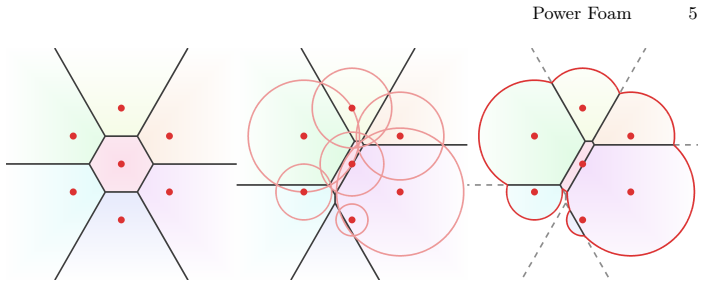
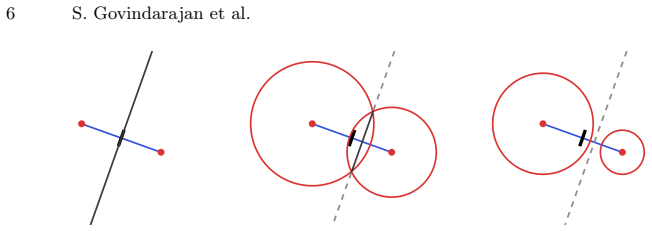
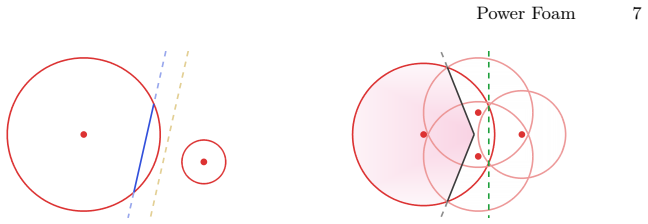
We introduce a differentiable 3D representation that unifies the ray tracing capabilities of foam-based ray tracing with the efficiency of modern rasterization pipelines. While prior foam representations enable constant-time ray traversal through an explicit volumetric partition of space, their potentially unbounded cells hinder efficient tile-based rasterization. We address this limitation by generalizing Voronoi foams to bounded power diagrams with controllable cell extents, enabling spatially bounded primitives without requiring expensive Delaunay triangulations during training. We further introduce an oriented surface formulation that explicitly models interfaces between interior and exterior regions, and decouple geometry from appearance by embedding differentiable texture directly on these surfaces. Together, these contributions yield a representation that preserves state-of-the-art ray tracing efficiency while achieving rasterization performance competitive with current generation 3DGS, providing a practical path toward unified real-time differentiable rendering.
Editorial analysis
A structured set of objections, weighed in public.
Referee Report
Summary. The manuscript introduces Power Foam, a differentiable 3D scene representation that generalizes Voronoi foams to bounded power diagrams. The central contributions are (1) controllable cell extents via power diagrams that remain spatially bounded without explicit Delaunay triangulation during optimization, (2) an oriented surface formulation that models interior/exterior interfaces, and (3) direct embedding of differentiable textures on those surfaces. The authors claim the resulting primitive set supports constant-time ray traversal while enabling tile-based rasterization whose performance is competitive with current 3D Gaussian splatting, thereby providing a unified real-time differentiable rendering primitive.
Significance. If the efficiency and differentiability claims are substantiated, the work would constitute a meaningful engineering advance toward a single representation that can be used interchangeably in ray-tracing and rasterization pipelines. Such unification is valuable for real-time differentiable rendering applications in graphics and vision. The absence of any quantitative results, complexity bounds, or implementation details in the supplied text, however, prevents assessment of whether the claimed unification is actually achieved.
major comments (1)
- [Abstract / §1] Abstract and §1: The load-bearing claim that 'bounded power diagrams with controllable weights produce spatially bounded cells that support both constant-time ray traversal and tile-based rasterization while remaining fully differentiable and trainable without building or maintaining a Delaunay triangulation' is asserted without any supporting derivation, incremental-update algorithm, or complexity statement. Because power diagrams are the weighted dual of Delaunay triangulations, any correct evaluation of cell boundaries, overlap ordering for rasterization, or interface normals for the oriented-surface loss necessarily requires neighbor enumeration or a spatial query structure. Without an explicit O(1) or amortized incremental scheme, the 'no expensive Delaunay' assertion remains unsubstantiated and directly affects the central unification claim.
Simulated Author's Rebuttal
We thank the referee for the constructive feedback and for recognizing the potential value of a unified differentiable primitive. We address the major comment below and will strengthen the manuscript with additional technical detail as requested.
read point-by-point responses
-
Referee: [Abstract / §1] Abstract and §1: The load-bearing claim that 'bounded power diagrams with controllable weights produce spatially bounded cells that support both constant-time ray traversal and tile-based rasterization while remaining fully differentiable and trainable without building or maintaining a Delaunay triangulation' is asserted without any supporting derivation, incremental-update algorithm, or complexity statement. Because power diagrams are the weighted dual of Delaunay triangulations, any correct evaluation of cell boundaries, overlap ordering for rasterization, or interface normals for the oriented-surface loss necessarily requires neighbor enumeration or a spatial query structure. Without an explicit O(1) or amortized incremental scheme, the 'no expensive Delaunay' assertion remains unsubstantiated and directly affects the central unification claim.
Authors: We agree that the abstract and §1 would benefit from explicit cross-references and a concise complexity argument. Section 3.1 derives the bounded power-diagram cells via the power-distance metric and shows that per-cell weights directly control extents while the cells remain convex and form a space partition; this preserves the original foam ray-traversal procedure (constant-time per intersection) without change. For rasterization, bounded cells enable per-tile primitive lists that are maintained by a lightweight incremental spatial index whose updates are local to affected cells and do not require global Delaunay reconstruction. We will add a new subsection (or appendix) containing the incremental neighbor-update algorithm, pseudocode, and an amortized-complexity statement (O(1) per cell per iteration for both traversal and tile culling). This revision will make the unification claim fully substantiated. revision: yes
Circularity Check
No circularity: new representation introduced via engineering generalization without self-referential derivations
full rationale
The paper presents a novel 3D representation by generalizing Voronoi foams to bounded power diagrams, adding an oriented surface formulation, and embedding differentiable textures. No equations, fitted parameters, or derivation chains are shown that reduce a claimed result to its own inputs by construction. Claims about avoiding Delaunay triangulations and achieving unified efficiency are stated as direct engineering outcomes of the proposed changes, with no load-bearing self-citations or renamings of prior results. The work is self-contained as a set of representational innovations rather than a predictive derivation.
Axiom & Free-Parameter Ledger
invented entities (1)
-
Power Foam representation
no independent evidence
Reference graph
Works this paper leans on
-
[1]
Barron,J.T.,Mildenhall,B.,Tancik,M.,Hedman,P.,Martin-Brualla,R.,Srinivasan, P.P.: Mip-nerf: A multiscale representation for anti-aliasing neural radiance fields. Int. Conf. Comput. Vis. (2021)
2021
-
[2]
IEEE Conf
Barron, J.T., Mildenhall, B., Verbin, D., Srinivasan, P.P., Hedman, P.: Mip-nerf 360: Unbounded anti-aliased neural radiance fields. IEEE Conf. Comput. Vis. Pattern Recog. (2022)
2022
-
[3]
In: IEEE Conf
Chao, B., Tseng, H.Y., Porzi, L., Gao, C., Li, T., Li, Q., Saraf, A., Huang, J.B., Kopf, J., Wetzstein, G., Kim, C.: Textured gaussians for enhanced 3d scene appearance modeling. In: IEEE Conf. Comput. Vis. Pattern Recog. (2025)
2025
-
[4]
ACM Trans
Condor, J., Speierer, S., Bode, L., Bozic, A., Green, S., Didyk, P., Jarabo, A.: Don’t splat your gaussians: Volumetric ray-traced primitives for modeling and rendering scattering and emissive media. ACM Trans. Graph.44(1), 1–17 (2025)
2025
-
[5]
OUP Us (1996)
Courant, R., Robbins, H.: What is Mathematics?: an elementary approach to ideas and methods. OUP Us (1996)
1996
-
[6]
arXiv preprint arXiv:2512.14180 (2025) 2, 10, 11
Di Sario, F., Rebain, D., Verbin, D., Grangetto, M., Tagliasacchi, A.: Spherical voronoi: Directional appearance as a differentiable partition of the sphere. arXiv preprint arXiv:2512.14180 (2025)
-
[7]
IEEE Transactions on information theory29(4), 551–559 (2003)
Edelsbrunner, H., Kirkpatrick, D., Seidel, R.: On the shape of a set of points in the plane. IEEE Transactions on information theory29(4), 551–559 (2003)
2003
-
[8]
In: IEEE Conf
Fridovich-Keil, S., Yu, A., Tancik, M., Chen, Q., Recht, B., Kanazawa, A.: Plenoxels: Radiance fields without neural networks. In: IEEE Conf. Comput. Vis. Pattern Recog. (2022)
2022
-
[9]
Govindarajan, S., Rebain, D., Yi, K.M., Tagliasacchi, A.: Radiant foam: Real-time differentiable ray tracing. In: Int. Conf. Comput. Vis. pp. 4135–4145 (October 2025)
2025
-
[10]
Hahlbohm, F., Friederichs, F., Weyrich, T., Franke, L., Kappel, M., Castillo, S., Stamminger, M., Eisemann, M., Magnor, M.: Efficient perspective-correct 3d gaussian splatting using hybrid transparency. Comput. Graph. Forum44(2), e70014 (2025)
2025
-
[11]
ACM Trans
Kerbl, B., Kopanas, G., Leimkühler, T., Drettakis, G.: 3d gaussian splatting for real-time radiance field rendering. ACM Trans. Graph.42(4) (July 2023)
2023
-
[12]
Kheradmand, S., Rebain, D., Sharma, G., Sun, W., Tseng, Y.C., Isack, H., Kar, A., Tagliasacchi, A., Yi, K.M.: 3d gaussian splatting as markov chain monte carlo. In: Adv. Neural Inform. Process. Syst. (2024), spotlight Presentation
2024
-
[13]
Kheradmand, S., Vicini, D., Kopanas, G., Lagun, D., Yi, K.M., Matthews, M., Tagliasacchi, A.: Stochasticsplats: Stochastic rasterization for sorting-free 3d gaus- sian splatting. In: Int. Conf. Comput. Vis. pp. 26326–26335 (2025)
2025
-
[14]
In: IEEE Conf
Ling, L., Sheng, Y., Tu, Z., Zhao, W., Xin, C., Wan, K., Yu, L., Guo, Q., Yu, Z., Lu, Y., et al.: Dl3dv-10k: A large-scale scene dataset for deep learning-based 3d vision. In: IEEE Conf. Comput. Vis. Pattern Recog. pp. 22160–22169 (2024) 16 S. Govindarajan et al
2024
-
[15]
In: Proc
Liu, R., Sun, D., Chen, M., Wang, Y., Feng, A.: Deformable beta splatting. In: Proc. SIGGRAPH (2025)
2025
-
[16]
ACM Trans
Lombardi, S., Simon, T., Saragih, J., Schwartz, G., Lehrmann, A., Sheikh, Y.: Neural volumes: Learning dynamic renderable volumes from images. ACM Trans. Graph.38(4), 65:1–65:14 (Jul 2019)
2019
- [17]
- [18]
-
[19]
Philips Research Reports8, 270–290 (1953)
Meijering, J.L.: Interface area, edge length, and number of vertices in crystal aggregates with random nucleation. Philips Research Reports8, 270–290 (1953)
1953
-
[20]
Mildenhall, B., Srinivasan, P.P., Tancik, M., Barron, J.T., Ramamoorthi, R., Ng, R.: Nerf: Representing scenes as neural radiance fields for view synthesis. In: Eur. Conf. Comput. Vis. (2020)
2020
-
[21]
ACM Trans
Moenne-Loccoz, N., Mirzaei, A., Perel, O., de Lutio, R., Esturo, J.M., State, G., Fidler, S., Sharp, N., Gojcic, Z.: 3d gaussian ray tracing: Fast tracing of particle scenes. ACM Trans. Graph. (2024)
2024
-
[22]
ACM Trans
Müller, T., Evans, A., Schied, C., Keller, A.: Instant neural graphics primitives with a multiresolution hash encoding. ACM Trans. Graph.41(4), 102:1–102:15 (Jul 2022)
2022
-
[23]
ACM Trans
Radl, L., Steiner, M., Parger, M., Weinrauch, A., Kerbl, B., Steinberger, M.: Stopthepop: Sorted gaussian splatting for view-consistent real-time rendering. ACM Trans. Graph.43(4), 1–17 (2024)
2024
-
[24]
In: IEEE Conf
Rebain, D., Jiang, W., Yazdani, S., Li, K., Yi, K.M., Tagliasacchi, A.: Derf: De- composed radiance fields. In: IEEE Conf. Comput. Vis. Pattern Recog. (2021)
2021
-
[25]
IEEE Conf
Schönberger, J.L., Frahm, J.M.: Structure-from-motion revisited. IEEE Conf. Com- put. Vis. Pattern Recog. (2016)
2016
-
[26]
Sitzmann, V., Zollhöfer, M., Wetzstein, G.: Scene representation networks: Con- tinuous 3d-structure-aware neural scene representations. In: Adv. Neural Inform. Process. Syst. (2019)
2019
-
[27]
Steiner, M., Köhler, T., Radl, L., Windisch, F., Schmalstieg, D., Steinberger, M.: Aaa-gaussians: Anti-aliased and artifact-free 3d gaussian rendering. In: Int. Conf. Comput. Vis. pp. 27650–27659 (2025)
2025
-
[28]
arXiv preprint arXiv:2209.02417 (2022)
Tagliasacchi, A., Mildenhall, B.: Volume rendering digest (for nerf). arXiv preprint arXiv:2209.02417 (2022)
-
[29]
IEEE Conf
Wu, Q., Martinez Esturo, J., Mirzaei, A., Moenne-Loccoz, N., Gojcic, Z.: 3dgut: Enabling distorted cameras and secondary rays in gaussian splatting. IEEE Conf. Comput. Vis. Pattern Recog. (2025) Power Foam 1 A Qualitative results We provide qualitative video comparisons in our webpage. B Proof that the Power Diagram is Pop-free We first briefly restate th...
2025
-
[30]
Sincex∈Π P, we havepow(x, P)≤pow(x, P ′), sox∈ H
-
[31]
Sincex ′ ∈Π P ′, we havepow(x′, P ′)≤pow(x ′, P), sox ′ /∈H
-
[32]
Power Foam 3
The boundary∂His a hyperplane, so any line crosses it at most once. Power Foam 3
-
[33]
Then the line segment fromx to Q starts in H (at x), exits H before reaching x′ (since x′ /∈H or x′ ∈∂H ), and must re-enterH to reach Q
Suppose for contradiction thatQ∈H . Then the line segment fromx to Q starts in H (at x), exits H before reaching x′ (since x′ /∈H or x′ ∈∂H ), and must re-enterH to reach Q. This requires crossing∂H at least twice—a contradiction, since∂His a hyperplane
-
[34]
Therefore Q /∈H, which meanspow(Q, P) ≥pow (Q, P ′). For sites in general position the inequality is strict, givingpow(Q, P ′) <pow (Q, P), i.e. ΠP ′ <Q ΠP. C Steiner points for ray tracing Algorithm 1:Steiner Point Insertion for Ray Tracing Input:Initial power cellsP={(p i, ri)}n i=1 1foriteration←1to6do 2S ← { ˆpj ∼ N S ⊂R 3} 3foreach ˆpj ∈ Sdo 4if∀(p i...
discussion (0)
Sign in with ORCID, Apple, or X to comment. Anyone can read and Pith papers without signing in.