Recognition: unknown
Bridging the Quantum Divide: A Learning-Centric Quantum Hackathon for Underrepresented Students (Extended Version)
Pith reviewed 2026-05-07 17:12 UTC · model grok-4.3
The pith
A two-day quantum hackathon using mastery learning and integrated course design successfully introduced underrepresented high school students to quantum computing basics.
A machine-rendered reading of the paper's core claim, the machinery that carries it, and where it could break.
Core claim
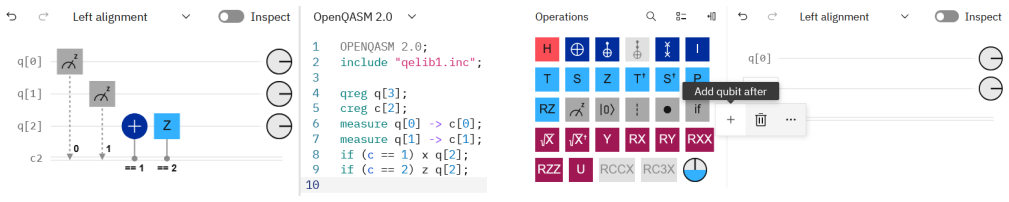
We designed and implemented a two-day quantum hackathon for underrepresented high school students in Nova Scotia, Canada. The first day introduced quantum computing through hands-on activities while the second day taught application through guided challenges. Both days followed mastery learning and specification grading inside the Integrated Course Design framework, with all circuit work performed in Quirk. Based on feedback from students, the hackathon successfully introduced students to the basics of quantum computing and reached most of our target demographics.
What carries the argument
The Integrated Course Design framework, which identifies situational factors for the target group, sets learning outcomes, and works backward to create curriculum and educative assessments, combined with mastery learning, specification grading, and the Quirk simulator for accessible circuit work.
Load-bearing premise
Self-reported student feedback reliably measures actual learning gains and the participants accurately represent the intended underrepresented demographics without unstated selection effects.
What would settle it
A pre- and post-hackathon quiz on quantum computing concepts showing no statistically significant score improvement would indicate the event did not successfully introduce the basics.
Figures





read the original abstract
This paper describes the design and implementation of a two-day quantum hackathon for underrepresented high school students in Nova Scotia, Canada. The first day of the hackathon is spent introducing students to quantum computing through hands-on activities, whereas the second day teaches students to apply this knowledge through guided challenges. Both days are informed by the theory of mastery learning and specification grading, with the full curriculum being crafted within the Integrated Course Design framework. This requires identifying situational factors unique to our target demographics, from which we develop learning outcomes, and then work backwards to a full curriculum with educative assessments. A novel aspect of our hackathon is that all circuit simulations are performed within Quirk: a decision based on best practices in computer science education. Based on feedback from students, we conclude that our hackathon successfully introduced students to the basics of quantum computing, and was able to reach most of our target demographics.
Editorial analysis
A structured set of objections, weighed in public.
Referee Report
Summary. The manuscript describes the design and implementation of a two-day quantum hackathon for underrepresented high school students in Nova Scotia. It applies mastery learning, specification grading, and Integrated Course Design to develop a curriculum using Quirk for circuit simulations on day 1 (introduction) and guided challenges on day 2 (application). The authors conclude, based on student feedback, that the event successfully introduced participants to quantum computing basics and reached most target demographics.
Significance. If the claims hold, the work offers a replicable, theory-informed model for broadening participation in quantum education, with explicit attention to situational factors for underrepresented groups and use of accessible tools like Quirk. The detailed backward design process from learning outcomes is a strength that could aid other educators, though the absence of objective measures limits its value as rigorous evidence of learning gains.
major comments (2)
- [Abstract] Abstract and conclusion: The central claim that the hackathon 'successfully introduced students to the basics of quantum computing' rests solely on post-event student feedback. No pre/post knowledge assessments, quiz scores, quantitative metrics, control comparisons, or error analysis are described, leaving open alternative explanations such as novelty effects or social desirability bias.
- [Abstract] Abstract and conclusion: The claim of reaching 'most of our target demographics' lacks supporting recruitment statistics, verification methods, or demographic data tables, making it impossible to evaluate selection effects or actual representation.
minor comments (2)
- Clarify the exact form and questions used in the student feedback collection to allow replication.
- Add a dedicated section or table summarizing participant numbers, demographics, and response rates if such data exist in the full manuscript.
Simulated Author's Rebuttal
We thank the referee for the careful review and constructive suggestions. We agree that the claims in the abstract and conclusion require more precise qualification to match the available evidence from student feedback. We will revise the manuscript to address both points raised.
read point-by-point responses
-
Referee: [Abstract] Abstract and conclusion: The central claim that the hackathon 'successfully introduced students to the basics of quantum computing' rests solely on post-event student feedback. No pre/post knowledge assessments, quiz scores, quantitative metrics, control comparisons, or error analysis are described, leaving open alternative explanations such as novelty effects or social desirability bias.
Authors: We agree that the evidence is limited to post-event feedback and does not include objective pre/post assessments or quantitative metrics. In the revised manuscript we will change the abstract and conclusion to state that student feedback indicated the hackathon successfully introduced participants to quantum computing basics, while explicitly noting the absence of pre/post measures and the possibility of novelty or social desirability effects. We will also add a dedicated limitations subsection discussing these constraints and their implications for interpreting the results. revision: yes
-
Referee: [Abstract] Abstract and conclusion: The claim of reaching 'most of our target demographics' lacks supporting recruitment statistics, verification methods, or demographic data tables, making it impossible to evaluate selection effects or actual representation.
Authors: The manuscript describes the target demographics and recruitment approach but does not present tabulated statistics or verification details. We will revise the relevant sections to include available self-reported demographic data from participants, describe the recruitment channels used, and qualify the claim to reflect that representation was assessed via participant feedback and registration information rather than independent verification. revision: yes
Circularity Check
No circularity: descriptive educational report with direct feedback-based claims
full rationale
The paper is a descriptive account of hackathon design and implementation using external educational frameworks (mastery learning, specification grading, Integrated Course Design) and reports outcomes solely from post-event student feedback. No equations, derivations, fitted parameters, or self-citations appear in the load-bearing steps. The central conclusion follows directly from the described activities and feedback collection without any reduction of claims to their own inputs by construction, rendering the chain self-contained.
Axiom & Free-Parameter Ledger
axioms (1)
- domain assumption Mastery learning and specification grading improve outcomes for underrepresented high school students in quantum topics
Reference graph
Works this paper leans on
-
[1]
The international year of quantum science and technology across Canada,
N. J. R. John Donohue, Ben Newling, “The international year of quantum science and technology across Canada,” inPhysics in Canada, vol. 81, no. 2. CAP, 2025
2025
-
[2]
Canada’s national quantum strategy,
ISED Citizen Services Centre, “Canada’s national quantum strategy,” Innovation, Science and Economic Development Canada, Report Iu4- 414/2022E-PDF, 2022
2022
-
[3]
Quantum manifesto: A new era of technology,
Quantum Flagship, “Quantum manifesto: A new era of technology,” European Commission, Report, 2016
2016
-
[4]
National quantum strategy: Building a thriving future with Australia’s quantum advantage,
DISR, “National quantum strategy: Building a thriving future with Australia’s quantum advantage,” Austrlian Government, Report, 2023
2023
-
[5]
Quantum informa- tion science and technology workforce development national strategic plan,
Subcommittee on Quantum Information Science, “Quantum informa- tion science and technology workforce development national strategic plan,” NSTC, Report, 2022
2022
-
[6]
Government launches quantum tech discovery,
S. Reti, “Government launches quantum tech discovery,” https://www. beehive.govt.nz, Dec. 2025
2025
-
[7]
A survey of educational efforts to accelerate a growing quantum work- force,
T. Plunkett, T. L. Frantz, H. Khatri, P. Rajendran, and S. Midha, “A survey of educational efforts to accelerate a growing quantum work- force,” inIEEE Int. Conf. on Quantum Computing and Engineering, 2020, pp. 330–336
2020
-
[8]
Post event report: African quantum summit 2025,
S. Majera, “Post event report: African quantum summit 2025,” Quan- tumKE, Report, 2025
2025
-
[9]
Framework for quantum technology driven research and innovation in South Africa: the South African Quantum Technology Initiative (SA QuTI),
National Working Group for Quantum Technology, “Framework for quantum technology driven research and innovation in South Africa: the South African Quantum Technology Initiative (SA QuTI),” Republic of South Africa: NSTC, Report, 2021
2021
-
[10]
From computing to quantum mechanics: accessible and hands-on quantum computing education for high school students,
Q. Sun, S. Zhou, R. Chen, G. Feng, K. T. Cheung, J. Li, S.-Y . Hou, and B. Zeng, “From computing to quantum mechanics: accessible and hands-on quantum computing education for high school students,”EPJ- QT, vol. 11, 2024
2024
-
[11]
2025 quantum open source survey,
Unitary Fund, “2025 quantum open source survey,” unitaryfoundation. github.io/survey-2025, 2025
2025
-
[12]
Teaching quantum computing without prerequisites: a case study,
G. P. Tempor ˜ao, T. B. S. Guerreiro, P. S. C. Ripper, and A. M. B. Pavani, “Teaching quantum computing without prerequisites: a case study,” inIEEE Int. Conf. on Quantum Computing and Engineering, 2022, pp. 673–676
2022
-
[13]
Teaching quantum information science to high-school and early undergraduate students,
S. E. Economou, T. Rudolph, and E. Barnes, “Teaching quantum information science to high-school and early undergraduate students,” 2020
2020
-
[14]
Quantum computing, math, and physics (QCaMP): In- troducing quantum computing in high schools,
M. Ivory, A. Bettale, R. Boren, A. D. Burch, J. Douglass, L. Hackett, B. Kiefer, A. Kononov, M. Long, M. Metcalf, T. B. Propp, and M. Sarovar, “Quantum computing, math, and physics (QCaMP): In- troducing quantum computing in high schools,” inIEEE Int. Conf. on Quantum Computing and Engineering, 2023, pp. 1–9
2023
-
[15]
Quantum computing for high- school students an experience report,
P. P. Angara, U. Stege, and A. MacLean, “Quantum computing for high- school students an experience report,” inIEEE Int. Conf. on Quantum Computing and Engineering, 2020, pp. 323–329
2020
-
[16]
Quantum computing education for computer science students: Bridging the gap with layered learning and intuitive analogies,
A. Mjeda and H. Murray, “Quantum computing education for computer science students: Bridging the gap with layered learning and intuitive analogies,” inIEEE Int. Conf. on Quantum Computing and Engineer- ing, vol. 03, 2024, pp. 61–70
2024
-
[17]
Introduction to quantum computing for every- one: Experience report,
J. Liu and D. Franklin, “Introduction to quantum computing for every- one: Experience report,” in54th ACM Technical Symp. on Computer Science Education V . 1, 2023, pp. 1157–1163
2023
-
[18]
Quantum computing for high school: an approach to interdisciplinary in STEM for teaching,
S. Satanassi, P. Fantini, R. Spada, and O. Levrini, “Quantum computing for high school: an approach to interdisciplinary in STEM for teaching,” J. Phys.: Conf. Ser, vol. 1929, no. 1, 2021
1929
-
[19]
Quantum science across canada in 2025,
The CAP International Year of Quantum Science and Technology Task Force, “Quantum science across canada in 2025,” inPhysics in Canada, vol. 81, no. 2. CAP, 2025
2025
-
[20]
Why written objectives need to be really SMART,
O. Ogbeiwi, “Why written objectives need to be really SMART,” British Journal of Healthcare Management, vol. 23, no. 7, pp. 324–336, 2017
2017
-
[21]
Smart goals: How the application of smart goals can contribute to achievement of student learning outcomes,
K. B. Lawlor and M. J. Hornyak, “Smart goals: How the application of smart goals can contribute to achievement of student learning outcomes,”Developments in Business Simulation and Experiential Learning, vol. 39, pp. 259–267, 2012
2012
-
[22]
A practical review of mastery learning,
M. Winget and A. M. Persky, “A practical review of mastery learning,” Am. J. Pharm. Educ., vol. 86, no. 10, pp. 1114–1122, 2022
2022
-
[23]
There’s a S.M.A.R.T. way to write management goals and objectives,
G. T. Doran, “There’s a S.M.A.R.T. way to write management goals and objectives,”Management Review, vol. 70, no. 11, pp. 35–36, 1981
1981
-
[24]
Be SMART: Promoting goal setting with students at-risk of early school leaving through a mentoring program,
J. Martins, T. Moreira, J. Cunha, J. Carlos N ´u˜nez, and P. Ros ´ario, “Be SMART: Promoting goal setting with students at-risk of early school leaving through a mentoring program,”Child. Youth Serv. Rev., vol. 157, p. 107423, 2024
2024
-
[25]
Beyond SMART? a new framework for goal setting,
T. Day and P. Tosey, “Beyond SMART? a new framework for goal setting,”The Curriculum Journal, vol. 22, no. 4, pp. 515–534, 2011
2011
-
[26]
Closing achievement gaps: Revisiting Benjamin S. Bloom’s ‘learning for mastery’,
T. R. Guskey, “Closing achievement gaps: Revisiting Benjamin S. Bloom’s ‘learning for mastery’,”J. Adv. Acad., vol. 19, no. 1, pp. 8–31, 2007
2007
-
[27]
Learing for mastery,
B. S. Bloom, “Learing for mastery,”Evaluation Comment, vol. 1, no. 2, pp. 1–12, 1968
1968
-
[28]
Mastery-based testing in linear algebra: An entry point to alternative grading,
R. Swanson, A. Bingham, M. Sanders, and C. Moulton, “Mastery-based testing in linear algebra: An entry point to alternative grading,”TLI, vol. 13, no. 1, pp. 1–20, 2025
2025
-
[29]
Effectiveness of mastery learning programs: A meta-analysis,
C.-L. C. Kulik, J. A. Kulik, and R. L. Bangert-Drowns, “Effectiveness of mastery learning programs: A meta-analysis,”RER, vol. 60, no. 2, pp. 265–299, 1990
1990
-
[30]
Comparing mastery-based testing with traditional testing in Calculus II,
A. Harsy and A. Hoofnagle, “Comparing mastery-based testing with traditional testing in Calculus II,”IJ-SoTL, vol. 14, 2020
2020
-
[31]
Second chance grading: An equitable, meaningful, and easy-to-implement grading system that synergizes the research on testing for learning, mastery grading, and growth mindsets,
O. E. Fernandez, “Second chance grading: An equitable, meaningful, and easy-to-implement grading system that synergizes the research on testing for learning, mastery grading, and growth mindsets,”PRIMUS, vol. 31, no. 8, pp. 855–868, 2021
2021
-
[32]
Standards- based grading: Preliminary studies to quantify changes in affective and cognitive student behaviors,
A. R. Carberry, M. T. Siniawski, and J. D. N. Dionisio, “Standards- based grading: Preliminary studies to quantify changes in affective and cognitive student behaviors,” in2012 Frontiers in Education Conf. Proceedings, 2012, pp. 1–5
2012
-
[33]
The evolution of a criterion referenced system of grading for engineering science coursework,
J. Heywood, “The evolution of a criterion referenced system of grading for engineering science coursework,” inIEEE Frontiers in Education Conf. Proceedings, 2014, pp. 1–6
2014
-
[34]
A national experiment reveals where a growth mindset improves achievement,
D. S. Yeager, P. Hanselman, G. M. Walton, J. S. Murray, R. Crosnoe, C. Muller, E. Tipton, B. Schneider, C. S. Hulleman, C. P. Hinojosa, D. Paunesku, C. Romero, K. Flint, A. Roberts, J. Trott, R. Iachan, J. Buontempo, S. M. Yang, C. M. Carvalho, P. R. Hahn, M. Gopalan, P. Mhatre, R. Ferguson, A. L. Duckworth, and C. S. Dweck, “A national experiment reveals...
2019
-
[35]
Implicit theo- ries of intelligence predict achievement across an adolescent transition: a longitudinal study and an intervention,
L. S. Blackwell, K. H. Trzesniewski, and C. S. Dweck, “Implicit theo- ries of intelligence predict achievement across an adolescent transition: a longitudinal study and an intervention,”Child Dev., vol. 78, pp. 246– 263, 2007
2007
-
[36]
Mastery learning and specs grading in discrete math,
E. Tuson and T. Hickey, “Mastery learning and specs grading in discrete math,” in27th ACM Conf. on Innovation and Technology in Computer Science Education Vol. 1. ACM, 2022, pp. 19–25
2022
-
[37]
The effects of standards-based grading on student performance in Algebra 2,
R. B. Rosales, “The effects of standards-based grading on student performance in Algebra 2,” EdD, Western Kentucky University, 2013
2013
-
[38]
Developing and implementing a specifications grading system in an organic chemistry laboratory course,
W. J. Howitz, K. J. McKnelly, and R. D. Link, “Developing and implementing a specifications grading system in an organic chemistry laboratory course,”J. Chem. Educ., vol. 98, no. 2, pp. 385–394, 2021
2021
-
[39]
L. D. Fink,Creating Significant Learning Experiences: An Integrated Approach to Designing College Courses, 2nd ed. San Francisco, USA: Jossey-Bass, 2013
2013
-
[40]
Wiggins and J
G. Wiggins and J. McTighe,Understanding by Design, 1st ed. Alexan- dria, USA: Association for Supervision and Curriculum Design, 2005
2005
-
[41]
Scored out of 10: Experiences with binary grading across the curriculum,
A. Berns, “Scored out of 10: Experiences with binary grading across the curriculum,” in51st ACM Technical Symp. on Computer Science Education, 2020, pp. 1152—-1157
2020
-
[42]
Introduction to the special issue on implementing mastery grading in the undergraduate mathematics classroom,
R. Campbell, D. Clark, and J. OShaughnessy, “Introduction to the special issue on implementing mastery grading in the undergraduate mathematics classroom,”PRIMUS, vol. 30, no. 8-10, pp. 837–848, 2020
2020
-
[43]
Simple specifications grading,
S. Carlisle, “Simple specifications grading,”PRIMUS, vol. 30, no. 8-10, pp. 926–951, 2020
2020
-
[44]
Variations in implementation of specifications grading in STEM courses,
M. Y . Tsoi, M. E. Anzovino, A. H. L. Erickson, E. R. Forringer, E. Henary, A. Lively, M. S. Morton, K. Perell-Gerson, S. Perrine, O. Villanueva, M. G. Whitney, and C. M. Woodbridge, “Variations in implementation of specifications grading in STEM courses,”Georgia J. of Sci., vol. 77, no. 3, pp. 1q+, 2019
2019
-
[45]
Using revision and specifications grading to develop students’ mathematical habits of mind,
P. V . Prasad, “Using revision and specifications grading to develop students’ mathematical habits of mind,”PRIMUS, vol. 30, no. 8-10, pp. 908–925, 2020
2020
-
[46]
The operational definition of competency-based education,
J. Gervais, “The operational definition of competency-based education,” JCBE, vol. 1, no. 2, pp. 98–106, 2016
2016
-
[47]
L. B. Nilson,Specifications Grading: Restoring Rigor, Motivating Students, and Saving Faculty Time. New York, USA: Routledge, 2014
2014
-
[48]
Effects of standards-based report cards on student learning,
T. A. Craig, “Effects of standards-based report cards on student learning,” EdD, Northeastern University, 2011
2011
-
[49]
Code camps and hackathons in education - literature review and lessons learned,
J. Porras, A. Knutas, J. Ikonen, A. Happonen, J. Khakurel, and A. Herala, “Code camps and hackathons in education - literature review and lessons learned,” in52nd Hawaii Int. Conf. on System Sciences, 2019, pp. 7750–7759
2019
-
[50]
Hack days as a method to increase interdisciplinary knowledge and collaboration skills of college students in STEM fields,
J. Tandon, N. Pakpour, and M. Gumina, “Hack days as a method to increase interdisciplinary knowledge and collaboration skills of college students in STEM fields,”JISE, vol. 10, no. 2, pp. 81–92, 2021
2021
-
[51]
Tackling regional public health issues using mobile health technology: Event report of an mHealth hackathon in Thailand,
A. Pathanasethpong, C. Soomlek, K. Morley, M. Morley, P. Polpinit, A. Dagan, J. W. Weis, and L. A. Celi, “Tackling regional public health issues using mobile health technology: Event report of an mHealth hackathon in Thailand,”JMIR Mhealth Uhealth, vol. 5, no. 10, 2017
2017
-
[52]
Synergy between smart cities’ hackathons and living labs as a vehicle for accelerating tangible innovations on cities,
M. Alba, M. Avalos, C. Guzm ´an, and V . M. Larios, “Synergy between smart cities’ hackathons and living labs as a vehicle for accelerating tangible innovations on cities,” inIEEE Int. Smart Cities Conf., 2016, pp. 1–6
2016
-
[53]
Learning from collaborative integration: The hackathon as design charrette,
B. Safarova, E. Ledesma, G. Luhan, S. Caffey, and C. Giusti, “Learning from collaborative integration: The hackathon as design charrette,” in33rd Int. Conf. on Education and Research in Computer Aided Architectural Design in Europe, 2015, pp. 233–240
2015
-
[54]
Understanding and improving the culture of hackathons: Think global hack local,
A. Decker, K. Eiselt, and K. V oll, “Understanding and improving the culture of hackathons: Think global hack local,” in2015 IEEE Frontiers in Education Conf., 2015, pp. 1–8
2015
-
[55]
R. M. Felder and R. Brent,Active Learning: Models from the Analytical Sciences. American Chemical Society, 2007, chapter Cooperative Learning, pp. 34–53
2007
-
[56]
The effect of cooperative learning models on learning outcomes: A second-order meta-analysis,
B. ¨Ozt¨urk, “The effect of cooperative learning models on learning outcomes: A second-order meta-analysis,”EPASR, vol. 18, no. 3, pp. 273–296, 2023
2023
-
[57]
Interpretations of criteria-based assessment and grading in higher education,
D. R. Sadler, “Interpretations of criteria-based assessment and grading in higher education,”Assessment & Evaluation in Higher Education, vol. 30, no. 2, pp. 175–194, 2005
2005
-
[58]
Teaching quantum computing to high-school-aged youth: A hands-on approach,
P. P. Angara, U. Stege, A. MacLean, H. A. M ¨uller, and T. Markham, “Teaching quantum computing to high-school-aged youth: A hands-on approach,”TQE, vol. 3, no. 1, pp. 1–15, 2022
2022
-
[59]
An exploration in the space of mathematics educations,
S. Papert, “An exploration in the space of mathematics educations,” International Journal of Computers for Mathematical Learning, vol. 1, no. 1, pp. 95–123, 1996
1996
-
[60]
Computational thinking,
J. M. Wing, “Computational thinking,”Commun. ACM, vol. 49, no. 3, pp. 33––35, 2006
2006
-
[61]
Computational thinking and thinking about computing,
——, “Computational thinking and thinking about computing,”Philos. Trans. R. Soc. A, vol. 366, no. 1881, pp. 3717–3725, 2008
2008
-
[62]
Bringing computational thinking to K-12: what is involved and what is the role of the computer science education community?
V . Barr and C. Stephenson, “Bringing computational thinking to K-12: what is involved and what is the role of the computer science education community?”ACM Inroads, vol. 2, no. 1, pp. 48–54, 2011
2011
-
[63]
Computational thinking in K–12: A review of the state of the field,
S. Grover and R. Pea, “Computational thinking in K–12: A review of the state of the field,”Educ. Res., vol. 42, no. 1, pp. 38–43, 2013
2013
-
[64]
Computational thinking through an empirical lens: A systematic review of literature,
N. O. Ezeamuzie and J. S. C. Leung, “Computational thinking through an empirical lens: A systematic review of literature,”JECR, vol. 60, no. 2, pp. 481–511, 2022
2022
-
[65]
Remaining trouble spots with computational thinking,
P. J. Denning, “Remaining trouble spots with computational thinking,” Commun. ACM, vol. 60, no. 6, pp. 33—-39, 2017
2017
-
[66]
Computational thinking education: Issues and challenges,
C. Angeli and M. Giannakos, “Computational thinking education: Issues and challenges,”Comput. Hum. Behav., vol. 105, 2020
2020
-
[67]
Computational thinking tools,
A. Repenning, A. Basawapatna, and N. Escherle, “Computational thinking tools,” inIEEE Symp. on Visual Languages and Human- Centric Computing, 2016, pp. 218–222
2016
-
[68]
To block or not to block, that is the question: students’ perceptions of blocks-based programming,
D. Weintrop and U. Wilensky, “To block or not to block, that is the question: students’ perceptions of blocks-based programming,” in14th Int. Conf. on Interaction Design and Children, 2015, pp. 199—-208
2015
-
[69]
Comparing block-based and text-based programming in high school computer science classrooms,
——, “Comparing block-based and text-based programming in high school computer science classrooms,”ACM Trans. Comput. Educ., vol. 18, no. 1, 2017
2017
-
[70]
Using app inventor in a K-12 summer camp,
A. Wagner, G. Jeff, J. Corley, and D. Wolber, “Using app inventor in a K-12 summer camp,” inProceeding of the 44th ACM Technical Symp. on Computer Science Education, 2013, pp. 621–626
2013
-
[71]
Transitioning from block- based to text-based programming languages,
L. Moors, A. Luxton-Reilly, and P. Denny, “Transitioning from block- based to text-based programming languages,” inInt. Conf. on Learning and Teaching in Computing and Engineering, 2018, pp. 57–64
2018
-
[72]
Heuristic evaluation for novice program- ming systems,
M. K ¨olling and F. McKay, “Heuristic evaluation for novice program- ming systems,”ACM Trans. Comput. Educ., vol. 16, no. 3, 2016
2016
-
[73]
Educational resources for promoting talent in quantum computing,
P. Pashaei, H. Amiri, R. Haenel, P. L. S. Lopes, and L. Chrostowski, “Educational resources for promoting talent in quantum computing,” in IEEE Int. Conf. on Quantum Computing and Engineering, 2020, pp. 317–322
2020
-
[74]
Teaching quantum computing to high school students,
C. Hughes, J. Isaacson, J. Turner, A. Perry, and R. Sun, “Teaching quantum computing to high school students,”Phys. Teach., vol. 60, no. 3, pp. 187––189, 2022
2022
-
[75]
Quantum computing online work- shops and hackathon for Spanish speakers: A case study,
A. Maldonado-Romo and L. Yeh, “Quantum computing online work- shops and hackathon for Spanish speakers: A case study,” inIEEE Int. Conf. on Quantum Computing and Engineering, 2022, pp. 709–717
2022
-
[76]
Pathways to quantum: Fostering high school student interest in quan- tum information science,
J. R. Simons, N. Holincheck, J. L. Rosenberg, and L. M. Akesson, “Pathways to quantum: Fostering high school student interest in quan- tum information science,” inIEEE Int. Conf. on Quantum Computing and Engineering, vol. 03, 2025, pp. 23–28
2025
-
[77]
Making the quantum world accessible to young learners through quantum picturalism: An experimental study,
S. D ¨undar-Coecke, C. Puca, L. Yeh, M. H. Waseem, E. M. Pothos, T. Cervoni, S. M. L. Pfaendler, V . Wang-Ma ´scianica, P. Sigrist, F. Tomassini, V . Anandraj, I. Khan, S. Gogioso, A. Kissinger, and B. Coecke, “Making the quantum world accessible to young learners through quantum picturalism: An experimental study,” 2025
2025
-
[78]
Experience teaching quantum computing,
C. C. Tappert, R. I. Frank, I. Barabasi, A. M. Leider, D. Evans, and L. Westfall, “Experience teaching quantum computing,” inAssociation Supporting Computer Users in Education, Paper presented at the 52nd Annual Meeting of the Association Supporting Computer Users in Education, 2019, pp. 46–60
2019
-
[79]
Increasing women’s participation in cs at large public universities: Issues and insights,
J. Rezwana and M. L. Maher, “Increasing women’s participation in cs at large public universities: Issues and insights,”ACM Inroads, vol. 14, no. 2, pp. 18—-25, 2023
2023
-
[80]
Engaging black and latinx students through communal learning opportunities: A relevance intervention for middle schoolers in stem elective class- rooms,
D. L. Gray, T. L. McElveen, B. P. Green, and L. H. Bryant, “Engaging black and latinx students through communal learning opportunities: A relevance intervention for middle schoolers in stem elective class- rooms,”Contemp. Educ. Psychol., vol. 60, 2020
2020
discussion (0)
Sign in with ORCID, Apple, or X to comment. Anyone can read and Pith papers without signing in.