Recognition: unknown
Solar Energetic Particle Reflection by Precursor ICMEs: Multi-spacecraft Observations of Bi-Directional Electron Beams at 1 AU
Pith reviewed 2026-05-07 16:49 UTC · model grok-4.3
The pith
Precursor ICMEs beyond 1 AU reflect solar energetic electrons, creating counter-streaming beams at Earth.
A machine-rendered reading of the paper's core claim, the machinery that carries it, and where it could break.
Core claim
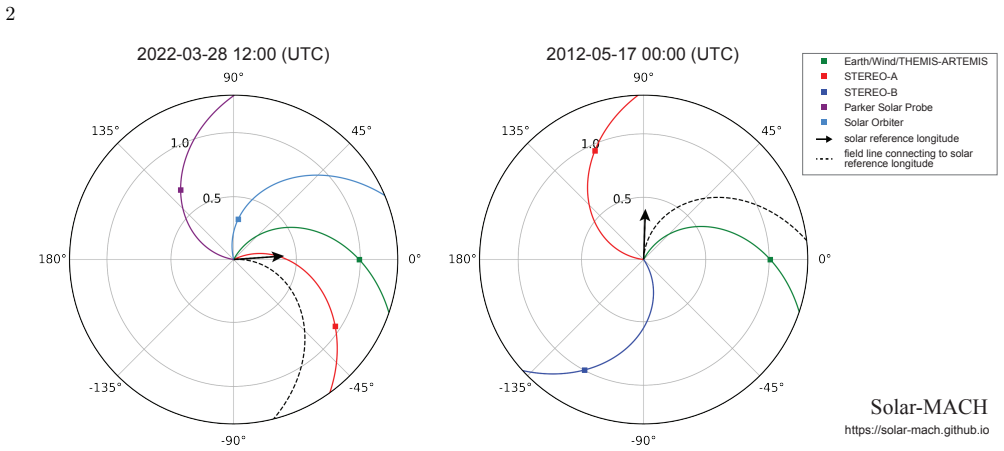
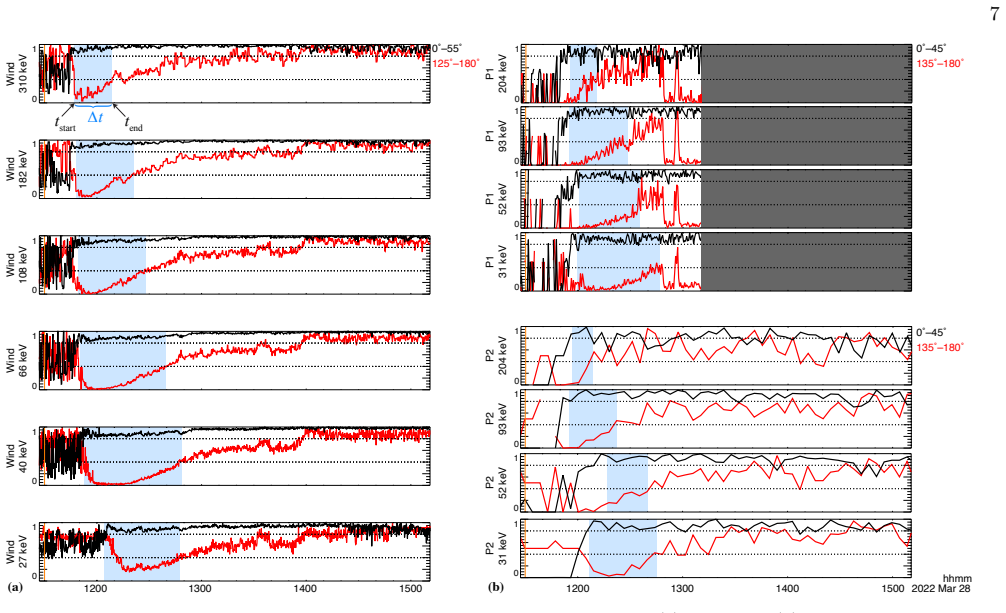
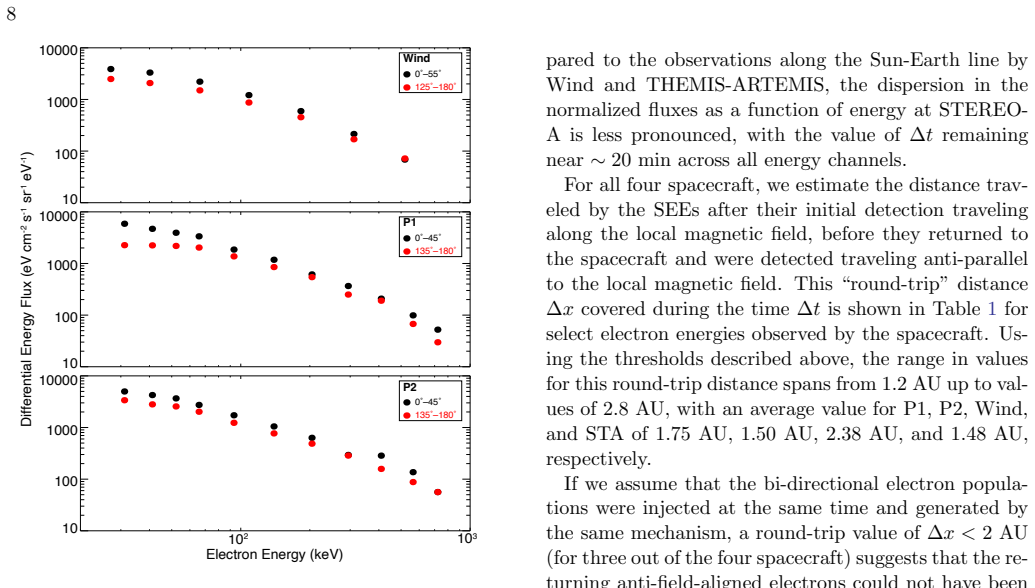
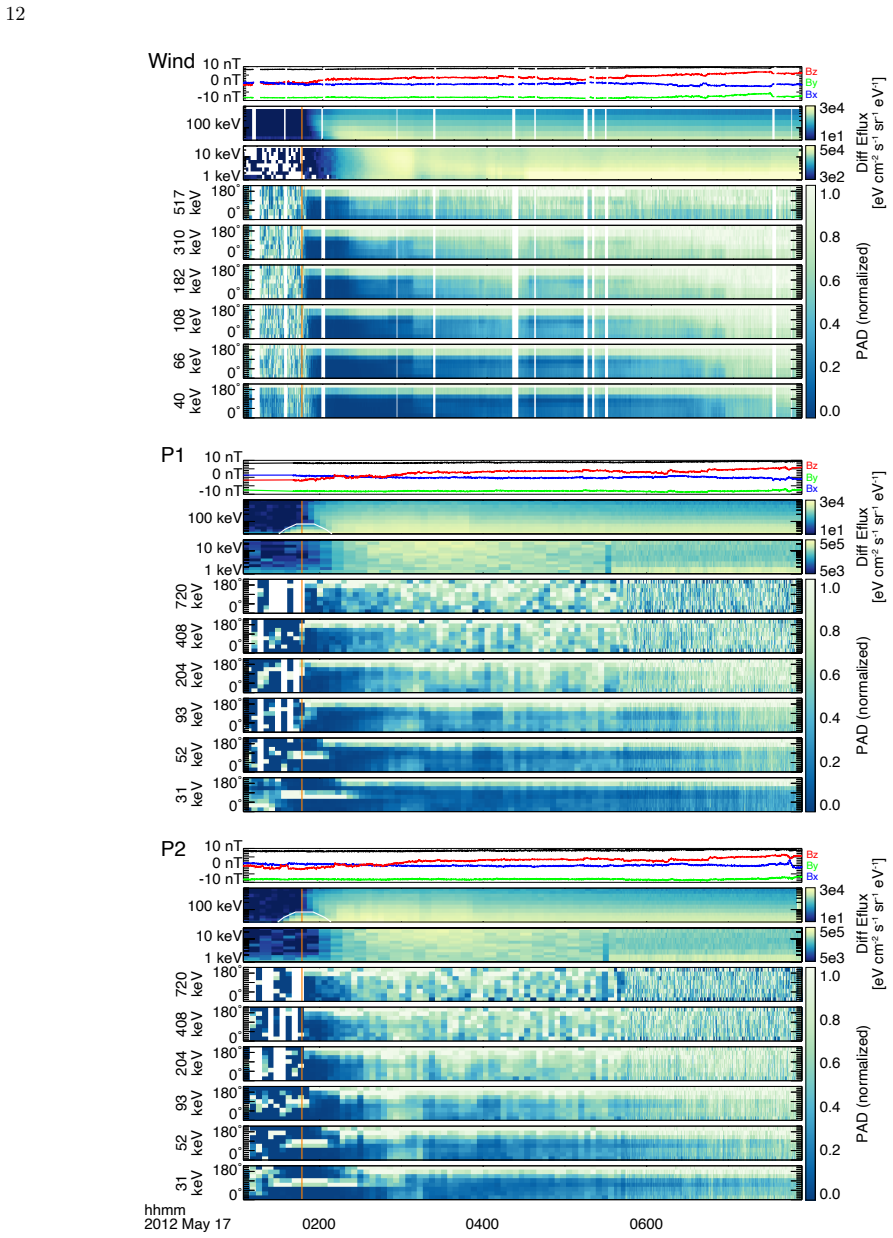
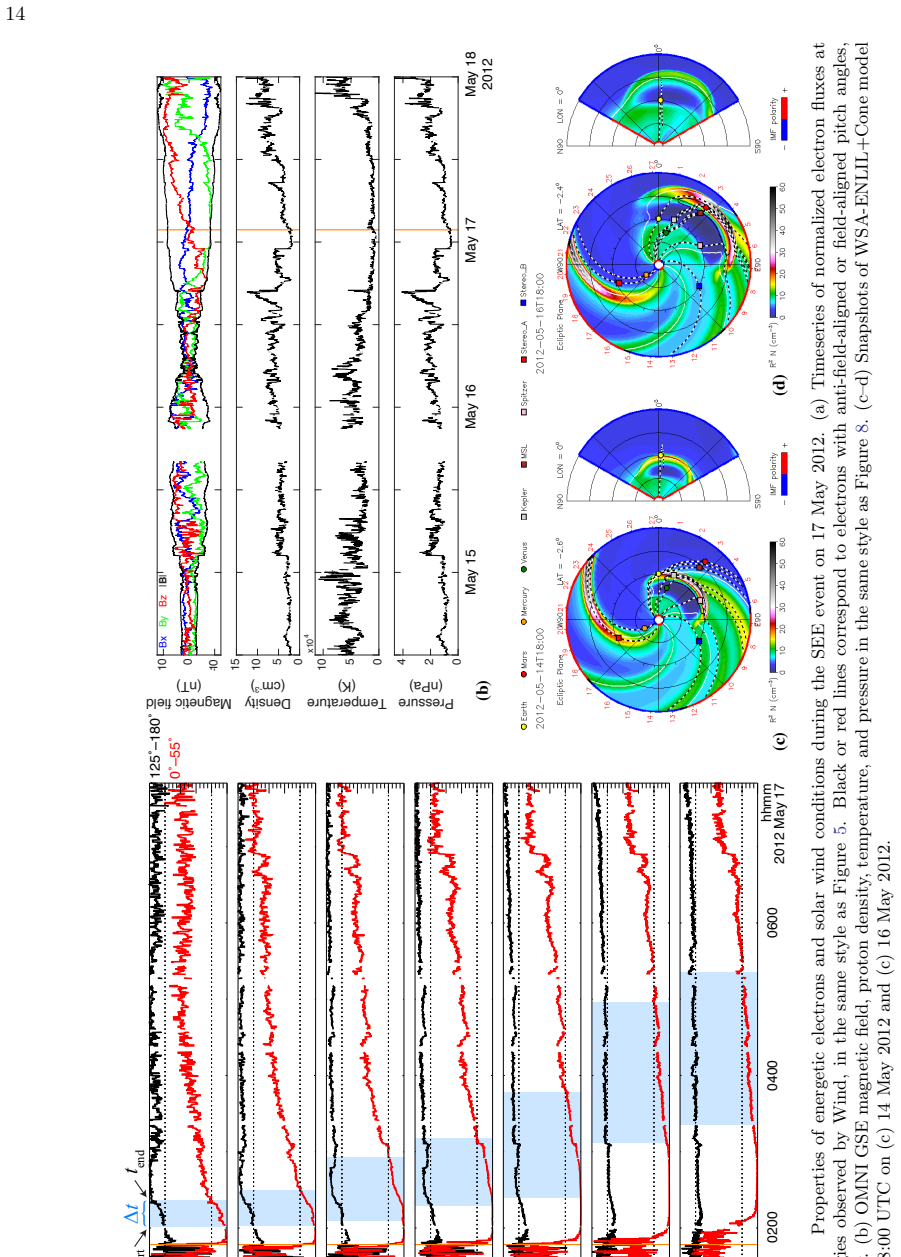
During both events an initial highly anisotropic outward electron beam was followed by a second beam of counter-streaming electrons whose arrival times at different energies implied path lengths of order 1-2 AU. An ICME had crossed the spacecraft several days before each event and remained beyond 1 AU at the moment the electrons were detected, placing the observed counter-streaming population on trajectories consistent with reflection at the ICME shock front rather than direct solar injection.
What carries the argument
Reflection of the outward electron population at the shock front of a precursor ICME located beyond 1 AU, which reverses direction along connected magnetic field lines and produces the observed counter-streaming beam.
If this is right
- Bi-directional electron beams at 1 AU can serve as a remote signature of a precursor ICME still located outside Earth's orbit.
- The same reflection process supplies a mechanism for Sunward particle transport during impulsive solar events.
- Radiation hazard assessments for astronauts and spacecraft must include possible Sunward arrivals of electrons that have bounced off distant ICME shocks.
- Particle transport models should incorporate the possibility of shock reflection when predicting fluxes and anisotropies at 1 AU.
Where Pith is reading between the lines
- Similar reflection could occur for protons or heavier ions, altering expected arrival directions in some solar energetic particle events.
- Routine monitoring of ICMEs beyond 1 AU might improve forecasts of when reflected electron beams will reach Earth.
- Energy-dependent reflection efficiency at the shock could contribute to the inverse velocity dispersion signatures seen in one event.
- The mechanism may operate more broadly in the inner heliosphere whenever an ICME lies downstream of an observer along a magnetic flux tube.
Load-bearing premise
The measured time delays and 1-2 AU path lengths result specifically from reflection at the precursor ICME shock rather than from scattering, differing injection times, or other propagation effects.
What would settle it
If spacecraft data show no ICME beyond 1 AU at the time of the counter-streaming detections, or if the magnetic connectivity and path lengths fail to match the round-trip distance to any candidate shock, the reflection interpretation would be ruled out.
Figures




read the original abstract
We present case studies of two impulsive solar energetic electron (SEE) events during which particles at energies from 1-600 keV were detected by THEMIS-ARTEMIS orbiting the Moon, Wind at Earth's first Lagrange point, and (for one event) STEREO-A located at 1 AU, off the Sun-Earth line. The SEEs were initially highly anisotropic, traveling outward along the magnetic field with distinct energy-time dispersion. For one event, the spectra contained inverse velocity dispersion (IVD) signatures, whereby electrons at intermediate energies arrived to the spacecraft before those at higher energies. Similar features were recently discovered within 1 AU for energetic protons; this represents the first IVD detection for energetic electrons at Earth's orbital distance. During both events, a second beam of counter-streaming electrons was detected after a short time. Based on the time-delay in the detections at various energies, the path traveled by these counter-streaming electrons was on the order of 1-2 AU. We show that an interplanetary coronal mass ejection (ICME) passed the spacecraft a few days prior to the onset of each event and was located beyond 1 AU when the SEEs were detected, suggesting that the electrons were part of the same population, but reflected off the shock front of these precursor ICMEs. In the context of solar system exploration, this represents an unidentified hazard for astronaut safety beyond low-Earth orbit: although the initial phase of impulsive SEE events typically stream anti-Sunward, ICMEs located beyond Earth provide a mechanism for hazardous particles to travel Sunward during extreme events.
Editorial analysis
A structured set of objections, weighed in public.
Referee Report
Summary. The manuscript presents multi-spacecraft observations of two impulsive solar energetic electron (SEE) events detected by THEMIS-ARTEMIS, Wind, and STEREO-A at 1 AU. It reports initial highly anisotropic outward beams with energy-time dispersion (including inverse velocity dispersion signatures in one event) followed by delayed counter-streaming beams. The central claim is that the counter-streaming electrons represent the same population reflected from the shock fronts of precursor ICMEs that had passed the spacecraft days earlier and were located beyond 1 AU at detection time, with path lengths estimated at 1-2 AU; implications for Sunward particle hazards during solar system exploration are noted.
Significance. If the reflection interpretation is confirmed, the work would identify a previously under-appreciated mechanism by which precursor ICMEs can redirect hazardous SEEs Sunward at 1 AU, with direct relevance to astronaut safety beyond low-Earth orbit. The multi-spacecraft dataset and the first reported IVD signatures for energetic electrons at Earth's orbital distance constitute clear observational strengths that constrain inner-heliospheric transport models.
major comments (3)
- [Abstract and main interpretation] Abstract and interpretation section: The claim that counter-streaming electrons followed round-trip paths of 1-2 AU to reflect off ICME shocks located beyond 1 AU rests on timing delays but lacks explicit quantitative comparison of observed energy-dependent arrival times against expected travel times (2 × magnetic path length / v(E)) for 1-600 keV electrons. Without such calculations or error estimates, the correspondence between path length, ICME position, and delays remains unverified and cannot yet exclude scattering, different injection onsets, or non-reflective propagation effects.
- [ICME positioning and timing] Position and timing analysis: The assertion that each precursor ICME 'was located beyond 1 AU when the SEEs were detected' is central to the reflection scenario, yet the manuscript provides no details on the radial extrapolation method, shock standoff distance, or magnetic connectivity mapping used to place the ICME at the required location at the precise detection epoch.
- [Discussion of bi-directional beams] Alternative explanations: While the text notes that the counter-streaming beams arrive after the outward beam, it does not quantitatively test or rule out competing interpretations (e.g., pitch-angle scattering into the anti-sunward direction or separate injections) using the reported anisotropies, spectra, or multi-spacecraft timing differences.
minor comments (2)
- [Abstract] The abstract would benefit from explicit listing of event dates and precise spacecraft heliocentric longitudes to allow readers to assess the geometric configuration immediately.
- [Figures and methods] Figure captions and text should clarify whether path-length estimates incorporate Parker spiral curvature or assume radial propagation.
Simulated Author's Rebuttal
We thank the referee for their constructive comments and positive evaluation of the significance of our multi-spacecraft observations. We have carefully considered each major comment and provide point-by-point responses below. Where appropriate, we will revise the manuscript to incorporate additional quantitative analyses and details.
read point-by-point responses
-
Referee: [Abstract and main interpretation] Abstract and interpretation section: The claim that counter-streaming electrons followed round-trip paths of 1-2 AU to reflect off ICME shocks located beyond 1 AU rests on timing delays but lacks explicit quantitative comparison of observed energy-dependent arrival times against expected travel times (2 × magnetic path length / v(E)) for 1-600 keV electrons. Without such calculations or error estimates, the correspondence between path length, ICME position, and delays remains unverified and cannot yet exclude scattering, different injection onsets, or non-reflective propagation effects.
Authors: We agree that providing explicit calculations would strengthen the interpretation. In the original manuscript, the path length estimate of 1-2 AU was derived from the observed time delays between the outward and counter-streaming beams across multiple energies, consistent with round-trip travel. However, to address this concern, we will add a new figure or table in the revised manuscript that compares the observed arrival time differences at various energies (1-600 keV) to the expected travel times calculated as 2 × path_length / v(E), including uncertainty estimates based on the timing resolution and energy binning. This will allow direct verification of the correspondence and help rule out alternative effects. revision: yes
-
Referee: [ICME positioning and timing] Position and timing analysis: The assertion that each precursor ICME 'was located beyond 1 AU when the SEEs were detected' is central to the reflection scenario, yet the manuscript provides no details on the radial extrapolation method, shock standoff distance, or magnetic connectivity mapping used to place the ICME at the required location at the precise detection epoch.
Authors: The manuscript does describe the passage of the ICME days prior using in-situ data from the spacecraft and notes its position beyond 1 AU at the time of the SEE events based on propagation models. However, we acknowledge the need for more explicit methodological details. In the revision, we will expand the relevant section to include: (1) the specific radial extrapolation method employed (e.g., using constant speed assumption or drag-based models), (2) estimates of shock standoff distance from the ICME leading edge, and (3) the magnetic connectivity mapping approach used to confirm the shock's location relative to the field lines connected to the spacecraft at the detection time. This will provide the quantitative basis for the positioning. revision: yes
-
Referee: [Discussion of bi-directional beams] Alternative explanations: While the text notes that the counter-streaming beams arrive after the outward beam, it does not quantitatively test or rule out competing interpretations (e.g., pitch-angle scattering into the anti-sunward direction or separate injections) using the reported anisotropies, spectra, or multi-spacecraft timing differences.
Authors: The manuscript argues for the reflection interpretation based on the multi-spacecraft timing consistency, the energy-dependent delays matching the path length, and the presence of the precursor ICME. We did not provide a dedicated quantitative section ruling out alternatives. To strengthen this, we will add in the discussion a quantitative assessment: comparing the observed pitch-angle distributions and spectra to expectations from scattering models (e.g., expected isotropization timescales), and using the timing differences across spacecraft to argue against separate injections or local scattering. This will explicitly address why the reflection scenario is favored. revision: yes
Circularity Check
No significant circularity; observational timing and positioning inferences are independent of the conclusion
full rationale
The paper's central claim rests on direct multi-spacecraft timing measurements of electron arrival delays (yielding estimated path lengths of 1-2 AU) combined with independent prior-passage data locating an ICME beyond 1 AU at the detection epoch. No equations, fitted parameters, or derivations are presented that reduce by construction to the target interpretation; the reflection suggestion is an inference from the observed delays and ICME positions rather than a self-definitional or self-citation load-bearing step. The analysis is self-contained against external benchmarks (spacecraft ephemerides and particle time-of-flight calculations) with no renaming of known results or ansatz smuggling.
Axiom & Free-Parameter Ledger
axioms (2)
- domain assumption Electrons propagate along magnetic field lines with negligible scattering over the observed timescales and distances.
- domain assumption The position and propagation speed of the precursor ICME can be reliably extrapolated from earlier observations to confirm it lies beyond 1 AU during the electron event.
Reference graph
Works this paper leans on
-
[1]
Acu˜ na, M. H., Ogilvie, K. W., Baker, D. N., et al. 1995, Space Science Reviews, 71, 5, doi: 10.1007/BF00751323
-
[2]
Angelopoulos, V. 2008, Space Science Reviews, 141, 5, doi: 10.1007/s11214-008-9336-1
-
[3]
Angelopoulos, V. 2011, Space Science Reviews, 165, 3, doi: 10.1007/s11214-010-9687-2
-
[4]
Angelopoulos, V., Cruce, P., Drozdov, A., et al. 2019, Space Science Reviews, 215, 9, doi: 10.1007/s11214-018-0576-4
-
[5]
Arge, C., Luhmann, J., Odstrcil, D., Schrijver, C., & Li, Y. 2004, Journal of Atmospheric and Solar-Terrestrial Physics, 66, 1295, doi: 10.1016/j.jastp.2004.03.018
-
[6]
Cohen, C. M. S., Leske, R. A., Christian, E. R., et al. 2024, The Astrophysical Journal, 966, 148, doi: 10.3847/1538-4357/ad37f8
-
[7]
Astronomy and Astrophysics , author =
Ding, Z., Wimmer-Schweingruber, R. F., Kollhoff, A., et al. 2025a, Astronomy & Astrophysics, 696, A199, doi: 10.1051/0004-6361/202553806
-
[8]
Astronomy and Astrophysics , author =
Ding, Z., Wimmer-Schweingruber, R. F., Chen, Y., et al. 2025b, Astronomy & Astrophysics, 1, doi: 10.1051/0004-6361/202556098
-
[9]
Domingo, V., Fleck, B., & Poland, A. I. 1995, Space Science Reviews, 72, 81, doi: 10.1007/BF00768758
-
[10]
Astronomy and Astrophysics , author =
Dresing, N., G´ omez-Herrero, R., Heber, B., et al. 2014, Astronomy and Astrophysics, 567, 1, doi: 10.1051/0004-6361/201423789
-
[11]
2023, Frontiers in Astronomy and Space Sciences, 9, doi: 10.3389/fspas.2022.1058810
Gieseler, J., Dresing, N., Palmroos, C., et al. 2023, Frontiers in Astronomy and Space Sciences, 9, doi: 10.3389/fspas.2022.1058810
-
[12]
2013, The Astrophysical Journal, 765, L30, doi: 10.1088/2041-8205/765/2/L30
Gopalswamy, N., Xie, H., Akiyama, S., et al. 2013, The Astrophysical Journal, 765, L30, doi: 10.1088/2041-8205/765/2/L30
-
[13]
, year = 1995, month = feb, volume =
Harten, R., & Clark, K. 1995, Space Science Reviews, 71, 23, doi: 10.1007/BF00751324
-
[14]
Kaiser, M. L., Kucera, T. A., Davila, J. M., et al. 2008, Space Science Reviews, 136, 5, doi: 10.1007/s11214-007-9277-0
-
[15]
Krucker, S., Kontar, E. P., Christe, S., & Lin, R. P. 2007, The Astrophysical Journal, 663, L109, doi: 10.1086/519373
-
[16]
Krucker, S., Larson, D. E., Lin, R. P., & Thompson, B. J. 1999, The Astrophysical Journal, 519, 864, doi: 10.1086/307415
-
[17]
Lario, D., Aran, A., & Decker, R. B. 2009, Solar Physics, 260, 407, doi: 10.1007/s11207-009-9463-1 17
-
[18]
Larson, D. E., Lillis, R. J., Lee, C. O., et al. 2015, Space Science Reviews, 195, 153, doi: 10.1007/s11214-015-0218-z
-
[19]
Laurenza, M., Cliver, E. W., Hewitt, J., et al. 2009, Space Weather, 7, doi: 10.1029/2007SW000379
-
[20]
2020, The Astrophysical Journal Letters, 905, L1, doi: 10.3847/2041-8213/abca87
Li, G., Wu, X., Zhao, L., & Yao, S. 2020, The Astrophysical Journal Letters, 905, L1, doi: 10.3847/2041-8213/abca87
-
[21]
2025, National Science Review, 12, doi: 10.1093/nsr/nwaf348
Li, Y., Guo, J., Pacheco, D., et al. 2025, National Science Review, 12, doi: 10.1093/nsr/nwaf348
-
[22]
1974, Space Science Reviews, 16, 189, doi: 10.1007/BF00240886
Lin, R. 1974, Space Science Reviews, 16, 189, doi: 10.1007/BF00240886
-
[23]
Lin, R. P. 1985, Solar Physics, 100, 537, doi: 10.1007/BF00158444
-
[24]
Lin, R. P., Anderson, K. A., Ashford, S., et al. 1995, Space Science Reviews, 71, 125, doi: 10.1007/BF00751328
-
[25]
Liuzzo, L., Poppe, A. R., Lee, C. O., & Angelopoulos, V. 2024, Geophysical Research Letters, 51, doi: 10.1029/2024GL110228
-
[26]
2023, Geophysical Research Letters, 50, 1, doi: 10.1029/2023GL103990
Angelopoulos, V. 2023, Geophysical Research Letters, 50, 1, doi: 10.1029/2023GL103990
-
[27]
McComas, D. J., Alexander, N., Angold, N., et al. 2016, Space Science Reviews, 204, 187, doi: 10.1007/s11214-014-0059-1
-
[28]
McFadden, J. P., Carlson, C. W., Larson, D., et al. 2008, Space Science Reviews, 141, 277, doi: 10.1007/s11214-008-9440-2
-
[29]
I., Klein, K., Trottet, G., et al
Miroshnichenko, L. I., Klein, K., Trottet, G., et al. 2005, Journal of Geophysical Research: Space Physics, 110, doi: 10.1029/2004JA010936 M¨ uller-Mellin, R., B¨ ottcher, S., Falenski, J., et al. 2008, Space Science Reviews, 136, 363, doi: 10.1007/s11214-007-9204-4 N´ u˜ nez, M. 2011, Space Weather, 9, doi: 10.1029/2010SW000640
-
[30]
Odstrcil, D. 2003, Advances in Space Research, 32, 497, doi: 10.1016/S0273-1177(03)00332-6
-
[31]
Papitashvili, N. E., & King, J. H. 2020, Space Physics Data Facility. https://spase-metadata.org/NASA/NumericalData/ OMNI/HighResolutionObservations/Version1/PT1M P´ erez-Peraza, J., M´ arquez-Adame, J. C., Miroshnichenko, L., & Velasco-Herrera, V. 2018, Journal of Geophysical Research: Space Physics, 123, 3262, doi: 10.1002/2017JA025030
-
[32]
2007, Space Weather, 5, doi: 10.1029/2006SW000268
Posner, A. 2007, Space Weather, 5, doi: 10.1029/2006SW000268
-
[33]
Purkhart, S., Veronig, A. M., Kliem, B., et al. 2024, Astronomy & Astrophysics, 689, A259, doi: 10.1051/0004-6361/202450092
-
[34]
Reames, D. 1999, Space Sci. Rev., 90, doi: 10.1023/A:1005105831781
-
[35]
Reames, D. V. 2021, Lecture Notes in Physics, Vol. 978, Solar Energetic Particles (Cham: Springer International Publishing), doi: 10.1007/978-3-030-66402-2
-
[36]
Richardson, I. G., & Cane, H. V. 2010, Solar Physics, 264, 189, doi: 10.1007/s11207-010-9568-6
-
[37]
Riley, P., Mays, M. L., Andries, J., et al. 2018, Space Weather, 16, 1245, doi: 10.1029/2018SW001962
-
[38]
2006, The Astrophysical Journal, 639, 1186, doi: 10.1086/499419
Ruffolo, D., Tooprakai, P., Rujiwarodom, M., et al. 2006, The Astrophysical Journal, 639, 1186, doi: 10.1086/499419
-
[39]
Saiz, A., Ruffolo, D., Bieber, J. W., Evenson, P., & Pyle, R. 2008, The Astrophysical Journal, 672, 650, doi: 10.1086/523663
-
[40]
2008, Space Science Reviews, 136, 227, doi: 10.1007/s11214-007-9174-6
Sauvaud, J.-A., Larson, D., Aoustin, C., et al. 2008, Space Science Reviews, 136, 227, doi: 10.1007/s11214-007-9174-6
-
[41]
Tan, L. C., Reames, D. V., & Ng, C. K. 2007, The Astrophysical Journal, 661, 1297, doi: 10.1086/516626
-
[42]
Wang, L. 2009, The Astrophysical Journal, 701, 1753, doi: 10.1088/0004-637X/701/2/1753
-
[43]
Torres, J., Chan, P. K., Zhao, L., & Zhang, M. 2025, Space Weather, 23, doi: 10.1029/2024SW003921
-
[44]
Wang, L., Lin, R. P., & Krucker, S. 2011, Astrophysical Journal, 727, doi: 10.1088/0004-637X/727/2/121
-
[45]
Wei, W., Lee, C. O., Dresing, N., et al. 2024, The Astrophysical Journal Letters, 973, L52, doi: 10.3847/2041-8213/ad78df
-
[46]
Wilson, L. B. 2021, lynnbwilsoniii/wind 3dp pros: Space Plasma Missions IDL Software Library, [Software]. Zenodo, doi: 10.5281/zenodo.4451330
discussion (0)
Sign in with ORCID, Apple, or X to comment. Anyone can read and Pith papers without signing in.